Have you ever noticed that two plants of the same kind can look very different, even when they grow close to each other? One may be tall and green, while another is short and pale. That is a clue that an organism's surroundings matter. Scientists use careful observations to explain that some traits are influenced by the world around a living thing.
A trait is a feature you can observe, such as height, leaf size, fur thickness, or skin color after being in the sun. In this lesson, we focus on physical traits, which are the body features we can see or measure. We are not studying hidden body instructions. We are studying how the environment can affect what an organism looks like.
When scientists talk about evidence, they mean facts they can observe. Evidence may come from seeing, measuring, comparing, or recording changes. If a plant in sunlight grows taller than a similar plant kept in shade, that observation can be evidence.
Physical trait means an observable body feature, such as color, size, shape, or thickness.
Evidence means observations or information that help support an explanation.
Explanation means an idea that tells why something happens.
Good explanations do not come from guessing. They come from matching an idea to real observations. If we say, "This rabbit has thicker fur because winter is cold," we should support that statement with evidence, such as seeing that the fur becomes thicker when temperatures drop.
An organism's environment includes the living and nonliving things around it. The environment can include sunlight, water, air, temperature, space, soil, and food. It can also include other living things, such as animals, people, and nearby plants.
As [Figure 1] shows, these conditions affect how organisms grow and develop. A flower with enough water may have large petals. A flower with too little water may stay small. A dog living in cold weather may grow a thicker coat than the same kind of dog in a warmer place.
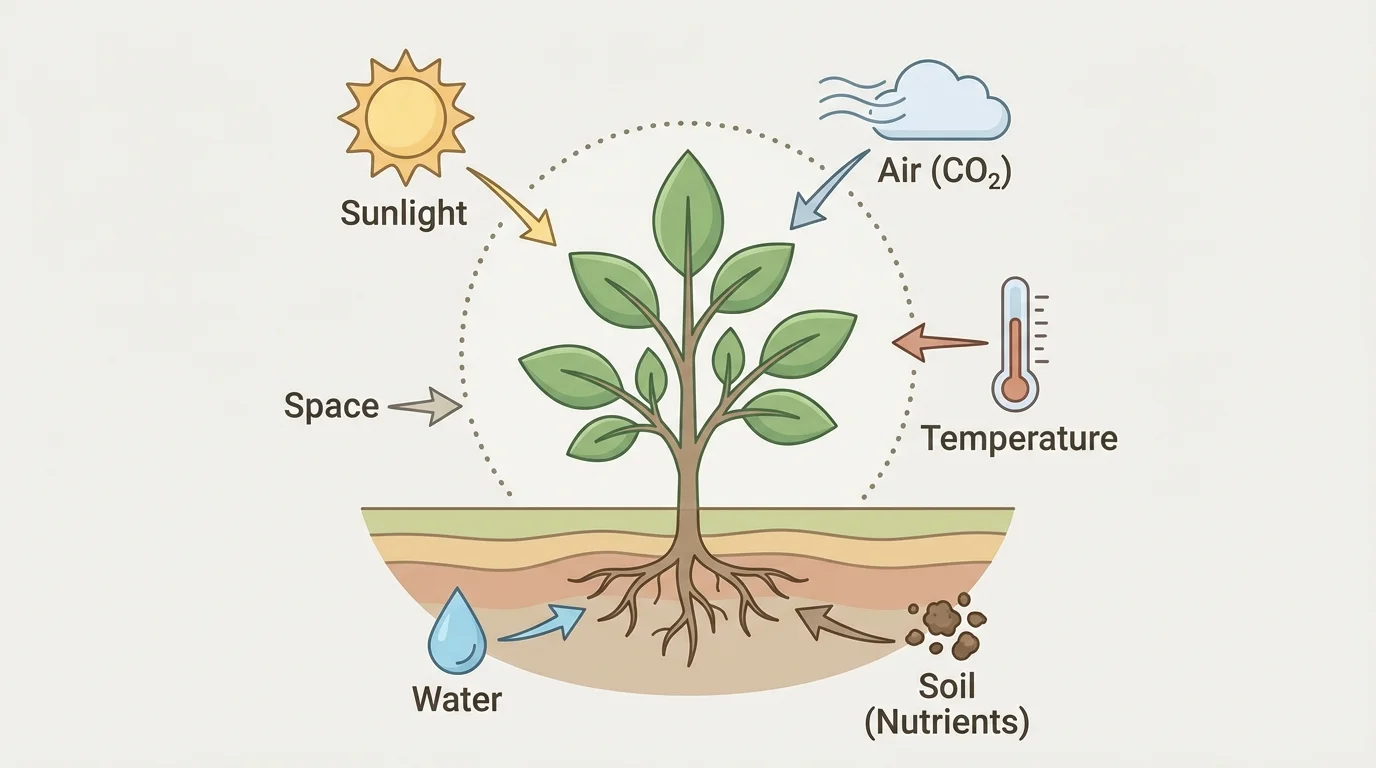
Think about a school garden. Some plants may be in bright sun for most of the day. Others may be blocked by shade from a fence or tree. Even if the plants are the same kind, the different conditions can lead to different traits.
You already know that living things need resources from their surroundings. Plants need water, air, sunlight, and space. Animals need food, water, air, and shelter. Those needs connect directly to how their bodies grow and look.
Environmental effects can happen slowly or quickly. A tan can happen after days in strong sunlight. Plant growth can change over weeks. A pet's fur may become thicker over a season.
Some traits change because the body responds to conditions around it. If a plant does not get enough light, it may become thin and stretched as it grows toward the light. If a child exercises often, muscles may become larger and stronger. If a person spends time in the sun, skin may become darker.
These changes are important because they show that traits are not affected only by what kind of organism something is. Conditions around the organism can also matter. This is why scientists compare organisms living in different places or receiving different amounts of water, food, or sunlight.
How scientists connect evidence to an explanation
Scientists observe a trait, notice a pattern, and then explain the pattern using evidence. For example, if several plants in full sunlight are taller than several similar plants in shade, the repeated pattern supports the explanation that sunlight influences plant growth.
One observation alone may not be enough. If just one plant is small, maybe it was stepped on or damaged. But if many shaded plants are smaller than many sunny plants, the evidence becomes stronger.
To support an explanation, scientists ask questions such as: What trait changed? What condition in the environment was different? What did we observe? Can we compare two similar organisms? These questions help us build a fair explanation.
For example, suppose two bean plants start out about the same size. One gets enough water every day. The other gets only a little water. After two weeks, the well-watered plant is taller and has more leaves. That difference is evidence that water affects plant traits such as height and leaf growth.
Using evidence in a simple plant comparison
Step 1: Observe two similar bean plants.
Plant A is in sunlight and receives enough water. Plant B is in shade and receives less water.
Step 2: Record what you notice.
Plant A grows taller and has more leaves. Plant B stays shorter and has fewer leaves.
Step 3: Explain using evidence.
The observations support the explanation that sunlight and water influence plant traits such as height and leaf number.
An explanation becomes stronger when the evidence clearly matches the claim. Instead of saying, "The plant just wanted to grow," a scientist says, "The plant in sunlight and with enough water grew taller, so the evidence supports the idea that those conditions affected its growth."
Plants give us clear examples because they stay in one place. This makes it easier to compare conditions. Two plants of the same kind can look different when one has enough sunlight and water while the other does not. Their traits may differ in height, leaf size, color, and number of flowers.
As [Figure 2] illustrates, a plant grown in rich soil may have larger leaves than a similar plant grown in poor soil. A sunflower in full sunlight often grows taller and stronger than one crowded in shade. A plant that does not get enough water may wilt, droop, or turn yellow.
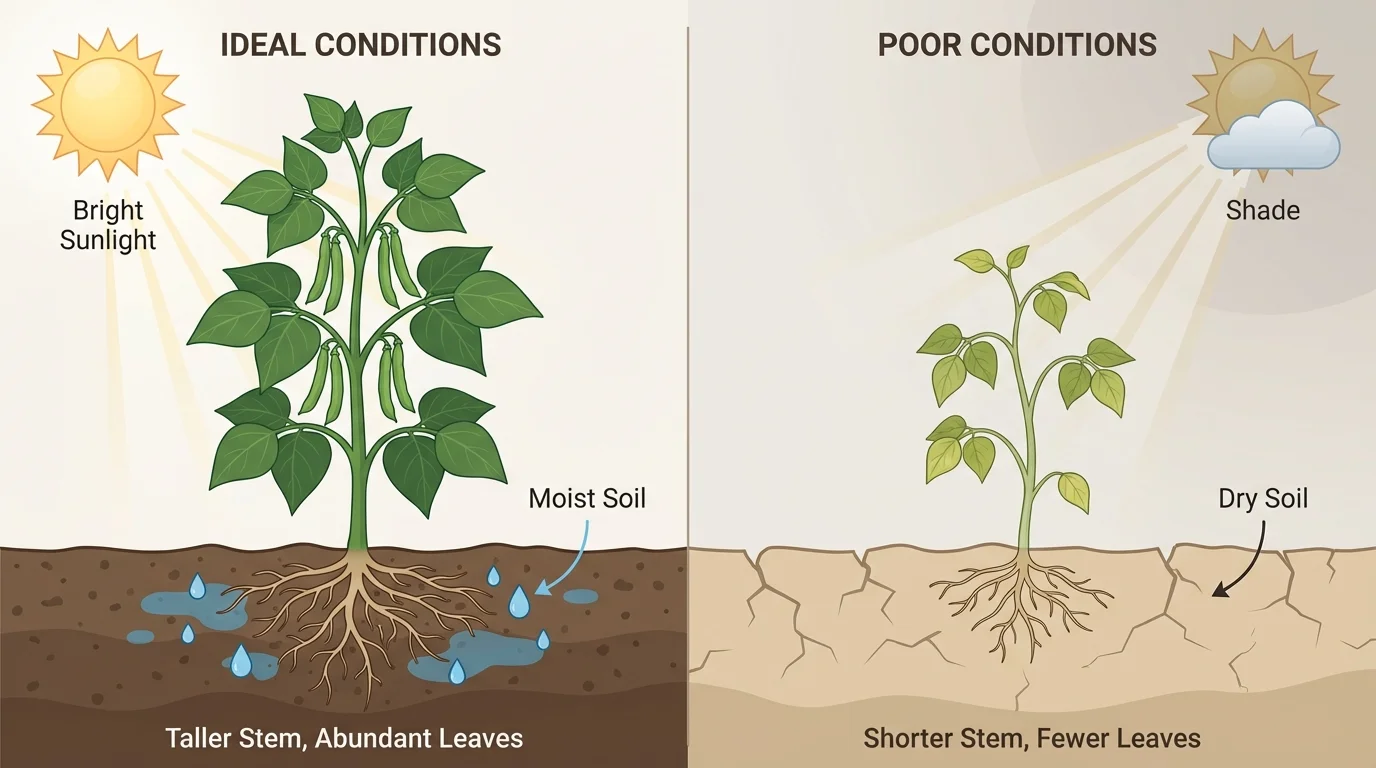
Gardeners use this kind of evidence all the time. If tomato plants in one part of a garden produce bigger fruits, the gardener may look at sunlight, water, and soil. The visible differences in the plants are clues.
Some hydrangea flowers can appear different colors depending on the soil conditions around them. The environment can change a very noticeable physical trait.
Later, when we compare evidence across many examples, we can return to the plant comparison in [Figure 2] and see how strong the pattern becomes when the same kind of result happens again and again.
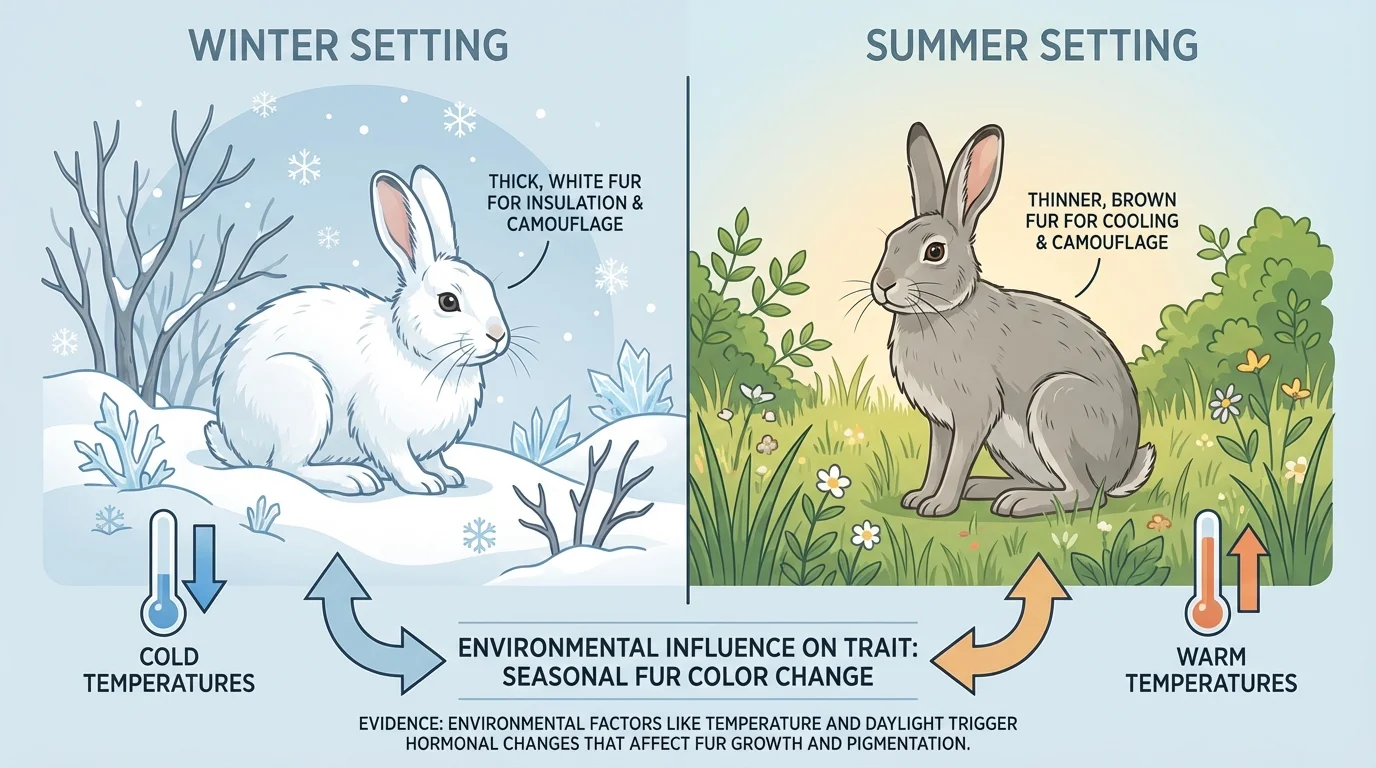
Animals also show visible changes related to their surroundings. In some places and seasons, their body coverings change to help them live there. A rabbit's coat can become thicker in colder weather. This is a physical trait we can observe.
As [Figure 3] shows, pets give us familiar examples. A dog that eats healthy food and gets exercise may have a shinier coat and stronger muscles than a dog that is unhealthy. A sheep living in cold weather may grow thick wool. Birds that do not get enough good food may develop weaker feathers.
Zoo workers, veterinarians, and wildlife scientists pay close attention to these traits. They use observations of fur, feathers, body condition, and size to understand whether animals are getting what they need from their environment.
Animal evidence example
Step 1: Observe a rabbit in winter and in warmer weather.
In winter, the rabbit has thicker fur. In warmer weather, the fur is thinner.
Step 2: Identify the changing environmental condition.
The temperature is lower in winter and higher in warmer seasons.
Step 3: Build the explanation.
The observations support the explanation that colder temperatures influence the thickness of the rabbit's fur.
The rabbit in [Figure 3] helps us remember an important idea: evidence comes from patterns we can actually observe, not from guessing what might happen.
People also have physical traits that can be influenced by the environment. A familiar example is a tan. If a person spends a lot of time in sunlight, the skin may become darker. The change in skin color is a visible trait, and the sunlight is the environmental factor.
Another example is muscle size. When a person exercises regularly, muscles may become larger and stronger. The trait is not random. It changes because the body responds to activity in the environment.
Food matters too. Healthy nutrition helps the body build strong hair, skin, and nails. If a person does not get enough healthy food, these physical traits may not look as healthy. Doctors and caregivers often look at these visible signs to learn how the body is doing.
Scientists often organize observations in charts or tables so patterns are easier to see. A table lets us compare the organism, the environmental condition, the trait, and the evidence that supports the explanation.
| Organism | Environmental condition | Physical trait observed | Evidence |
|---|---|---|---|
| Bean plant | More sunlight | Taller stem | Plants in brighter light grew taller than shaded plants |
| Bean plant | Enough water | More leaves | Well-watered plants had more leaves than dry plants |
| Rabbit | Colder weather | Thicker fur | Winter coat was thicker than warm-season coat |
| Person | More sunlight | Darker skin tone | Skin became darker after repeated time outdoors |
| Person | Regular exercise | Larger muscles | Muscles became stronger and more visible over time |
Table 1. Examples of organisms, environmental conditions, observed physical traits, and supporting evidence.
Notice that each row includes both an observation and an explanation. The observation is what was seen. The explanation tells how the environment may have influenced the trait. Tables help us avoid mixing up those two jobs.
Observation versus explanation
An observation is what you notice directly: "This plant is taller." An explanation tells why it may be that way: "This plant grew taller because it received more sunlight." Evidence links the two together.
When students learn to separate observation from explanation, they become better scientists. They learn to look carefully first and explain second.
It is important to make fair comparisons. If one plant gets more sunlight, more water, and better soil, it can be hard to tell which condition made the biggest difference. Scientists try to compare organisms that are as similar as possible except for the condition they are studying.
For example, if two plants are in the same kind of pot and receive the same amount of water, but one is in shade and the other is in sunlight, then sunlight is the main environmental difference. That makes the evidence clearer.
"Scientists do not just say what they think. They show what they observed."
Careful evidence also means looking more than once. If the same pattern appears again and again, the explanation becomes more convincing. That is why many observations are stronger than a single quick look.
Understanding environmental influences on traits helps people solve problems. Farmers adjust water, soil, and sunlight to grow healthy crops. Gardeners move plants to better places when they see leaves turning yellow or stems stretching toward light.
People who care for animals also use evidence. If a pet's coat becomes dull, a veterinarian may ask about food, exercise, and living conditions. Wildlife scientists protect habitats because the environment shapes how animals grow and stay healthy.
This idea also helps us care for ourselves. Wearing sunscreen, eating healthy foods, exercising, and getting enough rest all affect visible traits in our bodies. Evidence from observation helps people make wise choices.
