A footprint in rock can be older than any city, older than any castle, even older than people. That is one reason fossils are so exciting. A fossil is a clue from a world that existed long before us. Scientists study fossils to learn about plants and animals that lived on Earth long ago and to figure out what their homes were like.
A fossil is preserved evidence of something that lived long ago. Fossils are not always bones. They can also be shells, leaf prints, tracks, burrows, or marks left behind in mud that later hardened into rock. Fossils help answer two big questions: What kind of organism lived here? and What was the environment like?
When scientists analyze fossils, they look closely at the shape, size, pattern, and place where the fossil was found. They compare clues instead of guessing. A long, narrow footprint may suggest an animal that walked or ran. A leaf imprint with wide, flat parts may suggest a plant. A shell found in rock can be evidence that water once covered that place.
Fossil means preserved evidence of life from long ago. Organism means a living thing, such as a plant or animal. Environment means the surroundings where an organism lives, such as water, land, a forest, or a swamp.
Fossils are important because they show that Earth has changed over time. Some living things today resemble ancient organisms. That tells us life has a long history. We do not need to know the exact name of every fossil to learn from it. We can still use major clues to understand how an organism lived.
Many living things do not become fossils. After an organism dies, its body usually decays or gets eaten. Fossils form only in special conditions. Often, the remains or marks are quickly covered by mud, sand, or ash. Over a long time, those layers harden into rock. [Figure 1] shows that fossils can be body fossils or trace fossils. Body fossils come from parts of the organism itself, while trace fossils are signs of its activity.
A shell pressed into soft mud can leave an imprint. A bone buried under sediment may slowly change as minerals fill spaces and make it hard like stone. A footprint can remain if the mud dries, gets covered, and turns to rock. These different ways of preserving clues create different kinds of fossils.
Major fossil types include body fossils, such as bones, shells, and wood, and trace fossils, such as footprints, trails, nests, and burrows. For this topic, the most important idea is that fossils can preserve either parts of an organism or signs of what it did. Both kinds give evidence about life in the past.
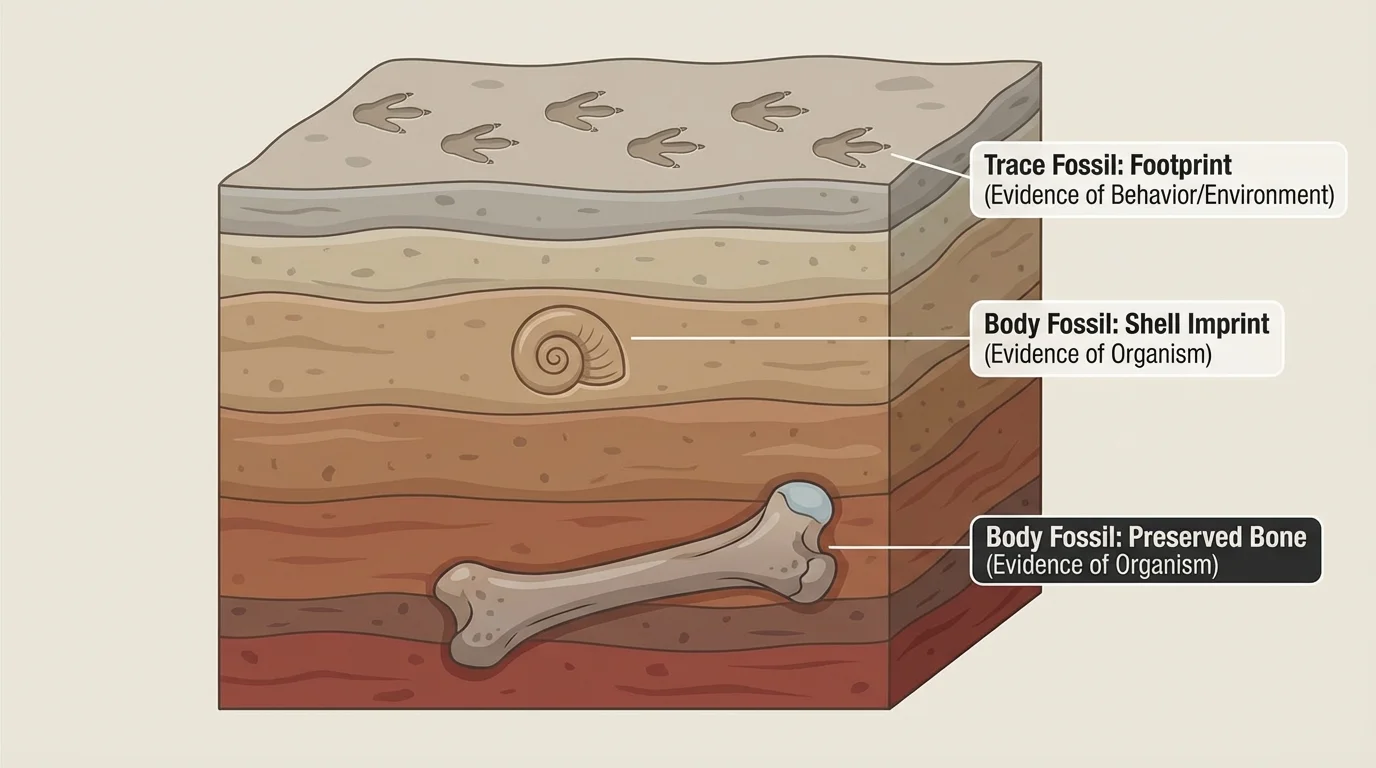
If a fossil is a footprint, scientists know an organism moved through that place. If a fossil is a shell, scientists know an organism with a hard outer covering lived there. As we later use clues from shape and location, this comparison helps us remember that fossils do not all tell the same kind of story.
Some fossils are tiny and can only be seen well with tools, while others are huge. No matter the size, each fossil can give evidence about a past organism and its environment.
Because fossil formation is rare, each fossil find matters. It is like getting one page from a very old book. Scientists must read that page carefully and compare it with other evidence.
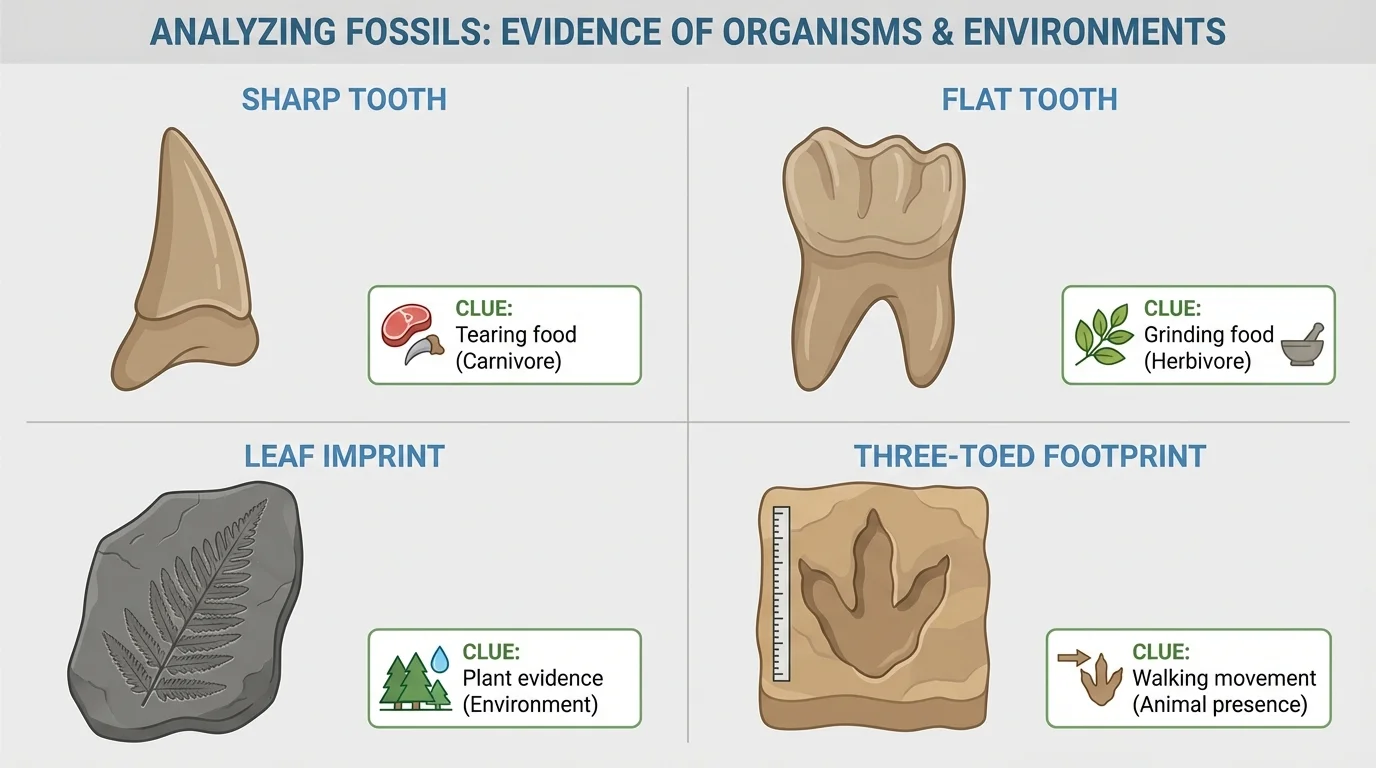
[Figure 2] The shape of a fossil can tell a lot. Fossil shapes give scientists evidence about how an organism may have moved, what it may have eaten, and what body parts it had. Sharp teeth can suggest biting or tearing food. Flat teeth can suggest grinding food. Wide leaves can suggest a plant. A shell suggests a hard body covering that protected the organism.
A trace fossil can also reveal behavior. Footprints may show whether an organism walked on two legs or four. A trail in rock may show that it crawled. A burrow may show that it lived partly underground. Scientists do not need to know the exact species name to make these observations. They use the fossil's features as clues.
Suppose a fossil shows a fish-shaped body with fins. That evidence suggests the organism lived in water. Suppose another fossil is a footprint in dried mud. That may suggest an organism moved on land near wet ground. If a fossil shell is found in rock that formed underwater, that is another clue pointing to a water environment.
Scientists often combine several clues. A leaf imprint found with many other plant fossils may suggest an area with lots of plant life. Large footprints found together may suggest that more than one animal moved through the same place. One clue helps, but many clues together make a stronger explanation.
Using fossil clues
A class finds two fossils in pictures from a science book: one is a shell imprint in rock, and one is a set of footprints.
Step 1: Look at the kind of fossil.
The shell imprint is a body fossil because it comes from part of the organism. The footprints are trace fossils because they show activity.
Step 2: Infer the organism.
The shell fossil gives evidence that the organism had a hard outer covering. The footprints give evidence that an organism moved across the ground.
Step 3: Infer the environment.
The shell may suggest a water environment. The footprints may suggest land or muddy edges of water.
By using clues, students can explain what kinds of organisms lived there and what the place may have been like long ago.
Later, when scientists compare many fossils from one area, this comparison remains useful because it reminds us that body parts and traces give different kinds of information.
A fossil is even more helpful when scientists know where it was found. The surrounding rock matters. Rock that formed from mud at the bottom of water can suggest a lake, river, swamp, or sea. Dry land can leave different clues, such as footprints, nests, and plant remains in soil-like layers.
Think about a beach today. You might see shells, wet sand, and tracks near the shore. Now think about a forest. You might see leaves, logs, soil, and roots. Ancient environments also left combinations of clues. Fossils and rocks together help scientists tell whether a place long ago was mostly underwater, near water, or on land.
Clues work best together
One fossil can tell part of the story, but fossils plus rocks tell more. A shell in water-laid rock gives stronger evidence for an ancient water environment than the shell alone. A footprint in muddy rock suggests not only that an organism walked there, but also that the ground was soft when the print was made.
Sometimes a place that is dry land today used to be covered by water. Fossils help prove that. If shell fossils are found far from the ocean, that is evidence that the environment there was different long ago. Earth changes slowly over time, and fossils help us discover those changes.
This is why paleontologists, scientists who study fossils, dig carefully. They do not just collect a fossil and leave. They record its location, the rock layer, and what other fossils are nearby. Those details help them build a better explanation of the past.
[Figure 3] Scientists also use rock layers to compare ages. Relative age means whether something is older or younger compared with something else. In many places, lower rock layers are older and upper layers are younger. This does not tell the exact number of years, but it helps put fossils in order.
If one fossil is found in a deeper layer and another is in a higher layer, the deeper one is usually older. This is a simple but powerful idea. It helps scientists understand which organisms lived earlier and which appeared later.
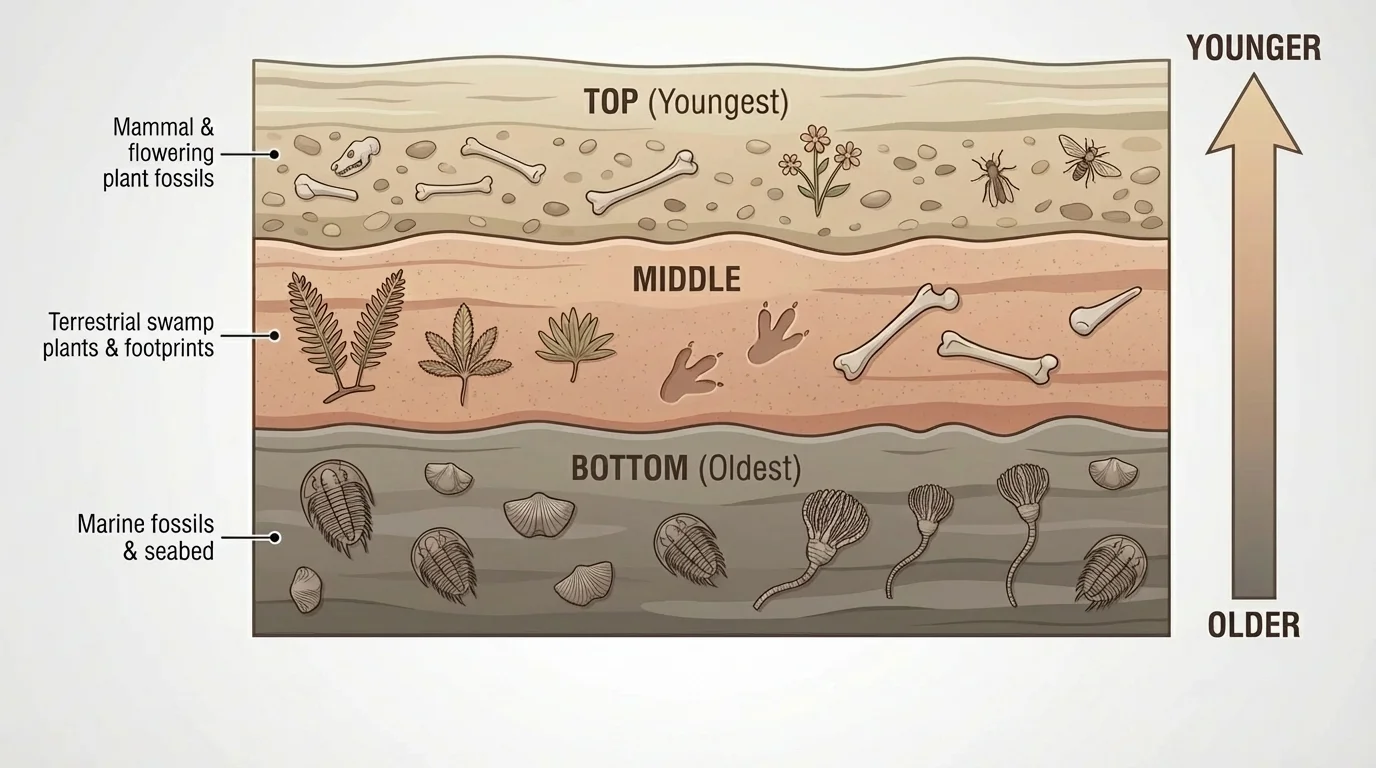
For example, if a shell fossil is found in the bottom layer and a footprint fossil is found in the top layer, the shell fossil is relatively older. Scientists are careful, though. They examine whether the layers have stayed in order and whether the fossils were moved after they formed.
| Rock layer position | Usual relative age | What scientists can infer |
|---|---|---|
| Top layer | Younger | Organisms in this layer lived later than those below |
| Middle layer | In between | These fossils are older than top fossils and younger than bottom fossils |
| Bottom layer | Older | Organisms in this layer lived earlier |
Table 1. Relative ages of fossils based on position in rock layers.
When students compare fossils, they often do not need exact dates. Relative age is enough to answer important questions. Which organism lived earlier? Which environment came first? As seen in [Figure 3], rock layers help organize Earth's history like pages in order.
Rocks can form in layers over time. New layers are often added on top of older layers. That earlier science idea helps explain why deeper fossils are usually older.
Relative age is part of the assessment boundary for this topic, so the focus stays on comparing older and younger fossils rather than naming exact ages in years.
Some organisms alive today resemble organisms that lived long ago. This does not mean they are exactly the same. It means some important features are similar. A shell fossil from long ago may resemble shells from living organisms today. A leaf fossil may resemble leaves of plants living now. These resemblances help scientists notice patterns in life on Earth.
Looking at fossils and living organisms side by side helps scientists ask useful questions. What body parts stayed similar? What may have changed? What kind of environment fits both? This shows that life has a long story, and some parts of that story can still be seen in organisms alive now.
Some fossils show that groups of organisms existed long before humans. Even when the exact species is different, similar body shapes can connect life from the past to life today.
This idea is not about memorizing names. It is about noticing evidence. If a fossil and a living organism have similar shapes, scientists may infer that they had similar needs or lived in somewhat similar environments.
Fossils are used in museums, national parks, and science labs to teach people about Earth's past. Scientists map where fossils are found and compare them across locations. They use careful notes, photographs, and measurements. Even young students can think like scientists by asking, "What does this fossil tell me?" and "What does the rock around it add to the story?"
Fossil evidence also helps people understand that environments change. A dry desert today may once have been underwater. A rocky hill may once have been a muddy place with footprints. Fossils help communities protect important sites because these places hold clues about Earth's history.
Real-world fossil investigation
A team studies fossils from two different rock layers at one site.
Step 1: Observe the lower layer.
The lower layer contains shell fossils in rock that formed in water.
Step 2: Observe the upper layer.
The upper layer contains footprints and plant imprints.
Step 3: Interpret the change.
The area may have changed from a water environment to a land environment over time.
By combining fossil types and relative age, scientists can explain how environments changed long ago.
That kind of reasoning is the heart of science. Scientists gather evidence, compare clues, and build explanations that fit the facts. Fossils are not just old objects. They are records of life and environments from Earth's distant past.
