A pond can look peaceful one week and very different the next. After a long dry spell, the water may shrink, the mud may crack, and some animals may disappear. When the environment changes, living things do not all respond in the same way. Some survive well, some move away, and some struggle. Learning to notice these changes helps us understand nature and helps us decide whether a solution really works.
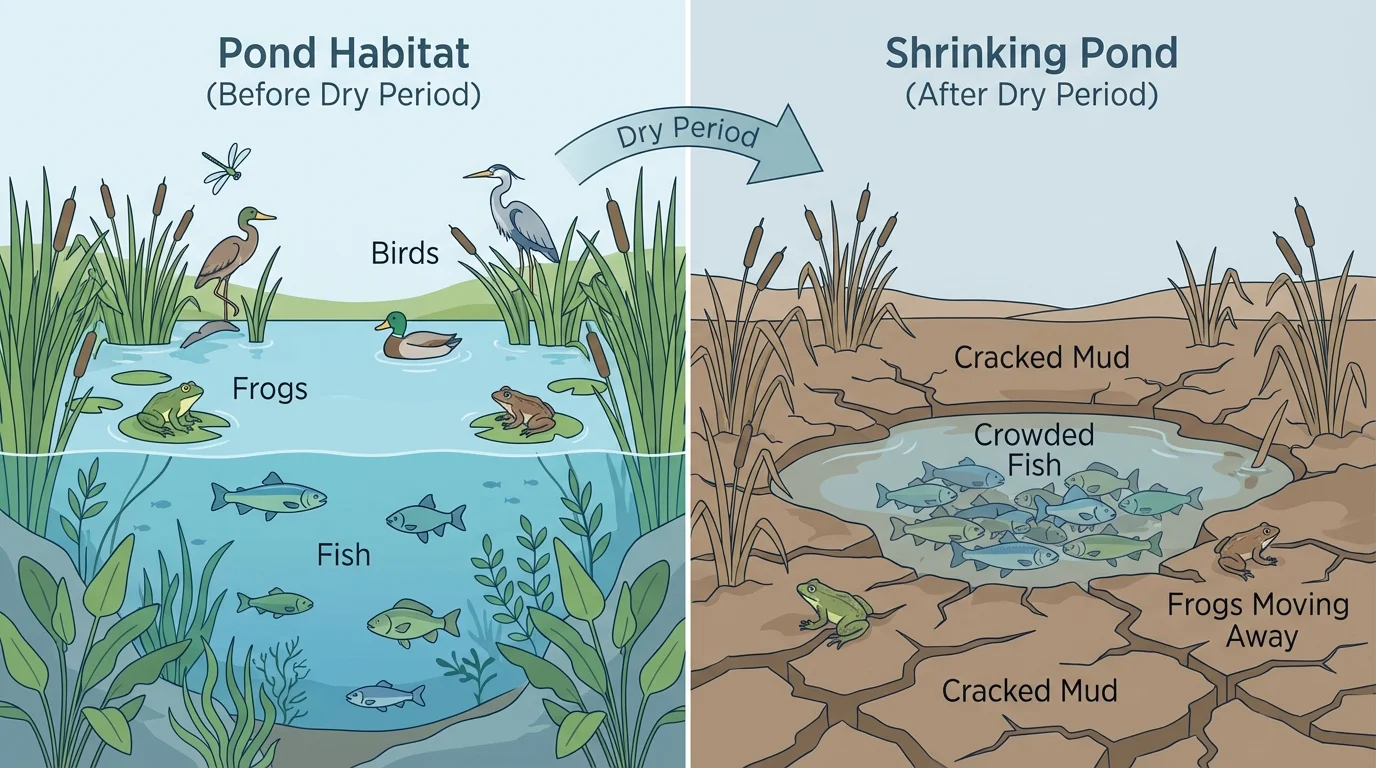
An environment is everything around a living thing, including water, soil, air, sunlight, and other living things. A place where a plant or animal lives is called a habitat. When one part of the environment changes, the habitat can change too, as [Figure 1] shows with a pond losing water during a dry period. That one change can affect food, shelter, and space for living things.
For example, if a pond begins to dry up, fish have less water to swim in. Frogs may have fewer wet places to hide. Water plants may not grow as well if the muddy edges dry out. Birds that visit the pond may find fewer insects or small animals to eat. One change in the environment can lead to many other changes in what lives there.
Not every environmental change is harmful to every organism. Some plants and animals may be able to live through the change better than others. A bird can fly to a new place. A turtle may slowly move to wetter ground. Some seeds can wait in dry soil until rain returns. But other living things may not be able to escape or survive so easily.
Claim is a statement that tells what you think is true.
Evidence is the information, observations, or facts that help support a claim.
Merit means the value or quality of a solution—how well it solves a problem.
When we study a problem caused by a changing environment, we are not just naming the problem. We are also thinking carefully about a solution. A good solution should help living things meet their needs without causing bigger problems.
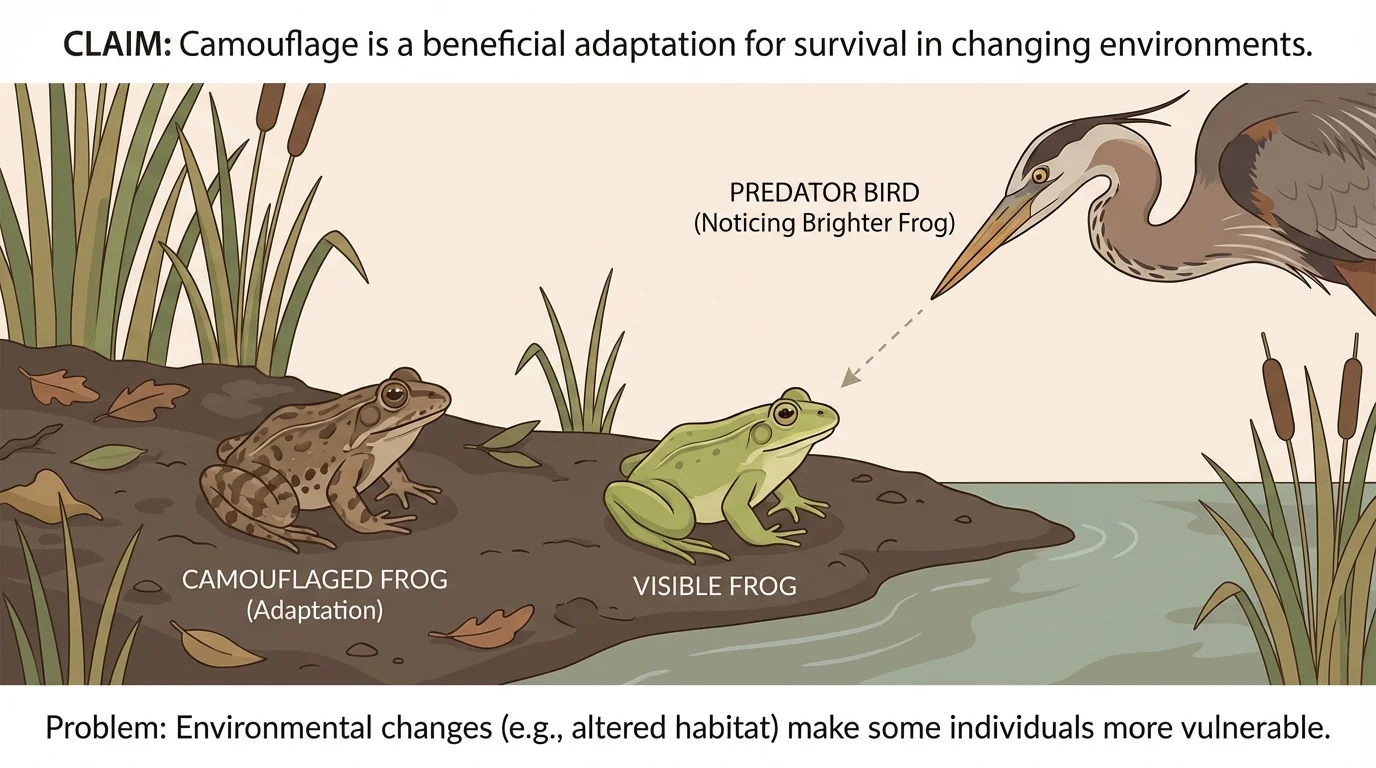
Living things of the same species are not always exactly alike. These small differences are called traits. A trait might be size, color, shape, or behavior. In a changed habitat, one trait may be more helpful than another, as [Figure 2] illustrates with frogs that blend in better near muddy water.
Suppose two frogs live near a pond. One frog has coloring that matches the muddy ground better. Another frog has brighter coloring that is easier for a bird to spot. If the pond shrinks and there are fewer wet plants for hiding, the frog that blends in may stay safer from predators. That helpful trait gives it an advantage in survival.
If that frog survives longer, it has a better chance to grow, find a mate, and have young. Having young is called reproduction. Over time, traits that help living things survive and reproduce may become more common in the group. This idea is part of natural selection, which means helpful traits are more likely to be passed on.
This does not mean a living thing chooses a new trait when trouble starts. It means some individuals already have differences, and those differences may help when the environment changes. The environment does not hand out traits; it makes some traits more useful than others.
Some seeds can stay alive in dry ground for a long time. When water comes back, they can begin growing again. That trait helps certain plants survive dry times better than others.
When scientists look at a habitat, they pay attention to these differences. They ask, "Which traits help here?" and "Which traits make survival harder?" Those questions help explain why the types of plants and animals in an area may change after one environmental change.
Let us focus on one clear problem: a pond that becomes much smaller after little rain. This single environmental change is enough to affect many living things. There is less water, less shade from water plants, and less room for animals that depend on the pond.
Fish may be crowded into a smaller space. When too many fish are crowded into a smaller area, it is harder for them to find enough food. Frogs may lose places to lay eggs. Insects that live on or near the water may become fewer. Plants that need lots of water may wilt or die. As a result, animals that eat those insects or use those plants may leave the area.
This is why the kinds of living things in the pond area may change. Some animals move away. Some plants die back. Some organisms that can handle drier conditions may become more common. The habitat is still there, but it is not the same habitat it was before, as we can tell from the pond changes first shown in [Figure 1].
How one change leads to more changes
When a habitat changes, living things may lose one or more basic needs: water, food, shelter, or space. If one plant dies, an insect may lose food. If insects become fewer, birds may have less to eat. A single environmental change can spread through the habitat like falling dominoes.
To solve the problem, we first need to decide exactly what the biggest need is. Is the main problem lack of water? Too much heat? Loss of shelter? Crowding? Good solutions match the real problem.
People sometimes try to help habitats after a change. But not every idea is equally useful. To judge possible solutions, we ask whether they truly help the organisms and whether they fit the problem. We can compare different ideas by looking at needs, possible benefits, and possible problems, as [Figure 3] organizes clearly.
For a shrinking pond, possible solutions might include adding shade near the pond, planting native grasses around the edge, bringing in some water for a short time, or creating a nearby wet area where animals can rest. Another idea might be moving animals somewhere else, but that can be hard and may not work well.
A solution has merit if it solves the problem well, helps the habitat, and does not create bigger troubles. For example, planting native plants may help hold moisture in the soil and give small animals shelter. A poor solution might help one species a little but hurt many others.
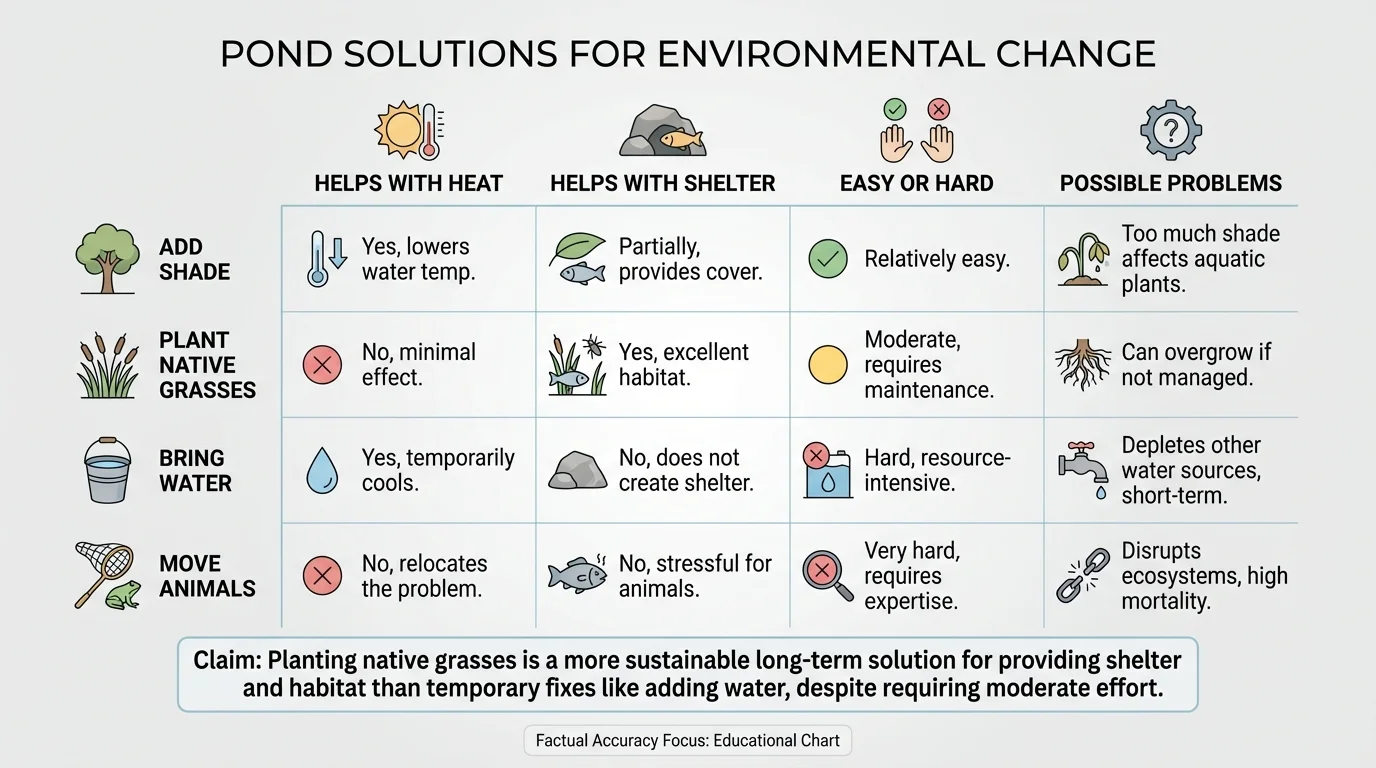
Sometimes the best solution is not the fastest one. Bringing buckets of water to a pond may help for one day, but it may not last long. Planting native grasses may take more time, but it can give longer-lasting shelter and help the area stay cooler and less dry.
| Possible solution | How it may help | Possible limit |
|---|---|---|
| Add shade near part of pond | Keeps ground cooler and offers shelter | Does not create much new water |
| Plant native grasses | Provides cover and helps soil hold moisture | Takes time to grow |
| Bring in water once | Raises water level for a short time | May not last |
| Move animals away | May help a few animals quickly | Stressful and hard to do safely |
Table 1. A comparison of possible solutions for a drying pond and their benefits and limits.
When we compare solutions, we are acting a bit like engineers. Engineers design ways to solve problems. In nature problems, a strong solution should match the habitat and the needs of the organisms that live there.
A claim should answer a question such as, "Which solution is best for helping organisms near a drying pond?" A strong claim is clear and specific. For example: Planting native grasses around the pond has more merit than moving animals away.
That claim needs reasons and evidence. A reason explains why the idea makes sense. Evidence includes observations such as: native grasses provide shade, hold soil in place, and offer hiding places for insects and frogs. Another piece of evidence might be that moving animals is difficult and may not help plants at all.
Example of a claim with evidence
Question: Which solution has more merit for a pond that is drying up: planting native grasses or moving frogs to another pond?
Step 1: State the claim
Planting native grasses has more merit.
Step 2: Give a reason
It helps more than one kind of living thing.
Step 3: Add evidence
Native grasses can provide cover for frogs, places for insects, and cooler ground near the pond edge.
Step 4: Explain the limit of the other idea
Moving frogs may help only some frogs, and it does not improve the pond habitat itself.
Notice that the claim does not just say "I like this idea better." It gives science-based reasons. It connects the solution to the needs of living things in the habitat.
Now consider one specific solution: making a small shaded area with safe natural materials near part of the pond and adding native plants around it. This solution has some merit because it helps with heat and shelter at the pond edge. Frogs, insects, and other small animals can use cooler, protected spaces nearby.
[Figure 4] The shaded area does not fix every problem. It does not magically fill the pond with water. But it may reduce stress for some organisms and protect the soil from drying as quickly. Adding native plants can also make the area better for insects, which can then help birds and frogs that eat them.
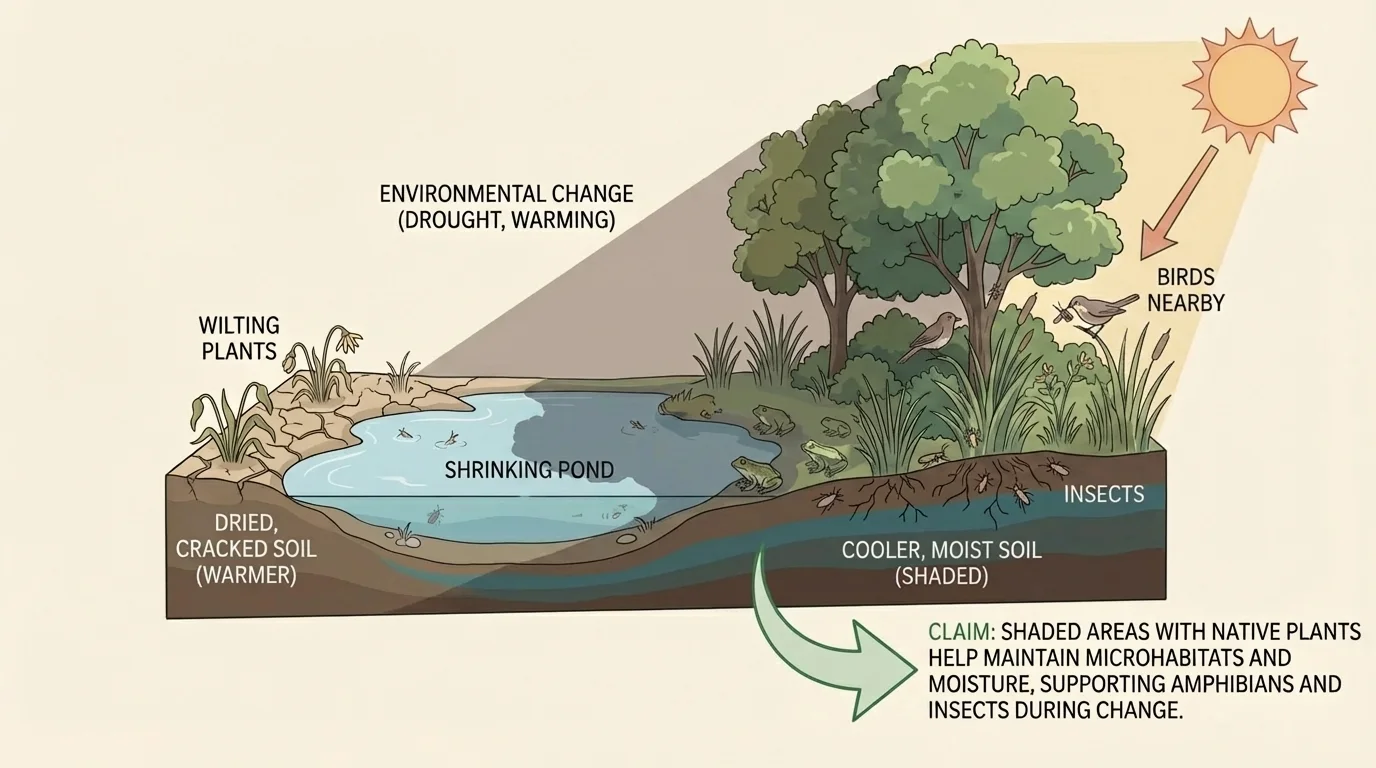
This is an example of a solution with partial merit. It helps, but only in certain ways. That is important in science: a solution does not need to be perfect to be useful. We should ask, "How much does it help?" and "Who does it help?"
Plants and animals need basic things to live: water, food, air, shelter, and space. When we judge a solution, we check whether it helps meet those needs.
If someone claimed that a shade shelter had no merit at all, the evidence would not support that. The shelter does help some organisms. If someone claimed that it solved every problem, that would also be too strong. Good claims match the evidence carefully.
Even with a good solution, the types of plants and animals in the area may still change. Some fish may still need deeper water. Some frogs may do well if there is cool shelter. Some plants that need lots of water may not return unless wetter conditions come back. A habitat solution can improve conditions without returning everything to exactly the way it was.
This is where traits matter again. As we saw with the frogs in [Figure 2], individuals with helpful traits may survive better in the changed habitat. Animals that can move quickly, hide well, or use different food sources may have an advantage. Plants with seeds that survive dry soil may also do better.
So when we make a claim about a solution, we should remember two ideas at the same time. First, the solution may help. Second, the environment still shapes which organisms can live there successfully. Solutions matter, but traits matter too.
Scientists observe what is happening in a habitat. They notice which organisms are present, which are disappearing, and what changed in the environment. Engineers use that information to design helpful solutions. Then both scientists and engineers look again to see whether the solution worked.
For example, after native plants are added near a pond, people can observe whether insects return, whether the soil stays cooler, or whether frogs use the area more often. These observations are evidence. Evidence helps us improve a solution or decide whether a different one is needed.
"The best solution is the one that fits the problem and is supported by evidence."
Making a claim is not guessing. It is choosing an answer and supporting it with reasons based on what we know about habitats, traits, survival, and the needs of organisms.
