A big storm can knock down trees, flood roads, and damage homes in just a short time. People cannot tell a hurricane, tornado, or blizzard to stop. But people can build things and make plans that help keep families safer. That is where science and engineering work together.
A weather hazard is dangerous weather that can hurt people or damage places. Some weather hazards bring strong wind. Some bring too much rain or snow. Some bring lightning, ice, or extreme heat. Weather is a natural part of Earth, so humans cannot eliminate these hazards. However, we can reduce the impact they have on our lives.
Reducing impacts means lowering the amount of harm. For example, if a storm would normally break many windows, storm shutters can help protect them. If heavy rain would normally flood a school entrance, a better drain can move water away. The dangerous weather still happens, but the damage can be less.
Weather hazard is dangerous weather that can cause harm, such as floods, hurricanes, tornadoes, blizzards, thunderstorms, or heat waves.
Design solution is something people create to solve a problem, such as a safer building, a warning system, or a barrier that blocks water.
Claim is a statement that says what you think is true.
Merit means how good or useful something is for a job.
When scientists and engineers study weather hazards, they ask questions like these: What kind of damage happens? Who needs protection? What design will work best? Then they test ideas and compare results.
A design solution can be an object, a structure, or a system. A stronger roof is a design solution. A flood wall is a design solution. A weather alert sent to phones is also a design solution. The purpose is the same: help people stay safer when dangerous weather happens.
Some design solutions protect people before a hazard arrives. For example, a raised house can help before a flood. Some help during the hazard, such as shutters during a hurricane. Some help after the hazard, such as a backup power system that keeps lights on after a storm.
Good design solutions fit the problem. A heavy-duty snowplow helps in a snowy place, but it does not solve a tornado problem. Sandbags may help with floodwater, but they do not protect against lightning. To judge a solution fairly, we must match it to the weather hazard it is meant to address.
Different hazards cause different kinds of damage, as [Figure 1] shows. Strong winds can pull off roof parts, break branches, and send objects flying. Heavy rain can cause streets and yards to flood. Snow and ice can make roads slippery and pile heavy weight onto roofs. Thunderstorms can bring lightning, heavy rain, and gusty wind. Heat waves can make it dangerous to stay outside too long.
A hurricane brings heavy rain and powerful wind over a large area. A tornado has spinning wind in a smaller area, but it can be extremely strong. A blizzard brings blowing snow, cold air, and low visibility. A flood happens when water covers land that is usually dry. Each hazard creates a different problem for people to solve.
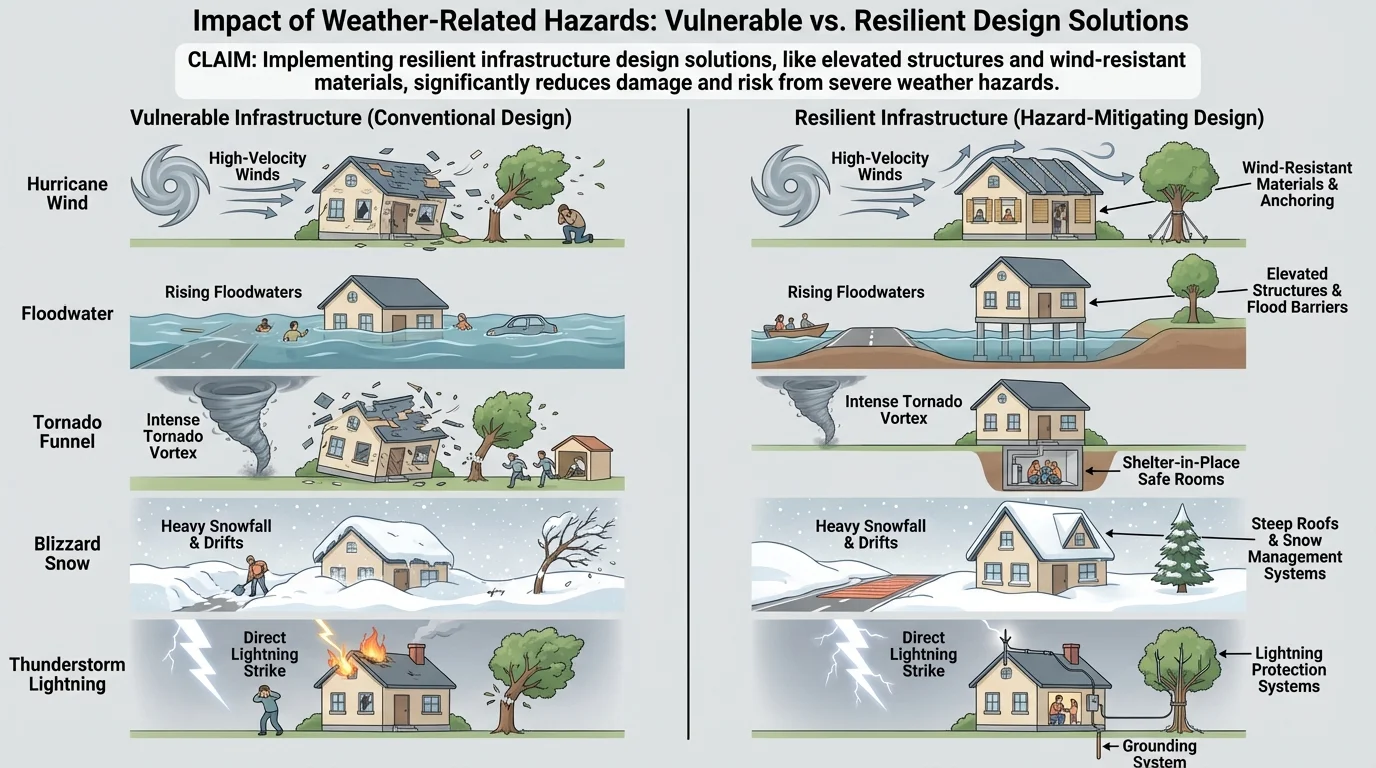
Because hazards are different, design solutions are different too. Communities near the ocean may focus on storm shutters and evacuation routes for hurricanes. Communities near rivers may focus on raised buildings and drainage systems for floods. Cold places may need salt trucks, snowplows, and insulated shelters during winter storms.
When we make a claim about a solution, we need to think about the specific hazard. A solution should be judged by how well it reduces the kind of harm shown earlier in [Figure 1].
Some schools practice severe weather drills just like fire drills. Practicing helps people know where to go quickly if a warning is given.
Practice is not a building material, but it is still part of a safety design because it helps people respond in an organized way.
To decide whether a solution has merit, we ask, "How well does it do its job?" We do not just guess. We look at evidence. Evidence can come from observations, tests, comparisons, or records from real storms.
A design solution may have high merit if it does several things well. It should reduce harm, be safe to use, and make sense for the place where it is used. Sometimes people also think about cost, how easy it is to build, and whether it can be used again and again.
| What to check | Question to ask | Example |
|---|---|---|
| Safety | Does it help protect people? | A safe room gives shelter during strong winds. |
| Effectiveness | Does it reduce damage? | Storm shutters help keep windows from breaking. |
| Fit for the hazard | Does it match the weather problem? | Sandbags match floods better than blizzards. |
| Usefulness | Can people really use it when needed? | A loud siren can warn many people quickly. |
Table 1. Questions students can use to judge the merit of a design solution for a weather hazard.
Merit does not mean perfect. A solution can be helpful even if it does not stop all damage. For example, shutters may stop some broken glass but not stop a whole tree from falling on a house. A good claim is honest about both the strengths and the limits.
How a scientific claim works
A strong claim has three parts: the claim, the evidence, and the reasoning. The claim tells what you think. The evidence tells what you observed or learned. The reasoning explains why the evidence supports the claim.
That pattern helps us speak clearly. Instead of saying, "I just like this idea," we can say, "This design has merit because it reduced damage in this kind of storm."
Homes in windy storm areas may need special features, and [Figure 2] illustrates how several features work together. These may include storm shutters, stronger windows, roof straps that hold the roof more tightly to the walls, and a safe indoor room away from windows. Each part has a job.
Storm shutters help cover glass so flying objects are less likely to break windows. Roof straps help hold the roof in place during strong winds. A safe room gives people a more protected indoor space. None of these features stop the storm itself, but they can reduce injury and damage.
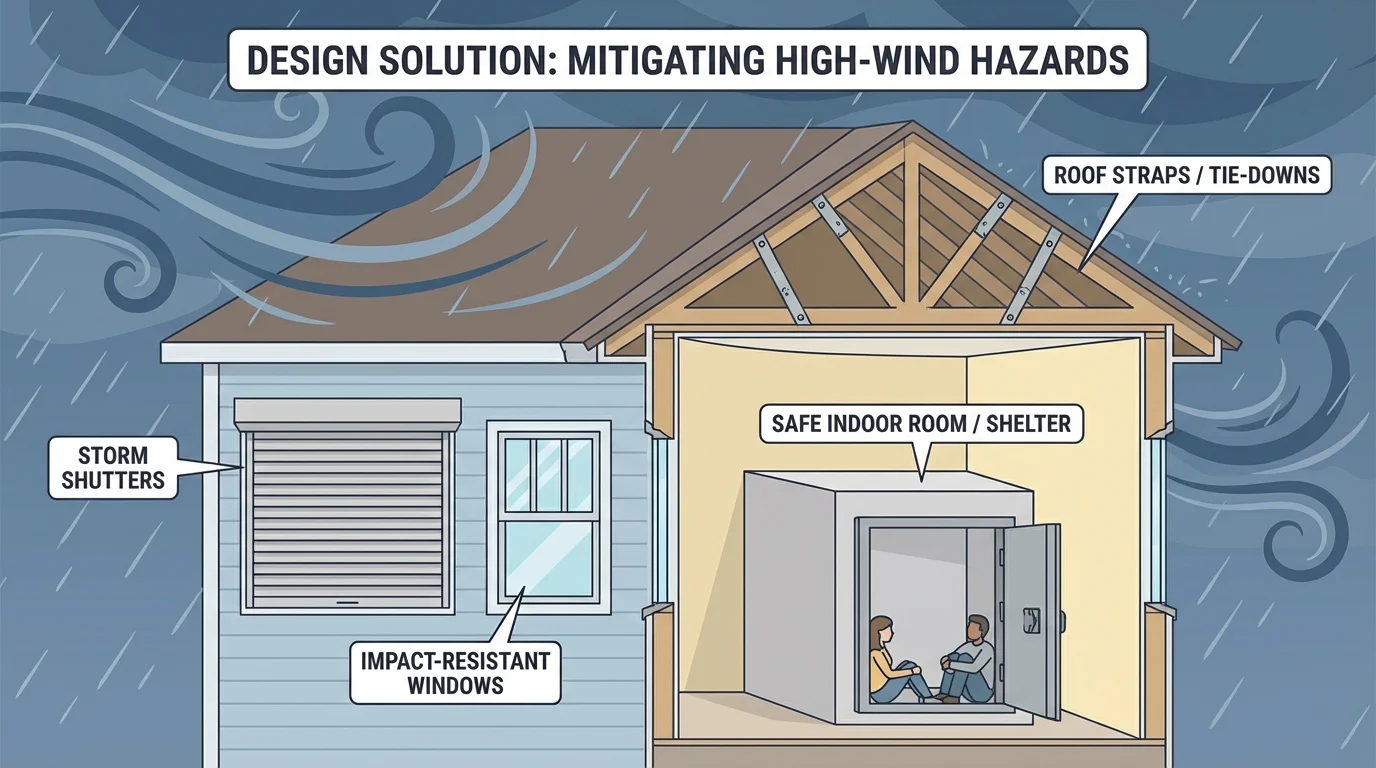
Suppose two similar houses are in the path of a severe windstorm. One house has shutters and roof straps. The other does not. After the storm, the first house has fewer broken windows and less roof damage. That is evidence we can use.
Making a claim about a wind-safe house
Step 1: State the problem.
Strong winds can break windows and pull roof parts loose.
Step 2: Identify the solution.
The house has storm shutters and roof straps.
Step 3: Use evidence.
During a storm, the house with these features has less damage than a similar house without them.
Step 4: Make the claim.
The design solution has merit because it reduces damage from strong winds.
Later, if students compare other houses, they might find that the best protection comes from combining several features, just as we see with the grouped protections in [Figure 2].
Floods happen when water covers land that is usually dry. In flood-prone places, height and water pathways matter, as [Figure 3] shows. A building raised above ground level may stay drier than one built low to the ground. Drains, channels, and barriers can also guide water away from important areas.
Sandbags can block some moving water from entering a doorway. Raised homes can keep living spaces above floodwater. Good drainage can help rainwater move away faster. These solutions do not remove the flood hazard, but they reduce how much water reaches people and property.
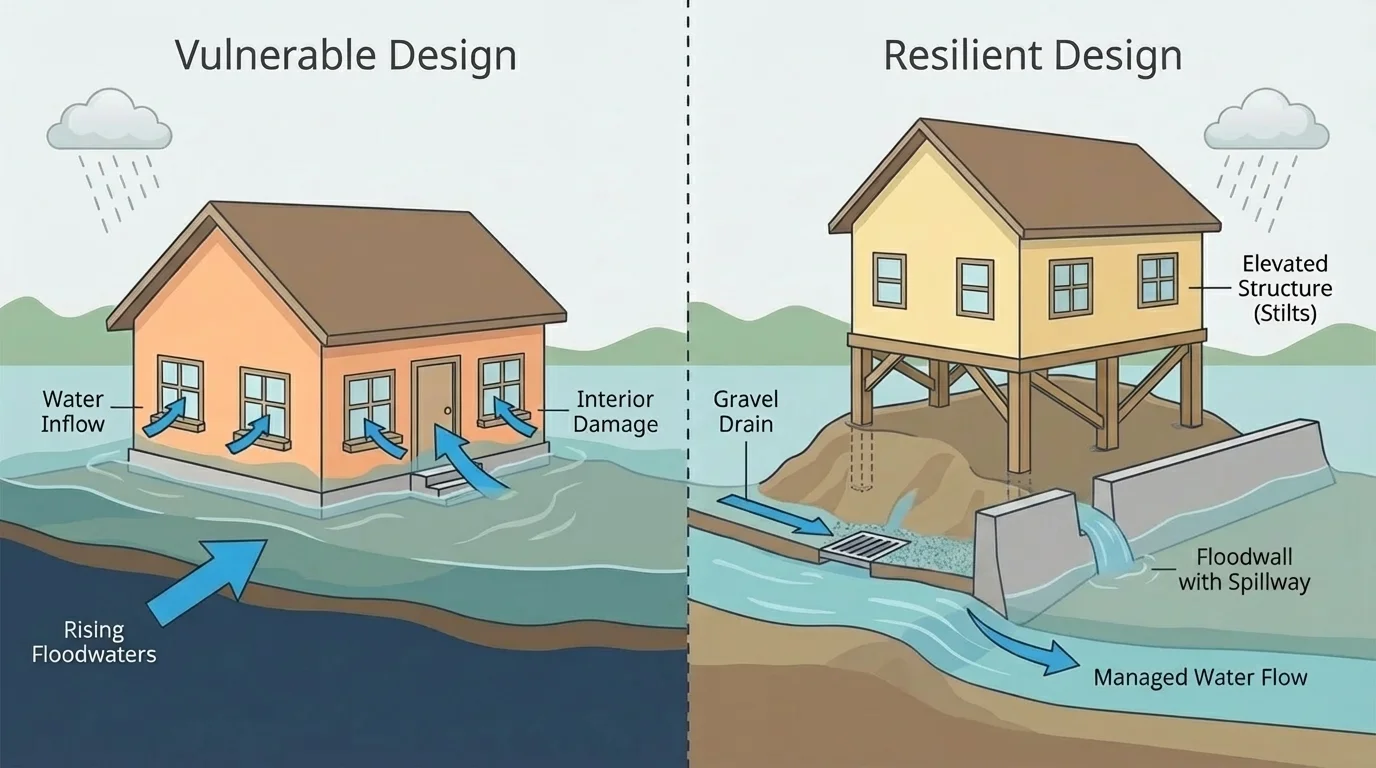
Imagine a neighborhood after heavy rain. The raised homes stay mostly dry, while lower homes have water inside. That gives evidence that raising buildings can have more merit than leaving them at ground level in that location.
However, one solution may not work everywhere. Sandbags are useful for smaller areas and short times. Raising a whole building may be stronger protection, but it takes more planning and work. A claim about merit should match the evidence from the place and problem being studied.
Comparing flood solutions
Step 1: Identify the hazard.
Heavy rain causes floodwater to rise around homes.
Step 2: Compare solutions.
One solution uses sandbags. Another solution raises the home.
Step 3: Judge the results.
The raised home keeps water farther from the living area. Sandbags help, but water may still get over or around them.
Step 4: Make a claim.
In this case, the raised home has greater merit for reducing flood impacts.
The visual comparison in [Figure 3] helps explain why getting above the water level can matter so much.
Not every design solution is a wall or a building part. Information can be a design solution too, and [Figure 4] shows how a warning moves from weather experts to community action. Sirens, weather radios, phone alerts, and school announcements help people act early.
If people hear a tornado warning in time, they can go to a safer indoor place. If families receive a hurricane alert early, they may have time to leave a dangerous area. A warning does not block wind or rain, but it reduces impacts by giving people time to protect themselves.
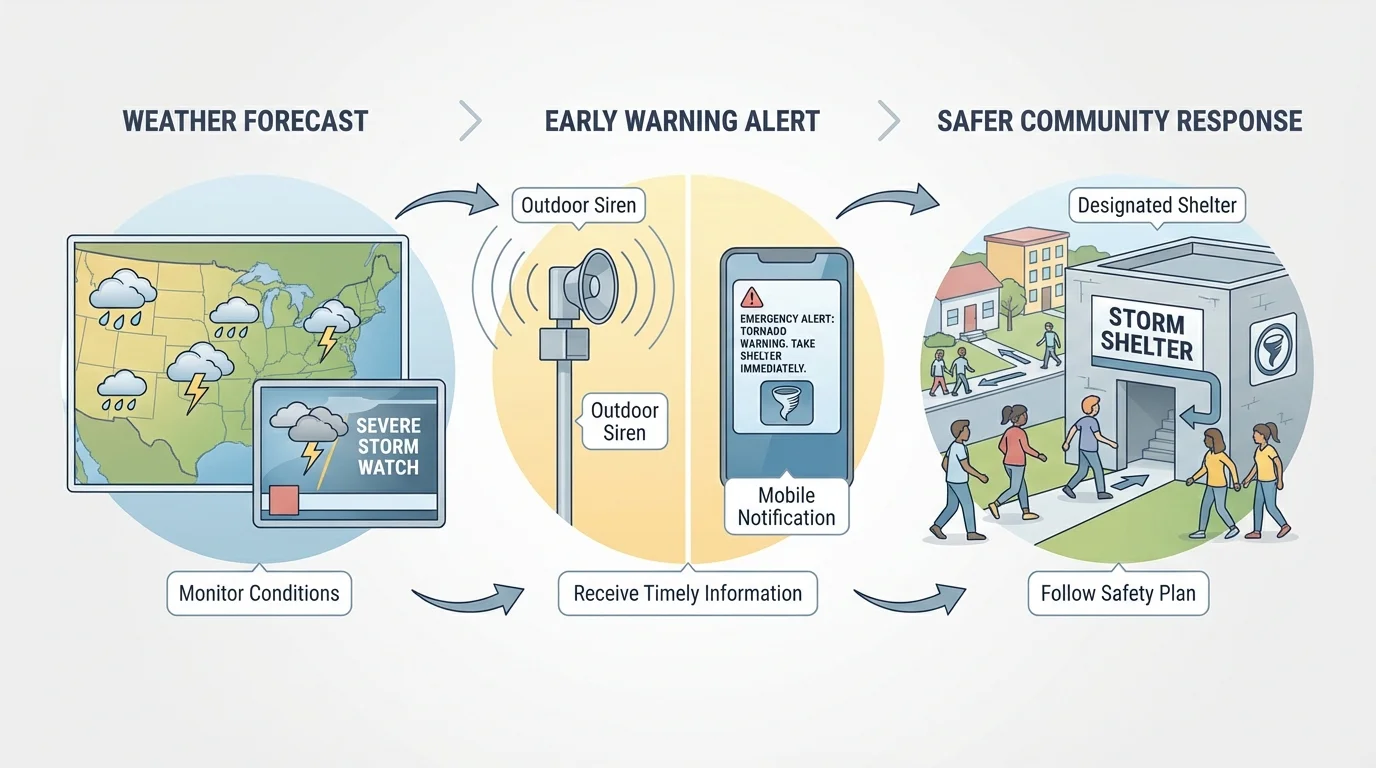
This is an important idea: a design solution can protect people by changing what they do. Good warnings are clear, fast, and easy to understand. If a warning arrives too late or is confusing, its merit is lower.
Communities often use more than one warning method. A phone alert may miss someone without a charged device, but a siren may still be heard. Using several methods together can make the whole system stronger, much like the connected steps shown in [Figure 4].
From earlier science learning, remember that observations help us understand patterns. Weather forecasts and warnings are based on observing patterns in clouds, wind, temperature, and rain.
That is why science matters in emergency planning. Better observations can lead to better warnings, and better warnings can reduce harm.
When you make a claim about merit, start with the hazard. Next, name the solution. Then add evidence. Finally, explain why the evidence shows the solution is useful.
Here is a simple pattern students can use: Claim: This solution has merit. Evidence: It reduced damage or helped people stay safer. Reasoning: It fits the hazard and lowers the impact.
For example, you might say, "The tornado warning system has merit because it gives people time to move to shelter before strong winds arrive." Or you might say, "The raised house has merit because floodwater stays below the living area." These are stronger than saying only, "It is good."
"A good claim is supported by evidence, not just opinion."
Sometimes two solutions both have merit, but one has more merit for a certain place. A flood wall may protect one building well, while better drains may help a whole street. Asking "better for whom?" and "better for what hazard?" makes claims more accurate.
Even strong solutions have limits. A powerful hurricane can still damage a well-built house. Floodwater can still rise higher than expected. A warning system can still fail if power is lost. That does not mean the solution is worthless. It means we should understand what it can and cannot do.
This is a key science idea: weather hazards come from natural processes. People cannot eliminate them. But people can reduce the impacts by designing smarter buildings, barriers, shelters, and warning systems.
Often the best protection comes from using more than one solution at the same time. A coastal town may use strong buildings, clear evacuation routes, and weather alerts. A snowy town may use plows, road salt, and warming centers. Combining ideas often provides better protection than relying on one tool alone.
Science helps us understand weather patterns and hazards. Engineering helps us create tools and structures to solve problems. When we observe damage, compare designs, and improve ideas, we are using both science and engineering practices.
Engineers often redesign solutions after learning from real storms. If a roof fails, they study why. If a drain is too small, they make a better one. If a warning is confusing, they change the message to make it clearer. Improvement is part of design.
Making a claim about merit is an important part of this work. It means looking carefully at what a solution does, using evidence, and explaining your thinking clearly. That is how people make wise choices that help communities stay safer in dangerous weather.
