Long ago, giant reptiles walked on land, strange fish swam in ancient seas, and forests grew in places that are now dry rock. Many of those living things are gone today. How do we know they were ever here? We know because Earth keeps clues. Some of the best clues are fossils, which are the preserved remains or signs of living things from long ago.
Earth has not always looked the way it looks now. Over millions of years, oceans have covered land, mountains have risen, and climates have changed. During that long history, many kinds of living things appeared, lived, and then disappeared. When a kind of organism is no longer found anywhere on Earth, it is called extinct.
Dinosaurs such as Tyrannosaurus rex are extinct. So is the woolly mammoth. Many ancient plants are extinct too. Extinction does not mean those organisms never existed. It means they lived in the past but are not alive now. Fossils help us learn about these lost forms of life.
Some organisms alive today are very different from extinct ones. Others seem to share some features. A bird has wings and legs. Some dinosaur fossils show animals with legs, claws, and feathers too. This does not mean birds are the same as the large dinosaurs children often imagine, but it does show that living things can share traits and be related through long lines of life.
Some fossils are so old that they formed long before humans existed. Scientists have found fossils of tiny sea creatures, giant ferns, and enormous reptiles that lived millions of years apart.
Not every organism becomes a fossil. Most living things die and decay completely. That is one reason fossils are so special. They are rare pieces of evidence from the past.
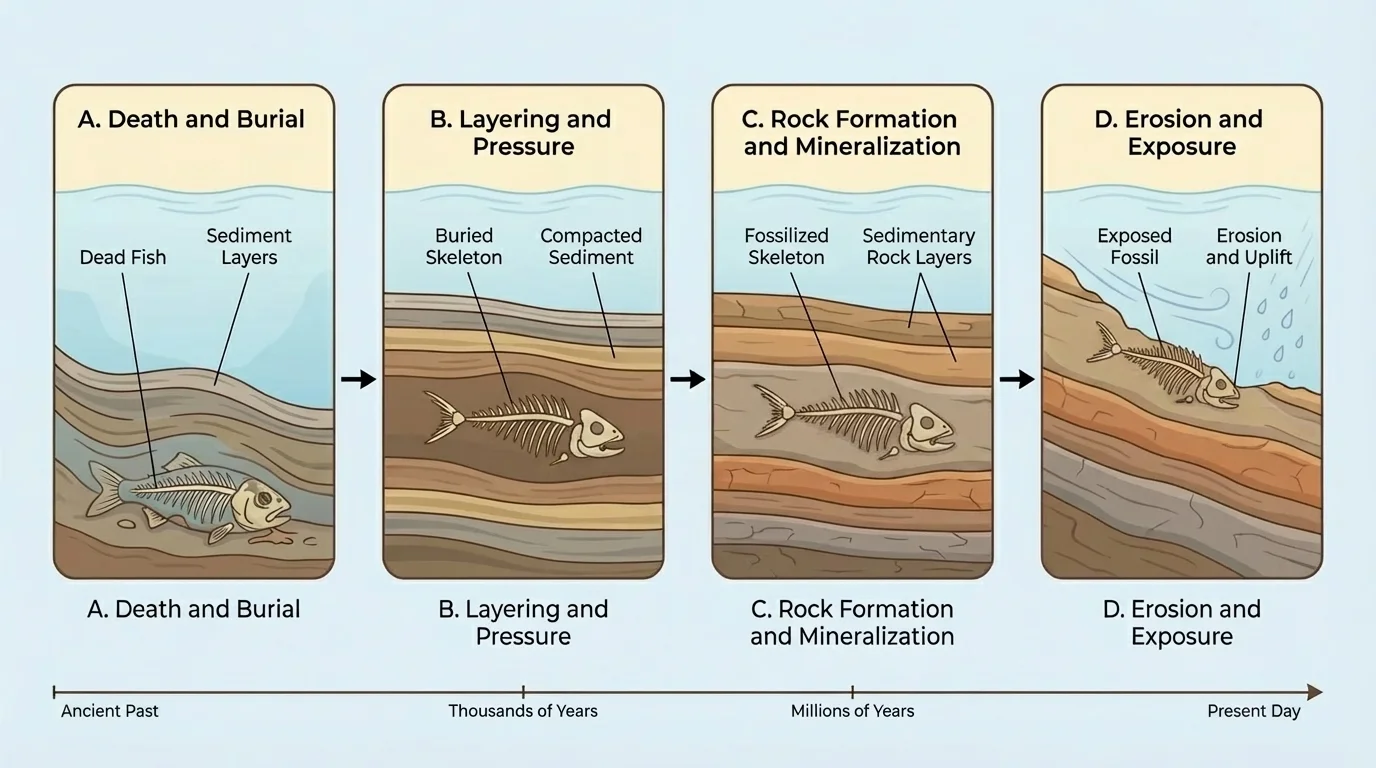
A fossil is the preserved remains or evidence of an organism that lived long ago. A fossil often forms when a dead organism is quickly buried by mud, sand, or other sediment. Over a very long time, more layers build up, and the buried remains may be preserved inside rock.
Some fossils are actual body parts, such as bones, teeth, shells, or wood. In other fossils, the original material is gone, but its shape remains in the rock. Sometimes minerals from water slowly replace parts of the organism. This can preserve hard details, like the lines on a shell or the shape of a leaf.
As [Figure 1] suggests, there are different kinds of fossils. A fossilized bone tells us about an animal's body. A leaf print in rock tells us about a plant. A footprint tells us that an animal walked through soft ground long ago. Even droppings can become fossils and give clues about what an animal ate.
Extinct means a kind of living thing no longer exists anywhere on Earth.
Sediment is small pieces of rock, sand, mud, or dirt that can cover remains.
Paleontologist is a scientist who studies fossils and ancient life.
Fossils usually form best when an organism has hard parts, such as bones or shells, and when it is buried quickly. Soft things like fur or skin usually decay. That is why many fossils are bones, shells, and teeth. Very special conditions, such as being trapped in amber or frozen in ice, can preserve more delicate parts.
Wind and water can later wear away rock and uncover fossils. That is why fossils may be found in cliffs, road cuts, riverbanks, and deserts. The fossil did not form there recently. It formed long ago and was hidden until the rock around it was worn away.
Fossils are like messages from the past. Different fossil types give different kinds of evidence. A skeleton can tell us an animal's size and shape. A tooth can suggest what it ate. A footprint can show how it moved.
In [Figure 2], scientists compare fossils to living organisms. If a fossil has fins, gills, and a fish-like body, it probably lived in water. If it has strong legs and claws, it may have walked on land. A long neck might help an animal reach food. Sharp teeth might mean it ate meat. Flat teeth might mean it ate plants.
Fossils can also show that life on Earth has changed over time. In lower rock layers, scientists may find older fossils. In higher layers, they may find younger fossils. When they compare them, they may notice that some groups changed slowly. Others disappeared. New groups appeared later.
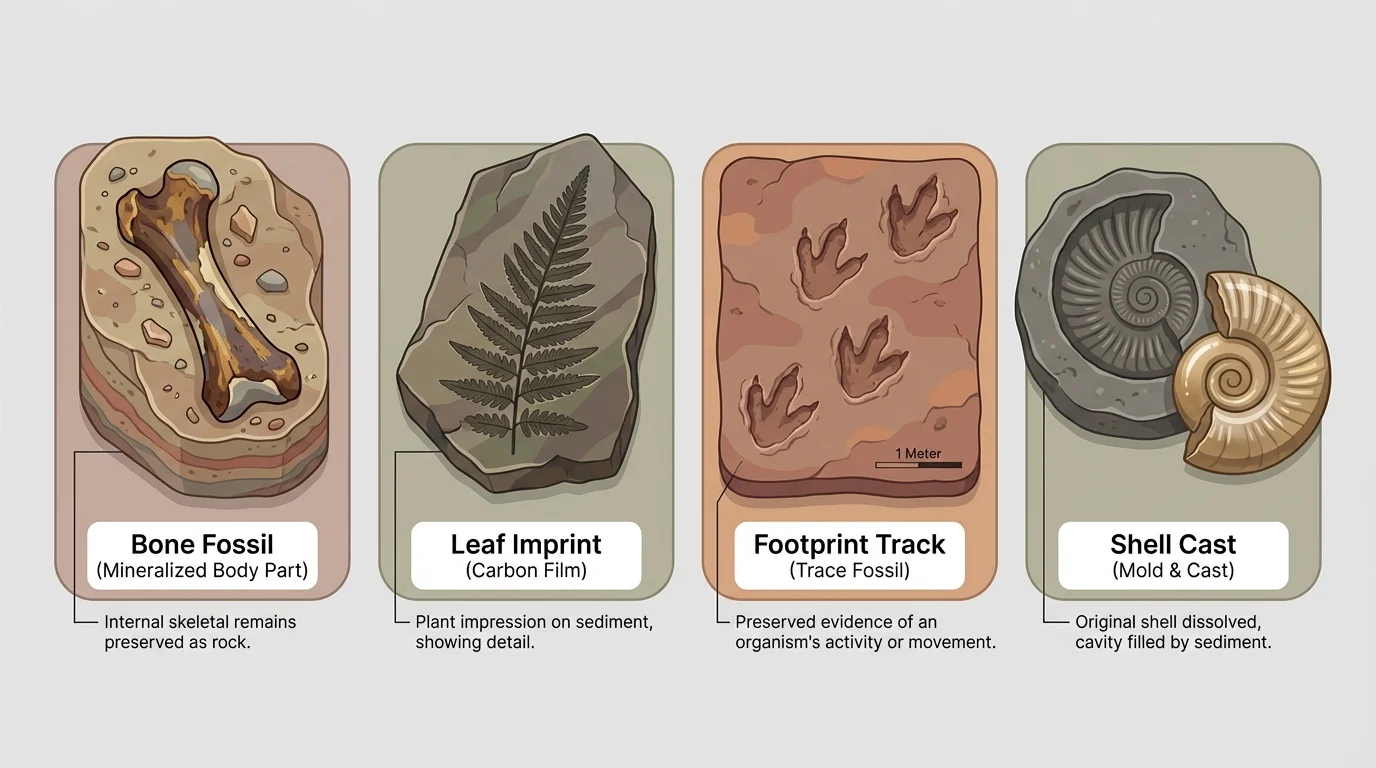
Some fossils are called trace fossils because they show what an organism did rather than showing its body. Footprints, nests, burrows, and bite marks are trace fossils. They can tell us whether an animal walked alone or in groups, whether it dug underground, or whether it hunted other animals.
A fossilized fern leaf tells us that plants grew in that place long ago. A shell fossil tells us that a shell-making animal lived there. A dinosaur footprint tells us that a dinosaur once stepped there. Each fossil gives only part of the story, but many fossils together can help scientists build a bigger picture.
Real-world example: learning from a footprint
Step 1: A paleontologist finds a line of fossil footprints in rock.
Step 2: The footprints are large, spaced far apart, and have three clawed toes.
Step 3: The scientist infers that a large animal with three-toed feet moved across soft ground.
Step 4: Because the prints are repeated in a path, the fossil gives evidence of movement, not just body shape.
This is why trace fossils are so useful. They show behavior from long ago.
As we saw earlier with fossil formation in [Figure 1], preserving these clues takes the right conditions. That is why each fossil find matters. It may fill in a missing part of Earth's history.
As [Figure 3] illustrates, fossils do more than tell us about individual organisms. They also reveal the kind of place where those organisms lived. Shells found in rock high on a mountain can be evidence that the area was once underwater. Plant fossils in the rock above them can show that the environment changed later.
If scientists find fish fossils and shell fossils together, they may infer that the place was once a lake, river, or ocean. If they find fossil tree trunks, fern leaves, and swamp plants, they may infer the area was once wet and warm. If they find fossils of animals adapted to dry conditions, they may infer the area was once much drier.
Rock layers help too. Mudstone may suggest calm water or muddy ground. Sandstone may suggest beaches, rivers, or deserts. When scientists look at both the rock and the fossils inside it, they can make careful conclusions about ancient environments.
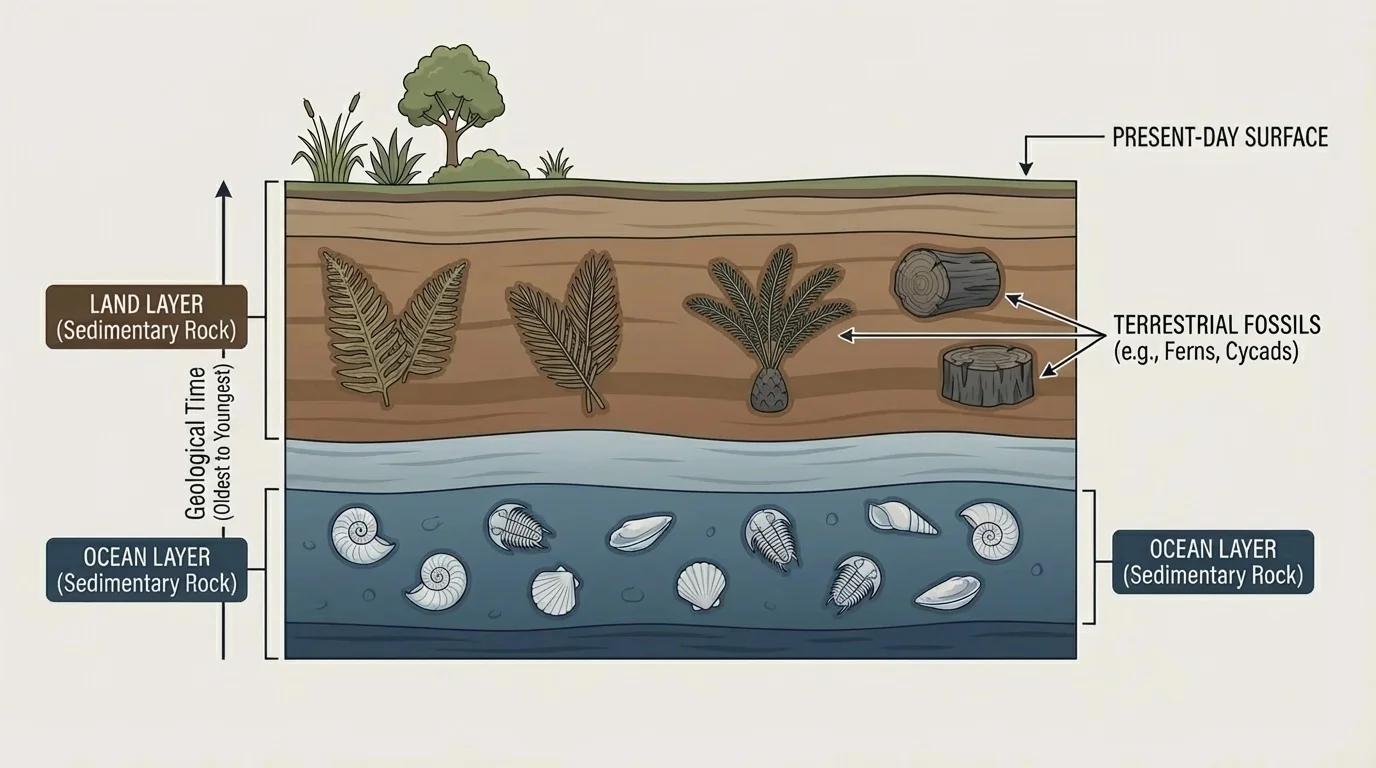
Sometimes a place changes many times. A region might be a shallow sea, then a swamp, then a forest, and later dry land. Fossils preserved in different layers record those changes. This helps scientists understand that Earth's surface and climates change over long periods.
| Fossil clue | Possible ancient environment |
|---|---|
| Shells and sea animals | Ocean or shallow sea |
| Fish and water plants | Lake, pond, or river |
| Fern leaves and swamp plants | Warm, wet swamp or forest |
| Tracks in dry sand layers | Dry land or desert-like area |
Table 1. Examples of how fossil clues can help scientists infer ancient environments.
These clues matter in the real world. Scientists use fossil evidence to learn how habitats changed in the past. That can help people understand long-term changes in climate, water, and land. Fossils do not predict the future by themselves, but they help us understand how Earth has changed before.
As [Figure 4] shows, when scientists place fossils in order from older layers to younger layers, they often see patterns of change. A series of horse-like fossils shows that older forms were smaller and had more toes, while later forms had body features more like modern horses. This pattern suggests that living things can change over long periods.
This evidence supports the idea of common ancestry. Common ancestry means that different living things may share ancestors from the distant past. Organisms are not all exactly the same, but they can still be related. Shared body parts and fossil patterns help scientists see those relationships.
For example, the arm of a human, the wing of a bird, and the flipper of a whale look very different on the outside. Yet inside, they have similar sets of bones. Fossils help show that such body plans have a long history. Over time, descendants can become different as they adapt to different ways of living.
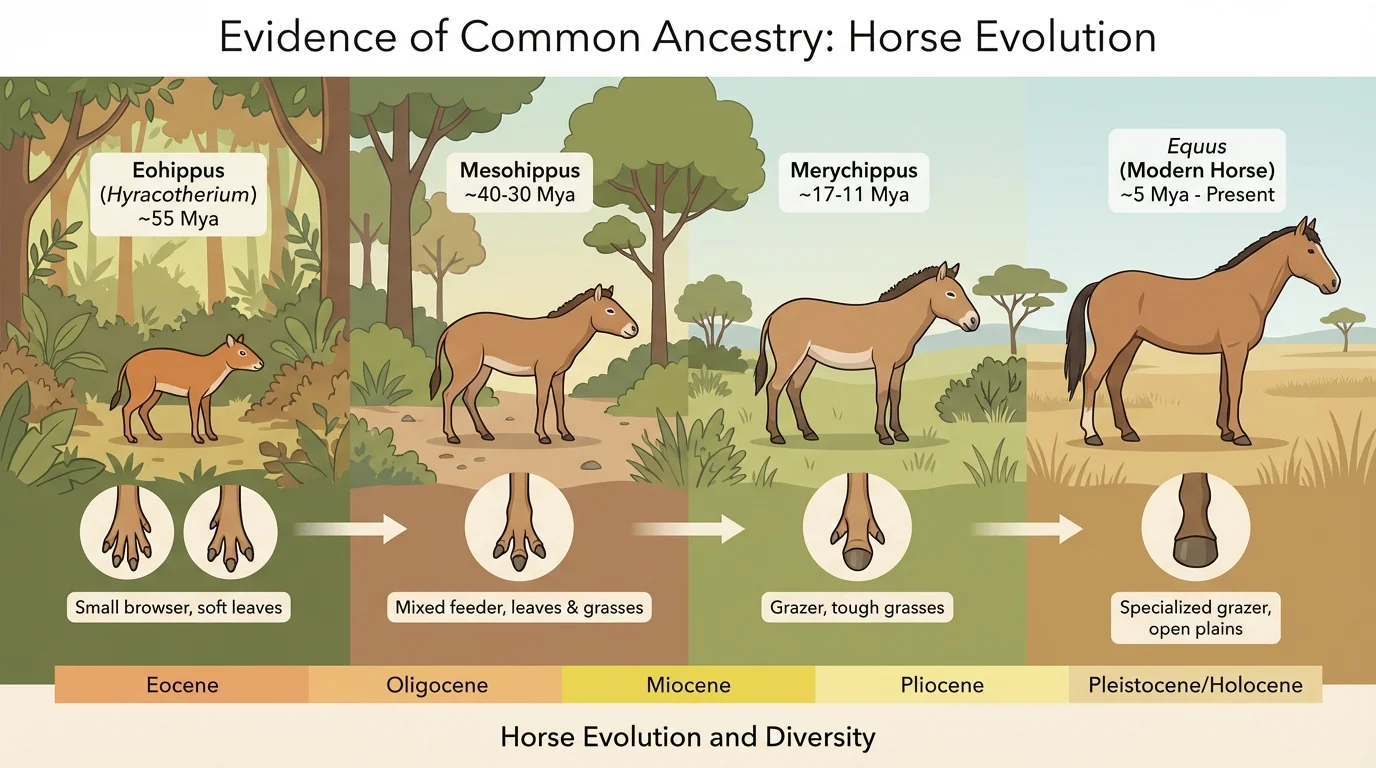
This does not mean one modern animal turns into another modern animal. It means populations change over many generations. Some traits are passed on. Some organisms survive better in certain environments. Over a very long time, these changes can lead to new forms of life.
How fossils support common ancestry
If older rock layers contain organisms with certain features, and younger layers contain organisms with many of those same features plus some new ones, scientists can compare them. Repeated patterns of similarity and change suggest that groups of organisms are connected through ancestors and descendants over long spans of time.
The changing environments shown earlier in [Figure 3] help explain why life also changes. If a habitat becomes drier, colder, deeper, or more open, organisms with helpful traits may survive and reproduce more successfully. Fossils preserve some of the evidence of those long changes.
A paleontologist studies fossils to learn about ancient life. Paleontologists work carefully. They do not simply dig up bones and guess. They record where a fossil was found, what rock layer it came from, what other fossils were nearby, and how the rock was formed.
They may brush away dirt with small tools, wrap fragile fossils so they do not break, and study them in museums or laboratories. They compare new discoveries with known fossils and with living organisms. They also work with other scientists, such as geologists, who study rocks and Earth's surface.
By combining many kinds of evidence, paleontologists can make strong conclusions. A single fossil bone may tell part of a story. A whole set of fossils from several layers tells much more. Scientists test ideas by looking for patterns that match the evidence.
Living things need food, water, air, and suitable habitats. Different body parts help organisms survive in different environments. Fossils let us see how organisms and habitats from the past were similar to or different from those of today.
The comparison of fossil types in [Figure 2] is helpful here too. A scientist may use a bone fossil for body shape, a footprint for movement, and a leaf imprint for habitat clues. Different kinds of evidence work together like puzzle pieces.
Fossils matter because they help us answer big questions. What lived here long ago? What was this place like in the past? Which organisms are gone now? How are living things related? Fossils do not answer every question, but they provide strong evidence.
They also remind us that Earth is always changing. Forests can become deserts. Seas can cover land and later retreat. Groups of organisms can thrive for millions of years and then disappear. New groups can appear. Life on Earth has a long, changing history.
When we protect places where fossils are found, we protect important evidence. Museums, parks, and research sites help people learn from these clues. A fossil in a rock is not just an old object. It is part of the story of life on Earth.
