Have you ever needed a jacket in the morning and then felt hot by afternoon? That quick change is a clue that weather can shift fast. But if a place is usually hot, cold, rainy, or dry year after year, that tells us about its climate. Scientists study both weather and climate because the sky, air, water, and land are always working together, and those patterns help people plan what to wear, how to travel, and even what crops to grow.
Weather is what the air and sky are like at a certain place and time. Weather includes things such as temperature, wind, rain, snow, clouds, and sunshine. If it is rainy this morning, windy at lunchtime, and clear by evening, those are all parts of the day's weather.
Weather can change very quickly. A storm can move in during one afternoon. Fog can cover the ground early in the day and disappear when the Sun warms the air. This is why weather reports are updated often.
Weather is the condition of the air outside at a certain time and place.
Climate is the usual pattern of weather in a place over many years.
When we talk about weather, we are usually talking about a short time: now, today, tomorrow, or this week. A weather report might say, "It will be cloudy with light rain," or "Temperatures will reach \(28^\circ\textrm{C}\)." That tells us what may happen soon.
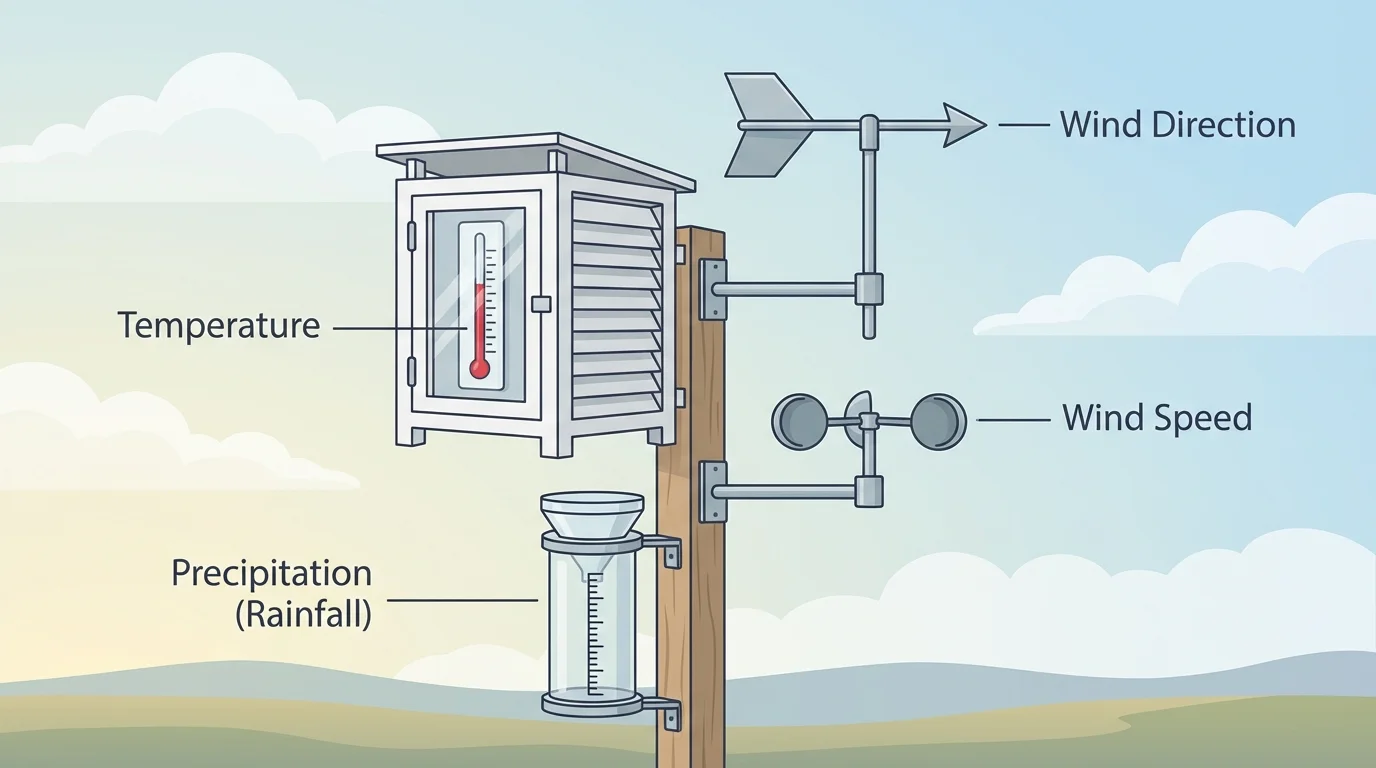
Scientists study weather carefully by using tools to measure what is happening in the air, as [Figure 1] shows. They do not just guess by looking outside. They record facts and numbers so they can compare one day with another.
A thermometer measures temperature. A rain gauge measures how much rain falls. A wind vane shows the direction the wind is blowing from. An anemometer measures how fast the wind is moving. Scientists may also use satellites in space, weather balloons, and radar to watch clouds and storms.
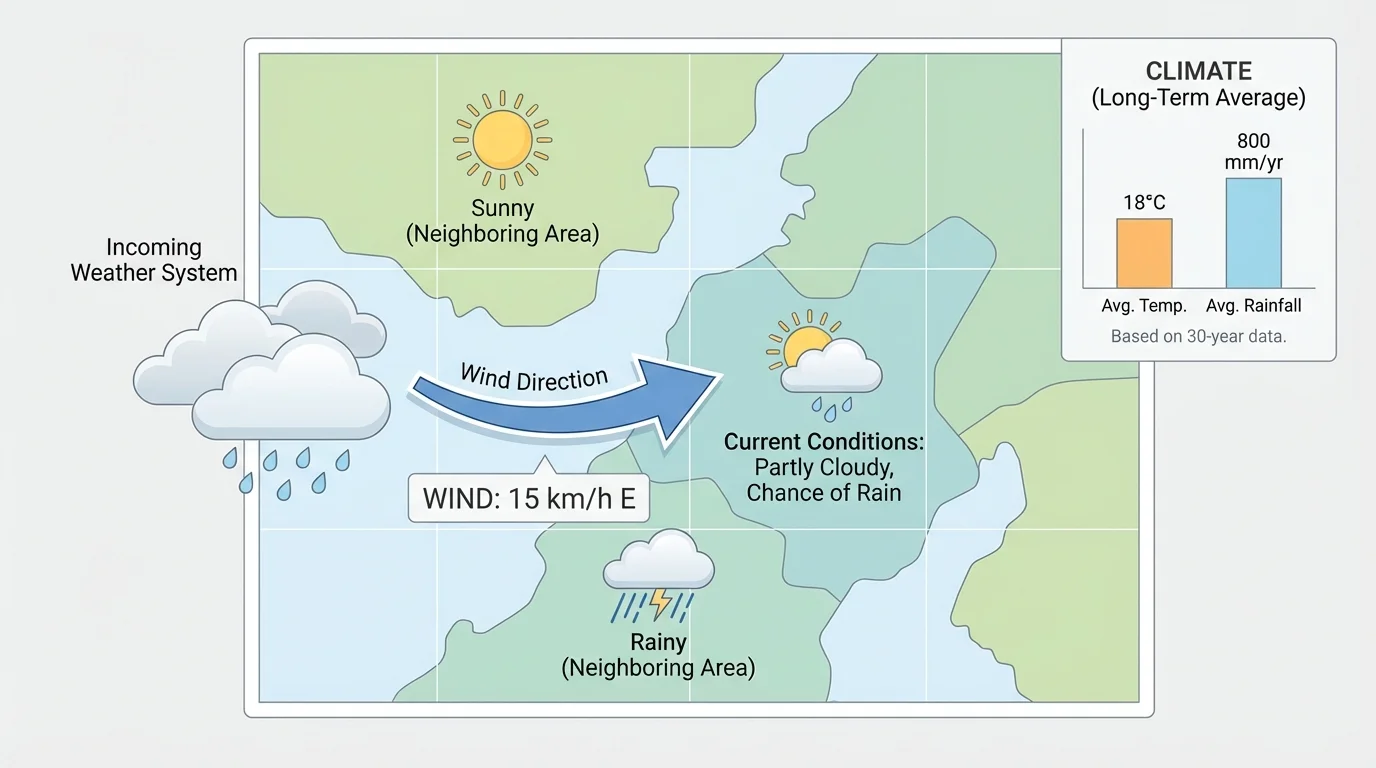
These observations are important because weather in one place can move to another place. If clouds and cool air are moving east, scientists can watch that movement and tell people farther east what weather may be coming next.
Scientists write down weather information over and over again. They may record the temperature in the morning, at noon, and in the evening. They may compare rainfall this week to rainfall last week. Keeping records helps them notice patterns.
A pattern is something that happens in a repeated or understandable way. For example, if afternoons in summer are often hotter than mornings, that is a pattern. If one area is rainy more often than another area nearby, that is also a pattern.
Scientists make a forecast by studying patterns across time and space, as [Figure 2] illustrates. They look at what the weather is doing now, what it did before in similar situations, and what is happening in nearby places.
Suppose dark clouds, falling air pressure, and strong winds often happen before a storm in a certain area. If scientists see those same signs again, they may predict another storm. They may also notice that rain in one town often reaches a nearby town a few hours later when the wind blows in that direction.
Forecasts are helpful, but they are not perfect. Weather is part of a huge Earth system, and many things affect it at once. A storm may slow down, speed up, or change direction. That is why forecasts sometimes change as scientists get new information.
People use weather forecasts every day. Families check if they need umbrellas. Pilots use forecasts to plan flights safely. Farmers watch forecasts to know when rain may help crops or when frost might damage plants. Knowing what is happening nearby can help predict what comes next.
Some weather satellites orbit high above Earth and take pictures of giant cloud systems. These pictures help scientists track storms over oceans where very few people live.
Weather forecasts may be for a few hours, a day, or several days. Usually, a forecast for tomorrow is more accurate than a forecast for many days later. That is because small changes in the air can grow into bigger differences over time.
Climate is not about one rainy day or one snowy week. Climate describes the range of weather conditions a place usually has over many years. It also includes how much those conditions change from year to year.
For example, a place may usually have warm summers and cool winters. Another place may usually be hot and dry most of the year. A third place may be cold most of the time, with lots of snow. These long-term patterns are climate.
Climate includes averages and variation. If a place usually gets about \(100 \textrm{ cm}\) of rain each year, that average helps describe the climate. But some years may be wetter and some may be drier. That difference from year to year is part of climate too.
Weather and climate work on different time scales
Weather tells what is happening now or soon. Climate tells what is typical over many years. A single cold day does not change a hot region's climate, just as one sunny day does not make a rainy place dry. Scientists need many years of observations to describe climate well.
A simple way to remember the difference is this: weather is what you get today, and climate is what you usually expect in that place over a long time.
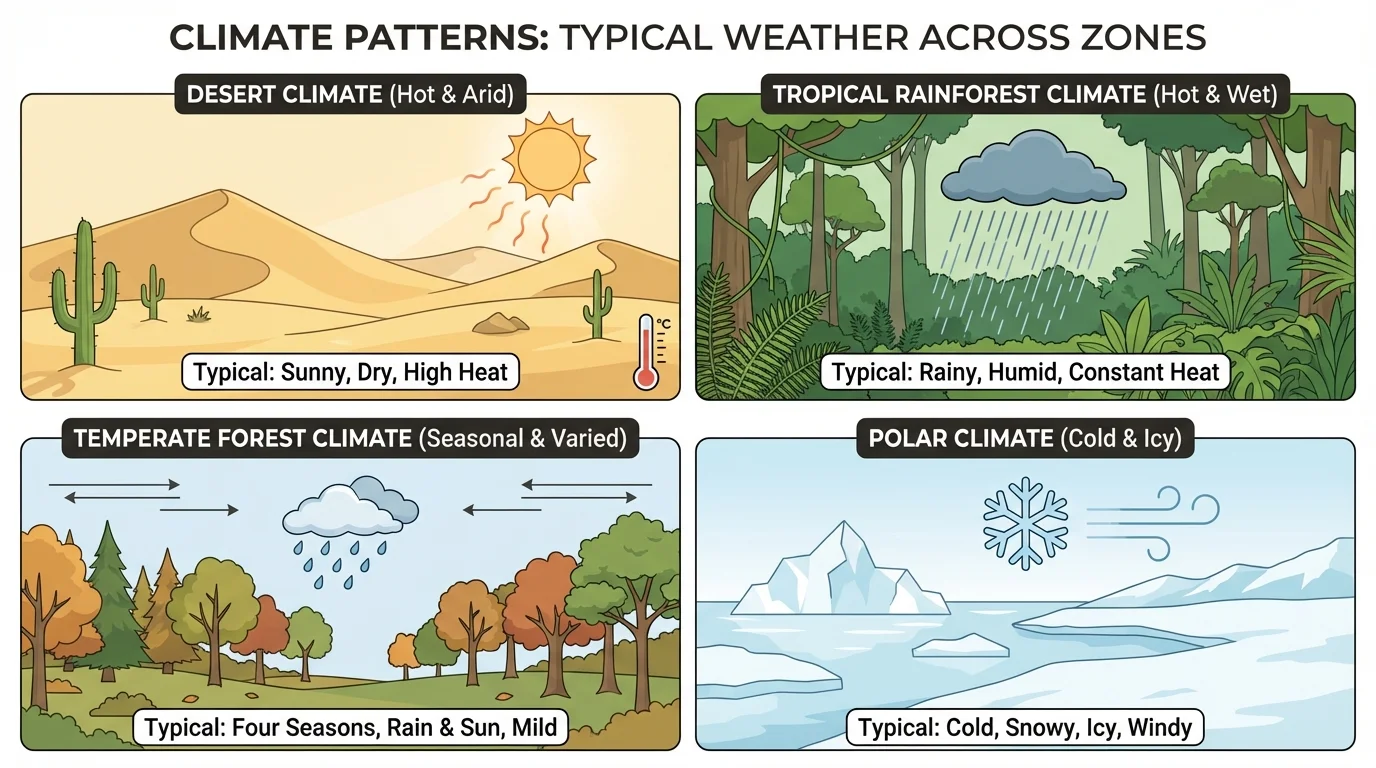
Places around Earth have different typical weather conditions, and [Figure 3] compares several of them. Some areas are usually hot and wet. Some are cold and dry. Some have four seasons with clear changes during the year.
A desert climate is usually dry, with very little rain. A tropical climate is warm and often rainy. A polar climate is very cold. A temperate climate may have warm summers, cool or cold winters, and moderate rainfall.
Location affects climate. Places near the equator usually get more direct sunlight during the year, so they are often warmer. Places near the poles get less direct sunlight, so they are usually colder. Mountains can also affect climate. Air moving up a mountain cools, and that can lead to more rain or snow on one side.
Large bodies of water, such as oceans and lakes, also affect climate. Water heats and cools more slowly than land. Because of that, places near oceans may have milder temperatures than places far inland. The same idea helps explain why beaches may feel cooler in summer afternoons and warmer in winter than inland areas.
The climate of a place helps decide which plants and animals can live there. Cacti can survive in dry deserts. Polar bears are adapted to cold polar regions. Tall trees and many insects live in warm, wet rainforests. The climate shapes habitats.
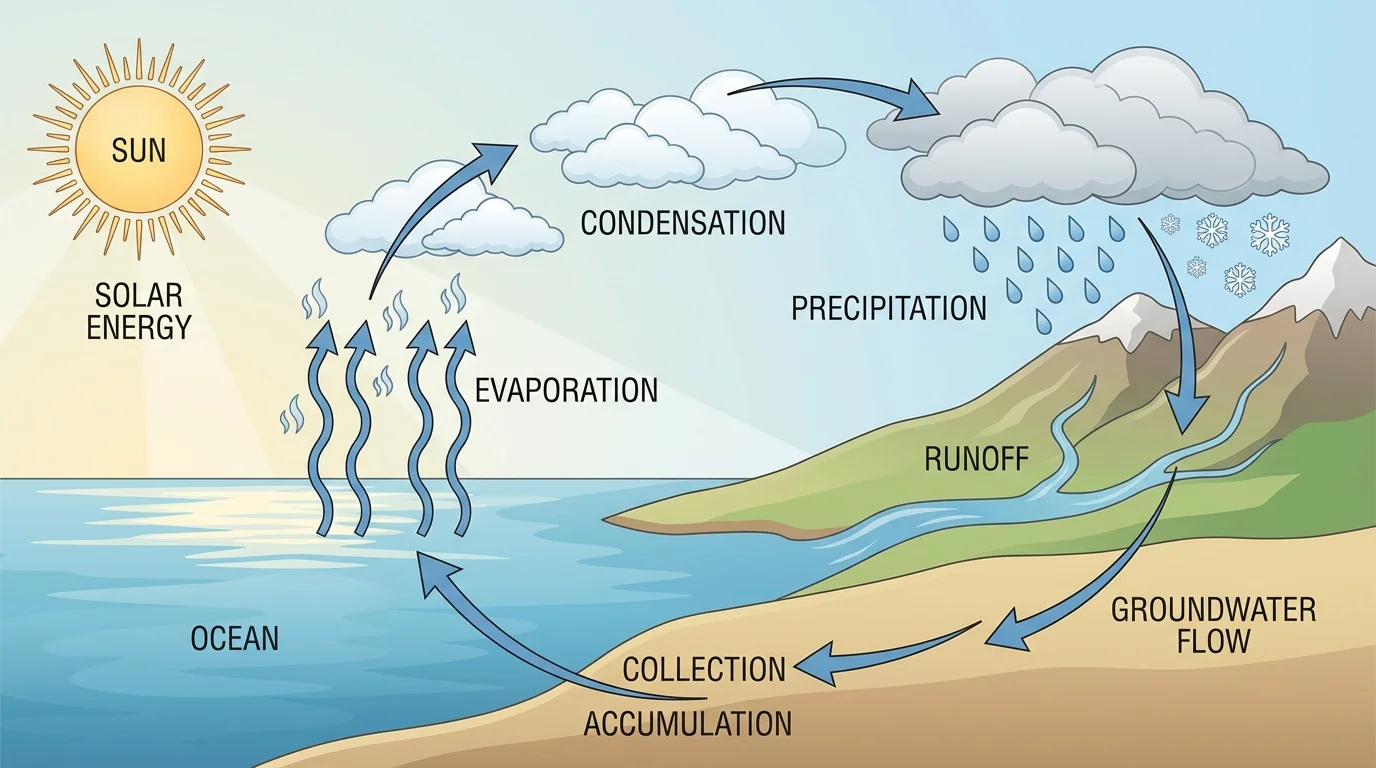
Weather happens because Earth's systems interact. The Sun provides energy, the air moves, water changes form, and land and water heat differently. Water moving through Earth's systems helps create clouds and rain, as [Figure 4] shows.
The Sun warms land and water. Some of that water changes into water vapor and rises into the air. This change is called evaporation. Higher in the sky, the water vapor cools and forms tiny drops that make clouds. This change is called condensation. When the drops grow heavy enough, they fall as rain or snow. That is precipitation.
This movement of water is part of the water cycle. Water can evaporate from oceans, lakes, rivers, and even puddles. It can return to Earth as rain, snow, sleet, or hail. Then it may flow into streams and oceans, soak into the ground, or evaporate again.
Air also moves because warm air and cool air behave differently. Warm air rises, and cooler air moves in to take its place. This movement helps form wind. Winds can push clouds and storms from one area to another.
Clouds matter because they can bring precipitation and also affect temperature. During the day, clouds can block some sunlight and keep places cooler. At night, clouds can help trap heat near Earth's surface. The water cycle connects directly to everyday weather because cloud formation and rainfall depend on water changing form.
Real-world example: Reading a week of temperatures
A scientist records afternoon temperatures for five days: \(24, 26, 25, 27, 28\).
Step 1: Add the temperatures.
\(24 + 26 + 25 + 27 + 28 = 130\)
Step 2: Divide by the number of days, which is \(5\).
\(130 \div 5 = 26\)
The average afternoon temperature is \(26^\circ\textrm{C}\). Scientists use averages like this when they study climate over long periods.
Earth's systems are always connected. Sunlight affects temperature. Temperature affects air movement. Air movement affects clouds and storms. Water in the air affects rain and snow. Land, mountains, and oceans change how all of these work in different places.
Weather and climate matter because they affect daily life and the natural world. People choose clothing based on weather. Schools and sports teams may change plans because of storms. Cities prepare for snowplows in cold regions and cooling centers in very hot weather.
Farmers depend on both weather and climate. Weather helps them decide when to plant, water, or harvest. Climate helps them choose which crops are likely to grow well in their region year after year.
Animals depend on weather and climate too. Some birds migrate when the seasons change. Some animals grow thicker fur before cold winter weather. Plants bloom at certain times because of changes in temperature, sunlight, and rainfall.
Earth has land, water, air, and living things that interact with one another. Weather and climate are part of these interactions because changes in one part of the system can affect another part.
Safety is another big reason to study weather. Forecasts can warn people about thunderstorms, hurricanes, blizzards, floods, and heat waves. These warnings give people time to prepare and protect themselves.
Scientists often compare data from different times and places. They may ask which city had more rain, which month was colder, or whether one year was warmer than another. Looking at numbers carefully helps them find patterns.
| Place | Typical Summer Weather | Typical Winter Weather | Climate Clue |
|---|---|---|---|
| Desert region | Hot and dry | Cool to mild, still dry | Very little rain |
| Tropical region | Warm and rainy | Warm, often rainy | Hot most of the year |
| Temperate region | Warm | Cool or cold | Seasons change clearly |
| Polar region | Cool or cold | Very cold | Cold most of the year |
Table 1. Examples of typical weather conditions that help describe different climates.
Suppose one town gets \(3 \textrm{ cm}\) of rain on Monday and \(1 \textrm{ cm}\) on Tuesday. The total rainfall for those two days is \(3 + 1 = 4\), so the town gets \(4 \textrm{ cm}\) altogether. Simple calculations help scientists organize weather records.
If another town gets \(0 \textrm{ cm}\) on Monday and \(5 \textrm{ cm}\) on Tuesday, do both towns get the same total over two days? No. The first town gets \(4 \textrm{ cm}\), and the second gets \(5 \textrm{ cm}\). Comparing totals helps show which place was wetter during that time.
Scientists do this kind of comparing on a much larger scale too. They study weather records from many years and many places. That is how they learn about climate patterns and how much those patterns vary over time.
