You cannot see energy itself, but you can see what it does. A drum can shake the air, a flashlight can brighten a dark corner, a warm bowl can heat a spoon, and a battery can make a bulb glow. These changes are clues. They are evidence that energy has moved from one place to another.
Scientists often look for evidence by making careful observations. If something starts moving, lights up, gets warmer, or makes a sound, that can be a sign that energy has been transferred. In this lesson, we will focus on four ways energy moves from place to place: by sound, by light, by heat, and by electric current.
Energy transfer means energy moves from one object or place to another. When one thing affects another thing, and we can observe a change, that change can be evidence that energy has moved. We do not need to measure exactly how much energy moved. We just need to notice what happened.
For example, when sunlight shines on a sidewalk, the sidewalk gets warmer. When someone speaks across a room, another person hears the sound. When you plug in a lamp and turn it on, the bulb glows. In each case, energy moved from one place to another.
Observation is something you notice using your senses or simple tools. Evidence is information that helps support an idea. In science, observations can become evidence when they help show that something happened, such as energy moving from one place to another.
A good scientist asks, "What changed?" If an object becomes warmer, brighter, louder, or starts moving, that change is important evidence. Those changes help us explain energy transfer in the world around us.
Sound begins when something vibrates, as [Figure 1] shows with a drum causing nearby materials to move. A vibration is a back-and-forth motion. When an object vibrates, it can make the material around it vibrate too. Usually that material is air, but sound can also travel through water and solids.
Think about a drum. When the drumhead is hit, it vibrates. Those vibrations move through the air to your ears. You hear the sound because energy moved from the drum to the air and then to your ears. You may not see the sound moving, but you can observe its effects.
One way to gather evidence is to watch what sound does. If you place a few grains of rice on stretched plastic wrap over a bowl and then make a loud sound nearby, the rice may jump or shake. The rice moves because sound energy from the source reaches the plastic wrap and makes it vibrate too.
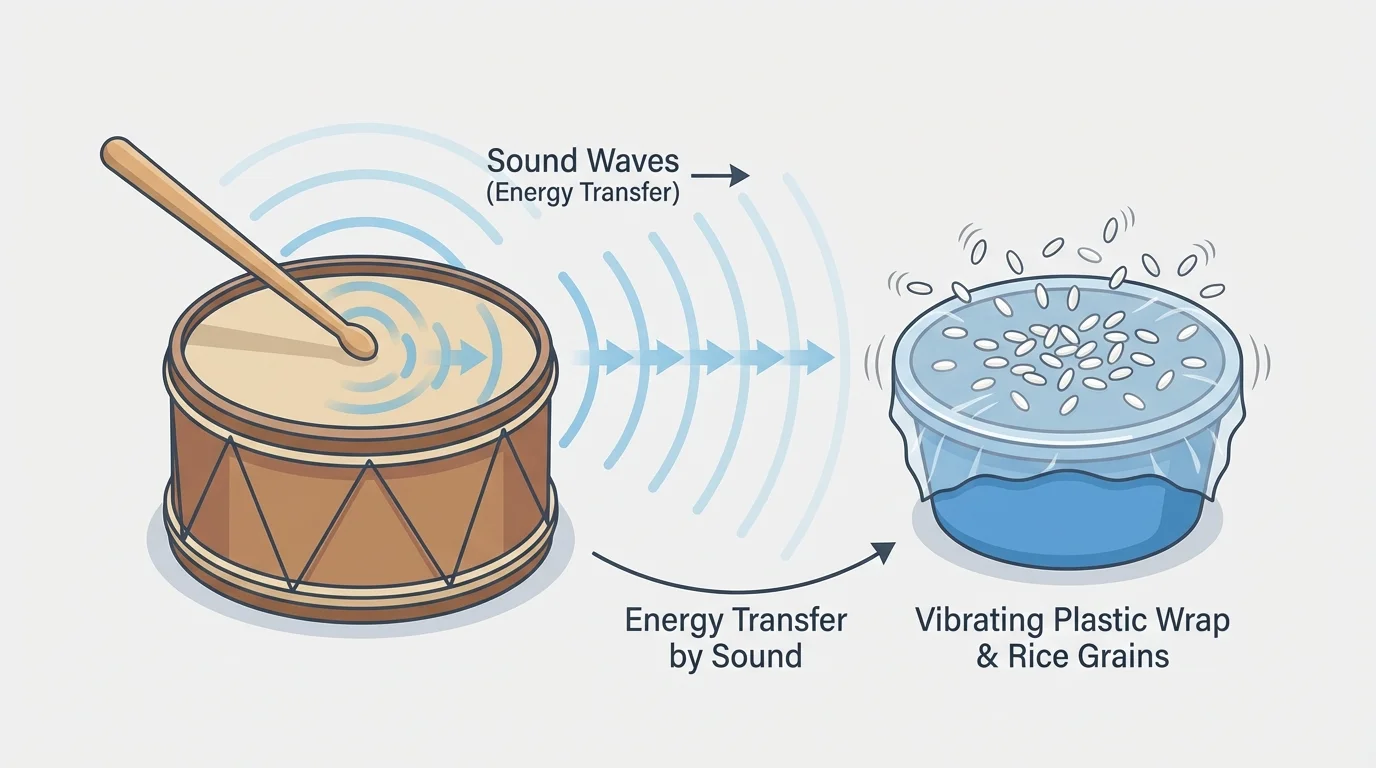
Another example is a speaker playing music. If you lightly touch the speaker, you may feel it buzzing. That buzzing is evidence of vibrations. If paper bits near the speaker move, that is another clue that sound energy has traveled from the speaker to the paper through the air.
Observing sound energy
Step 1: Notice the source of sound.
A bell rings, a drum is struck, or a speaker plays music.
Step 2: Look for a change somewhere else.
You hear the sound, see rice grains shake, or feel a surface vibrate.
Step 3: Use the change as evidence.
The new motion or sound gives evidence that energy moved from the source to another place.
Later, when you compare sound to the other kinds of energy transfer, remember the drum example in [Figure 1]. The important clue is motion caused by vibrations.
Light carries energy from a source to another place. Sources of light include the Sun, flashlights, lamps, candles, and glowing screens. When light reaches an object, that object can become visible or warmer.
If you walk into a dark room and switch on a flashlight, as [Figure 2] shows, objects that were hard to see become easy to see. That change is evidence that light energy traveled from the flashlight to the objects and then to your eyes. Light helps information travel too, because it lets your eyes detect what is around you.
Light can also affect materials. A black shirt left in the sunshine often feels warmer than it did before. Sunlight has transferred energy to the shirt. A solar garden light is another example from daily life. During the day, sunlight reaches the light and provides energy that helps it work later.
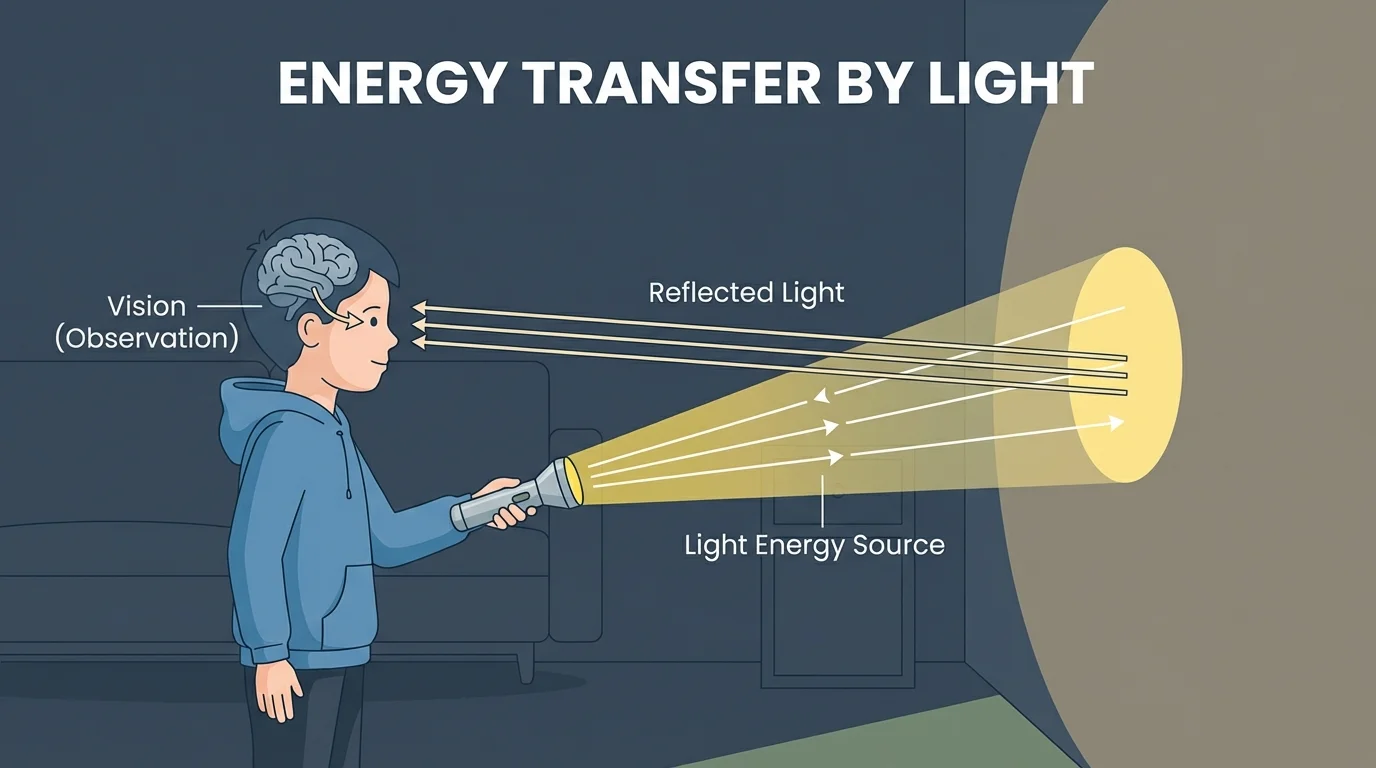
You can observe light energy in many school situations. A projector sends light across the classroom to a screen. The screen becomes bright enough for students to read. A reading lamp sends light onto a book page. Without that energy transfer, the page would stay dim.
The Sun is so far away, yet its light still reaches Earth and warms land, water, and air. The warmth you feel on a sunny day is evidence that energy traveled a very long distance through light.
The flashlight scene in [Figure 2] also helps explain why we can see objects that do not make their own light. Light from a source reaches the object first, and then the object sends light to our eyes.
Heat is energy moving from a warmer place to a cooler place. When two objects have different temperatures, energy can move between them. The warmer object loses some energy, and the cooler object gains some energy.
You observe heat transfer all the time. As [Figure 3] shows, a metal spoon in a bowl of hot soup soon becomes warm. The soup is warmer than the spoon, so energy moves into the spoon. A cold hand wrapped around a warm mug also receives energy from the mug. You feel this as warmth.
Heat can move when objects touch. It can also move through air. If you stand near an oven, campfire, or heater, you feel warmer even if you are not touching it. The important evidence is the change in temperature or the feeling of warmth.
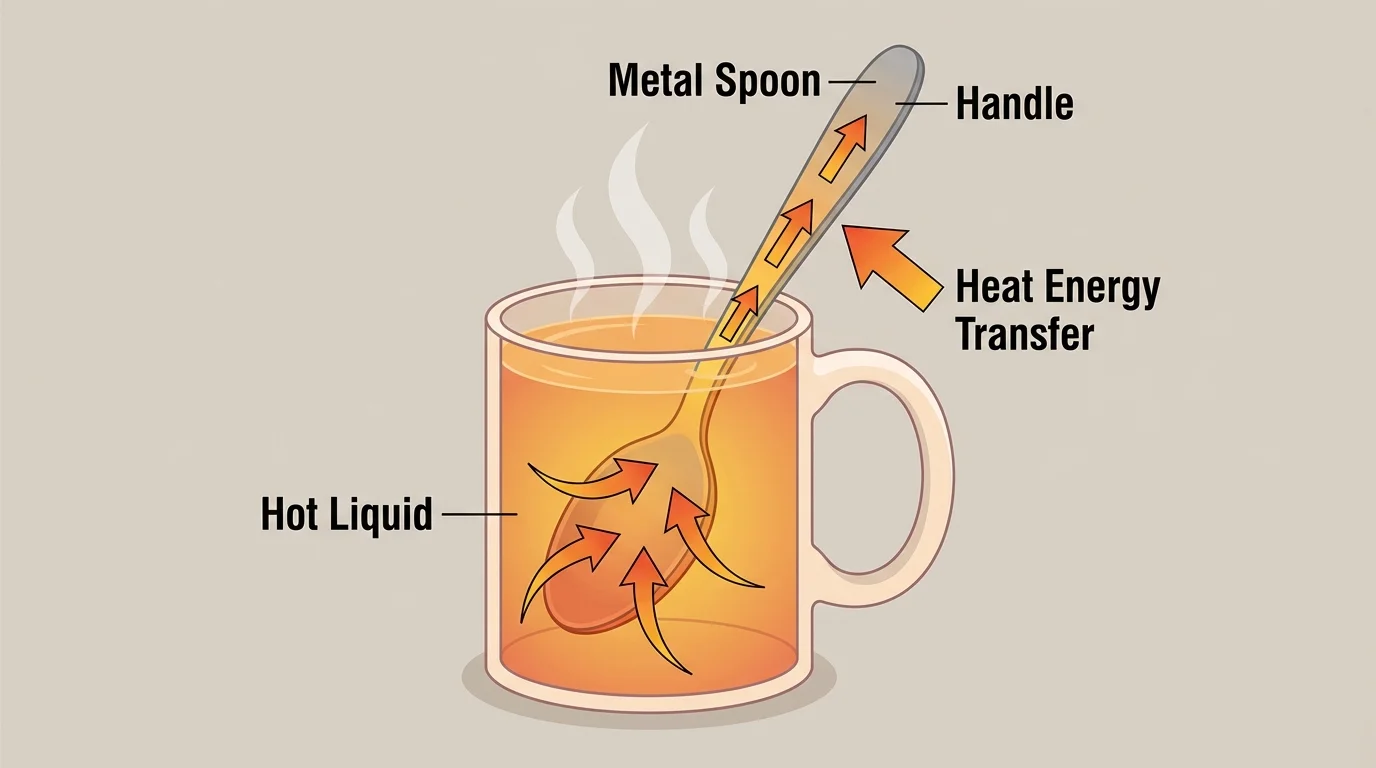
Cooking is full of heat transfer examples. A pan on a stove gets hot. Then the pan transfers energy to the food. Butter melts on warm toast because energy moves from the toast to the butter. Ice cream melts in the sun because energy from the warmer surroundings reaches the colder ice cream.
In winter, you may notice that a sunny window feels warmer than a shady wall. In summer, playground equipment can become hot in sunlight. These observations are useful evidence that energy has moved by heat and light. The mug and spoon in [Figure 3] make this idea easier to picture because the warmer object causes a cooler object to warm up.
How we know heat moved
We know heat has moved when something becomes warmer or cooler. A mitten dries near a heater, chocolate softens in your hand, or a cold drink makes the outside of the cup feel cool. These changes are signs that energy is moving between objects and their surroundings.
Scientists often use thermometers for careful observations, but your senses can give clues too. Feeling warmth, seeing melting, or noticing steam can all help show that heat energy moved from one place to another.
An electric current can move energy through a path called a circuit, as [Figure 4] illustrates. A circuit usually includes an energy source, such as a battery, and a device, such as a bulb, buzzer, or motor. When the path is complete, energy can move through the circuit to the device.
If you connect a battery, wires, and a small bulb correctly, the bulb lights up. The glowing bulb is evidence that energy moved through the electric current from the battery to the bulb. If the path is broken, the bulb goes out because the energy cannot move through the whole circuit.
Electric current can also make a fan spin, a toy car move, or a buzzer make sound. In each case, the change you observe gives evidence that energy has traveled from the source to another place through the circuit.
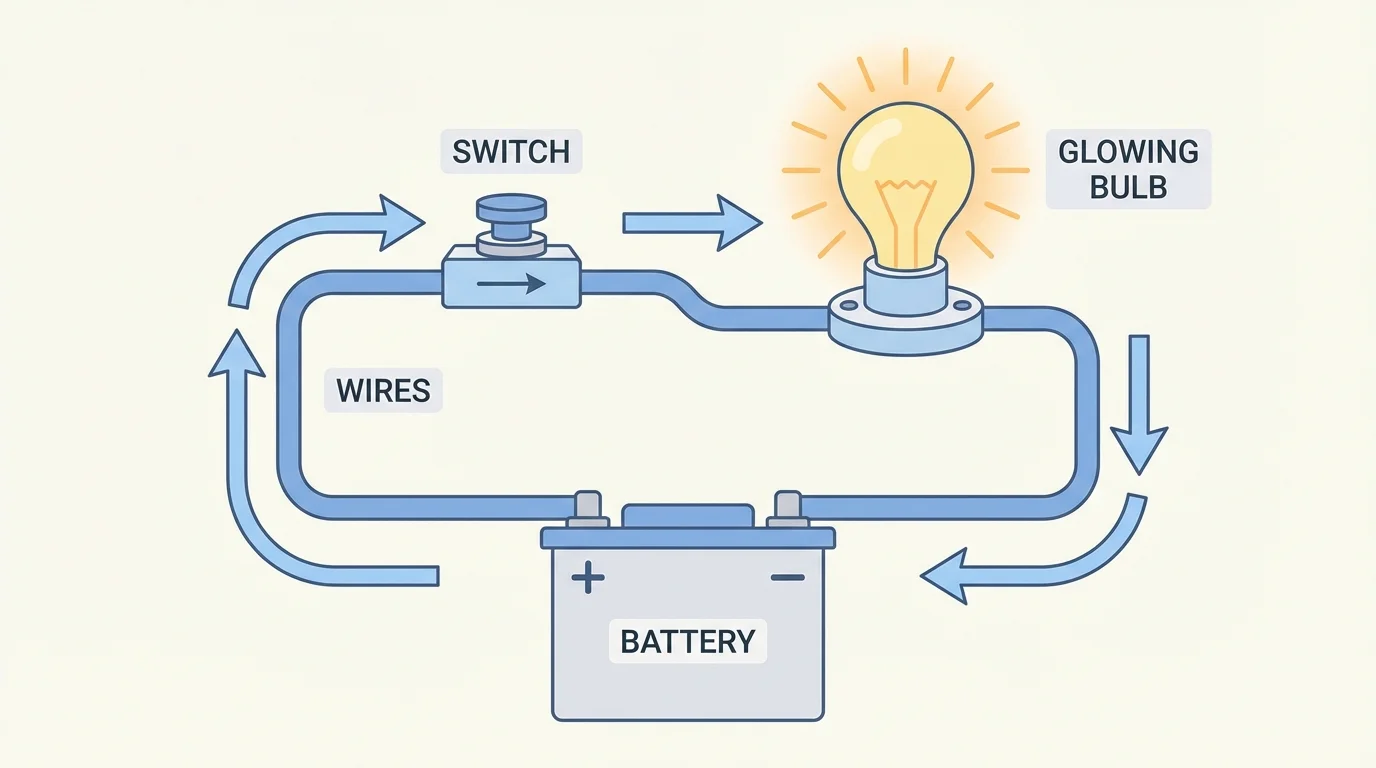
Your home is full of examples. A lamp turns on when current moves through its circuit. A toaster warms bread using electric current. A doorbell makes sound because electric current carries energy to it. A phone charger transfers energy to the phone through electric current in the charging system.
Using a simple circuit as evidence
Step 1: Build or observe a complete path.
The battery, wires, and bulb are connected in a loop.
Step 2: Look for a result.
The bulb glows, a motor spins, or a buzzer sounds.
Step 3: Explain the evidence.
The visible or audible change shows that energy moved through the circuit by means of electric current.
When you think about electric devices, return to the circuit in [Figure 4]. The strongest clue is that something in the circuit changes: it lights, moves, or makes sound.
These four kinds of energy transfer are different, but they all have something in common: we know energy moved because we can observe a change. We may hear, see, feel, or notice motion. Those observations become evidence.
| Way energy moves | Common source | What you can observe | Example |
|---|---|---|---|
| Sound | Drum, bell, speaker | Heard sound, shaking, vibration | Rice grains jump near a loud sound |
| Light | Sun, lamp, flashlight | Brightness, visibility, warming | Flashlight brightens a dark room |
| Heat | Hot soup, stove, sunlight | Warmer object, melting, drying | Spoon becomes warm in soup |
| Electric current | Battery, outlet | Bulb glows, motor spins, buzzer sounds | Battery lights a bulb |
Table 1. Examples of how energy moves by sound, light, heat, and electric current, and the observations that provide evidence.
Some situations include more than one kind of energy transfer at the same time. A lamp uses electric current, gives off light, and may also become warm. A speaker uses electric current and produces sound. A campfire gives off light and heat. Even when more than one kind happens together, you can still observe evidence for each one.
Good observations are careful and specific. Instead of saying "something happened," a scientist might say, "The bulb glowed," "The spoon felt warmer," or "The rice grains moved." Specific observations are stronger evidence because they clearly describe the change.
Scientists also compare before and after. Before the flashlight was switched on, the room was dark. After it was switched on, the wall was bright. Before the soup touched the spoon, the spoon was cool. After a short time, the spoon was warm. Before the circuit was complete, the bulb was off. After the switch closed the circuit, the bulb was on.
Cause and effect is an important science idea. If one event causes another event, the second event is an effect. In energy transfer, the source is often the cause, and the observed change is the effect.
Our senses are useful, but simple tools can help too. Eyes can detect light, ears can detect sound, skin can sense warmth, and tools like thermometers can help notice temperature changes. The main goal is still the same: use observations to support the idea that energy moved.
Understanding energy transfer helps people design useful things. Engineers build insulated cups to slow heat transfer so drinks stay warm or cold longer. Builders place windows carefully so sunlight can brighten rooms. Musicians use speakers so sound energy reaches an audience. Electricians design circuits that safely carry energy to lights and machines.
Nature also gives many examples. Sunlight warms Earth's surface. Birds hear sounds made by other birds. Warm rocks heat the air above them. Tiny electric circuits inside devices help weather stations, clocks, and communication tools work.
Bats use sound in a powerful way. They make sounds and detect the returning echoes, which gives them evidence about where objects are in the dark.
At school, energy transfer helps every day. Classroom lights brighten the room. A computer screen sends light to your eyes. The bell uses sound energy to signal time. A cafeteria oven transfers heat to food. Chargers use electric current to power devices.
Because energy transfer can be useful and powerful, safety matters. Very loud sounds can hurt hearing, so people wear ear protection around strong noise. Bright light should not be stared at directly, especially sunlight. Hot objects can burn skin, so oven mitts and careful handling are important. Electric current should be used with proper materials and adult supervision.
These safety rules make sense when you understand energy transfer. If energy can move from place to place, it can help us, but it can also harm us if we are careless. Observing changes helps us learn, but using energy wisely helps us stay safe.
