Why does a fast soccer ball travel farther after a kick than a gently tapped one? Why does a bicycle feel much harder to stop when it is moving quickly? These are everyday clues that speed matters. When objects move faster, they can push harder, knock things over more easily, and make bigger changes. Scientists use these kinds of clues as evidence to explain what is happening.
In science, we learn not just by watching something happen, but by asking what the observation tells us. When we see a toy car moving quickly and crashing into a row of blocks, we may notice that more blocks fall over than when the car moves slowly. That observation helps us build an explanation: the faster-moving car has more energy.
All around you, moving objects show signs of energy. A slowly tossed ball may land softly in your hands, while a quickly thrown ball is much harder to catch. A skateboard rolling very slowly may stop when it touches a crack, but a faster skateboard often keeps going. A leaf drifting in a light breeze moves gently, while strong wind can swing branches and move loose objects across the ground.
These examples are important because we cannot see energy directly with our eyes. Instead, we notice what energy does. We look for changes: things moving, bending, falling, or stopping. If one moving object causes a bigger change than another similar object, that can be evidence that it has more energy.
You already know that a force is a push or a pull, and that objects can move in different ways. This lesson connects motion to energy by focusing on one simple pattern: when the same kind of object moves faster, it has more energy.
Scientists often compare two situations that are almost the same except for one thing. Here, we compare objects that are similar, but one is moving more slowly and one is moving more quickly. If the faster one causes a bigger effect again and again, that repeated pattern is strong evidence.
Energy is the ability to cause change. An object can have energy in different ways. In this lesson, we focus on the energy an object has because it is moving.
Energy is the ability to cause change.
Kinetic energy is the energy an object has because it is moving.
Speed tells how fast something is moving.
When a ball is sitting still on the ground, it is not moving, so it does not have kinetic energy from motion. When the ball starts rolling, it has kinetic energy. If it rolls faster, it has more kinetic energy. We do not need exact numbers to understand this idea. We can use careful observations instead.
Think about pushing a toy car across the floor. A tiny push makes the car move slowly. A stronger push can make it move faster. The faster car is more likely to bump a pencil out of the way or tip over a small block. That bigger effect is evidence that the car has more energy while it is moving.
How speed and energy are connected
For objects of the same kind, speed changes how much kinetic energy they have. If one object is moving faster than another similar object, the faster one has more kinetic energy and can usually cause a bigger change when it hits, pushes, or moves something else.
It is important to keep the comparison fair. If you compare a marble and a bowling ball, many things are different. But if you compare the same marble rolling slowly and then rolling quickly, speed is the main difference. That makes the evidence easier to understand.
Scientists do more than make guesses. They use observations and test results to support an explanation. A good explanation often has three parts: a claim, evidence, and reasoning.
The claim is what you say is true. The evidence is what you observed. The reasoning tells how the evidence supports the claim. For this topic, a claim might be: "The faster-moving object has more energy." Evidence might be: "The faster toy car knocked down more blocks." Reasoning might be: "Objects with more kinetic energy can cause bigger changes."
Building a scientific explanation
Step 1: Make a claim.
The fast ball has more energy than the slow ball.
Step 2: Add evidence.
When both balls rolled into blocks, the fast ball knocked over more blocks.
Step 3: Explain the reasoning.
A faster-moving object has more kinetic energy, so it can cause a bigger change when it hits something.
This way of thinking helps you move from "I saw it happen" to "I can explain why it happened." In science, that is a big step.
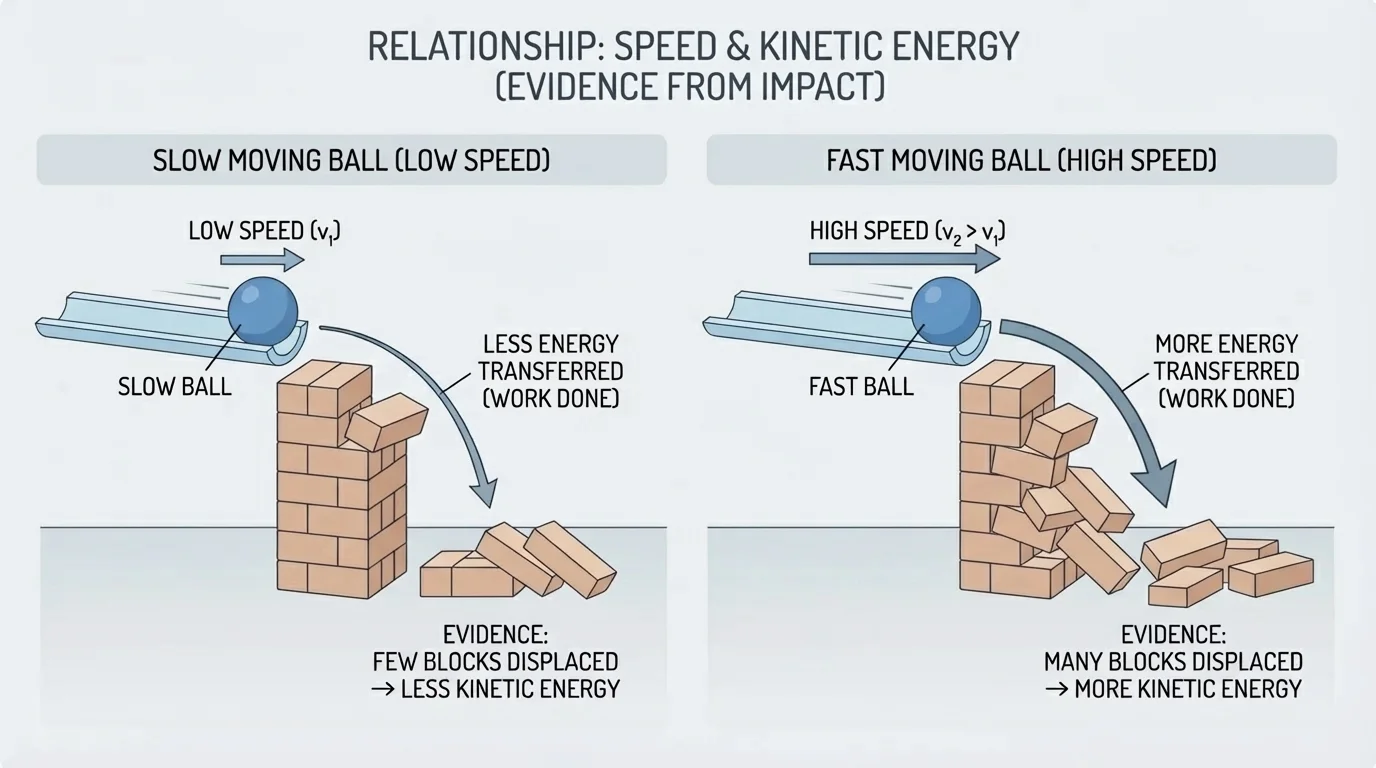
[Figure 1] One clear pattern appears in many tests with rolling balls and blocks: when the same kind of object moves faster, it usually causes a bigger effect. A slowly moving ball may only nudge one block. A faster-moving ball may knock down several blocks or push them farther.
The same pattern happens with toy cars. If the same toy car rolls slowly into a cup, the cup may move a little. If the car rolls faster into the same cup, the cup may slide farther. These effects help us explain that the faster-moving car has more energy.
We can also think about playground motion. A swing moving gently is easy to stop with your feet. A swing moving fast is much harder to stop. That is another clue that faster motion means more energy.
Sports give us many examples too. A baseball tossed lightly reaches the catcher softly. The same baseball thrown much faster reaches the glove with a much greater impact. A basketball bounced more quickly has more kinetic energy than one bounced gently. In each case, the object is moving, and the faster motion is connected to greater energy.
Later, when you think again about the blocks in [Figure 1], notice that the important evidence is not just that the ball moved. It is that the faster ball caused a larger change. That larger change helps support the explanation about energy.
A meteor entering Earth's atmosphere moves extremely fast, and that great speed gives it tremendous kinetic energy. Even small objects in space can make big changes because of how fast they move.
Wind is moving air, so it can show this idea too. Slow wind may only flutter a flag. Faster wind may bend tree branches or move outdoor furniture. The air is still the same kind of matter, but when it moves faster, it can cause bigger changes.
This idea matters in daily life. Drivers slow down near schools, crosswalks, and neighborhoods because faster-moving cars have more energy and are harder to stop safely. Bicyclists wear helmets because falls or crashes at higher speeds can cause bigger impacts. On playgrounds, children are taught to be careful around fast-moving swings, scooters, and balls for the same reason.
Engineers and designers use this idea too. They make seat belts, helmets, pads, and bumpers to help reduce harm during fast motion. These safety tools do not remove the fact that faster objects have more energy, but they help manage what happens when that energy causes a sudden change.
Everyday evidence of speed and energy
A student rolls the same toy truck across the floor in two different ways. In the first try, the truck moves slowly and taps a sponge, barely moving it. In the second try, the truck moves faster and pushes the sponge much farther. The truck in the second try has more kinetic energy because it is moving faster.
Even in nature, animals use speed and energy. A hawk diving quickly toward the ground has more kinetic energy than when it is gliding slowly. A river flowing rapidly can move sticks and rocks more easily than a slow-moving stream. These examples show the same pattern in living things and in the natural world.
[Figure 2] A simple investigation can give strong evidence with a toy car and a ramp. If the same car starts from a low place on the ramp, it rolls down more slowly. If it starts from a higher place, it rolls down faster. Then you can compare what happens when it reaches the same target, such as a cup, block, or small stack of dominoes.
To make the test fair, use the same car, same ramp, same floor, and same target each time. Change only where the car begins on the ramp. That way, the speed is the important difference in the comparison.
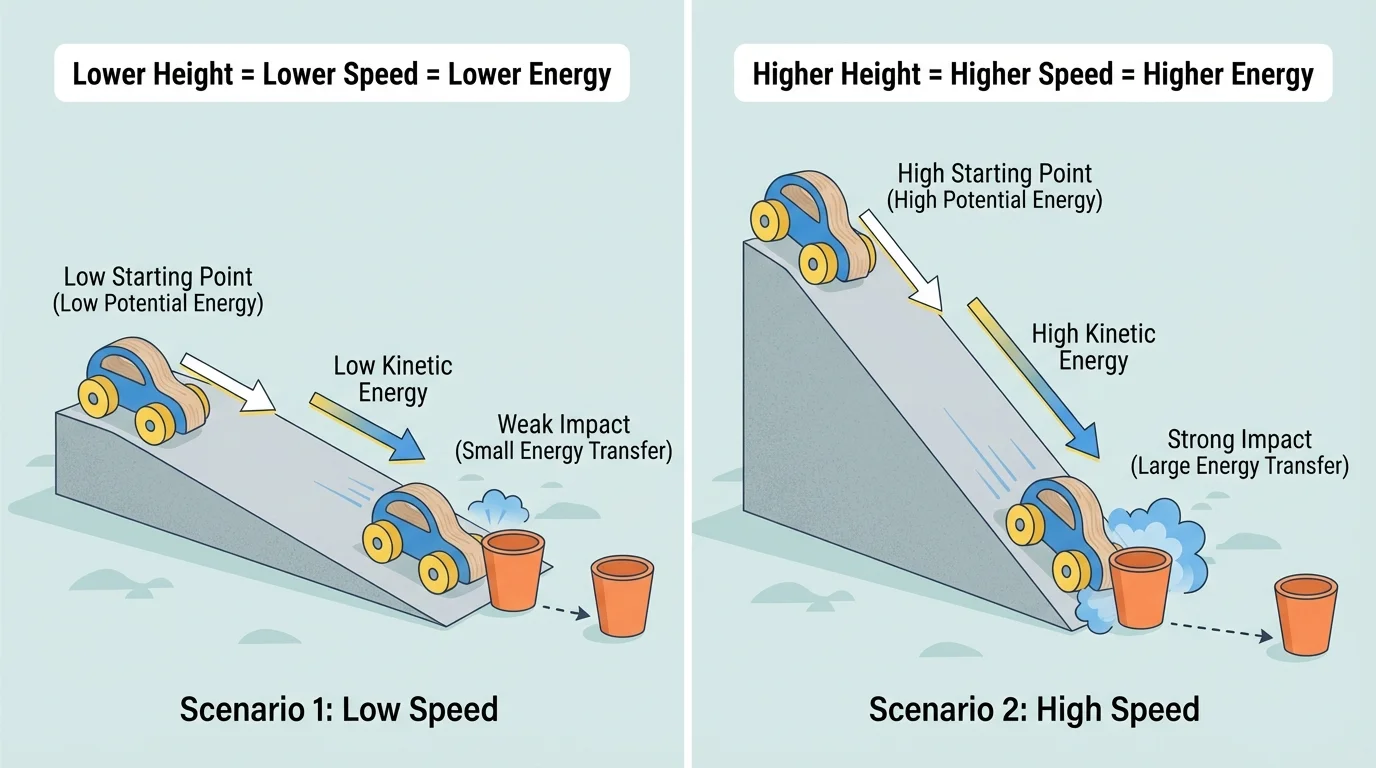
When students try this kind of test, they often see that the faster-moving car pushes the target farther or knocks over more pieces. This repeated result is evidence that the faster-moving car has more energy. No exact measurement is needed. The size of the change is enough to support the explanation.
You could also compare two rolls of the same ball across the same surface. One roll is gentle and slow. The other is stronger and faster. If the faster roll moves a line of blocks farther, that supports the same idea. Good evidence comes from repeated tests that show the same pattern.
What makes evidence strong?
Evidence is stronger when the test is fair, the observations are clear, and the same pattern happens more than once. If a faster-moving object repeatedly causes a bigger effect than a slower-moving version of the same object, that is strong support for the explanation that faster motion means more kinetic energy.
When you think back to the ramp setup in [Figure 2], notice how useful it is that only one main factor changes. Because the toy car and target stay the same, students can connect the stronger impact to greater speed.
Speed is not the only thing that matters in motion. A heavier object can also cause a bigger change than a lighter object, even if they are moving at the same speed. But in this lesson, we focus on one relationship: when the same kind of object moves faster, it has more energy.
This is important because science explanations often focus on one variable at a time. If too many things change at once, it becomes hard to tell what caused the result. That is why fair comparisons are so helpful.
| Situation | What stays the same | What changes | What we learn |
|---|---|---|---|
| Same toy car on same floor | Car and surface | Speed | Faster car has more kinetic energy |
| Same ball and same blocks | Ball and target | Speed | Faster ball causes a bigger change |
| Different objects | Very little | Mass and speed | Harder to tell which factor matters most |
Table 1. Fair and unfair comparisons when using evidence to explain how speed relates to energy.
So if someone asks, "Does speed matter?" the answer is yes. If someone asks, "Is speed the only thing that matters?" the answer is no. Scientists can hold both ideas at the same time by making careful comparisons.
When you explain this idea, try to use clear scientific language. You might say, "My evidence shows that the faster object caused a bigger effect." Then add, "This supports the explanation that faster-moving objects have more kinetic energy."
Here are examples of strong science sentences: "The fast marble moved the cup farther than the slow marble." "The faster ball knocked over more blocks." "Because the objects were the same except for speed, the evidence supports the idea that faster motion means more energy." These statements are stronger than just saying, "It went faster," because they connect observation to explanation.
"In science, observations become powerful when they help explain a pattern."
You do not need complicated formulas to understand this topic. What matters most is seeing the pattern, comparing carefully, and using evidence to support a clear explanation. When the same kind of object moves faster, it has more kinetic energy and can usually cause a bigger change.
