A soccer ball bounces off a wall. A bike tire hits a rock. Two bumper cars crash and spin away. These moments happen fast, but a lot is going on. When objects collide, they push on each other, their motion changes, and energy moves from one place or form to another. Collisions are not just noisy bumps. They are clues that help us understand how the world works.
Scientists study collisions by asking questions such as: What will happen when these objects hit? Will they bounce, stop, or change direction? Will the collision make sound? Will one object squish or bend? By asking questions and making predictions, we can learn how energy is transferred and conserved when objects touch.
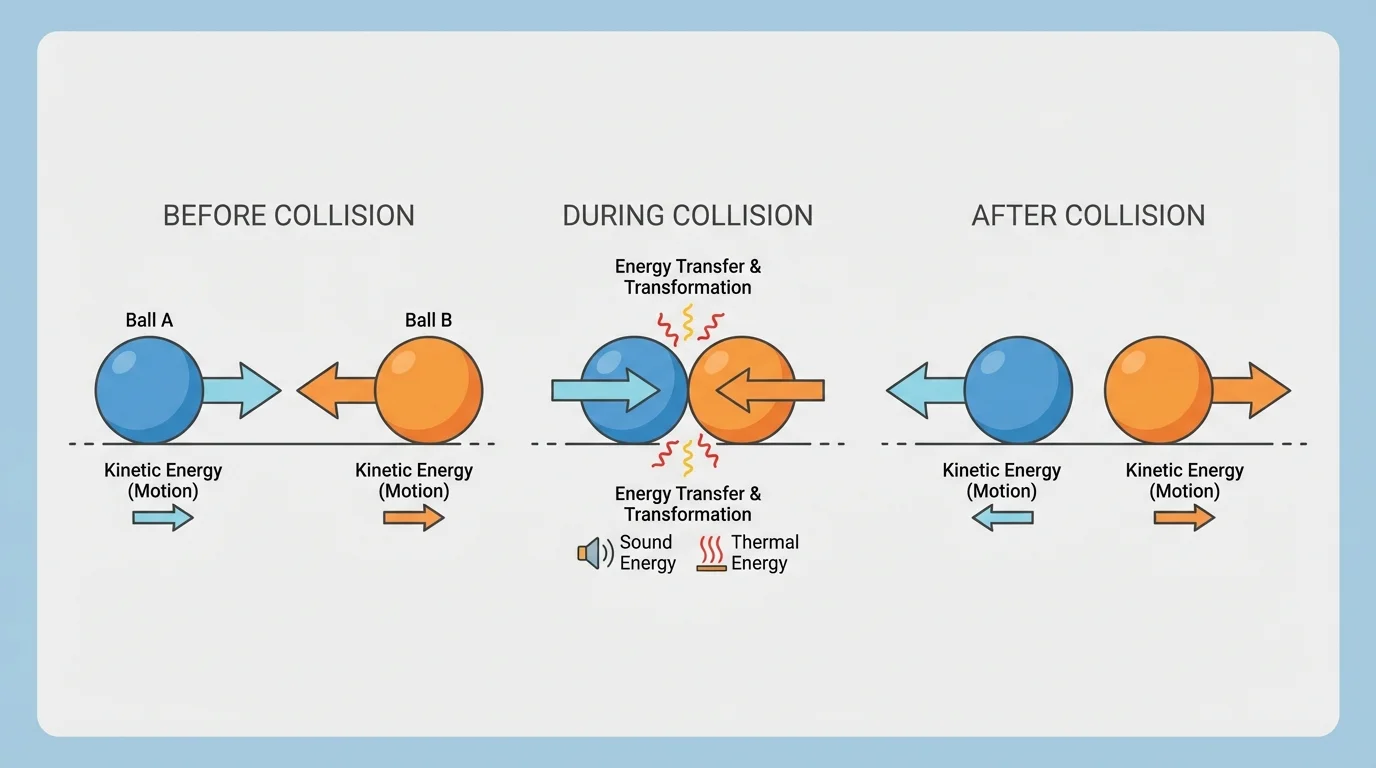
A collision happens when two objects touch and push on each other. The push between touching objects is a contact force. During the short time the objects are touching, each object can change the other object's motion, as [Figure 1] illustrates with two rolling balls meeting and moving differently after impact.
If a moving ball hits a still ball, the moving ball may slow down, and the still ball may start moving. If a toy car hits a wall, the car may stop or bounce back. If one person gently bumps another while skating, both skaters may glide in new directions. In every case, the collision involves a push between objects.
Motion can change in several ways during a collision. An object can speed up, slow down, stop, start moving, or change direction. These changes tell us that energy has been transferred. We do not need to measure exact amounts to notice that something important happened.
One important idea is that both objects matter. Sometimes people think only the moving object changes, but the object it hits can change too. A bat and a baseball both push on each other. A foot and a soccer ball both push on each other. The results depend on the objects and how they collide.
Collision is when objects touch and affect each other's motion.
Contact force is a push or pull that happens when objects are touching.
Motion means how an object moves, including how fast it goes and what direction it travels.
Even when a collision seems simple, it may include several changes at once. A ball can slow down, make a sound, warm up a tiny bit, and bounce in a new direction. That is why collisions are so useful for studying energy.
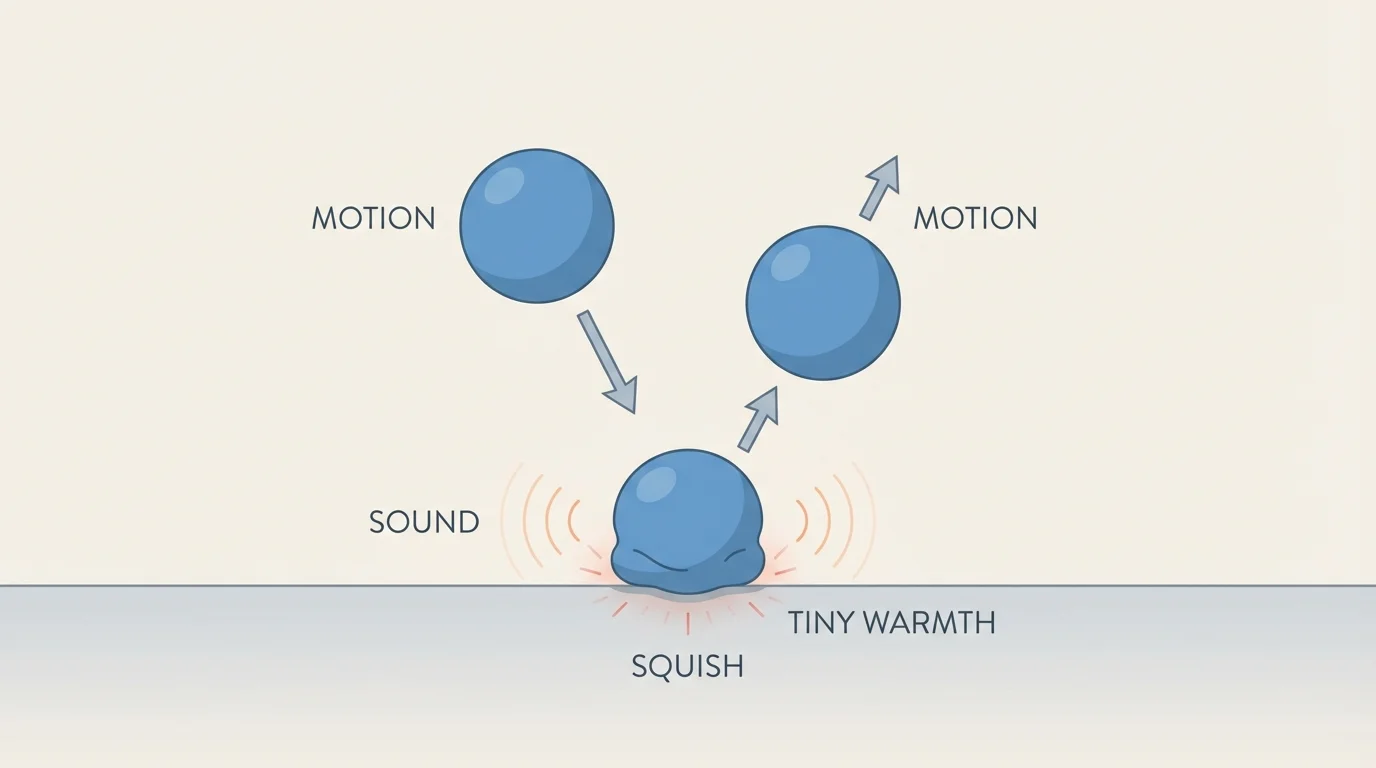
A moving object has kinetic energy, which is energy of motion. When a collision happens, that energy does not simply disappear. Instead, as [Figure 2] shows with a ball hitting the floor, energy can be transferred to another object or changed into other forms such as sound, a tiny bit of warmth, or a change in shape.
Think about a rubber ball hitting the floor. Before the collision, the ball is moving. At impact, the ball squishes for a moment. Some energy is stored in the squished shape. Then the ball pushes back and rises again. At the same time, the collision makes sound, and a little energy becomes thermal energy, which is related to warmth.
Now think about a lump of clay dropped on the floor. The clay hits and sticks. It changes shape and does not bounce much. The energy of motion changes more into shape change, sound, and thermal energy, and less into bouncing back up.
These examples show that the kind of material matters. A rubber ball is bouncy, so it gives back more motion after the collision. Clay is not very bouncy, so more of the motion changes into other forms.
Another useful idea is energy transfer. Energy transfer means energy moves from one object to another or from one form to another. When one billiard ball hits another, kinetic energy transfers from the first ball to the second. When a drumstick hits a drum, some kinetic energy transfers into sound.
Energy can also be temporarily stored in an object that bends, stretches, or squishes. A trampoline mat stretches when someone lands on it. Then it pushes back upward. This stored energy is called elastic energy. In collisions, elastic energy helps explain why some objects bounce.
Energy is conserved, but it can change form. During a collision, the total energy is not lost. It moves and changes. Some stays as motion, some may become sound, some may become thermal energy, and some may be stored for a moment in bent or squished materials.
This is why a super-bouncy ball and a beanbag act so differently. The super-bouncy ball keeps more of its motion after impact. The beanbag stops quickly because much of its motion changes into shape change, sound, and thermal energy.
Good science begins with clear questions. When studying collisions, helpful questions focus on things we can observe. For example: Which object will move after the collision? Will the object bounce higher, lower, or not at all? Will the objects stick together or separate? Will the collision be loud or quiet?
A prediction is a statement about what you think will happen and why. A strong prediction includes a reason. For example, "I predict the rubber ball will bounce off the tile because rubber is bouncy and tile is hard." Another prediction could be, "I predict the toy car will stop sooner when it hits the pillow because the pillow squishes and absorbs more of the car's motion energy."
Scientists also ask comparison questions. What changes if the object moves faster? What changes if the object is heavier? What changes if the surface is soft instead of hard? These questions help us look for patterns.
Prediction example: rolling ball and block
Step 1: Ask a question.
What will happen when a rolling ball hits a stack of light blocks?
Step 2: Use what is known.
The ball has kinetic energy because it is moving. The blocks are light, so they may be easier to move.
Step 3: Make a prediction.
The ball will knock some blocks over, and the blocks will move because energy transfers from the ball to the blocks.
When we make predictions, we do not guess wildly. We use what we know about materials, motion, and energy. Then we compare the prediction with what we actually observe.
Several factors can change what happens in a collision. One factor is how fast an object is moving before it hits. In general, a faster-moving object often causes a bigger change in motion than the same object moving slowly. Another factor is how much matter an object has. In everyday life, heavier objects are often harder to stop or move.
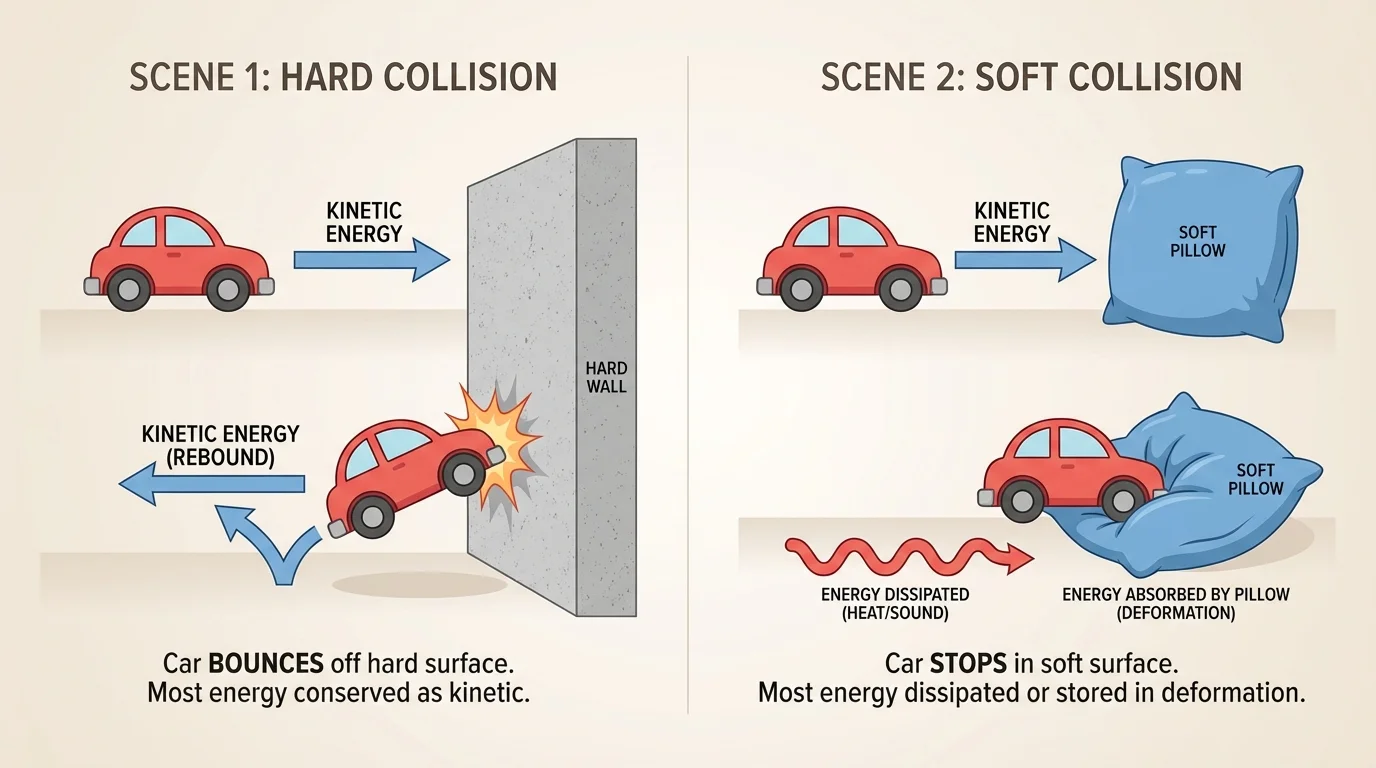
A third factor is direction. If two objects move straight toward each other, the result can be very different from one object gently tapping the side of another. A fourth factor is the kind of material. As [Figure 3] makes clear, a hard wall and a soft pillow can lead to very different collision outcomes even when the same toy car rolls into them.
Hard surfaces often cause stronger bounces because they do not squish much. Soft surfaces often reduce bouncing because they bend or compress more. That means more motion energy changes into other forms instead of returning as bounce motion.
The shape of objects matters too. A round ball may roll and bounce differently from a flat block. A helmet is shaped and padded to help spread out the force of a collision and protect a person's head. That design changes how energy is transferred during impact.
| Factor | What to Notice | Possible Effect |
|---|---|---|
| Speed before collision | Slow or fast motion | Faster motion often leads to a bigger change |
| Mass | Lighter or heavier object | Heavier objects are often harder to move or stop |
| Direction | Head-on or side hit | Objects may bounce back or turn |
| Material | Hard, soft, bouncy, sticky | Changes bouncing, stopping, and sound |
Table 1. Factors that affect what happens when objects collide.
When students ask, "What matters most?" the answer is often: more than one thing. Real collisions usually involve several factors at once. A fast, heavy, rubber ball hitting a hard surface behaves differently from a slow, light, foam ball hitting carpet.
A woodpecker can strike a tree many times without serious injury because its body structure helps manage the forces and energy transfers during each impact.
That is one reason engineers test materials carefully. Car bumpers, bike helmets, and playground mats are designed to change how collisions happen so people stay safer.
Not all collisions look the same. Some objects bounce apart. Some stop. Some stick together. Some move off in new directions. [Figure 4] shows these common outcomes, which can all be predicted by thinking about motion, contact forces, and how energy changes during impact.
If two marbles collide, they may bounce away from each other. If a ball rolls into a line of dominoes, the dominoes may fall. If a piece of clay hits another piece of clay, they may stick together. If a moving hockey puck hits another puck at an angle, both may slide off in different directions.
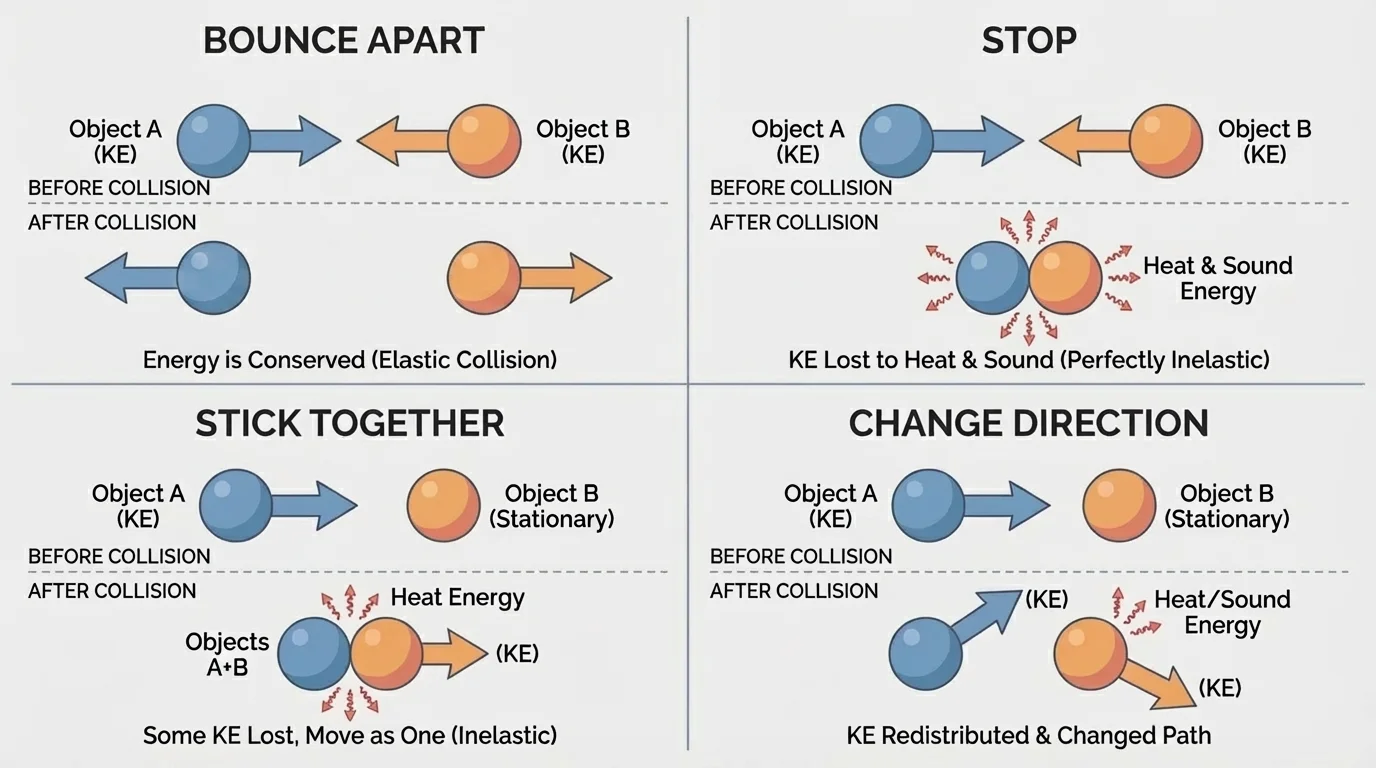
Sometimes a collision causes almost all visible motion to stop. That does not mean the energy vanished. Instead, more energy may have changed into sound, thermal energy, or shape change. This idea helps explain why a dropped beanbag does not bounce like a tennis ball.
Later, when comparing sports equipment or safety gear, these same patterns from [Figure 4] can be used again: bouncing, stopping, sticking, and turning are clues that energy has been transferred in different ways.
From earlier learning, a force is a push or a pull. During a collision, the push between touching objects is a contact force, and that force changes motion.
Even tiny collisions can show these ideas. A raindrop hits a leaf and splashes. A spoon taps a bowl and makes sound. A cat jumps onto a cushion and the cushion compresses. Different results, same big idea: collisions transfer energy and change motion.
Sports are full of collisions. A basketball hits the floor and bounces. A baseball bat strikes a ball and sends it flying. A goalkeeper catches a soccer ball and brings it to a stop. In each case, the collision changes motion and transfers energy. Players learn to predict outcomes based on speed, angle, and the materials involved.
Transportation gives us another important set of examples. Seat belts, airbags, and car crumple zones are designed to reduce injury. They do this by changing how the collision affects people. Soft or bendable parts increase the time over which the collision happens and spread out the force, helping protect the body. More of the moving car's energy changes into shape change, sound, and thermal energy instead of all being transferred quickly to passengers.
On playgrounds, rubber mats under swings and slides help make falls safer. The mats compress during impact, which changes the collision compared with concrete. The same idea is used in gym mats, padded walls, and helmets.
Real-world case: why helmets help
Step 1: A moving head has kinetic energy.
If a rider falls, the head is moving before impact.
Step 2: The helmet changes the collision.
The hard outer shell spreads the impact, and the soft inner foam compresses.
Step 3: Energy changes form.
More energy goes into compressing the helmet materials, with less harmful effect on the skull and brain.
This does not remove all danger, but it greatly improves safety. Engineers use what they know about collisions to design better protective equipment.
To learn from collisions, scientists make careful observations. They notice what moves, what stops, what bends, what makes sound, and what changes direction. They also try to keep tests fair by changing only one thing at a time.
For example, suppose we compare how the same ball behaves on tile, carpet, and grass. Keeping the ball the same helps us focus on the effect of the surface. Or suppose we compare a rubber ball and a foam ball on the same floor. Keeping the surface the same helps us focus on the effect of the material.
Useful observations might include: "The rubber ball bounced higher than the foam ball," "The toy car hitting the pillow made less sound than hitting the wall," or "The clay stuck while the rubber ball bounced." These are strong scientific observations because they describe what was actually noticed.
How to build a fair prediction
Step 1: Name what will stay the same.
Use the same ramp and the same toy car.
Step 2: Name what will change.
Change only the object the car hits, such as a block or a pillow.
Step 3: Predict the result and explain why.
The car will bounce or stop differently because the block is hard and the pillow is soft.
Fair tests help us trust our results. If too many things change at once, it becomes hard to know what caused the different outcome.
Scientists do not stop after one prediction. They compare the prediction with evidence. If the evidence matches, confidence grows. If the evidence is different, the prediction can be improved.
Suppose someone predicts that a tennis ball and a rubber playground ball will bounce the same because both are balls. After observing, they may find that one bounces higher. Then they can revise the prediction by thinking more carefully about the materials, the amount of air inside, and how much the balls squash during impact.
This process of asking questions, predicting, observing, and revising is how science works. It helps us understand the patterns in collisions. It also helps people design safer buildings, better sports gear, quieter machines, and stronger packaging for fragile objects.
By now, the collision patterns first introduced with rolling balls in [Figure 1] connect to many situations. The same energy ideas also appear in the bouncing ball sequence in [Figure 2] and in the hard-versus-soft comparison in [Figure 3]. Different examples, one important science idea: when objects collide, contact forces transfer energy in ways that change motion.
