A small flashlight can glow even when there is no wall outlet nearby. A toy car can zoom across the floor from the energy in a battery. A wind-up toy can move after you twist a knob. These devices may seem very different, but they all do something important: they convert energy from one form to another.
Scientists study how energy moves and changes. Engineers use those ideas to solve problems. When people design a useful device, they think about what kind of energy goes in, what kind comes out, and how to make the device work better.
Energy is the ability to make things happen. It can make objects move, lights shine, and sounds play. In this topic, we focus on a few important forms of energy: stored energy, kinetic energy, electric energy, light, and sound. Energy can change from one form into another, as [Figure 1] shows with simple pathways that fit this lesson.
Stored energy is energy held and ready to be used. A battery has stored energy. A wound-up spring has stored energy. Kinetic energy is the energy of motion, like a spinning wheel or a turning crank. Electric energy is the energy carried by moving electric charges through a circuit. A bulb can use electric energy to produce light, and a buzzer can use it to produce sound.
Energy conversion means changing energy from one form to another. For example, a hand crank can change kinetic energy into electric energy, and a battery can provide stored energy that becomes motion, light, or sound.
One important science idea is that energy is not made from nothing and does not simply disappear. Instead, it changes form and moves from place to place. If a hand-crank flashlight glows, the light does not come from nowhere. It comes from your moving hand.
Sometimes we can describe an energy pathway in order. For a battery-powered toy car, the path may be: stored energy in the battery, then electric energy in the wires, then motion of the wheels. For a buzzer, the path may be: stored energy, then electric energy, then sound.
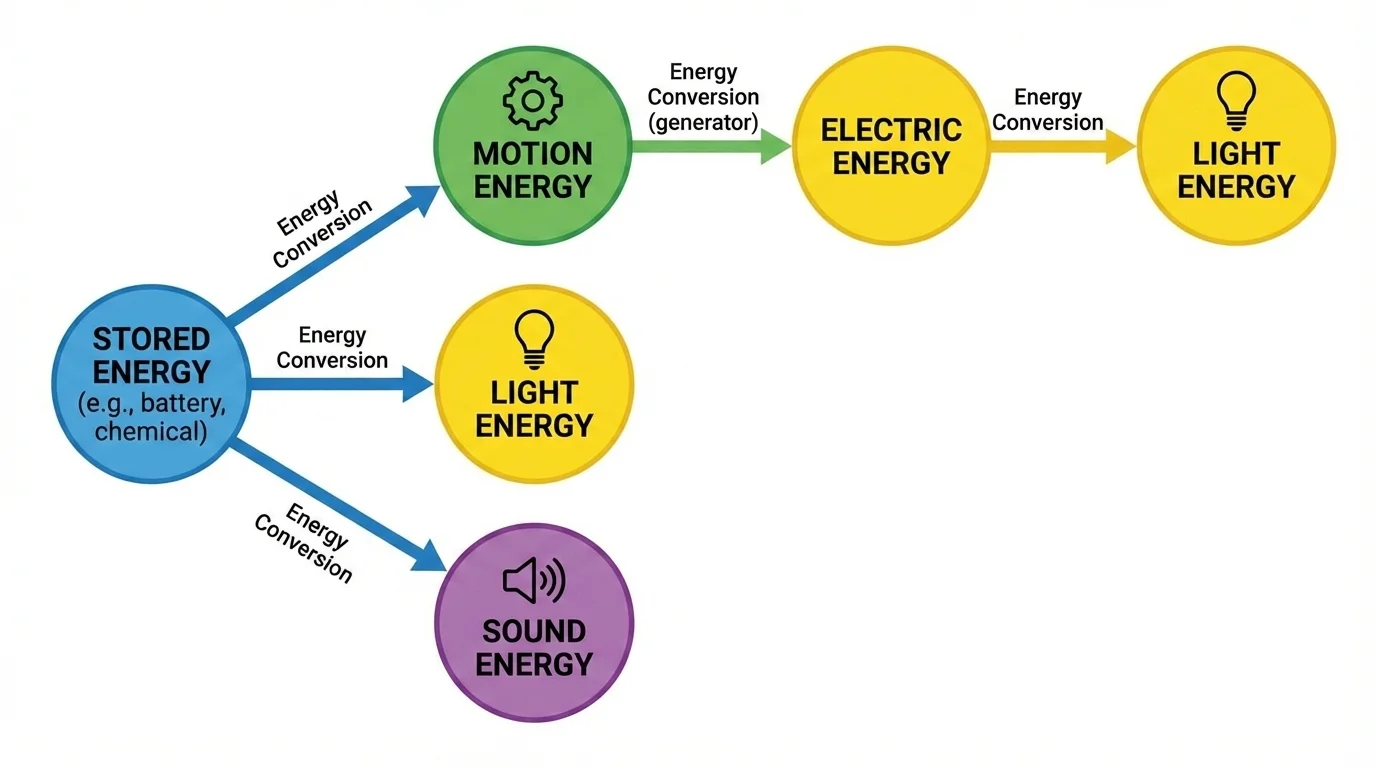
In this lesson, we study devices with a clear limit. The devices should either change motion energy into electric energy, or use stored energy to cause motion or produce light or sound. That means our examples stay focused on things like hand-crank flashlights, battery toys, buzzers, and wind-up devices.
A device is a tool or object made to do a job. An energy-converting device is designed so that one kind of energy goes in and another kind of energy comes out. Looking at the input and the output helps us understand what the device is doing.
For example, if you turn a crank with your hand, your hand supplies motion energy. If the device then makes electricity, the output is electric energy. If a battery powers a lamp, the battery provides stored energy and the lamp produces light. If a battery powers a small speaker, the result is sound. If a battery powers a car, the result is motion.
| Device | Energy In | Energy Out |
|---|---|---|
| Hand-crank flashlight | Motion energy | Electric energy, then light |
| Battery toy car | Stored energy | Motion |
| Battery buzzer | Stored energy | Sound |
| Battery lamp | Stored energy | Light |
| Wind-up toy | Stored energy in a spring | Motion |
Table 1. Examples of devices and the energy changes they make.
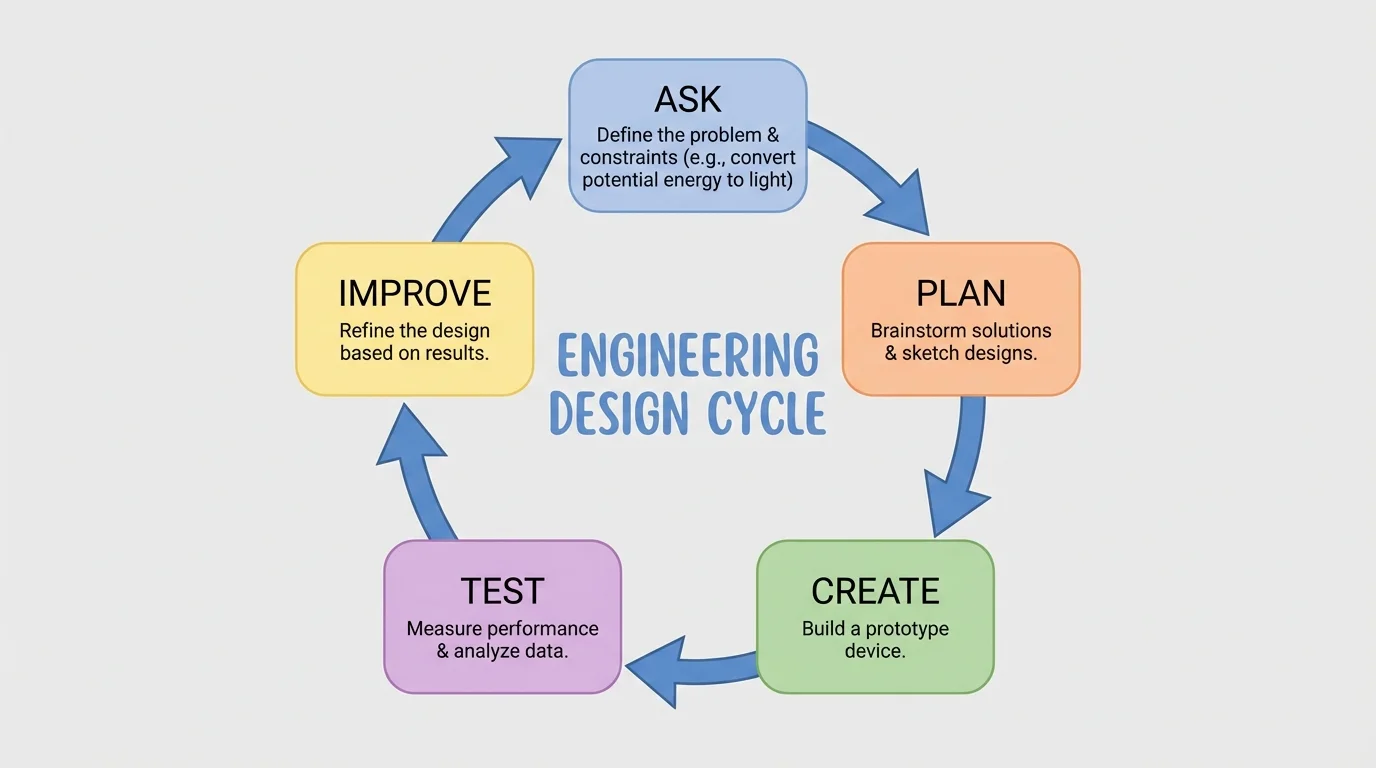
Engineers do more than build things once. They follow a process to solve problems, and [Figure 2] shows a simple design cycle that starts with asking what the device should do and ends with improving it.
First, they identify the problem. Maybe the goal is to make a flashlight that shines brighter, a toy car that travels farther, or a buzzer that sounds louder. Next, they plan a design. Then they build a model or a first version. After that, they test it carefully. Finally, they improve the design using evidence from the test.
The design cycle is a repeating process. A first design is rarely perfect. Engineers test, notice what works and what does not, and then change the design. That process of changing and improving is called refinement.
This cycle often repeats many times. A better handle might help a crank turn more smoothly. A tighter connection might help electricity flow better. A lighter toy car body might move more easily. Each test gives clues.
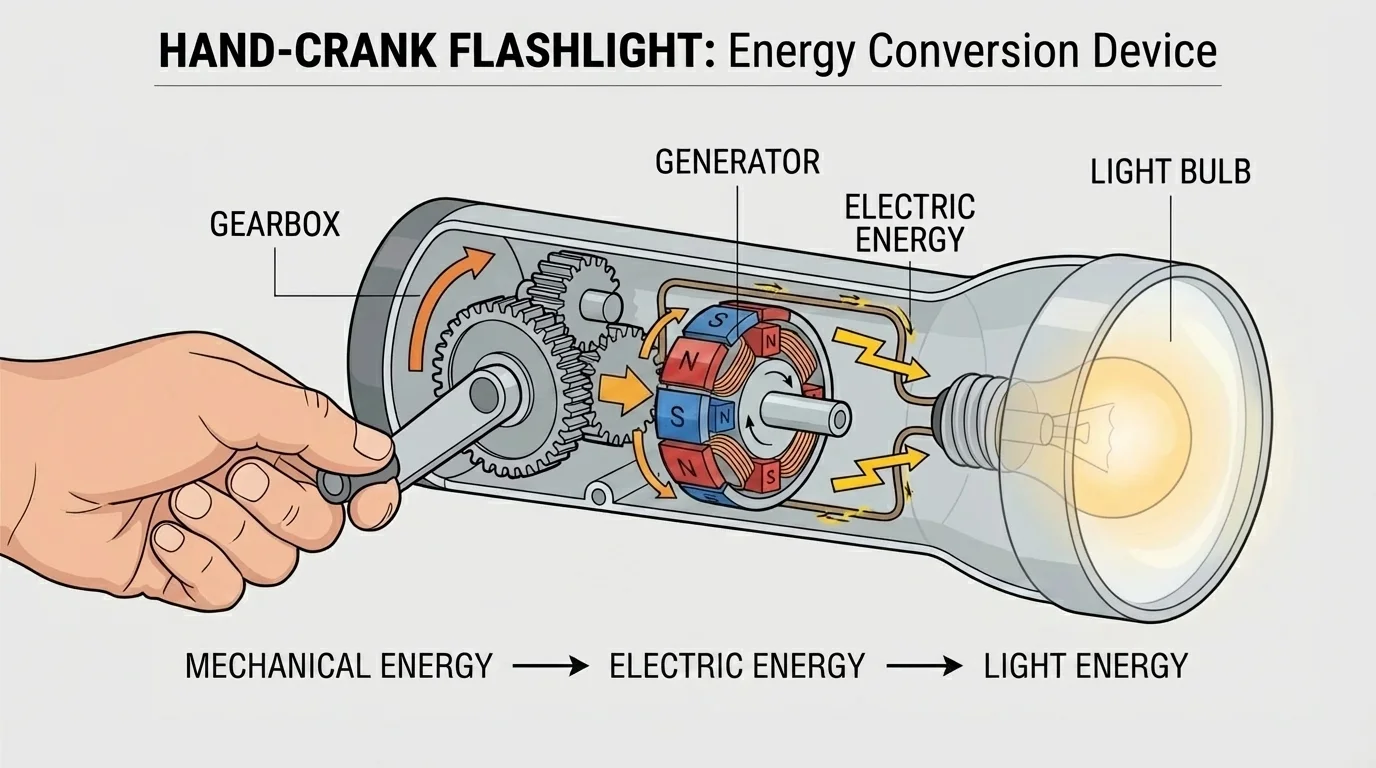
A hand-crank flashlight is a strong example of energy conversion because it shows a clear chain: your hand turns the crank, the moving parts inside spin, electric energy is produced, and the bulb lights up.
[Figure 3] When you rotate the crank, you give the device kinetic energy. Inside the flashlight, moving parts help turn that motion into electric energy. The bulb then uses the electric energy to produce light. The faster or longer you crank, the more energy you transfer into the system.
This kind of device is useful during a power outage because it does not need a wall plug at that moment. Your own motion becomes the energy source. That makes the science idea easy to see: kinetic energy can be converted into electric energy.
Case study: comparing two crank handles
Step 1: State the goal.
The goal is to find which handle shape helps a student turn the flashlight more easily for the same amount of time.
Step 2: Keep most things the same.
Use the same flashlight body, same bulb, and the same test time, such as \(30 \textrm{ s}\).
Step 3: Change one thing.
Test handle A and handle B, but change only the handle shape.
Step 4: Observe the results.
Record which handle feels easier to turn and which one makes the light brighter or keeps it on longer.
If one handle helps the user turn more steadily, that design may be better because it transfers kinetic energy more effectively.
Notice that the flashlight does not create energy from nowhere. Your muscles move your hand, your hand turns the crank, and that kinetic energy helps produce electricity. Later, when we talk about fair testing, the same flashlight example in [Figure 3] helps us think about what to change and what to keep the same.
A battery stores energy chemically, but for this lesson we simply treat it as stored energy that can be used by a device. When the battery is connected in a circuit, the device can use that stored energy to do something useful.
In a toy car, stored energy in the battery becomes electric energy in the circuit. Then a motor uses that electric energy to make the wheels move. The final result is motion. If the wheels stick or rub too much, the car may not move very far even when the battery is fresh.
In a buzzer or small speaker, stored energy becomes electric energy, and then the device vibrates to make sound. In a lamp, stored energy becomes electric energy, and then the bulb produces light. These examples show that the same starting form of energy can lead to different results depending on the design.
Some emergency radios use a hand crank. One part of the device changes motion energy into electric energy, and another part uses that energy to make sound.
A wind-up toy works in a related way. Twisting the key stores energy in a spring. When the spring unwinds, the toy moves. Here the stored energy causes motion without a battery.
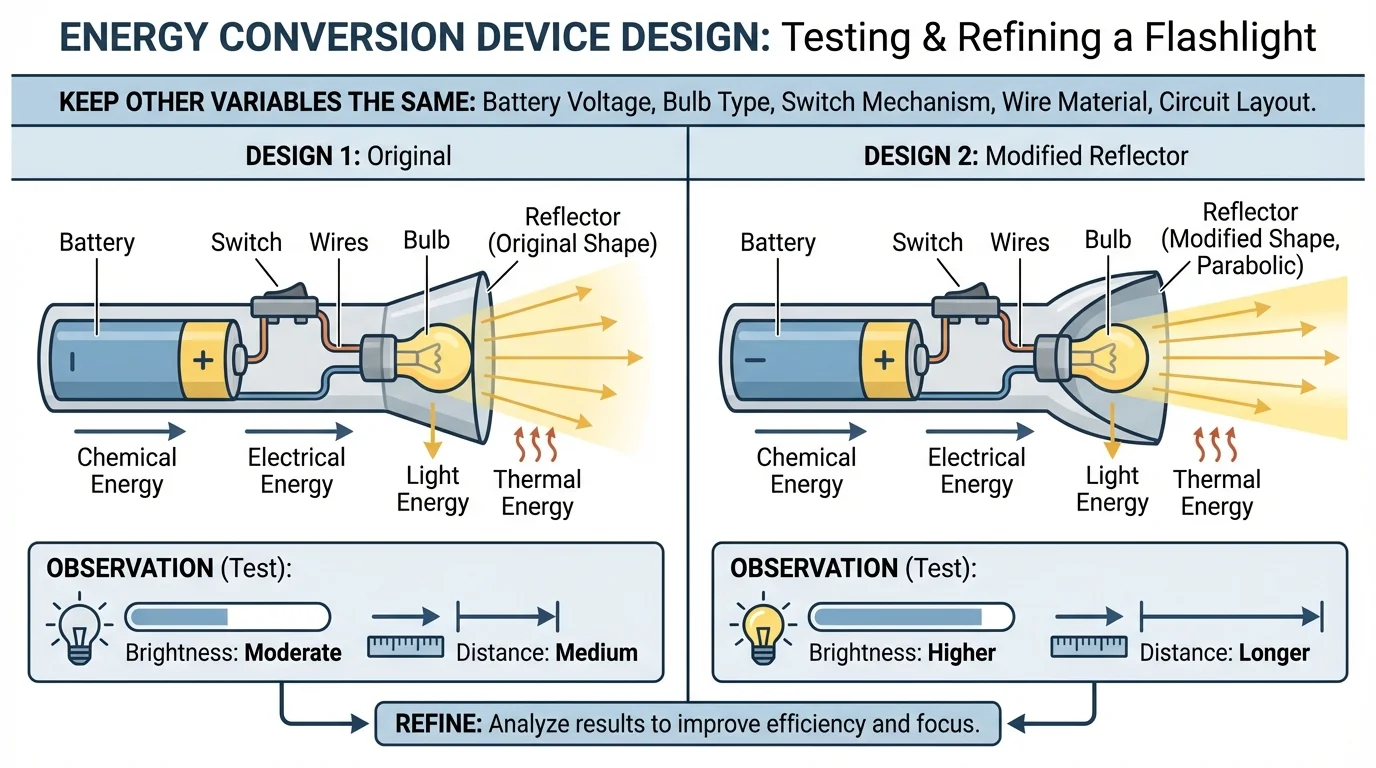
When engineers test a device, they need evidence, and [Figure 4] shows an important idea: a fair test changes only one feature at a time so the results are easier to understand.
If you change too many things at once, you cannot tell which change caused the new result. For example, if one toy car has different wheels, a different battery, and a different body shape, the test is confusing. But if the cars are the same except for wheel size, the test is much fairer.
You already know that scientists make observations and compare results. In engineering, those same skills help us decide whether a design is working well.
Evidence can include what you see, hear, or measure. A flashlight can be compared by brightness or by how long it shines. A toy car can be compared by distance traveled. A buzzer can be compared by whether the sound is clear and easy to hear.
Simple measurements can help. If a toy car rolls for different distances, you can measure the distance. If one car goes \(40 \textrm{ cm}\) and another goes \(65 \textrm{ cm}\), then the second car traveled farther by \(65 - 40 = 25 \textrm{ cm}\).
You can also average repeated trials to get a better idea of performance. Suppose one flashlight shines for \(8 \textrm{ s}\), \(10 \textrm{ s}\), and \(9 \textrm{ s}\). The total is \(8 + 10 + 9 = 27\), and the average is \(27 \div 3 = 9 \textrm{ s}\). Repeating a test helps because one trial alone may not tell the whole story.
Example of a fair test with a toy car
Step 1: Ask a question.
Which wheel size helps a battery toy car travel farther?
Step 2: Keep things the same.
Use the same battery type, same car body, same floor, and same starting point.
Step 3: Change one thing.
Change only the wheel size.
Step 4: Test more than once.
Run each car \(3\) times and measure the distance each time.
Step 5: Decide from evidence.
The wheel size with the greater average distance is the better design for this goal.
To refine a device means to improve it after learning from tests. Refining is not guessing. It uses evidence. If a flashlight is hard to crank, the handle might need to be larger or smoother. If a toy car wobbles, the wheels may need better alignment. If a buzzer sounds weak, the connections may need to be tighter.
Sometimes a change improves one part of a device but makes another part worse. A bigger wheel might help a car move farther, but it might also make the car heavier. Engineers think about trade-offs like that and decide which design best meets the goal.
As the design gets better, the tests should continue. The fair-test ideas from [Figure 4] still matter because each new version should be compared carefully with the old version.
Not every bit of energy in a device ends up in the form we want most. Some energy may become unwanted heat or extra sound. For fourth grade, the big idea is simple: different designs transfer energy with different levels of effectiveness.
Friction is one reason. Friction is a force that resists motion when surfaces rub together. In a toy car, too much friction at the wheels can reduce how far the car travels. In a crank device, parts that rub too hard may be harder to turn.
Loose connections can also matter in a battery-powered device. If the parts do not connect well, electric energy may not move through the circuit effectively. That can make a light dimmer or a buzzer quieter.
Strong materials, a good shape, and smooth-moving parts often help energy transfer more effectively. Looking back at the flashlight in [Figure 3], a handle that is easier to grip can help the user crank more steadily, which can improve the output.
Energy-converting devices are part of everyday life. Battery-powered flashlights turn stored energy into light. Doorbells and buzzers turn stored energy into sound. Toy cars and small fans turn stored energy into motion. Hand-crank tools can change kinetic energy into electric energy when electricity is needed away from outlets.
Bicycle lights can also connect to this idea. When a rider moves, some devices use wheel motion to help produce electric energy for a light. That is another example of motion energy being converted into electric energy and then into light, just like the energy pathway introduced earlier in [Figure 1].
"Good designs get better when we test them and learn from the results."
Engineers use these ideas to solve real problems. A design may need to work during storms, on camping trips, or in places without easy access to plugs. The more clearly we understand energy conversion, the better we can design useful tools.
When building or testing simple devices, safety matters. Use only safe classroom materials and follow adult directions. Do not take apart wall-powered electronics. Small batteries, bulbs, wires, and classroom kits should be handled carefully and correctly.
Smart design also means choosing the right device for the job. If the goal is bright light during an emergency, a hand-crank flashlight may be useful because motion can provide the needed energy. If the goal is a toy that moves for a long time, a battery-powered car or a well-designed wind-up toy may be a better choice.
In every case, the same big idea remains: look at the energy going in, observe the energy coming out, test the device fairly, and improve the design with evidence.
