Have you ever walked into a dark room at night and bumped into a chair you didn't see? The chair was still there, but without light, your eyes could not see it. This everyday problem is actually a clue to a big science idea: we see objects only when light gets from them into our eyes.
Light is a kind of energy that travels in straight lines. Scientists call light a type of wave, but in this lesson we will mostly think of it as straight lines or little paths called light rays that show where the light goes.
Some things give off their own light. These are called light sources. Examples include the Sun, lamps, flashlights, and candles. These things send light out in many directions.
Most of the objects around you—your desk, your shoes, your pencil—do not make their own light. They need light from a source to shine on them. Then something special happens to that light so that you can see the objects.
Light is energy that travels in straight lines and lets us see when it enters our eyes.
Light source is an object like the Sun or a lamp that gives off its own light.
Light ray is a simple drawing of the path that light energy takes, usually shown as a straight arrow.
You already use light every day: opening the curtains to brighten a room, turning on a lamp to read, or using a flashlight during a power outage. All of these involve light traveling from a source, bouncing off things, and reaching your eyes.
Scientists often use a model to explain how something works. A model can be a picture, a diagram, or even just a careful description. To explain how we see objects, we use a model with three main parts: a light source, an object, and an eye, as shown using light rays in [Figure 1]. This model helps us understand what must happen for us to see something.
Here is the main idea:
Only when light that has reflected from the object enters your eyes can you see the object. If any of these parts is missing—no light source, no object, or the light is blocked from your eyes—you cannot see the object.
We can describe this idea as a chain of events:
1. Light source → sends out light rays.
2. Light rays → hit an object.
3. Light rays → reflect from the object into an eye.
When the rays reach your eyes, your brain helps you notice the object and understand where it is. We will not go into details of how the inside of the eye works, but we know that light must enter the eye for sight to happen.
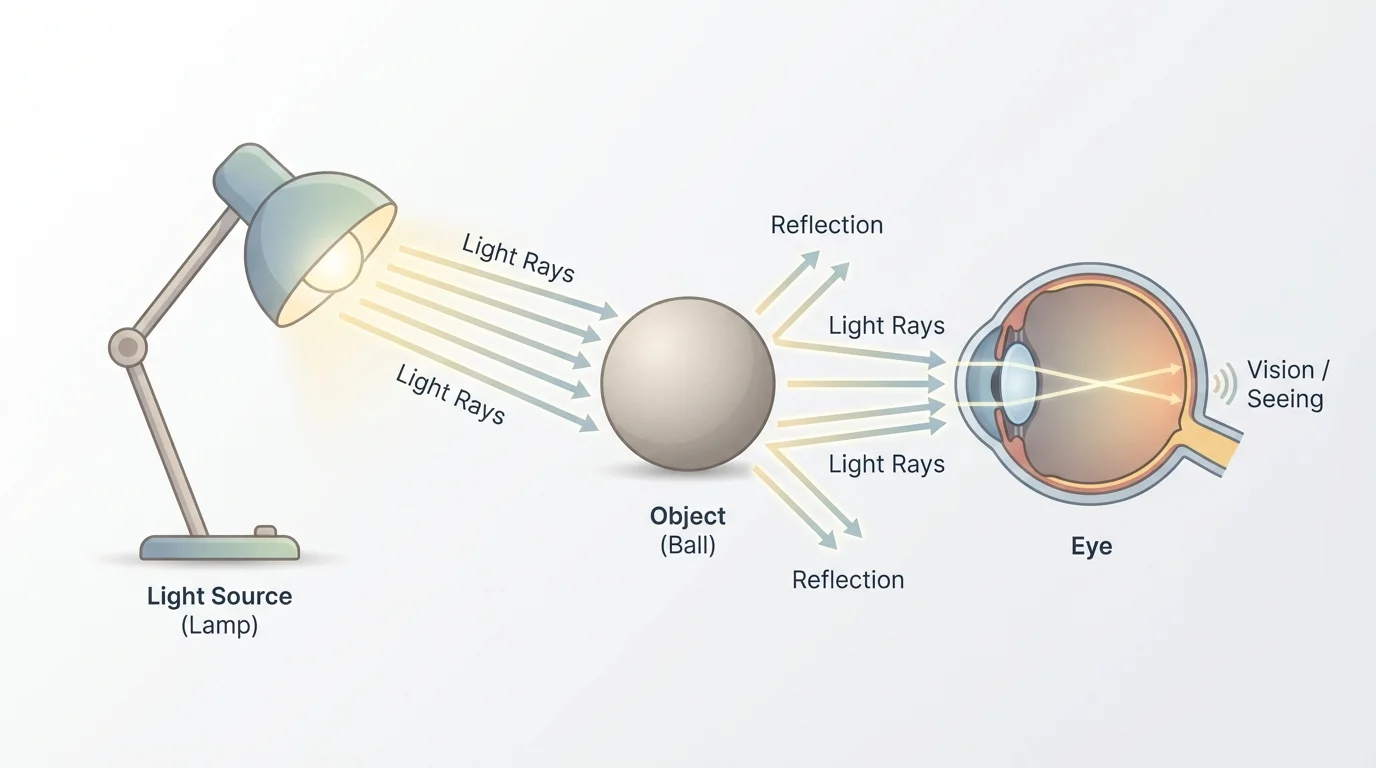
Think about reading a book at night. The lamp is the light source. Light from the lamp shines onto the pages of the book. The pages do not glow on their own. Instead, light reflects from the pages into your eyes. That is why you can see the words.
The same thing happens outside on a sunny day. Sunlight shines on trees, buildings, and people. Light reflects from them into your eyes, so you can see the whole scene.
Some animals, like cats and raccoons, seem to have glowing eyes at night. Their eyes are not light sources. A special layer in their eyes reflects light back, which makes them appear to glow when a light shines on them.
This matches our model: light from a source (like car headlights) hits the animal's eyes, reflects, and then that reflected light enters our eyes.
When light hits an object, some of it reflects. Reflection means the light bounces off the surface. The way it bounces depends on the surface. This difference is important for how clearly we can see images, as shown in [Figure 2].
There are two main types of surfaces to think about:
Because a mirror is very smooth, light rays reflect in an organized pattern. That is why you see a clear picture of your face when you look into a bathroom mirror. The light follows a neat path from your face to the mirror and then into your eyes.
A painted wall is rough at a tiny scale. Light still reflects, but it scatters in many directions. You do not see a picture of yourself in the wall, but you do see the wall itself. That happens because some of the scattered light still reaches your eyes.
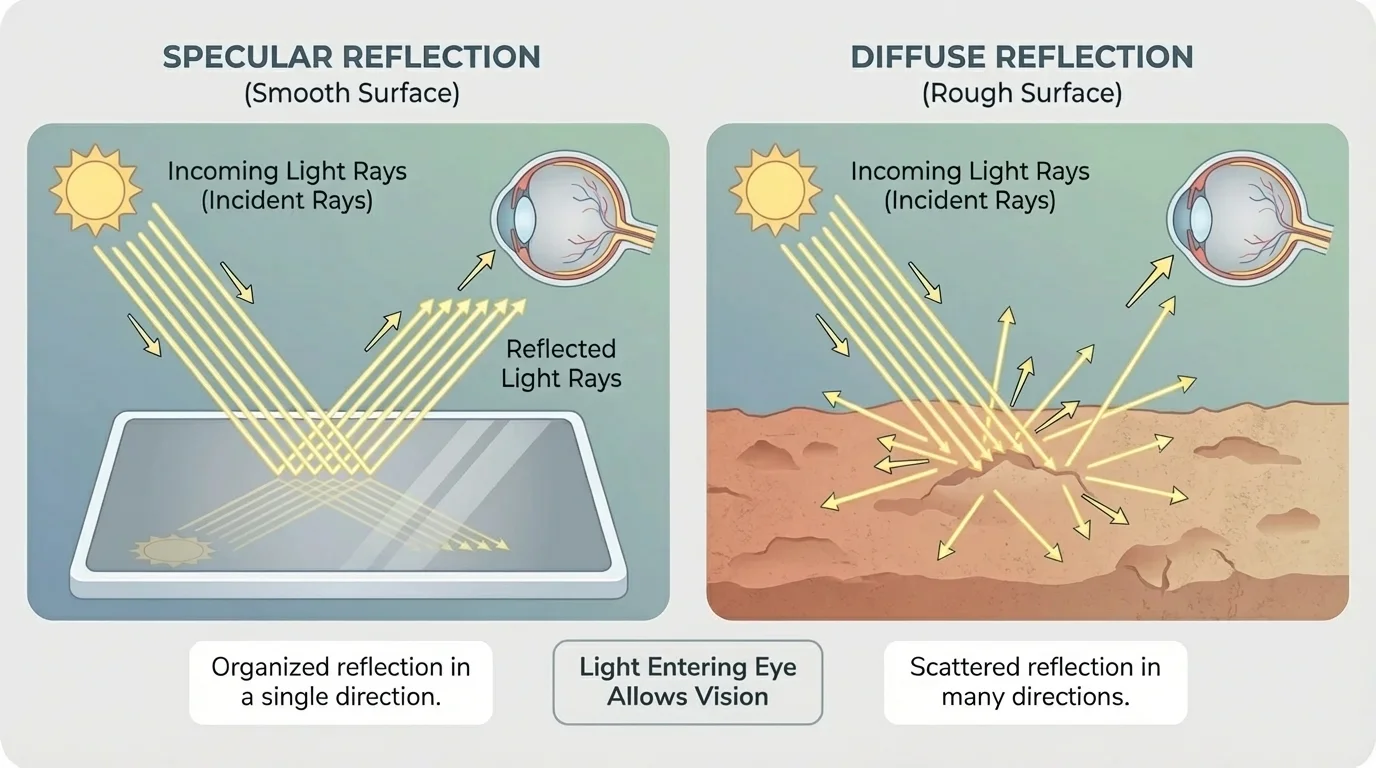
Both mirrors and walls reflect light. The difference is that mirrors give clear images, while rough surfaces give no clear images, just the color and brightness of the object.
When you see a red ball on the ground, light from a source (the Sun or a lamp) hits the ball. The ball's surface is not smooth like a mirror, but it still reflects light in many directions. Some of those rays go into your eyes, and you see the ball.
Everyday example: Seeing your friend at the park
Imagine you are at the park on a sunny day and you spot your friend on the swings. Here is how our model explains what happens.
Step 1: The Sun is the light source.
Sunlight travels in straight lines and shines on your friend.
Step 2: Light reflects from your friend.
Your friend's clothes, face, and hair all reflect sunlight in many directions.
Step 3: Some reflected light enters your eyes.
The light that reaches your eyes allows you to see your friend clearly enough to wave and say hello.
If a big wall suddenly blocks your view, the chain is broken. Light from your friend cannot reach your eyes anymore, so you cannot see your friend, even though your friend is still there and still lit by the Sun.
This example fits the same pattern we saw in [Figure 1]: light from a source, reflection from the object, and light entering your eyes.
Now think about what happens in total darkness. If you are in a cave or a room with all the lights off and no windows, you might not see anything at all. Why? Because without light, there is nothing to reflect from objects into your eyes.
Some people think that our eyes send out light like flashlights, but that is not correct. Our eyes do not send out light. They receive light.
We can test this with a simple thought experiment:
This tells us that seeing needs light coming into the eyes, not out of them.
Shadows are another clue. A shadow happens when something blocks light from reaching a surface. In the shadow, less light reflects from the surface into our eyes, so it looks darker. But we can still see objects in a shadow if some light reaches them from other directions.
If there is truly no light at all—no lamps, no candles, no sunlight, no glow from screens—objects are still there, but our eyes cannot detect them. The chain of light source → object → eye is broken at the very beginning.
Not all materials interact with light in the same way. Some let light pass straight through. Some block light. Some scatter it.
Understanding this helps us apply our model in more situations, as shown for different materials in [Figure 3].Here are three useful words for how materials interact with light:
| Type of material | What it does with light | What you see |
|---|---|---|
| Transparent | Lets most light pass through in straight lines | You can see clearly through it |
| Translucent | Lets some light through but scatters it | You see blurry shapes or just light, not clear images |
| Opaque | Does not let light pass through; it reflects or absorbs light | You cannot see through it at all |
Table 1. How transparent, translucent, and opaque materials affect light and what we see.
Examples:
Shiny metal can be both opaque and very reflective, like a mirror. It does not let light pass through, but it reflects so neatly that you see images in it.
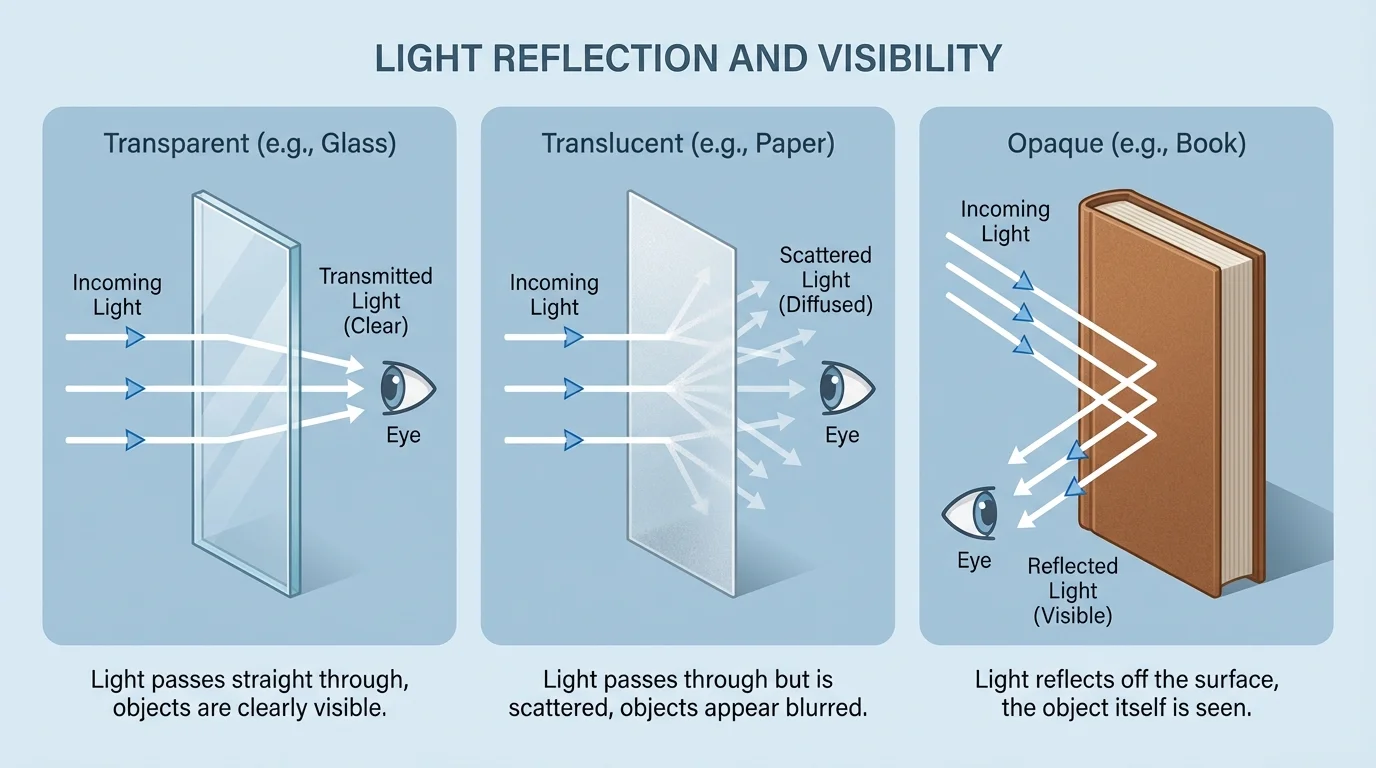
Our main idea still works for all these materials. Whether light passes through, scatters, or reflects, you only see something when light from that thing reaches your eyes. For a transparent window, you mainly see what is on the other side because light comes through the window into your eyes. For an opaque door, you see the door itself because light reflects from its surface into your eyes.
Scientists and engineers use investigations to test their models and improve them. Here are some simple observations that match our model about light, reflection, and seeing.
Investigation 1: Flashlight and a Toy
In a dark room, place a small toy on a table. Turn off all the lights and cover any windows. First, notice what you can (or cannot) see. Then turn on a flashlight and shine it at the toy.
This matches the pattern in [Figure 1]: source → object → eye.
Investigation 2: Mirror vs. Wall
Stand the same distance away from a mirror and from a painted wall, one at a time, in a well-lit room.
In both cases, you see something because light is reflecting into your eyes. The way it reflects changes what you see.
Investigation 3: Object in a Box
Place a small object in a box. Close the box. Poke a tiny hole in one side and take a peek through the hole.
These simple investigations help support the model by showing that without light, or if light cannot reach your eyes, you cannot see objects, even though they are present.
The same idea—that light must reflect from objects and enter eyes or cameras—shows up in many technologies and safety tools around you.
Cameras and Phones
A camera in a phone or tablet works a lot like an eye. Light from the Sun or from lamps reflects from objects and enters the camera's lens. Instead of a brain, a computer chip inside the camera records the pattern of light to make a picture.
If there is not enough light, your pictures look dark or blurry. That is why cameras sometimes use a flash, which is like a tiny light source. The flash sends out light, which reflects from objects and back into the camera.
Road Signs and Bike Reflectors
Many road signs and bicycles have special reflectors on them. At night, when car headlights shine on the reflector, the reflector sends much of the light back towards the car. This makes the sign or bike appear bright to the driver.
This is very helpful for safety. It uses our model in a clever way: headlights (source) → reflector (object) → reflected light → driver's eyes, so the driver can see the sign or bicycle clearly.
Periscopes and Mirrors in Tools
Submarines and some science toys use periscopes. A periscope uses mirrors to change the path of light. Light from an object above the water reflects from one mirror, then a second mirror, and finally into the sailor's eyes.
Even though the sailor is hidden inside the submarine, the light is still making the same kind of journey: source → object → mirror(s) → eye.
Computer and TV Screens
Screens on computers, tablets, and TVs are special because they are also light sources. Tiny parts of the screen give off light directly. This light travels straight into your eyes, so you can see pictures, words, and videos, even in a dark room.
Even here, the rule is the same: to be seen, light must enter your eyes. The difference is that for screens, the light comes straight from the screen, not from another light reflecting.
All of these stories—from dark rooms to sunny parks, from mirrors to bike reflectors—fit one main science idea. Understanding this idea helps you think like a scientist whenever you notice light and seeing in your everyday life.
