A giraffe's long neck, a cactus's thick stem, a duck's webbed feet, and a maple tree's seeds all look very different. But they share a big scientific idea: each structure has a job. Living things are not built at random. Their body parts help them get what they need, stay safe, grow, act in certain ways, and make more living things like themselves.
In science, an argument is not a fight. It is a careful explanation that says, "Here is what I think, here is the evidence, and here is why the evidence supports my idea." When you construct an argument about plants and animals, you are making a claim about how a structure helps a living thing and then supporting that claim with observations.
Claim, evidence, and reasoning work together in scientific thinking. A claim is the idea you want to prove. Evidence is what you observe, such as a turtle's shell or a sunflower's broad leaves. Reasoning explains how the evidence supports the claim. For example, if a shell is hard and covers much of a turtle's body, that evidence supports the idea that the shell helps protect the turtle from danger.
A strong science argument uses real examples. Instead of saying, "Plants have parts," you can say, "Roots help plants take in water and hold the plant in place." That is much stronger because it names a structure and explains its function.
Living things have external structures, which are parts on the outside, and internal structures, which are parts inside the body. External structures are often easy to see, such as leaves, bark, wings, tails, petals, or claws. Internal structures are inside but still large enough to think about without zooming in, such as bones in animals or the thick inner stem of some plants that helps hold them upright.
Internal structures are body parts inside a plant or animal that help it live and function.
External structures are body parts on the outside of a plant or animal.
Function means the job a structure does.
Scientists look at both kinds of structures because the job of a body part often explains why it has a certain shape, size, or covering. A polar bear's thick fur is outside the body and helps keep it warm. A deer's bones are inside the body and help support movement. A tree's bark protects the outside, while sturdy wood inside helps hold the trunk up.
When we study this topic, we focus on large, visible structures of whole plants and animals. We do not need to study tiny parts too small to see with just our eyes. The big body parts already give us powerful evidence about how living things meet their needs.
Plants may stay rooted in one place, but they are far from helpless. Their different parts do different jobs, as [Figure 1] shows in a flowering plant. A plant must get water, take in sunlight, stay supported, grow, and reproduce. Its structures help it do all of these things.
Roots are important external structures in many plants. Roots grow into the ground and take in water and minerals from the soil. They also anchor the plant so wind or rain does not easily pull it out. A large tree can stand tall during a storm partly because its root system holds it in place.
The stem supports the plant above the ground. It holds up leaves, flowers, and fruits so they can get sunlight and interact with the environment. Many stems also carry water from roots to the rest of the plant. In a sunflower, the tall stem lifts the flower high into the light. In a cactus, the thick stem stores water, helping the plant survive in a dry desert.
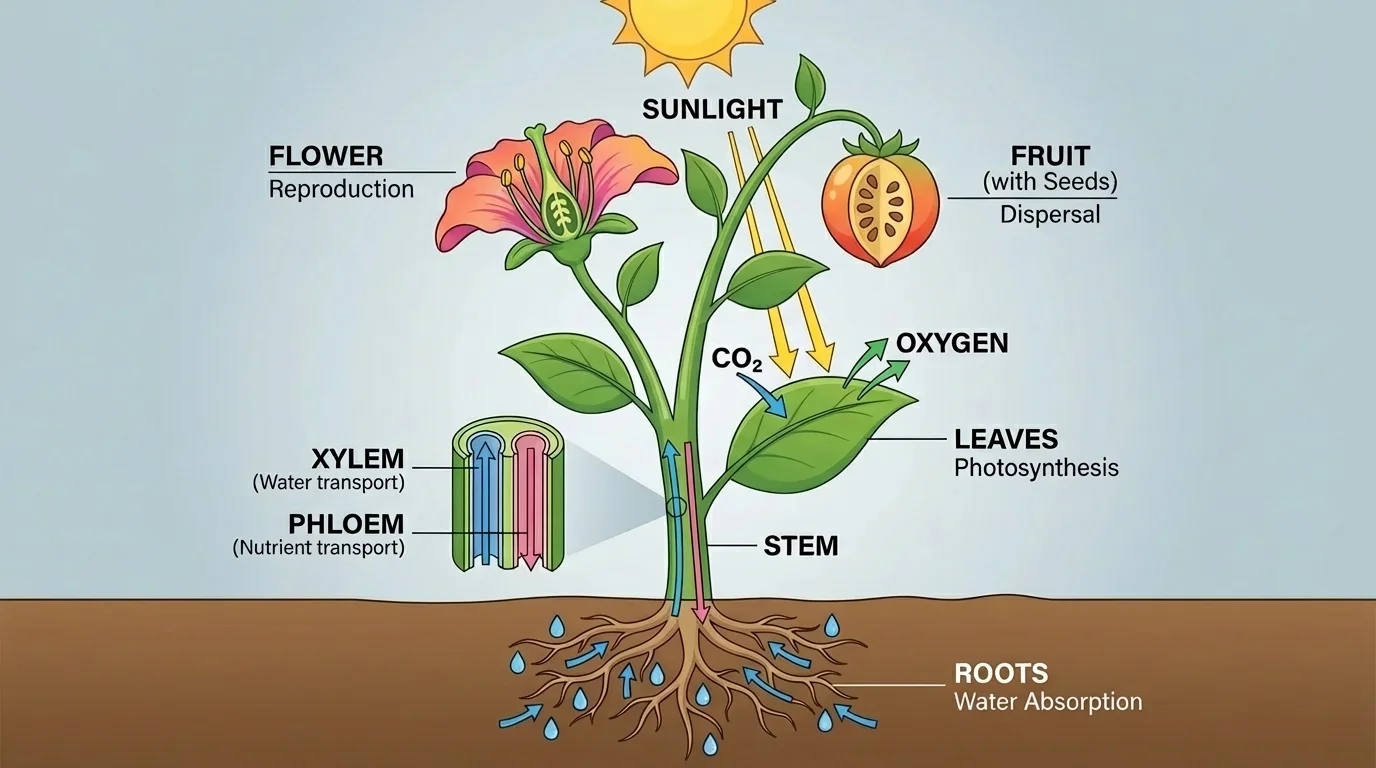
Leaves are usually broad and flat. This shape helps them catch sunlight. Sunlight is important because plants use it to make food. A plant with healthy leaves can grow better because it can gather more of the energy it needs. In shady forests, some plants have especially wide leaves to catch as much light as possible.
Bark is another useful plant structure. It covers the outside of many trees and protects them from damage, insects, and drying out. The hard outer covering of bark works almost like a shield. Inside the trunk, strong wood helps support the tree's height and the weight of its branches.
Different habitats lead to different plant structures. Water lilies have broad leaves that float on water. Pine trees often have narrow needles that help them live in cold or dry places. Cacti have spines instead of broad leaves. The spines help protect the plant and reduce water loss, while the thick stem stores water. These examples give evidence that plant structures match the plant's needs.
Plants also need structures that help them make new plants. Reproduction in plants often depends on visible body parts such as flowers, cones, fruits, and seeds. These are not just decorations. They are important survival tools for the next generation.
Some seeds travel amazing distances. A dandelion seed can float on the wind, while a coconut can travel across water to a new shore.
A flower is an external structure that helps many plants reproduce. Bright colors and scents can attract animals such as bees, butterflies, or birds. When these animals visit flowers, they may carry pollen from one flower to another flower of the same kind. This helps the plant produce seeds.
Fruit protects seeds and can help spread them. Animals may eat the fruit and carry the seeds elsewhere. Some fruits have hooks that attach to animal fur. Others, like maple seeds, spin through the air. These structures increase the chance that seeds will land in places where they can grow.
Seeds contain the beginning of a new plant. Their outer covering protects the young plant inside. Some seeds are hard and tough, which helps them survive until conditions are right for growth. Cones on pine trees also protect seeds. Whether a plant makes flowers or cones, the visible structures support reproduction.
Notice that the same plant can have several structures working together. In [Figure 1], the roots support water intake, the stem supports the body, the leaves gather light, and the flower and fruit help reproduction. This combination helps the whole plant survive and continue its species.
Animals move, find food, escape danger, and respond to their surroundings. Their body parts are shaped for these jobs, as [Figure 2] illustrates with several different animals. When we look closely at animal structures, we can often predict how an animal lives.
Behavior means the ways an animal acts. Structures and behavior are connected. For example, a duck has webbed feet that help it paddle through water. Because of this structure, swimming becomes one of its common behaviors. A rabbit has strong back legs for hopping, which helps it move quickly away from predators.
Body parts also help animals get food. An eagle's sharp beak and strong claws help it catch and tear food. A deer has teeth built for chewing plants. A hummingbird has a long beak that helps it reach nectar inside flowers. Different feeding structures are evidence that different animals eat different foods.
Protection matters too. A turtle's shell protects its body. A porcupine's quills help keep predators away. A hedgehog can curl into a ball so its spines face outward. Thick fur helps some animals stay warm, while scales can protect others from injury and water loss.
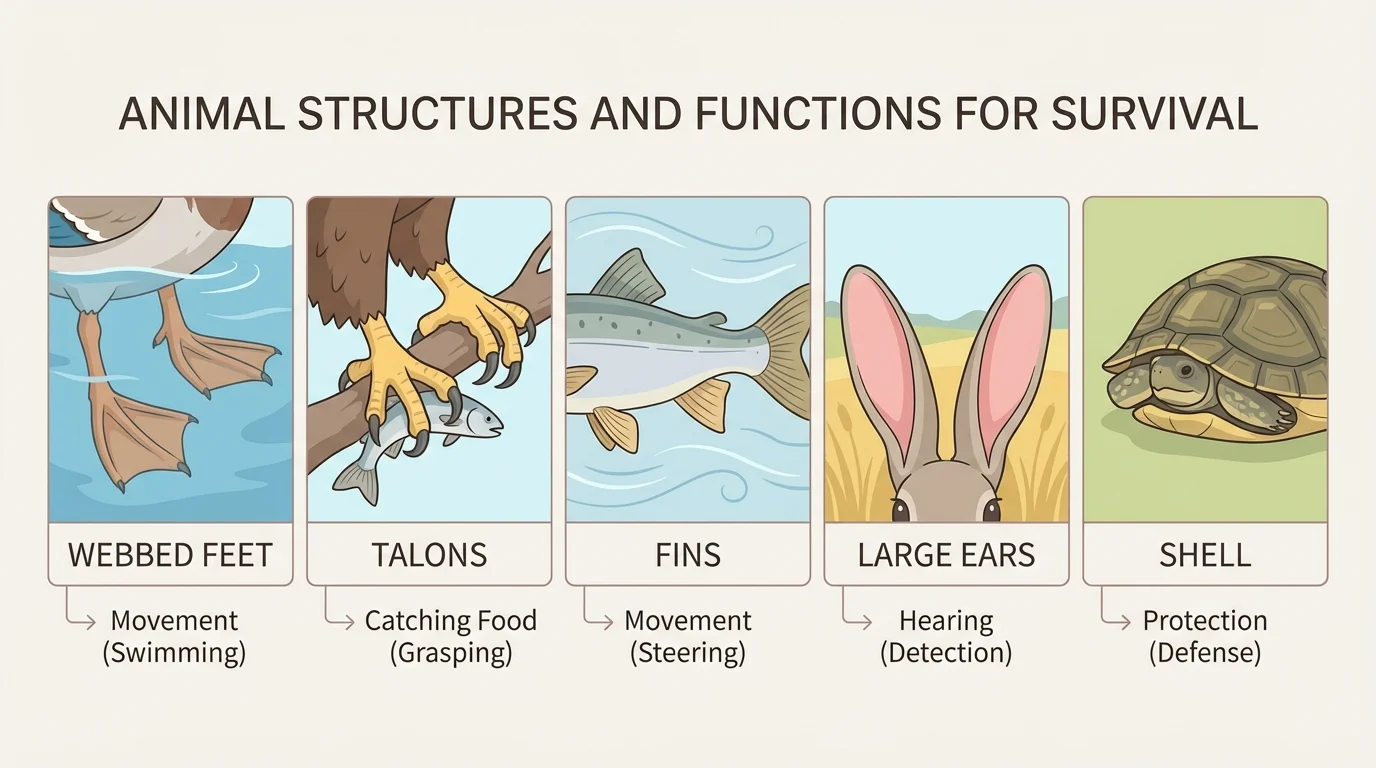
Animals also have structures that help them sense the world. Large ears can help animals hear faint sounds. Big eyes may help animals see well in the dark. Whiskers can help some animals feel objects nearby. These structures support behaviors such as hunting, hiding, and finding shelter.
Internal structures matter as well. Bones support the body and help animals move. A bird's skeleton supports its wings. A fish has internal support that helps its body keep its shape while swimming. Even though we cannot always see internal parts directly, they are still major structures that help survival and movement.
Different environments lead to different animal structures. Fish have fins for moving in water. Birds have wings for flying. Camels have broad feet that help them walk on sand. Polar bears have thick fur and wide paws for cold, snowy habitats. The structure fits the job.
Reproduction is not only about making offspring. In many animals, body structures also help protect eggs or care for young. These structures increase the chance that babies will survive.
Birds use beaks and claws to build nests and care for chicks. A penguin's body covering helps keep eggs or young warm in a cold environment. Female kangaroos have pouches that protect and carry their young while they continue to develop. These are strong examples of structures supporting reproduction and survival at the same time.
Example: arguing from evidence about bird beaks
Claim: A bird's beak helps it survive and care for its young.
Step 1: Observe the structure.
A bird's beak is hard, pointed, and shaped for picking up food.
Step 2: Gather evidence.
Parent birds use beaks to collect worms, seeds, or insects and bring them to chicks in the nest.
Step 3: Explain the reasoning.
If the beak helps the parent get food and feed the chicks, then the beak supports both survival and reproduction.
Some animal structures also help attract mates or compete for them. Deer antlers, peacock tail feathers, and frog calls produced using throat structures can play roles in reproduction. The key idea is that visible structures often do more than one job.
Plants and animals are different, but both have structures with functions. Both need support, protection, resources, growth, and reproduction. The exact structures differ, but the basic needs of living things connect them.
| Living thing | Structure | Main function |
|---|---|---|
| Plant | Roots | Take in water and anchor the plant |
| Plant | Stem | Support the plant and hold leaves up |
| Plant | Leaves | Capture sunlight for making food |
| Plant | Flower | Help reproduction by attracting pollinators |
| Plant | Fruit | Protect and spread seeds |
| Animal | Wings | Help movement through air |
| Animal | Fins | Help movement through water |
| Animal | Shell | Protect the body |
| Animal | Teeth or beak | Help get and eat food |
| Animal | Fur or feathers | Protect and help control body temperature |
Table 1. Examples of plant and animal structures and the functions they perform.
Sometimes different organisms solve the same problem with different structures. A tree uses bark for protection, while a turtle uses a shell. A bird uses wings for movement, while a fish uses fins. A sunflower uses bright petals to attract pollinators, while some animals use bright feathers or body parts to attract mates. Different structures can serve similar purposes.
The comparison in Table 1 becomes even clearer when you look back at [Figure 2]. The duck's feet, eagle's claws, fish's fins, rabbit's ears, and turtle's shell all show that shape and function are connected. That is one of the most important ideas in life science.
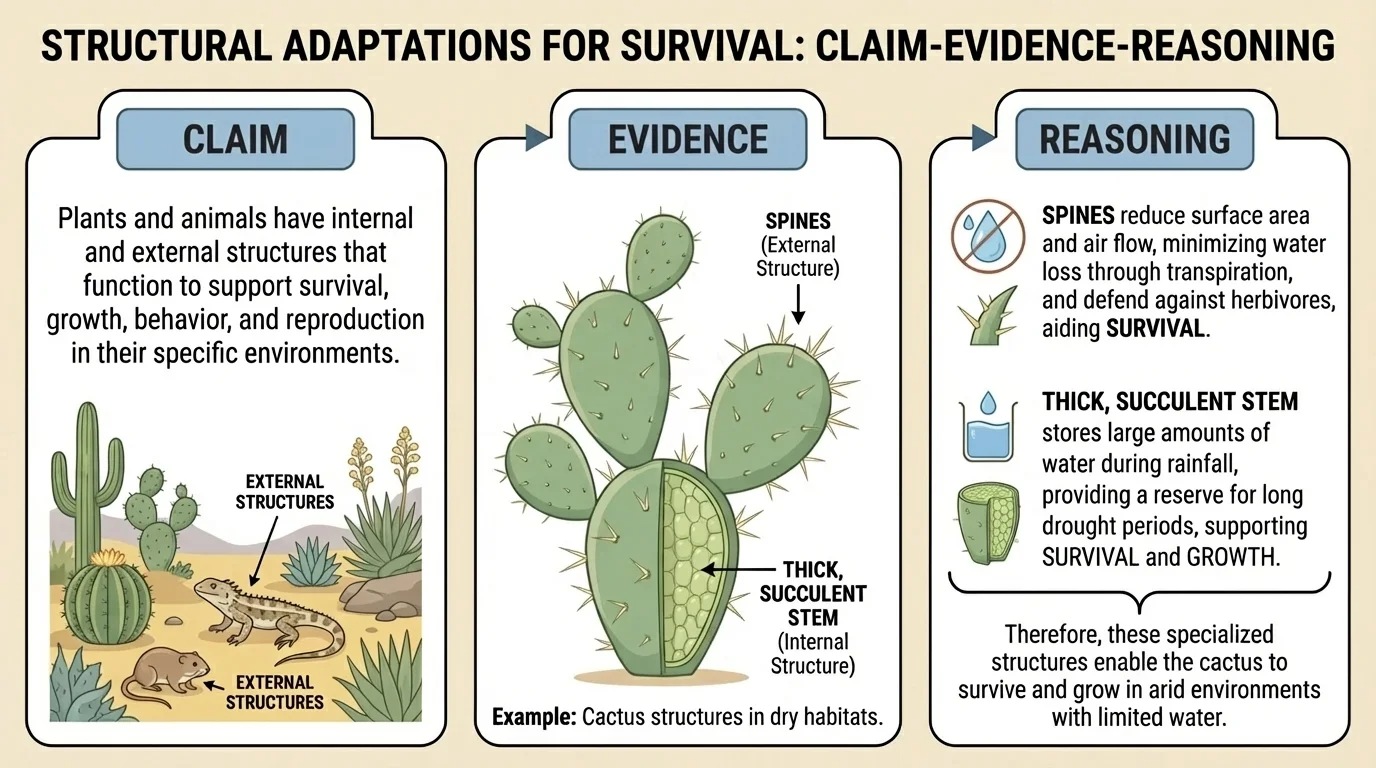
Scientists support ideas with observations, and [Figure 3] presents a clear way to organize those ideas into a claim, evidence, and reasoning chart. This helps us move from "I think so" to "I can explain why."
Suppose you want to argue that a cactus has structures that help it survive in the desert. Your claim might be: "A cactus's structures help it survive in a dry habitat." Then you need evidence. You could observe that the cactus has a thick stem and sharp spines. Then you add reasoning: the thick stem stores water, and the spines help protect the cactus and reduce water loss.
Here is another example. Claim: "A duck's external structures help it survive and behave in water." Evidence: it has webbed feet and feathers coated to resist water. Reasoning: webbed feet help it paddle, and its feathers help it stay dry and warm. Therefore, these structures support survival and behavior.
Example: building an argument about a tree
Step 1: Make a claim.
A tree has structures that support survival, growth, and reproduction.
Step 2: Add evidence.
The tree has roots, bark, leaves, flowers, and seeds.
Step 3: Explain the reasoning.
Roots take in water and hold the tree in place. Bark protects the trunk. Leaves gather sunlight. Flowers and seeds help the tree reproduce. Because each structure has a helpful job, the evidence supports the claim.
A strong argument names the structure, tells what it does, and connects that function to survival, growth, behavior, or reproduction. Short answers can be correct, but detailed answers are more convincing because they include stronger evidence.
This idea matters outside science class. Farmers and gardeners need to understand plant structures to help crops grow well. If roots need space and water, soil conditions matter. If flowers help plants reproduce, pollinators such as bees matter too. Looking at a plant's leaves, stems, and fruits can help people decide how to care for it.
Animal shelters, veterinarians, and wildlife experts also use structure-function ideas. A bird with an injured wing may not be able to fly or escape danger. A turtle with shell damage may be less protected. A dog's teeth, legs, ears, and coat all give clues about its health and needs.
Living things interact with their environment. Structures are one reason they can do that. A structure is useful because it helps an organism meet needs in its habitat.
People who protect habitats think about structures too. If a wetland is damaged, ducks may lose the places where their webbed feet and feeding behaviors work best. If a forest is cut down, squirrels may lose the trees that support climbing and nesting. Structure and environment fit together.
The cactus example in [Figure 3] also connects to real life. Gardeners in dry places choose plants with thick stems, waxy coverings, or small leaves because these structures help plants handle heat and little rainfall. Understanding visible structures helps people make better decisions.
When you look closely at a living thing, you can ask powerful questions: What structures does it have? What jobs do those structures do? How do those jobs help the organism survive, grow, behave, and reproduce? These questions help you build strong scientific explanations from the evidence you can actually observe.
