A deer in a forest may suddenly freeze when it hears a tiny crack of a twig. A dog may rush toward the door when it smells food. An owl may turn its head toward a faint sound in the dark. These actions may look very different, but they all follow the same big idea: animals take in information, their bodies and brains work with that information, and then they respond. This is one of the most important ways animals stay alive.
Animals are always surrounded by information. Light, sound, smells, tastes, temperature, movement, and touch all give clues about what is happening nearby. Food, danger, family members, shelter, and changes in the environment can all be detected through the senses. To understand animal behavior, we can ask three simple questions: What information did the animal receive? How was it processed? What response followed?
Animals have body parts that help them gather information. Some of these are external structures, such as eyes, ears, noses, whiskers, skin, beaks, and antennae. Other parts are internal structures, such as the brain and nerves, which help handle the information and guide the body's actions. Together, these structures support life, growth, and behavior.
Senses are ways animals gather information from the environment, such as seeing, hearing, smelling, tasting, and touching.
Brain is the organ that processes information and helps control responses.
Response is what an animal does after receiving and processing information.
Model is a simple representation used to explain how something works.
When scientists study animal behavior, they often use models because a model helps make a complex process easier to understand. A model does not include every tiny detail. Instead, it shows the most important parts and how they connect.
If an animal could not gather information, it would have a hard time finding food, avoiding danger, or caring for its young. A bird must notice seeds on the ground. A fish must detect movement in the water. A squirrel must hear the sound of a predator. Senses help animals learn what is happening around them right now.
Sometimes the same kind of information leads to different responses. For example, the smell of another animal may mean food to a wolf, but it may mean danger to a rabbit. This shows that animal responses are not all the same. The information enters through the senses, but the animal's brain helps organize the response in a way that fits that animal's needs.
Even young children know that people use their senses every day. Animals do too, but many animals are especially strong in one sense. A dog's sense of smell is much stronger than a human's sense of smell. An eagle can spot prey far away. A cat's whiskers help it notice contact and movement nearby. These examples show how body structures help animals collect useful information.
Some owls can hunt in very low light and can also locate prey by sound. Their bodies are built to collect information in ways that match the way they live.
Because habitats are different, animals need different kinds of information. An animal in the ocean may depend on movement in water, while an animal in the desert may depend strongly on smell, touch, and sight. The environment helps shape which information matters most.
A simple way to understand animal behavior is to use the pattern sense information → brain processing → response. This pattern, shown clearly in [Figure 1], helps explain many animal actions. An animal first detects something in the environment. Next, the brain handles that information. Finally, the animal's body carries out a response.
Think about a rabbit in a field. Its eyes may detect movement, and its ears may detect a sound. Those sense organs gather information and send it to the brain. The brain processes the information and helps decide whether the rabbit should keep eating, stay still, or run away. Then muscles in the legs help the rabbit move.
This is a model because it simplifies what is happening into clear steps. It does not need to explain every tiny part inside the body. It only needs to show that information comes in, is processed, and leads to action.
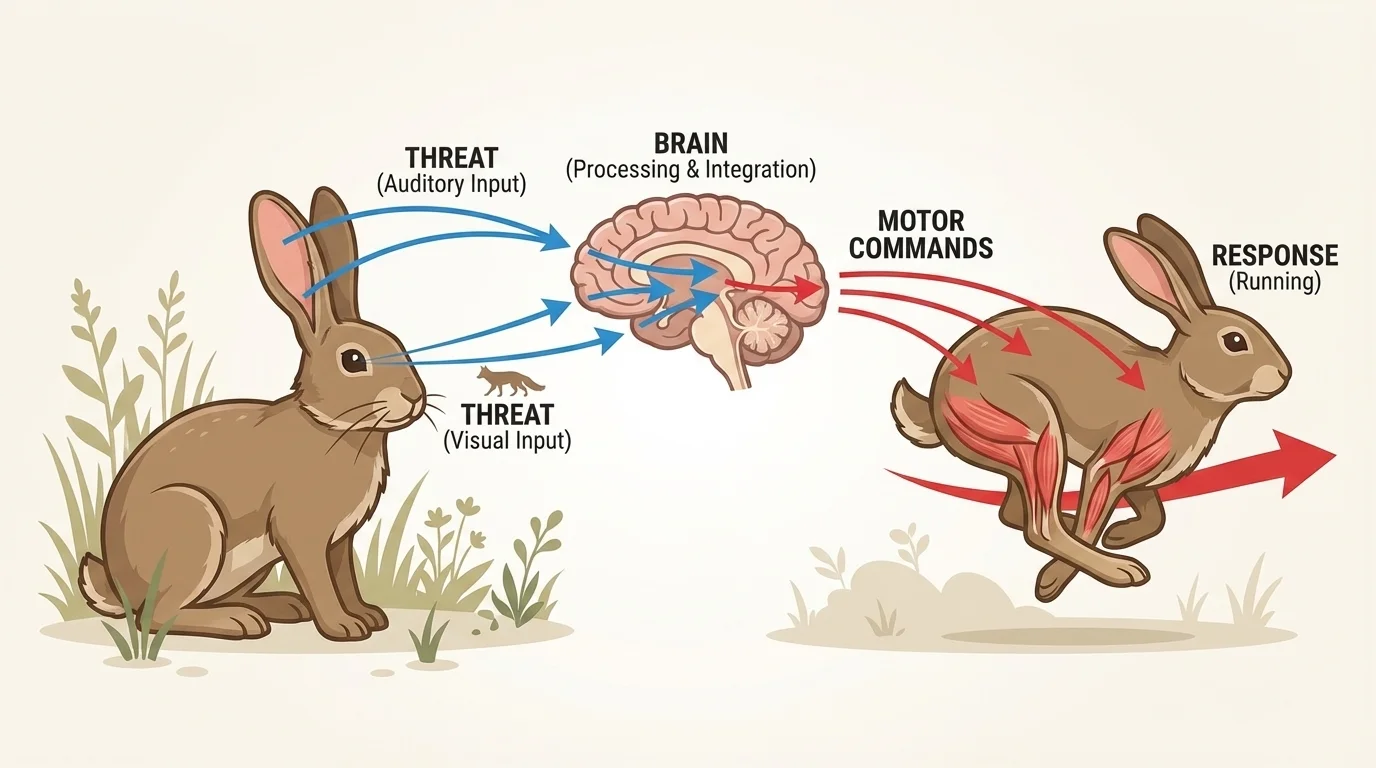
The same model works for many other animals. A frog sees an insect, the brain processes that information, and the frog flicks out its tongue. A bird hears a warning call, the brain processes the sound, and the bird flies away. A seal feels movement in the water, the brain processes it, and the seal turns toward possible prey.
One important idea is that the response can be movement, but it does not have to be. A response might be freezing in place, opening the mouth to eat, making a sound, hiding, or changing direction. As we saw in [Figure 1], the body's action depends on the kind of information and what is best for survival.
Information in, action out
Animals are not simply moving at random. Their bodies constantly collect clues from the environment. The brain uses those clues to guide behavior. This helps the animal act in ways that improve its chances of finding food, staying safe, and living successfully in its habitat.
This process also shows why internal and external structures are both important. Eyes, ears, noses, skin, and whiskers help collect information. The brain helps process it. Muscles and other body parts help carry out the response.
Each sense gathers a different kind of information, as [Figure 2] illustrates. Sight detects light and movement. Hearing detects sound. Smell detects odors in the air or water. Taste detects flavors in food. Touch detects pressure, texture, temperature, and contact.
Animals often use more than one sense at the same time. A raccoon searching for food may use touch with its paws, smell with its nose, and sight with its eyes. A hawk may depend mostly on sight while hunting, but it still uses other senses too.
| Sense | What information it gathers | Example response |
|---|---|---|
| Sight | Light, color, shape, motion | A hawk dives when it sees prey |
| Hearing | Sound, direction, loudness | A deer lifts its head when it hears a snap |
| Smell | Odors from food, other animals, danger | A dog follows the smell of a trail |
| Taste | Flavor of food | An animal spits out harmful food |
| Touch | Pressure, vibration, temperature, contact | A cat pulls back from a hot surface |
Table 1. Different senses gather different kinds of information and can lead to different responses.
Notice that one event can be sensed in more than one way. A fox approaching may be seen, heard, or smelled. That gives an animal several chances to notice danger. This is useful because environments can be noisy, dark, or full of obstacles.
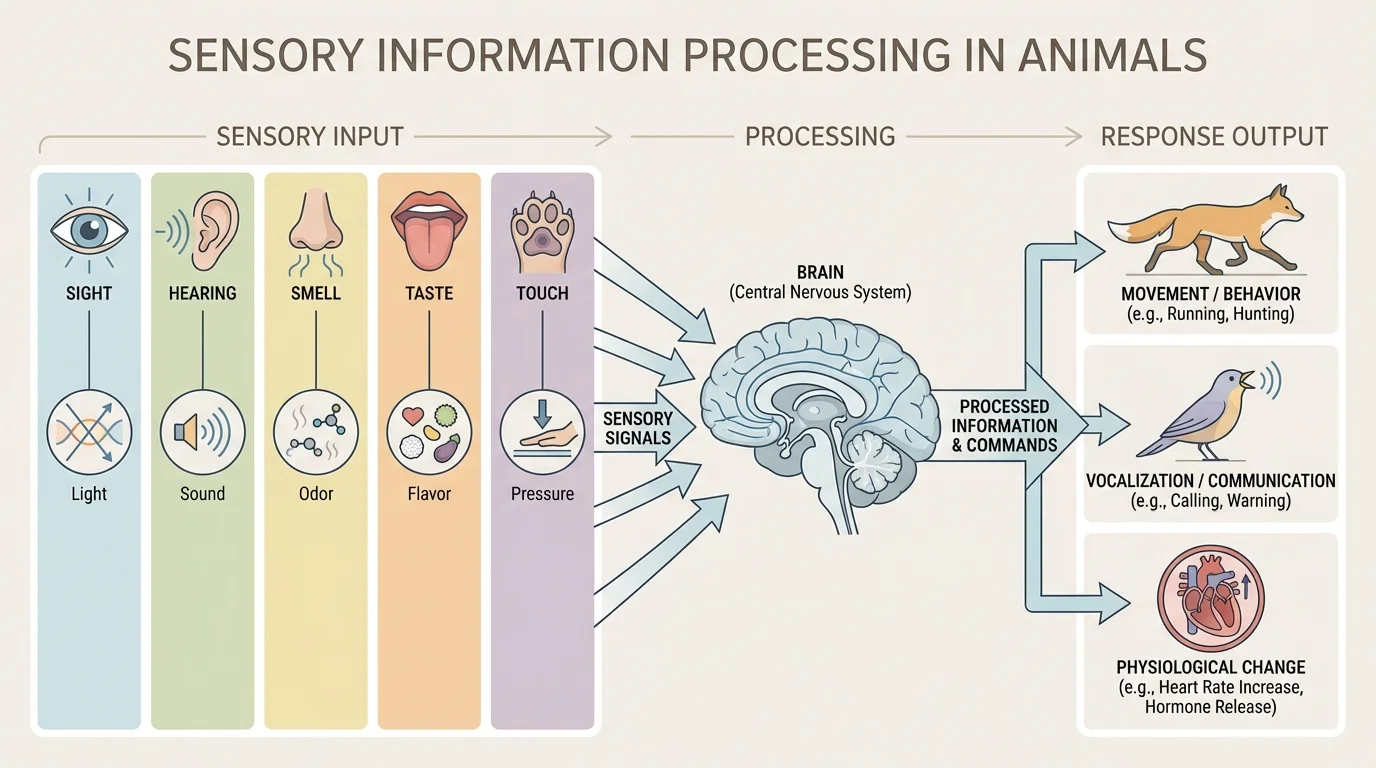
Some animals depend more on one sense than another because of where and how they live. Nocturnal animals, which are active at night, often rely strongly on hearing or smell. Daytime hunters may rely strongly on sight. Aquatic animals may be especially good at detecting movement in water.
Later, when comparing animals, it helps to remember [Figure 2]. The same five major senses exist in many animals, but the strength and use of each sense can be very different.
Animals have special body structures that make certain kinds of sensing more effective, as [Figure 3] shows. These structures help animals gather information that is especially important in their habitats.
An eagle has large, powerful eyes that help it notice prey from far away. Sharp vision is useful for hunting from the sky. A dog has a nose that is excellent for detecting smells, which helps it track animals, find food, and notice changes in its surroundings.
A cat has whiskers that help it sense nearby objects and movement. This is useful in tight spaces or low light. A bat has body structures that help it detect sounds, which supports movement and finding food in darkness.
These differences do not mean one animal is "better" than another. They show that animals are suited to their own ways of life. The structures of the body and the behaviors of the animal work together.
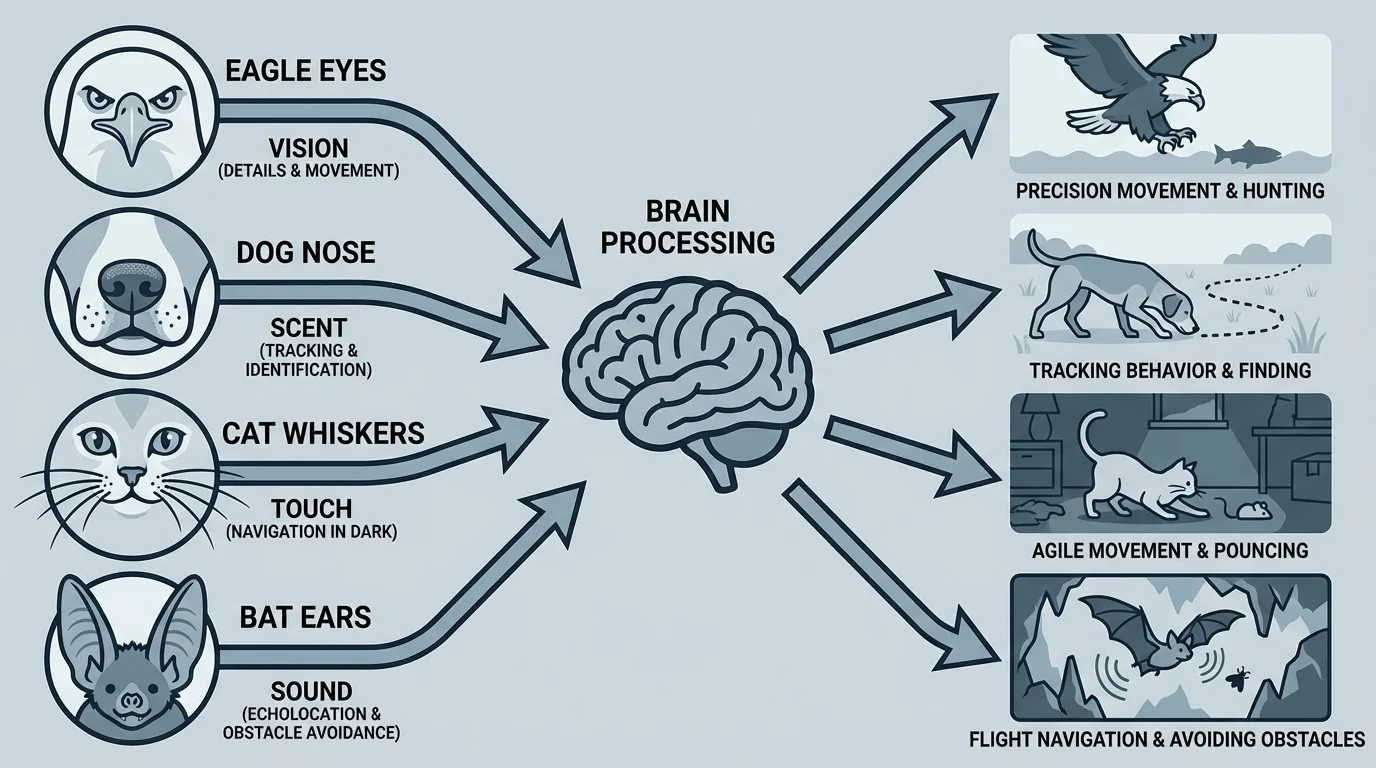
Imagine four animals in the same place at the same moment: an eagle overhead, a dog on the ground, a cat in the bushes, and a bat nearby at dusk. They do not gather exactly the same information in the same way. As seen in [Figure 3], each animal notices what its body is especially good at detecting.
Real-world example: A dog at home
Step 1: The dog smells food from the kitchen.
Step 2: The smell information is processed in the brain.
Step 3: The dog walks, runs, or waits near the kitchen.
This example shows that a response can be guided by smell instead of sight or sound.
Body structures are not just for appearance. They have functions. Ears collect sound. Eyes collect light. Skin senses touch and temperature. Noses gather odor information. The brain helps put this information to use.
Not all responses happen in the same way or at the same speed. Some are very quick. If a fish detects a sudden disturbance in the water, it may dart away almost at once. If a snail is touched, it may pull back into its shell. If a bird hears a loud noise, it may fly off immediately.
Other responses take longer because the animal may keep gathering information before acting. A fox may stop, watch, listen, and smell before deciding where to move next. A squirrel may pause on a branch, look around carefully, and then continue climbing.
This shows that processing in the brain can lead to different kinds of behavior. Sometimes the best response is fast escape. Sometimes the best response is waiting, watching, or approaching carefully. The response depends on the situation.
Living things need information from their surroundings. Earlier science learning about habitats and survival connects here: animals behave in ways that help them get resources and avoid harm.
Animals can also respond to the same information in different ways at different times. A bird that hears another bird's song may fly closer during mating season, but fly away if it hears a predator's call. The sense information matters, but the meaning of that information matters too.
A model is useful when we want to explain behavior clearly. One simple model uses boxes and arrows, as [Figure 4] shows: stimulus or information → sense organ → brain → response. A stimulus is anything in the environment that an animal can detect, such as a sound, smell, touch, or movement.
For example, a deer in the woods may hear a twig snap. In the model, the sound is the information. The ears receive it. The brain processes it. The response may be freezing to listen more or running away. A model helps us explain that sequence in a simple way.
We can use the same model for many cases. A frog sees a fly and jumps. A mouse smells a cat and hides. A penguin hears its chick and moves toward it. A bee sees a flower and lands on it.
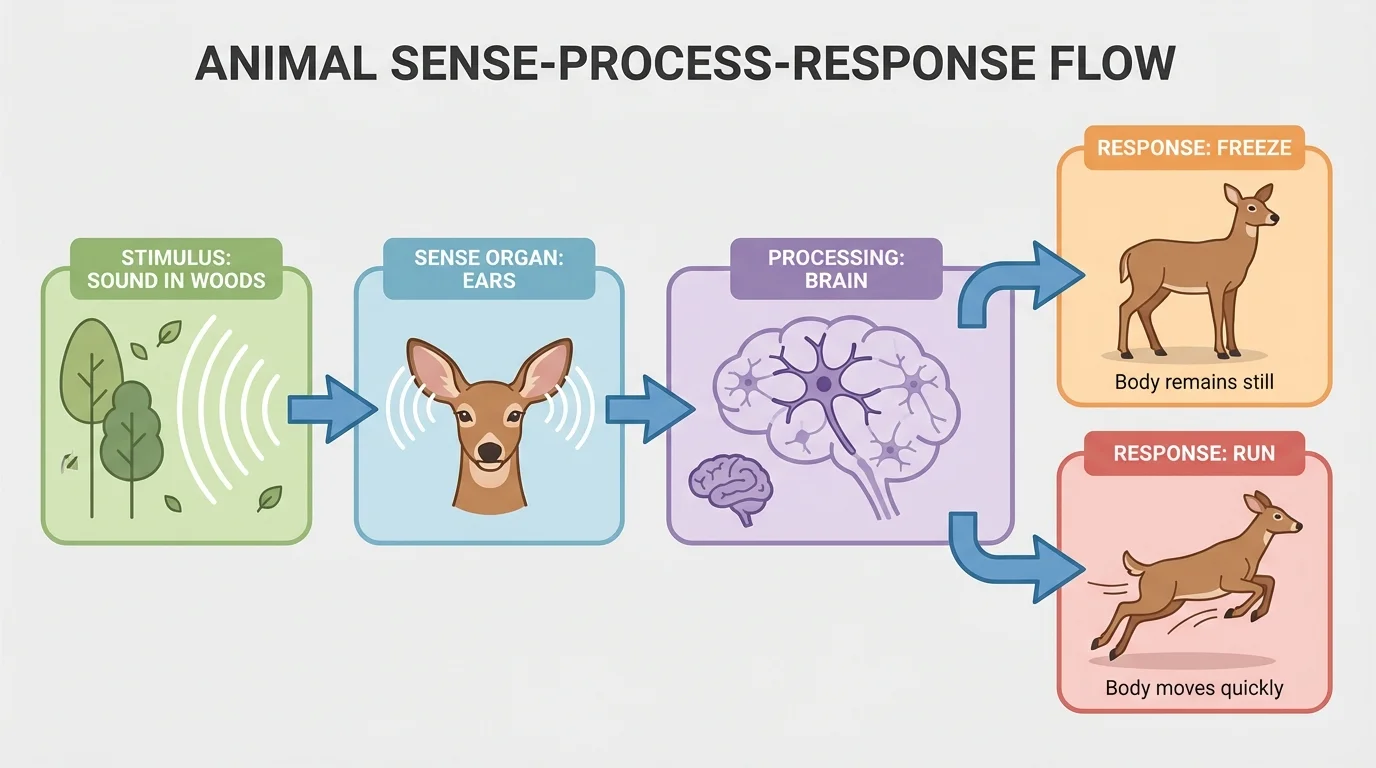
Models are powerful because they can be reused. The details change, but the pattern stays the same. As shown in [Figure 4], information enters, the brain handles it, and a response follows.
Here are several simple models written in words:
Owl: sound of mouse → ears → brain → head turns toward sound.
Shark: smell of food → odor-sensing structures → brain → swims toward source.
Turtle: touch on shell → touch sense → brain → pulls in body.
Horse: sudden movement nearby → eyes → brain → steps away or runs.
One pattern, many behaviors
Animals may eat, hide, run, turn, freeze, chase, or call out, but these different actions can all be explained with the same basic pattern: receive information, process it, and respond. This is why a simple model is so useful in science.
When scientists compare animals, they often ask which structures collect information best, what kind of information matters most, and what responses help the animal survive. This connects body structure to function, which is a major idea in life science.
People use knowledge about animal senses in many ways. Trainers work with service dogs because dogs gather smell and sound information very effectively. Pet owners learn that cats may respond to touch and sound differently than dogs do. Farmers watch animal behavior to notice when animals detect weather changes or possible threats.
Wildlife experts also use this idea. They know that bright lights, loud sounds, or strong smells can change animal behavior. Protecting habitats sometimes means reducing signals that confuse or disturb animals. For example, sea turtle hatchlings can be affected by artificial lights because those lights give information that may lead them in the wrong direction.
Engineers sometimes design tools by studying animals. Cameras inspired by sharp animal vision, sensors inspired by whiskers, and search methods inspired by dogs' smell abilities all connect science to technology. Animal structures and behaviors can give humans ideas for solving problems.
Some rescue teams use dogs because dogs can detect smells that humans cannot notice. The dog gathers information with its nose, the brain processes it, and the dog gives a trained response that helps people.
These real-world examples matter because they show that the study of senses is not only about wild animals. It helps us care for pets, protect wildlife, and create useful technologies.
One misunderstanding is thinking that senses and responses are separate from the rest of the body. In fact, they are connected. External structures gather information, internal structures process it, and body parts carry out the response.
Another misunderstanding is thinking that animals always respond the same way to the same information. They do not. A response can change depending on the animal, the environment, and what the brain determines is most useful at that moment.
It is also important to remember that we are focusing on the big picture, not small internal details. We do not need to study exactly how the brain stores information or exactly how sensory parts work at a microscopic level. For this topic, the important idea is that animals receive information, process it in the brain, and respond in different ways.
When you observe an animal, you can ask: What did it sense? What body structures helped it sense that? What did the brain do with the information? What response followed? Those questions help turn simple observation into scientific thinking.
