Did you know that rocks can tell stories without using any words? A cliff, canyon wall, or road cut may look like a pile of stripes, but those stripes are really clues. They can show that a place was once under water, that a river cut through land, or that wind and rain slowly changed the ground. By looking carefully at patterns in rocks and fossils, scientists can figure out how a landscape changed over long periods of time.
A landscape is the shape and features of an area of land. Landscapes include mountains, valleys, rivers, beaches, plains, and canyons. The Earth's surface does not stay the same. Water, wind, ice, plants, and gravity can all change it. Sometimes these changes happen slowly over many years. The clues for those changes are often locked inside rock layers and fossils.
When scientists study Earth's past, they look for evidence. Evidence is information that helps support an explanation. A scientist does not just guess what happened. Instead, the scientist observes rocks, notices patterns, compares layers, and uses fossils to build a careful explanation.
Look at a hill after a heavy rain. Small channels may form where water runs downhill. Over time, little changes like that can become bigger changes. A stream can carve a valley. Waves can wear away a shore. Wind can move sand from one place to another. If enough time passes, a place can look very different from how it looked before.
Some places that are dry land today were once covered by water. Some places that are now deep valleys may once have been flatter land. Some areas that are now rocky cliffs may have been built up in layers over a long time and then shaped by erosion later. We do not need to know the exact number of years to understand the order of events. We can often tell what happened earlier and what happened later.
From earlier science learning, you may remember that Earth's surface changes because of processes such as weathering, erosion, and deposition. In this topic, the focus is on using clues in rocks and fossils to explain those changes over time.
That idea of order is called relative time. Relative time means telling whether something is older or younger compared with something else. For this lesson, that is the key idea. We are not trying to memorize special rock names or explain every way rocks form. We are reading the clues they leave behind.
One important clue is a rock layer. In many places, rocks appear in layers stacked one on top of another. These layers can be different colors, thicknesses, or textures. Lower layers are usually older than the layers above them, as shown in [Figure 1]. This pattern helps scientists place events in order.
If a cliff has a dark layer at the bottom, a tan layer in the middle, and a red layer at the top, the dark layer is usually the oldest and the red layer is the youngest. That does not tell the exact age in years, but it does tell the sequence. The order matters because each layer formed before the one above it was added.
Scientists also notice when layers are not flat or complete. A layer may be tilted, broken, or partly missing because some rock was worn away. That missing part is also evidence. It suggests that after one set of layers was there, erosion removed some material before more layers appeared later. So even a gap can tell part of the story.
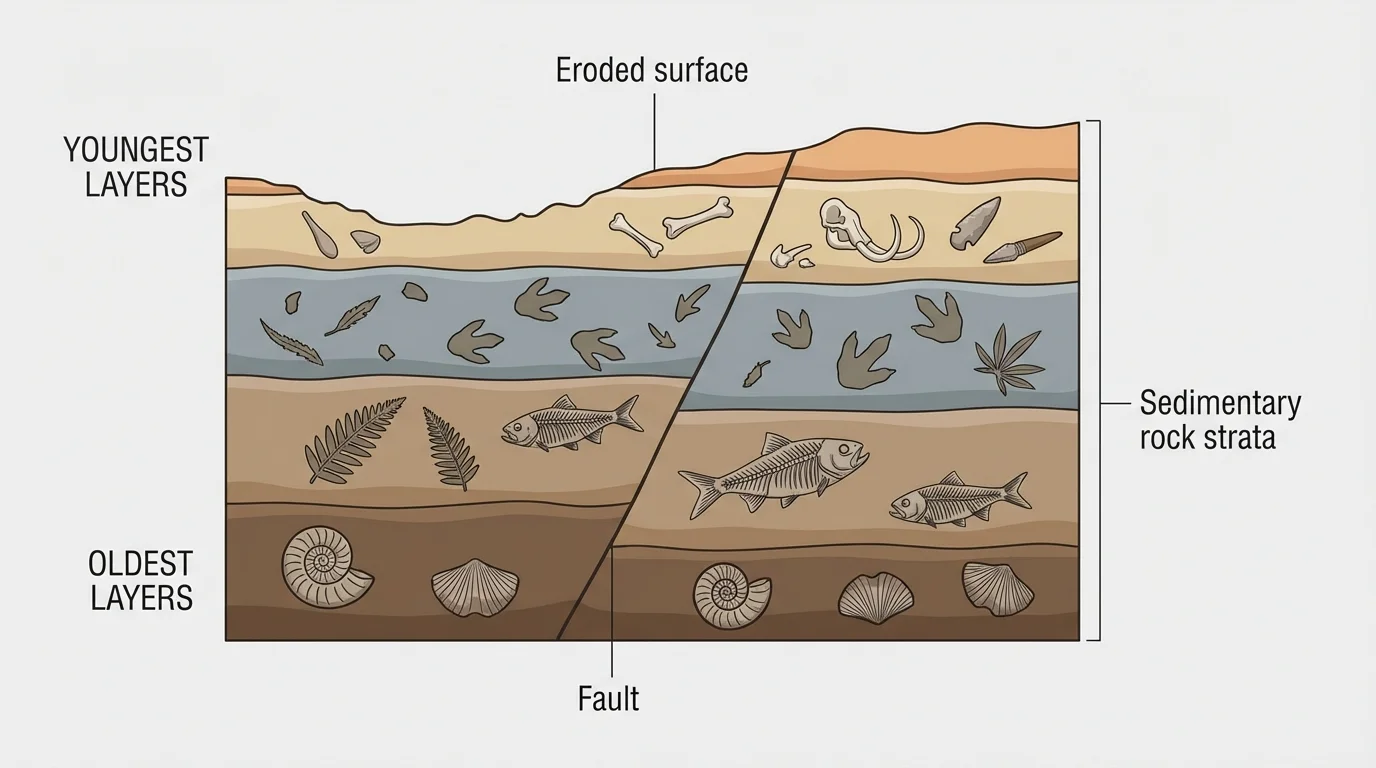
Patterns matter. If the same kind of layer appears in several nearby places at the same height, scientists may infer that the area once had a wider layer spread across it. If part of that layer is gone today, erosion may have removed it. In this way, the present shape of the land can be explained by looking at what remains.
Relative time means putting events in order from older to younger or earlier to later. Erosion is the movement of rock and soil from one place to another by water, wind, ice, or gravity.
A canyon wall is a great example. The sides of the canyon may show many layers that were once part of a larger area. Now a river runs between them. The layers tell us that the rocks were there first, and the cut made by the river happened later. The river did not create the lower layers after the canyon appeared. Instead, the canyon formed after the layered rocks already existed. Reading from bottom to top helps us think through the order of events.
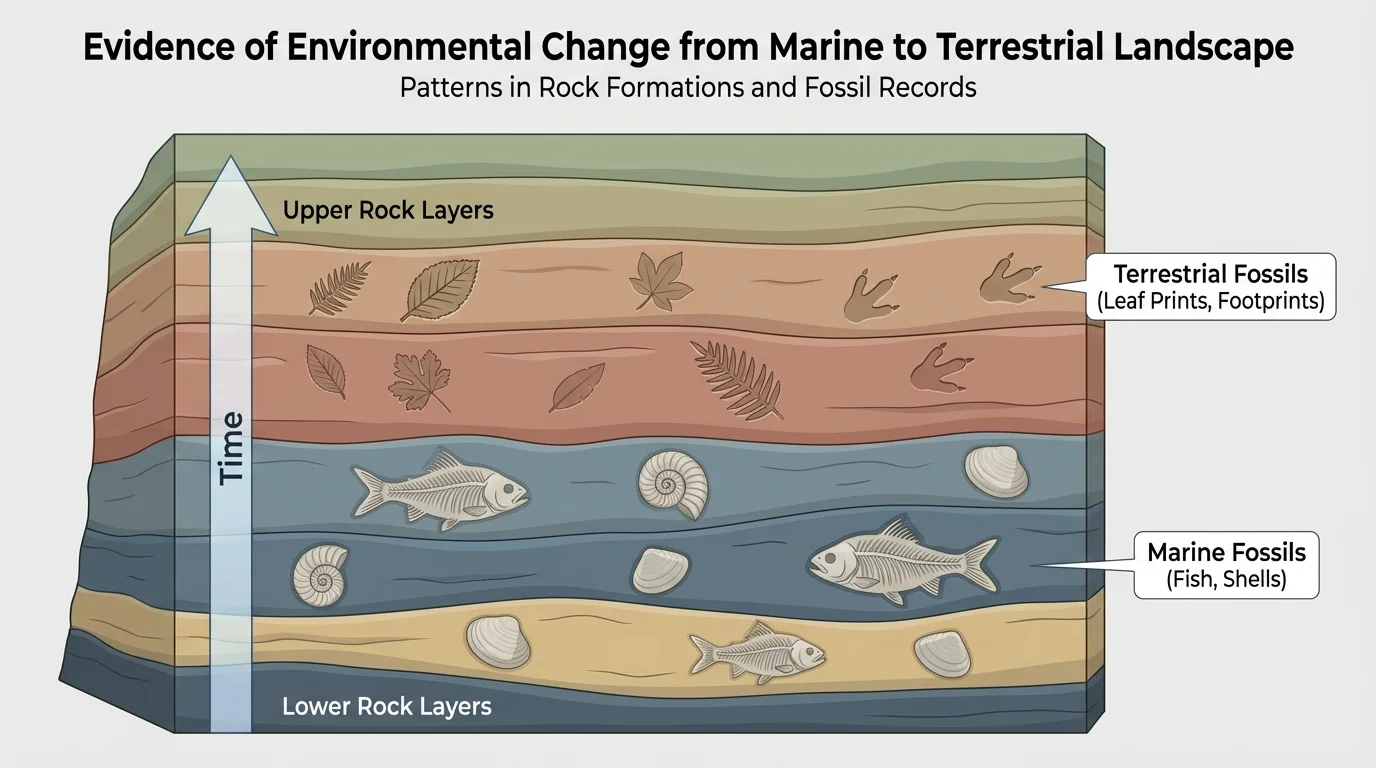
Another powerful clue is a fossil. Fossils are the remains or traces of living things from long ago. A fossil might be a shell, a bone, a leaf print, or a footprint. Fossils help scientists understand what kinds of living things were in a place when a layer formed, and they also help reveal what that environment was like, as shown in [Figure 2].
For example, if a rock layer contains fish fossils or shell fossils, that is evidence the place may once have been underwater or near water. If a higher layer contains plant prints or land-animal footprints, that is evidence the area later became more like dry land. These fossils do not just identify living things. They help tell the story of changing environments.
Fossils found in different layers can also show change over time. If shell fossils are in lower layers and no shell fossils are in upper layers, the environment may have changed. Perhaps water covered the area earlier, but later the water moved away, the land rose, or sediments built up until the place became dry land. Scientists compare the kinds of fossils and where they are found in order to support these explanations.
It is important to connect the fossil to the rock layer around it. A shell fossil lying loose on the ground could have been moved. But a shell fossil still inside a lower rock layer is stronger evidence. It tells us about that layer's past environment. Scientists trust evidence more when they know exactly where it came from.
Some fossils are not body parts at all. A footprint, tunnel, or leaf impression can be a fossil too. These trace fossils give clues about how living things moved or lived in the past.
Suppose a hillside has lower layers with many shell fossils and upper layers with plant fossils. A scientist can support the explanation that the hillside area changed from a watery environment to a land environment. That explanation uses patterns in both the layers and the fossils. The strongest explanations often use more than one kind of clue.
Rock layers and fossils are most useful when we combine them. A single clue may tell only part of the story, but several clues can support a stronger explanation. Scientists often ask questions such as: Which layer is older? Which layer is younger? What fossils are found in each layer? What does that suggest about the environment? Has erosion changed the shape of the land since those layers formed?
Imagine an area with three visible layers. The bottom layer has shell fossils. The middle layer has no fossils but is partly worn away. The top layer has plant prints. A strong explanation would be that the bottom layer formed first in or near water, then erosion affected the area, and later a younger layer formed in a land environment. This explanation follows the evidence instead of making a random guess.
Building an explanation from patterns means looking for repeated clues and using them together. If lower layers are older, and those lower layers contain aquatic fossils, while younger layers above contain land fossils, the pattern supports the idea that the environment changed over time.
Scientists also compare nearby places. If one cliff and another cliff have similar lower layers with similar fossils, those places may have shared part of the same history. If one place has a valley cutting through the layers, the valley is younger than the layers it cuts through. That is because the layers had to exist before the valley could be carved into them.
When you explain a landscape change, use words that show order: first, next, later, older, and younger. Those words help keep the explanation clear. Earth science often depends on ordering events correctly.
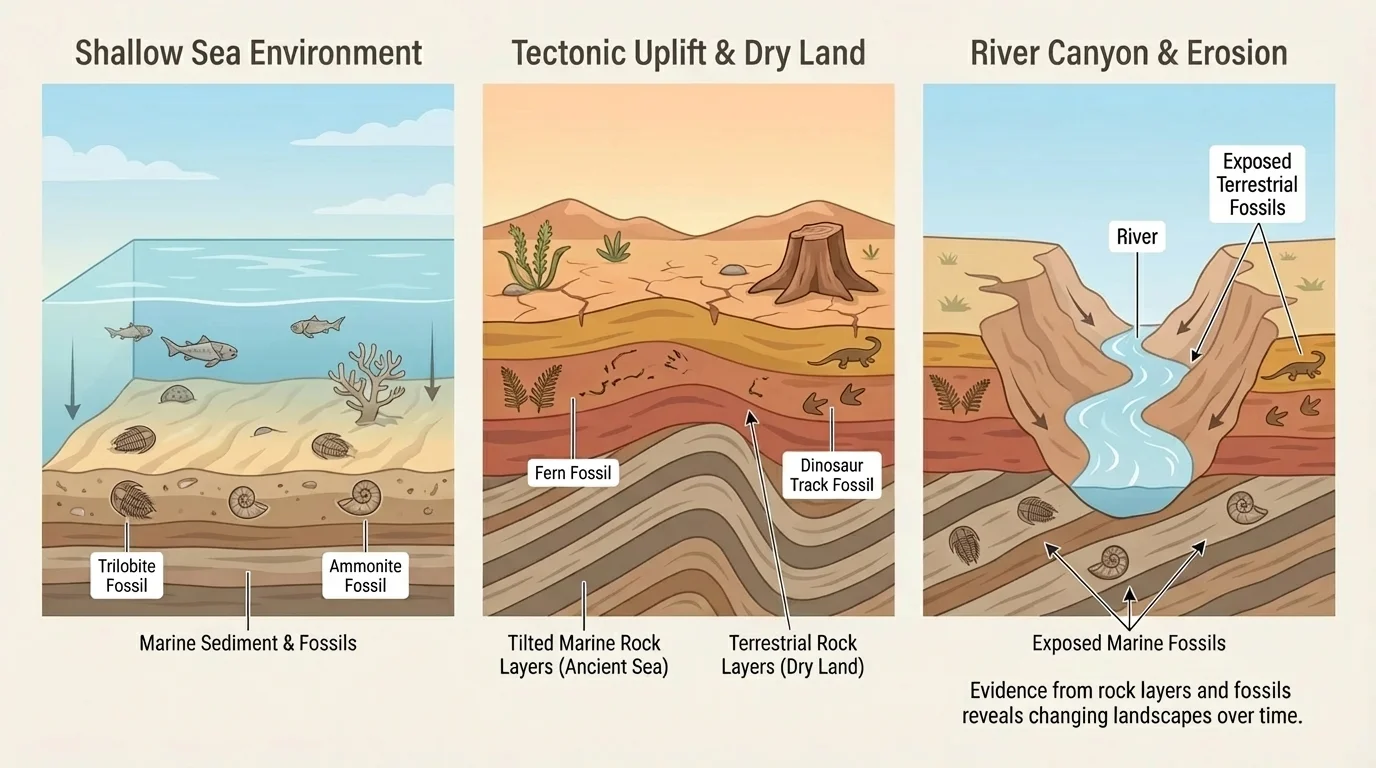
One common example is finding shell fossils far from today's ocean, as [Figure 3] illustrates. A place can be dry land now but still contain shell fossils in older rock layers. That evidence supports the explanation that the area was once covered by water or located much closer to a body of water in the past, and then changed over time.
Another example is a river valley. If layered rocks are visible on both sides of the valley, the layers likely existed before the river cut down through them. The river's action happened later. The landscape changed from a more connected area of rock to a lower valley between higher sides.
Canyons are especially good places to read Earth's story. Their walls reveal many layers at once. Scientists can look from bottom to top and notice changes in color, thickness, and fossils. Then they can explain that the land was built up in layers over time and shaped later by erosion. A canyon is like a giant open book made of stone.
Case study: Explaining a changing place
A student observes a road cut with four layers. The lowest layer has shell fossils. The two middle layers have no visible fossils. The top layer has plant prints, and a small stream has cut into all four layers.
Step 1: Identify the order of the layers
The lowest layer is the oldest. The top layer is the youngest.
Step 2: Use the fossils as clues
Shell fossils suggest the oldest layer formed in or near water. Plant prints in the top layer suggest a land environment later.
Step 3: Explain the stream cut
Because the stream cuts across all four layers, the stream valley is younger than all of them.
Step 4: State the explanation
The place was likely in or near water first, became land later, and then the stream cut into the area after the layers were already there.
Notice that this explanation does not need exact dates. It uses relative time. That fits how geologists often begin: by deciding what happened before and after based on visible evidence.
A beach can also change into another kind of landscape. Sand and shells may collect in one time period, and later the area may become drier and higher. Then rain and streams may carve through it. The clues left in layers and fossils help scientists reconstruct that history. The sequence in [Figure 3] makes this idea easier to see because it shows the same place changing from water to land to a carved valley.
Scientists do not simply look once and decide. They observe carefully, record what they see, and compare clues. A good explanation is based on observations that other people can also check. If several students look at the same rock wall, they should be able to point to the same lower and upper layers and notice the same fossils.
Here is a simple way scientists think: observe, identify patterns, and explain. First, they observe what layers and fossils are present. Next, they identify patterns, such as lower layers being older or shell fossils appearing only in certain layers. Finally, they explain how the landscape changed in a way that fits the evidence.
| Clue | What it may show |
|---|---|
| Lower rock layer | Usually older than the layer above it |
| Upper rock layer | Usually younger than the layer below it |
| Shell or fish fossil in a layer | The area may once have been in or near water |
| Plant print or land footprint in a layer | The area may once have been dry land |
| Valley cutting through layers | The valley formed after the layers were already there |
| Partly missing layer | Erosion may have removed rock before later changes happened |
Table 1. Common clues in rock layers and fossils and what they can suggest about landscape change.
Words like support and suggest are important in science. Evidence supports an explanation. It does not mean every explanation is the only possible one at first. Scientists may gather more evidence and improve their ideas. But the explanation must match the clues that are actually present.
"The Earth has a history, and the rocks help us read it."
If someone says, "This land was always dry," but the lower layers contain many shell fossils, the evidence does not support that claim. A better claim would be, "This area was once underwater or near water and later became dry land." Good science explanations are tied directly to what can be observed.
Learning to read rock and fossil evidence is useful beyond science class. It helps people understand the ground they build on, the places they live, and the natural history of their community. Road builders, park scientists, and museum experts all use evidence from the Earth to learn about the past.
It also helps us appreciate that Earth is always changing. The playground, beach, hill, or river near you may not look the same far in the future. Slow changes can add up. The clues in rocks remind us that even when Earth seems still, it has a long story of change.
When you look at layered rocks now, try thinking like a scientist. Which layer is older? Which is younger? Are there fossils? What kind? Is there evidence that water or wind changed the land later? These questions turn a rock wall into a record of landscape change.
