Every time a light turns on, a bus moves down the street, or a stove heats food, something important is happening behind the scenes: people are using energy from Earth's natural resources. That may sound surprising, because flipping a switch feels simple. But the energy we use each day often begins far away in sunlight, moving air, flowing water, trees, coal, oil, or natural gas. Learning where energy comes from helps us understand something even bigger: the choices people make about energy can help or harm the environment.
Energy is the ability to make things happen. Energy can make things move, heat up, light up, or produce sound. A lamp uses energy to shine. A toaster uses energy to make bread warm and crisp. Your body uses energy from food so you can run, think, and play.
People need energy every day. We use it to cook meals, charge devices, ride in cars and buses, keep buildings warm or cool, and power schools and hospitals. Energy is useful, but it does not just appear by itself. Humans must get it from sources found in nature.
Natural resource means something people get from nature and use. Natural resources include water, air, sunlight, soil, trees, coal, oil, and natural gas.
Fuel is a material people use to provide energy. Some fuels come from plants, and some come from materials found underground.
Some natural resources are used directly. For example, sunlight can warm your skin and brighten a room. Wind can push a sailboat. Flowing water can turn large machines that help make electricity. Other natural resources become fuels that people burn or process to do useful work, such as heating buildings or helping vehicles travel.
Scientists often group natural resources into two big categories, as [Figure 1] shows: renewable resources and nonrenewable resources. A renewable resource can be replaced by nature in a fairly short time or is always available when conditions are right. Sunlight, wind, and moving water are examples. Trees can also be renewable when people replant and manage forests carefully.
A nonrenewable resource takes a very long time to form in nature. Coal, oil, and natural gas are in this group. Once large amounts are used, they cannot be replaced quickly on a human timescale. That means people need to think carefully about how much they use.
Some fuels come from plants or other living things. Wood is one example. Another is biomass, which is plant or animal material used as fuel. Some fuels come from resources underground, such as coal, oil, and natural gas. These fuels have been used for a long time because they can provide a lot of energy.
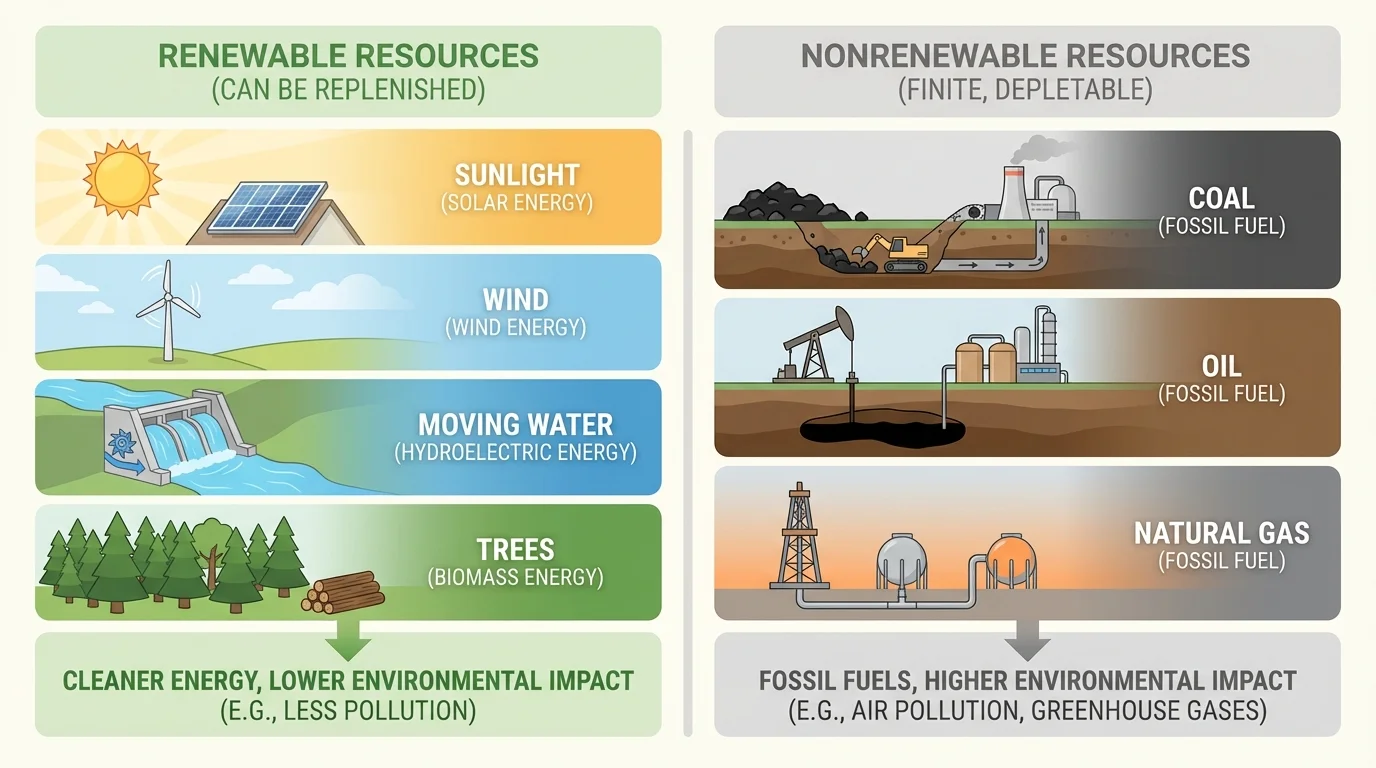
It is important to remember that "renewable" does not always mean "no impact." Cutting too many trees can damage habitats. Building structures to capture wind or water can change places where animals live. Even so, renewable resources can often be used again and again more easily than nonrenewable ones.
Some communities get much of their electricity from moving water, while others use wind or sunlight more often. Different places can use different natural resources to meet their energy needs.
People choose fuels and energy sources for many reasons. They think about cost, how easy the source is to use, how much energy it provides, and how it may affect the environment. These choices are part of science and engineering because people are solving real problems about how to power homes, schools, and cities.
[Figure 2] helps show that you may not see the natural resource when you use energy, but it is still there in the story of that energy. At home, a light bulb may use electricity that comes from moving water, wind, sunlight, or fuels such as natural gas. A car may run using fuel made from oil. A stove may use electricity or natural gas. These paths from resource to use are easier to compare in the flowchart below, which links natural sources to things students see every day.
At school, energy helps run computers, lights, heaters, fans, and kitchen equipment. On a cold day, heating systems keep classrooms comfortable. On a hot day, fans or air conditioners may cool the air. A school bus needs energy to move students safely. Even the water fountain may depend on energy if pumps are used.
Transportation uses a great deal of energy. Cars, buses, trucks, trains, airplanes, and ships all need energy sources. Some vehicles use gasoline or diesel made from oil. Some use electricity stored in batteries. Electric vehicles still need electricity from somewhere, so it still matters how that electricity is made.
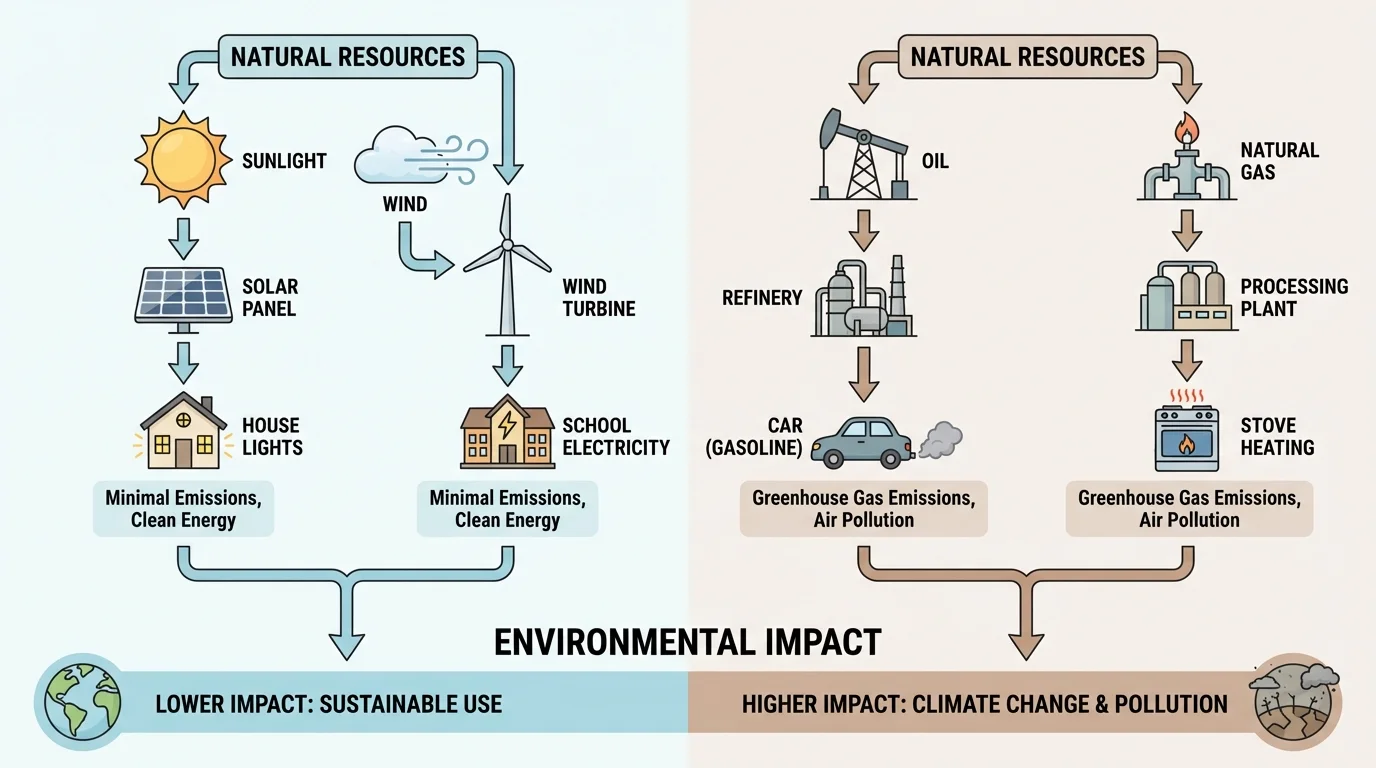
Heating and cooking are also important uses of energy. Families may use electricity to run an oven or microwave. Some homes use natural gas for heating water or cooking food. In some places, people still use wood as a fuel for cooking or warmth. The source may be different, but the idea is the same: energy and fuels come from natural resources.
Energy use is connected to choices
When people decide how to power a home, a school, or a vehicle, they are choosing among natural resources. These choices can affect convenience, cost, and the environment. A source that works well in one place may not be the best choice in another place.
That is why scientists, engineers, city leaders, and families all think about energy. They want enough energy for daily life, but they also want to protect the places where people, plants, and animals live.
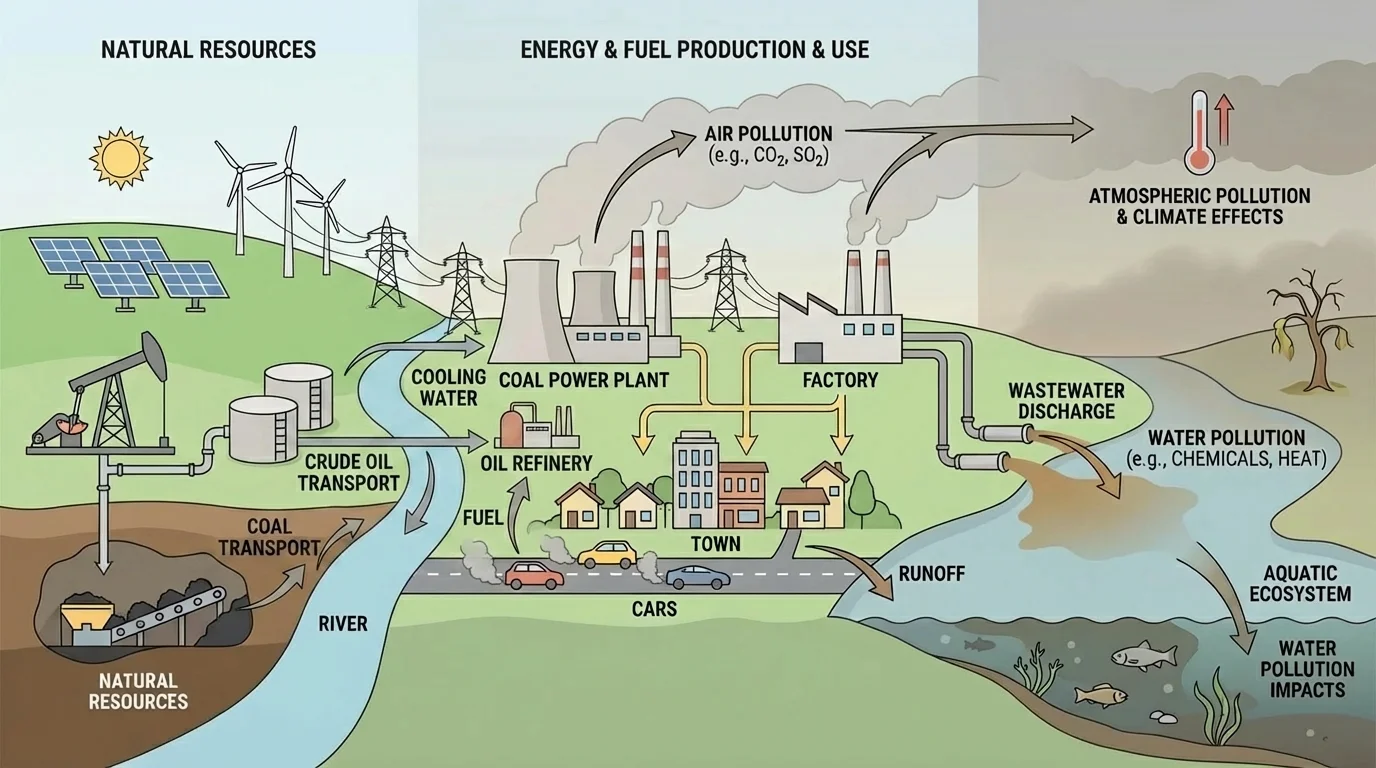
Using energy can affect the environment in many ways, as [Figure 3] illustrates. When some fuels are used, gases and tiny particles can go into the air. Dirty air can make it harder for people and animals to stay healthy. It can also change the quality of the environment around towns and cities.
Some energy use affects water and land. Getting natural resources from the Earth may disturb soil, plants, and animal habitats. Transporting fuels can sometimes lead to spills or leaks that harm water and living things. Building large energy projects can also change habitats, even when the energy source is renewable.
Burning many fuels releases carbon dioxide, written as \(\textrm{CO}_2\). This gas is a normal part of Earth's atmosphere, but too much of it can contribute to climate change. Grade 4 students do not need all the details of the process, but it is important to know that using some fuels can change the air around our planet.
Trash and wasted energy can also hurt the environment. If lights stay on in an empty room, more energy may need to be produced than necessary. If people waste fuel, more natural resources are used up. Saving energy does not just lower bills; it can also reduce pollution and protect resources.
Not every effect is easy to see right away. A person may not notice air pollution when using a single car trip or turning on one lamp. But when millions of people do the same things every day, the effects add up. That is one reason communities work on better energy choices.
Real-world example: one school day
A school uses electricity for lights, computers, kitchen machines, and heating or cooling.
Step 1: Think about the uses.
Lights help students read, computers help students learn, and heating or cooling keeps the building comfortable.
Step 2: Think about the source.
The electricity may come from sunlight, wind, moving water, natural gas, coal, or a mix of sources.
Step 3: Think about the impact.
If the school wastes electricity, more natural resources may be needed. If the school saves electricity, it may lower pollution and protect resources.
This example shows that energy choices connect daily life to the environment.
As seen earlier in [Figure 1], the kind of resource matters too. Using a renewable resource may reduce some problems, while using a nonrenewable resource may increase others. Still, every energy choice should be made thoughtfully.
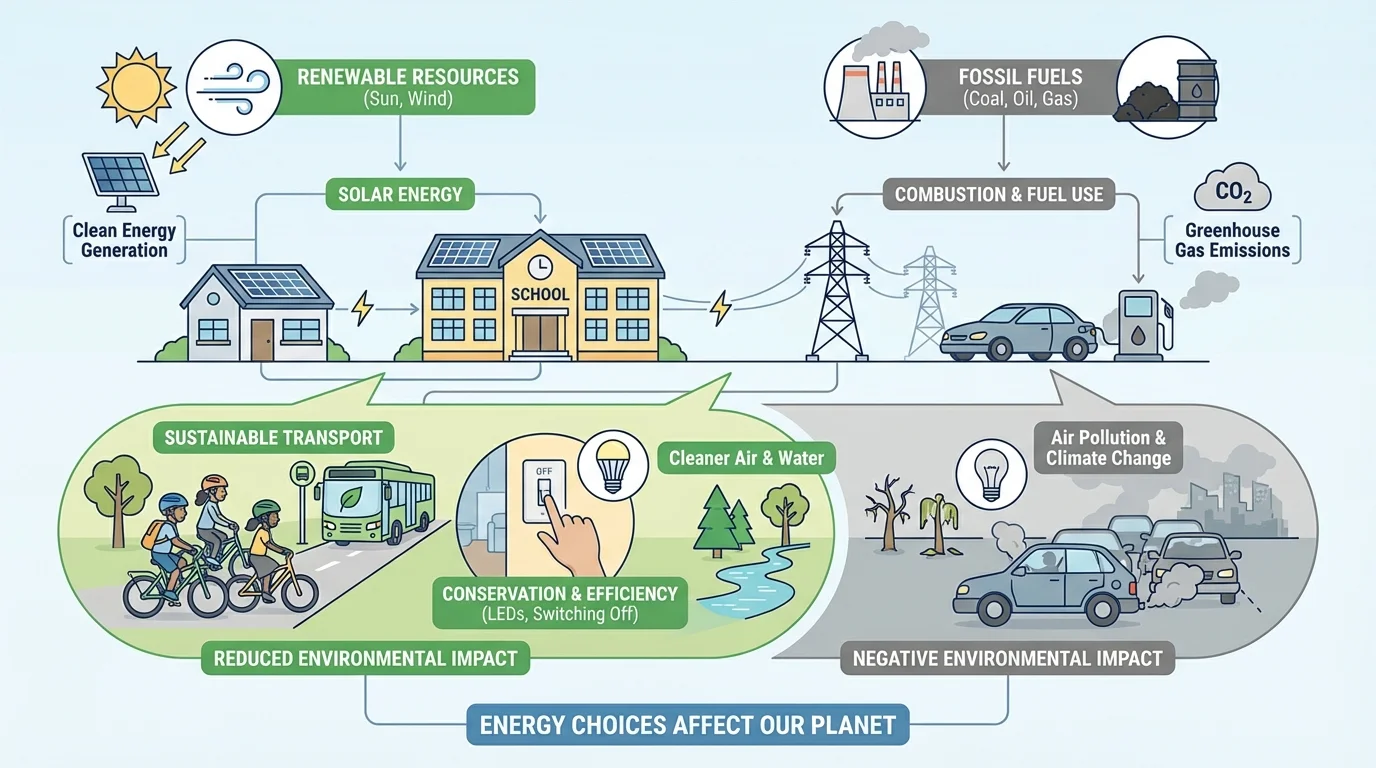
People can lower environmental harm in two main ways: by using cleaner energy sources when possible and by using less energy when it is not needed. Conservation means using resources carefully so they are not wasted. This idea is important for water, forests, soil, and energy.
Examples of conservation are turning off lights in empty rooms, unplugging chargers that are not being used, walking or biking short distances, riding a bus with many other people instead of many separate cars, and using machines or bulbs that need less electricity. These choices are shown in [Figure 4], where homes and schools use energy more wisely.
Renewable energy sources can also help. Solar panels use sunlight. Wind turbines use moving air. Dams and other systems can use flowing water. Some communities use biomass from plants or waste materials. These sources can reduce the use of some nonrenewable fuels, though they still must be managed carefully.
Using less energy does not mean giving up the things people need. It means thinking carefully. A well-insulated building, for example, may stay warm in winter and cool in summer with less energy. A school that uses daylight from windows may need fewer electric lights during the day.
People depend on natural resources for many needs, including food, water, building materials, and energy. Good choices about one resource often help protect others too.
Later, when communities make big decisions, they often compare several ideas: How much energy is needed? Which resources are available? Which choice causes less pollution? Which choice protects habitats better? Science helps people gather and combine information to answer those questions.
There is no perfect energy source. Each one has benefits and drawbacks. Some are easy to use but can pollute more. Some are cleaner during use but depend on weather or location. Looking at a comparison helps us understand why communities often use a mix of energy sources.
| Energy source | Comes from | Common use | Possible environmental effect |
|---|---|---|---|
| Sunlight | The Sun | Electricity, heating | Equipment takes space, but using sunlight can reduce some air pollution |
| Wind | Moving air | Electricity | Turbines can affect some habitats, but wind use can reduce some air pollution |
| Moving water | Rivers and flowing water | Electricity | Can change water habitats |
| Wood and biomass | Plants and organic material | Heating, some fuels | Can create smoke or harm forests if not managed well |
| Coal | Underground rock resource | Electricity | Can cause air pollution and adds \(\textrm{CO}_2\) to the air |
| Oil | Underground liquid resource | Transportation fuels | Can cause air pollution and spills |
| Natural gas | Underground gas resource | Heating, electricity, cooking | Can cause air pollution and adds \(\textrm{CO}_2\) to the air |
Table 1. Comparison of common energy sources, where they come from, how people use them, and some environmental effects.
This table does not mean one source is always good or always bad. It shows that energy choices involve trade-offs. People often gather information from many sources before making decisions.
A family might choose LED light bulbs because they use less electricity than older bulbs. A town might add more buses so fewer cars crowd the road. A school might plant trees near the building to provide shade, which can help reduce the need for cooling. These are examples of people solving problems by thinking about energy and the environment together.
In some places, houses have solar panels on the roof. In other places, wind turbines stand on open land where the wind blows strongly. Communities near rivers may use moving water to help make electricity. As shown before in [Figure 2], the same daily need, such as turning on a light, can be connected to different natural resources.
Communities also work to protect the environment while meeting human needs. They may set rules to keep air and water cleaner. They may study where animals live before building energy projects. They may teach people how to save energy at home and at school. These actions show that science is not just about facts. It also helps people make responsible choices.
"We all use energy, so we all share the job of using it wisely."
Thinking about energy this way helps us become careful citizens. We can ask useful questions: Where did this energy come from? Is it renewable or nonrenewable? How does using it affect air, water, land, plants, animals, and people? What can we do differently?
People need energy to live safely and comfortably. Homes need light and heat. Schools need power for learning. Communities need transportation, hospitals, and communication systems. Natural resources make all of this possible.
But because energy and fuels come from nature, using them always connects us back to the environment. The goal is not to stop using energy. The goal is to understand where it comes from, how it helps us, and how our choices can reduce harm. When people gather information, compare options, and use resources wisely, they can meet their needs and care for Earth at the same time.
That is why learning about energy is so important. It helps us see that even small actions, such as switching off a light, walking instead of riding in a car for a short trip, or supporting cleaner energy choices, can make a real difference over time. As seen in [Figure 4], smart choices by many people together can help build healthier communities and a healthier planet.
