Have you ever noticed that when you toss a ball, jump off a step, or let go of a pencil, the object always moves the same general direction? It goes down. That may seem ordinary, but it is actually one of the biggest clues about how our planet works. Earth is constantly pulling on objects around it, and that pull gives us strong evidence that the gravitational force exerted by Earth on objects is directed down.
Scientists do not just say something is true because it seems obvious. They build arguments using evidence. In science, to support an argument means to use observations, examples, and reasoning to explain why an idea makes sense. In this lesson, the idea we are supporting is that Earth's gravity pulls objects downward, toward the planet.
Everyday life gives us many clues about gravity. If you drop a spoon in the kitchen, it falls to the floor. If rain forms in clouds, the drops fall to the ground. If you jump on a playground, you rise for a moment and then come back down. If a soccer ball is kicked into the air, it eventually returns to Earth.
These events look different, but they share an important pattern: objects near Earth's surface move downward when they are no longer being held up. This repeated pattern is evidence that a force is acting in a downward direction.
Gravity is the pull between objects that have mass. Near Earth's surface, Earth's gravity pulls objects toward Earth.
Force is a push or a pull. Gravity is a pulling force, not a pushing force.
Even objects that are not falling freely still show the effect of gravity. A backpack resting on the floor stays there because gravity pulls it down to the floor. A picture hanging on a wall would fall if the nail stopped supporting it. A leaf drifting from a tree may sway side to side because of moving air, but gravity still pulls it downward the whole time.
[Figure 1] In science, "down" does not mean the bottom of a map or the bottom edge of a page. direction matters: for gravity, down means toward the center of Earth. No matter where you stand on Earth, Earth pulls you and nearby objects inward, toward the planet's center.
This idea helps explain something that can seem confusing at first. People in different parts of the world all say objects fall down, even though they are standing in different positions on Earth. That is because each person's "down" points toward Earth's center from where they are standing.
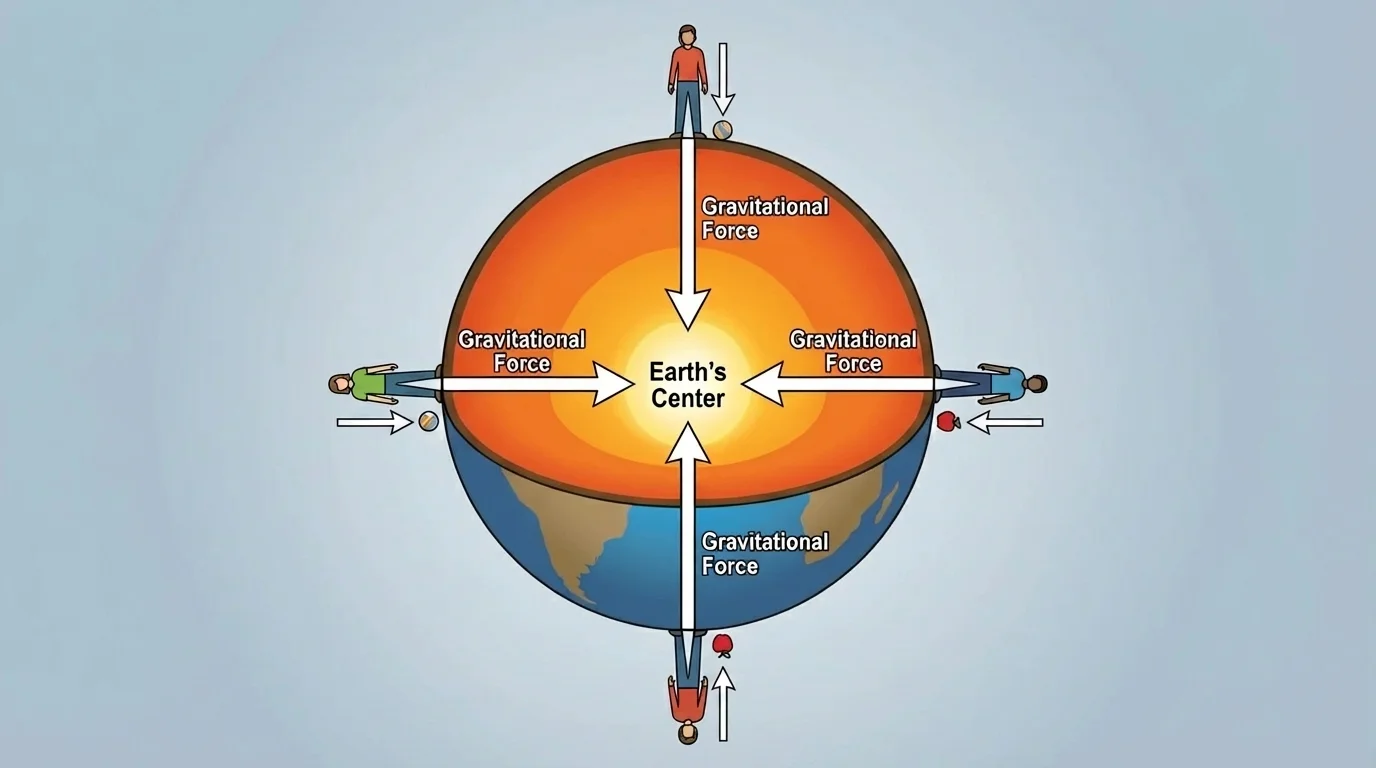
If you stand in Nebraska, your down points toward Earth's center. If someone stands in South Africa, their down also points toward Earth's center. The arrows point in different compass directions on a map, but they all point inward toward the same center. That is why gravity is described as directed down.
You can think of Earth as a huge sphere pulling things toward itself from every side. This is different from saying there is one universal "down" in space. In space, astronauts may float because they are in a different situation. But near Earth's surface, the downward pull is toward the center of Earth, just as we saw in [Figure 1].
Down depends on where you are standing. A person on one side of Earth and a person on another side do not point the same way into space when they point "down." However, both point toward Earth's center. That is the key idea behind the direction of Earth's gravitational pull.
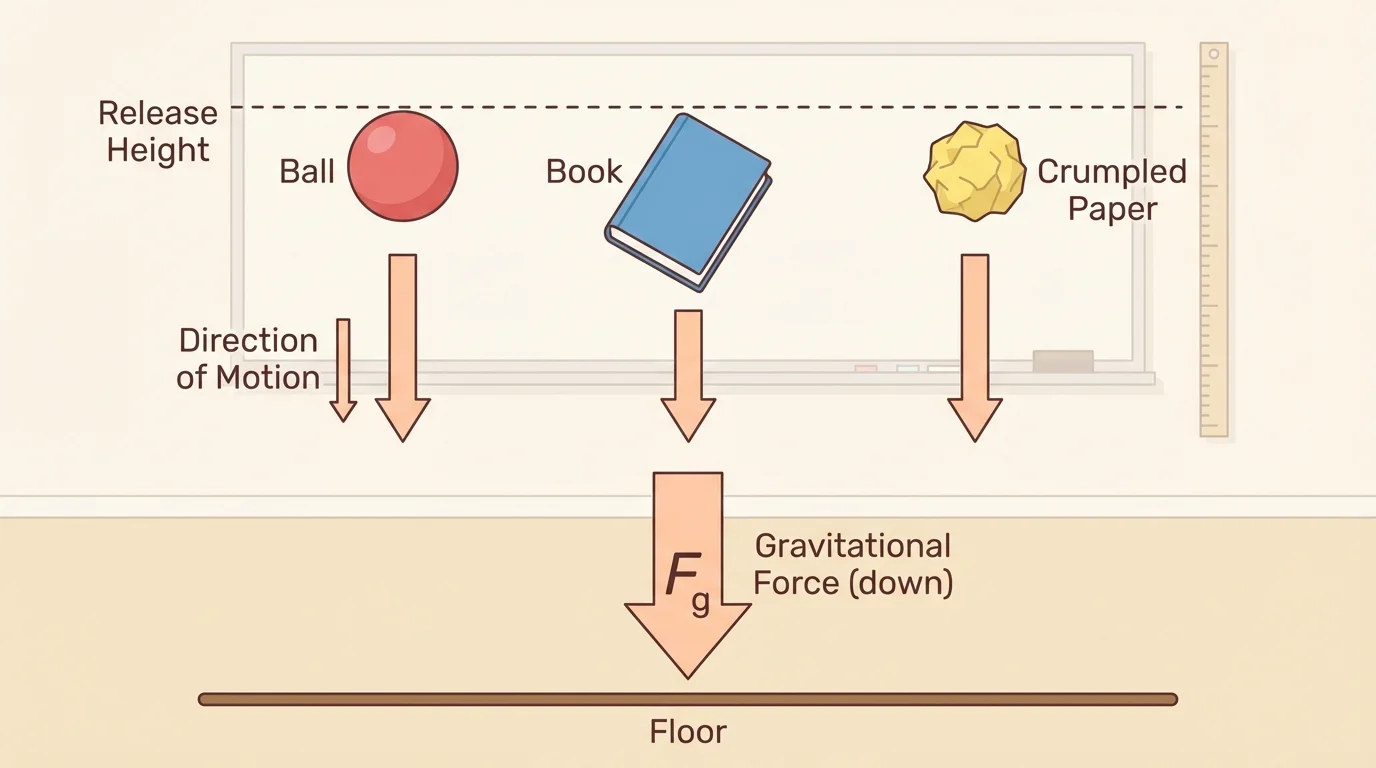
To support a scientific argument, we use evidence from repeated observations. In many simple tests, as [Figure 2] helps illustrate, objects released near Earth's surface move downward. When the same pattern happens again and again, it becomes strong evidence for the direction of gravity.
Suppose you release a ball from your hand. It falls down. Release a book from a low height over a safe surface, and it also moves down. Let go of a set of keys, and they move down too. Different shapes, sizes, and materials still show the same direction of motion when they are released.
This evidence matters because it is not based on just one object. Gravity acts on many kinds of objects: toys, leaves, apples, raindrops, and people. The repeated result supports the claim that Earth's gravitational force is directed down.
You can also gather evidence by watching water. Pour water from a cup, and it moves downward. Waterfalls move downward over cliffs. Snowflakes drift down from the sky. Even though air can blow them sideways, Earth's pull is still downward.
Another clue comes from what happens after an object is thrown upward. A tossed ball rises only for a short time. Then it slows, stops for a moment, and returns downward. That pattern makes sense if gravity is pulling down the whole time. The throw gives the ball an upward start, but Earth's gravitational pull keeps acting downward and changes the ball's motion.
Using evidence to support the claim
Claim: Earth's gravitational force on objects near Earth's surface is directed down.
Step 1: Observe many objects.
Drop a pencil, a ball, and an eraser from the same height. Each one moves downward when released.
Step 2: Look for a pattern.
The objects are different, but the direction is the same. Their motion is toward the ground.
Step 3: Explain the pattern.
A force must be pulling the objects downward. Near Earth, that force is gravity.
The repeated pattern supports the argument that Earth's gravity acts downward.
Some students wonder whether heavy objects are pulled in one direction and light objects in another. They are not. Earth's gravity pulls both heavy and light objects downward. A bowling ball and a marble are both pulled toward Earth.
Objects can move in different ways while gravity acts on them. A feather may flutter, and a paper airplane may glide. A kite may rise when wind pushes it. A helicopter may move upward because its blades push air downward. But in all of these cases, gravity still pulls downward. Other forces can change the motion, yet gravity keeps the same direction.
This is important scientific thinking: the direction of a force is not always the same as the final path an object takes. If you throw a ball forward, the ball moves forward and down. The forward motion comes from your throw, but the downward pull comes from gravity. The path combines both effects.
A rolling ball on the ground also helps us think carefully. Gravity pulls it downward even while it rolls sideways across the floor. The floor pushes up on the ball and keeps it from moving through the ground. So the ball's sideways motion does not mean gravity has turned sideways. Gravity is still directed down.
On the Moon, astronauts still come back down after they jump because the Moon also has gravity. The jump looks slower and higher than on Earth, but the pull is still toward the Moon's center.
[Figure 3] A common question is this: if gravity pulls down all the time, why does a book stay on a desk instead of continuing downward? The answer is that other forces can act too. The desk pushes upward on the book while gravity pulls downward on it.
When the upward push from the desk matches the downward pull of gravity, the book stays still. Gravity has not disappeared. It is still directed down. The desk simply prevents the book from moving farther downward.
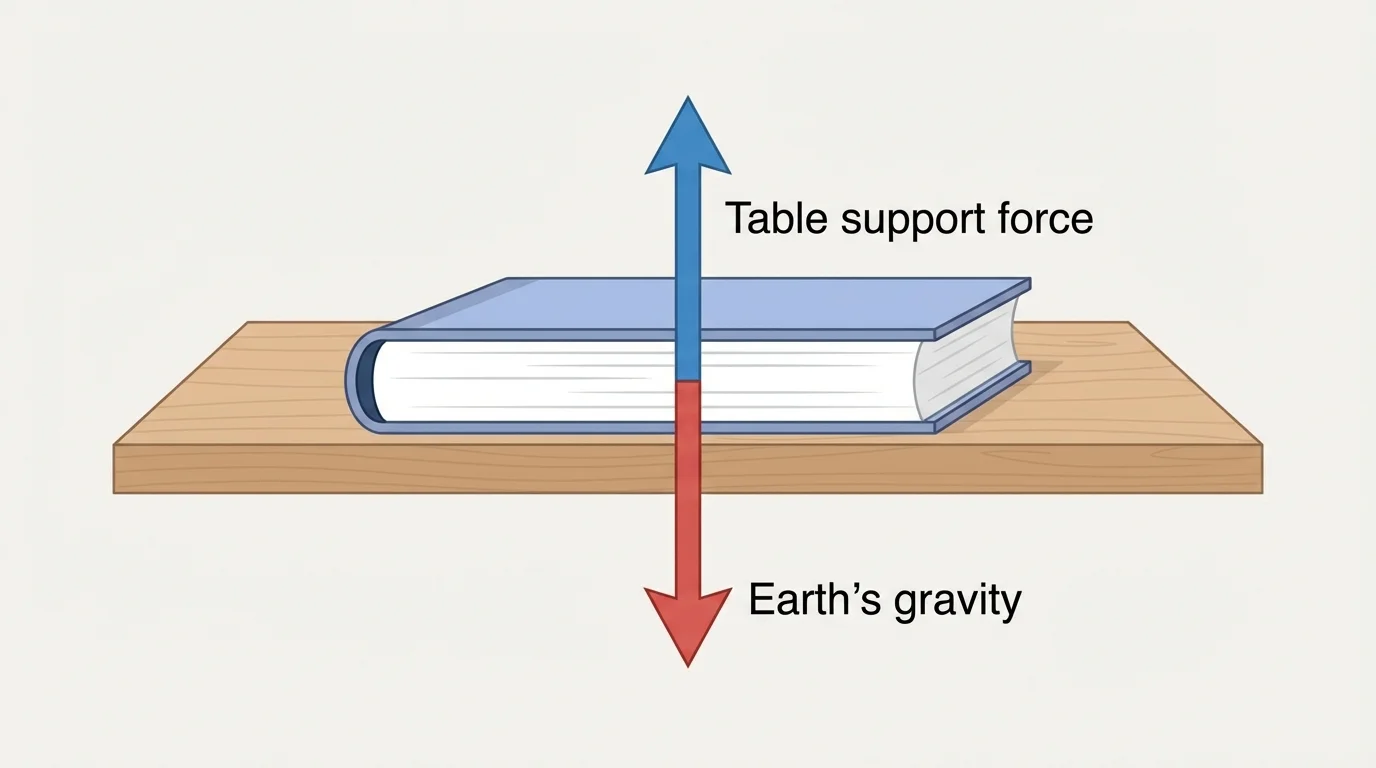
The same idea works when you stand on the floor. Earth's gravity pulls you downward, but the floor pushes upward on your feet. Because of that support, you do not sink through the floor. If the support were removed, you would fall downward.
This helps us make a stronger argument. We are not just saying, "Objects fall, so gravity must be down." We are also noticing that when support is present, objects stop moving downward. That shows gravity is still pulling down, but another force is balancing it.
Parachutes are another useful example. A parachute does not turn gravity off. Gravity still pulls the skydiver downward, as in the resting-book example, where another force changes what happens. The parachute increases air resistance, which slows the fall, but the direction of gravity remains downward.
You may already know that forces can change an object's motion. A force can start motion, stop motion, speed it up, slow it down, or change its direction. Gravity is one of those forces, and near Earth's surface it acts downward.
Understanding gravity's downward pull is useful in many parts of life. Builders need to know which way gravity acts so that buildings stay stable. Tables, chairs, bridges, and shelves must support weight against the downward pull of Earth.
Sports depend on gravity too. In basketball, players aim shots while knowing the ball will arc and come down. In baseball, a pop fly rises and then falls back toward the field. In diving, gymnasts and swimmers plan their motions knowing they will return downward after moving upward.
Transportation uses this idea as well. Roads on hills need safety features because gravity pulls vehicles downhill. Pilots, engineers, and roller coaster designers all think carefully about how objects and people move under Earth's downward pull.
Even simple home activities depend on gravity. Water flows downward through pipes. Food placed on a shelf needs support. A lamp sitting on a table stays there because the table pushes up while gravity pulls down. These are everyday reminders that Earth's gravitational force has a consistent direction.
Real-world case: building a bookshelf
Step 1: Think about the books.
The books are pulled downward by Earth's gravity.
Step 2: Think about the shelf.
The shelf must push upward strongly enough to support the books.
Step 3: Use the idea in design.
If the shelf is weak, it may bend or break because gravity keeps pulling the books downward.
This is why understanding the direction of gravity matters in engineering and design.
One misunderstanding is that "down" means south. It does not. South is a compass direction on Earth's surface. Down means toward Earth's center. Those are different ideas.
Another misunderstanding is that if something moves sideways, gravity must be pulling sideways. But a skateboard rolling across a flat surface is still being pulled downward by gravity. The ground supports the rider and board, so they do not drop through the pavement.
Some students also think that if an object goes up, gravity must be off for a moment. That is not correct. When you throw a ball upward, your hand gives it an upward push at first. After the ball leaves your hand, gravity continues pulling downward the entire time. That is why the ball slows, stops, and comes back down.
A final misunderstanding is that objects need to be large for gravity to pull on them. In fact, Earth pulls on tiny things like dust, raindrops, and grains of sand, as well as large things like cars and people. The direction is still down toward Earth's center.
The strongest scientific argument combines all these observations: dropped objects move downward, thrown objects return downward, resting objects need support against downward pull, and people all over Earth define down as toward the planet's center. Together, these pieces of evidence support the claim that Earth's gravitational force on objects near Earth's surface is directed down.
