You can sprint across a field, a bird can flap its wings, and a kitten can stay warm on a cool morning. These actions seem very different, but they are connected by one surprising idea: the energy helping those animals move, grow, and stay warm was once energy from the sun. That means a cheeseburger, a fish, an apple, a seed, and even the grass in a meadow are all part of a huge story of energy moving through living things.
Animals need energy to live. They use it when they run, jump, swim, breathe, heal, and grow. They also use energy to keep their bodies working even when they are resting. An animal gets this energy from food. When an animal eats, its body can use the stored energy in that food.
That idea leads to an important question: where did the food's energy come from in the first place? A rabbit eats plants. A fox may eat a rabbit. A child may eat fruit, vegetables, eggs, or meat. If we trace the energy back far enough, we find that it began with sunlight.
Food chain is a model that shows how energy moves from one living thing to another as organisms eat plants or other animals.
Producer is a living thing, such as a plant, that can make its own food using sunlight.
Consumer is a living thing, such as an animal, that gets energy by eating plants or other animals.
Scientists often say that plants are the bridge between the sun and animals. Animals cannot capture sunlight and make their own food the way plants do. Instead, animals depend on plants directly or indirectly. Some animals eat plants. Other animals eat plant-eaters. Either way, the energy in animal food can be traced back to the sun.
Plants are special because they can take in energy from sunlight and use it to make food, as shown in [Figure 1]. Leaves collect sunlight, and the plant stores energy in the food it makes. That stored energy can be found in roots, stems, leaves, fruits, and seeds.
The important idea is not that plants "create" energy from nothing. Instead, they change sunlight energy into a form that can be stored in food. Later, when an animal eats the plant, some of that stored energy becomes available to the animal.
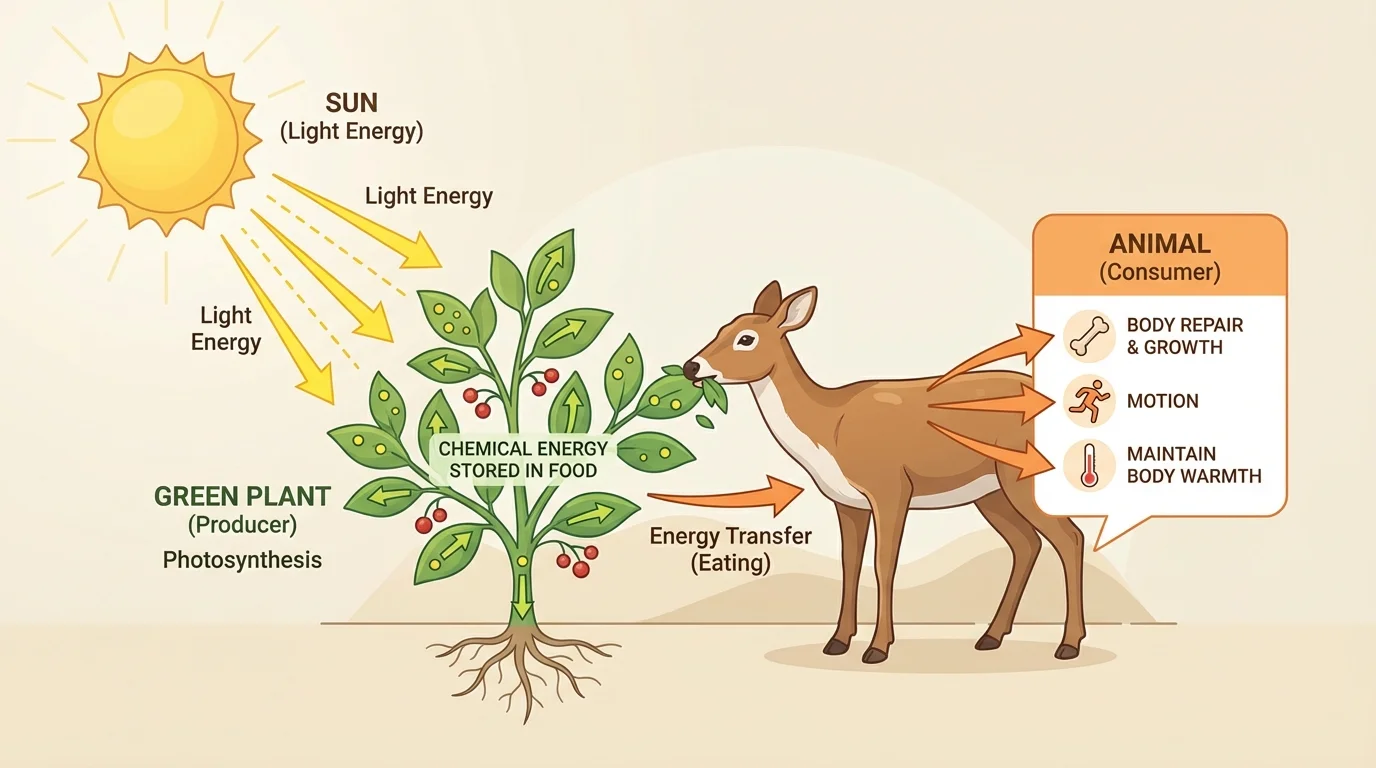
Think about corn growing in a field. Sunlight shines on the corn plant. The plant makes and stores food. A chicken may eat corn. Then a person may eat the chicken or eggs from the chicken. The energy in that meal can be traced back to the sun because the corn plant first captured sunlight energy.
The same is true in a forest. Sunlight helps a tree make food. A deer eats leaves or plants in the forest. A wolf may eat the deer. Even though the wolf never "ate sunshine," the energy in its food originally came from sunlight captured by plants.
Some of the energy stored in foods people eat today may have passed through several living things first. A single meal can connect sunlight, plants, animals, and people in one chain of energy transfer.
Plants are not food for only large animals. Tiny insects, caterpillars, and other small organisms also depend on plants. This means sunlight supports many food chains at once, from a backyard garden to an ocean habitat.
A model helps us understand something that may be too large, too complex, or too hard to see directly. A food chain is one kind of model. It uses names, pictures, and arrows to show how energy moves. In a simple chain, the arrow points from the food to the eater because energy is moving that way, as shown in [Figure 2].
For example, a model might look like this: sun → grass → rabbit → fox. This means sunlight helps the grass make food. The rabbit eats the grass and gets some of that stored energy. Then the fox eats the rabbit and gets some of the energy that was once in the grass.
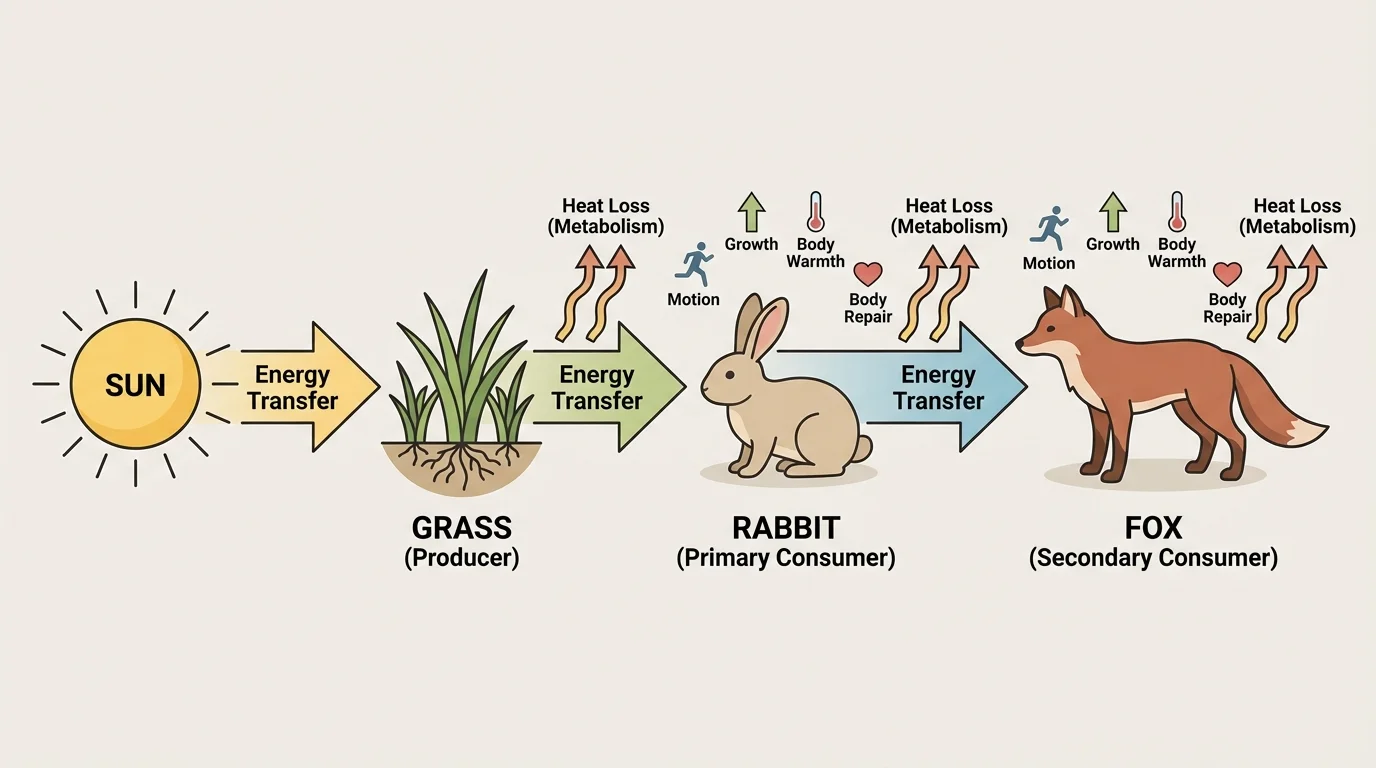
Another food chain could be sun → pond plants → insect → fish → heron. The chain may be longer or shorter, but the same pattern appears again: sunlight enters the system first through plants.
Humans are part of food chains too. Suppose a person eats rice and beans. The rice plant and bean plant captured energy from sunlight. If a person eats a hamburger, the cow got energy by eating plants such as grass or grain. The energy in the hamburger still has its beginning in the sun.
When you study a model, it is important to remember that it is simpler than real life. In nature, many animals eat more than one kind of food, and many food chains connect together. Still, the model helps us see the big idea clearly. Just as [Figure 2] shows with a simple chain, energy usually starts with the sun, moves into plants, and then moves into animals.
Real-world example: tracing energy in a sandwich
Step 1: Look at the bread. Wheat plants used sunlight to make and store food.
Step 2: Look at the lettuce and tomato. These are plants, so their stored food energy also came from sunlight.
Step 3: Look at the turkey or cheese. The turkey got energy by eating plants. A cow that made the milk for cheese also got energy from plants.
Even a simple sandwich contains energy that can be traced back to the sun through plants.
Scientists also use arrows in models to show the direction of energy flow. The arrows do not mean that one organism is "chasing" another. They mean the stored food energy moves from one organism to the next when eating happens.
[Figure 3] shows that animals use food energy in several important ways. It organizes these uses into four big jobs: body repair, growth, motion, and maintaining body warmth. These uses explain why animals must keep getting food.
Body repair means fixing worn-out or damaged parts. If a cat gets a small cut, its body needs materials and energy to heal. If a bird loses feathers and grows new ones, that also requires energy from food.
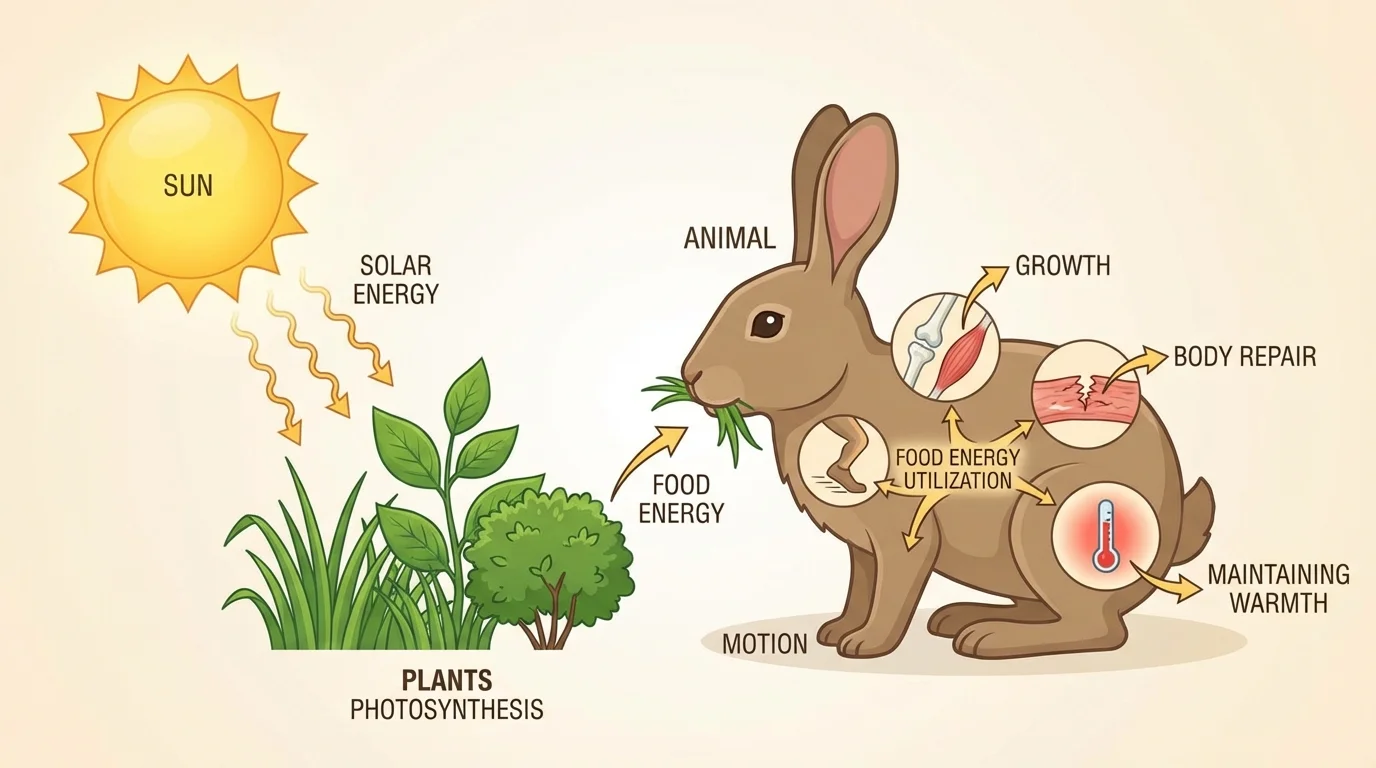
Growth means getting larger and developing as the body changes over time. A puppy grows into a dog. A tadpole grows and changes into a frog. Building new body parts takes energy.
Motion includes walking, flying, slithering, swimming, hopping, and even tiny movements inside the body. A squirrel leaping from branch to branch uses energy. So does a fish flicking its tail through water. Muscles need energy to help the body move.
Maintaining body warmth is especially important for animals such as birds and mammals that keep a fairly steady body temperature. On a cold day, a chickadee puffed up on a branch still needs food energy to stay warm. People also use energy from food to help maintain body temperature.
Even when an animal is sleeping, food energy is still being used. Its heart keeps working, its lungs keep moving air, and its body continues carrying out life processes. So eating is not just for active moments like running or playing. Food energy supports life all the time.
Energy can change from one form to another. Earlier science learning may have shown energy changing in flashlights, moving balls, or heating objects. Living things also depend on energy transformations. The difference here is that we are tracing the energy in food back to sunlight.
The four uses of food energy connect to everyday observations. A growing child needs food for growth. A soccer player needs food for motion. A person healing from an injury needs food for body repair. On a chilly day, the body uses food energy to help stay warm. These are not separate ideas; they are all jobs done by energy from food.
The pattern in [Figure 3] also helps explain why different animals may need different amounts of food. A tiny hummingbird that moves constantly and must stay warm may need food often. A larger animal resting in shade may use energy differently. But all animals rely on food energy to meet their needs.
Scientists use many kinds of models. A drawing of a food chain is a model. A chart comparing organisms is a model. Even a spoken explanation can act like a simple model if it helps us describe something that cannot be watched all at once.
Models are useful because energy flow happens over time and through many living things. You cannot look at a rabbit and directly see sunlight energy inside it. But a model helps you trace the path: sunlight to plant, plant to rabbit. It makes an invisible idea easier to understand.
| Model type | What it shows | Example |
|---|---|---|
| Food chain | A simple path of energy flow | Sun → grass → rabbit → fox |
| Food web | Many connected food chains | One plant eaten by several animals |
| Labeled diagram | Parts or processes | An animal using food energy for warmth and motion |
Table 1. Examples of models that help show how energy moves through living things.
When students draw arrows from the sun to a plant and then to an animal, they are not just making a picture. They are building a scientific explanation. The arrows show the direction of energy movement. The picture becomes evidence for the idea that animals depend on plants, and plants depend on sunlight.
Why the sun matters so much
For most living things in everyday ecosystems, the sun is the starting point of food energy. Plants capture sunlight and store energy in food. Animals then get that energy by eating plants or by eating other animals that ate plants. This is why the sun is often called the original source of energy in food chains.
Models also help compare different habitats. In a prairie, the chain might begin with grass. In the ocean, it may begin with tiny plant-like organisms near the surface. In a garden, it may begin with bean plants or flowers. The starting producer can change, but the original energy source remains sunlight in most cases.
Look at a pet dog. The dog may eat food made from chicken, rice, or other ingredients. The rice is a plant, so its energy came from sunlight. The chicken got energy by eating plants or plant-based feed. So your dog's food still connects back to the sun.
Farm animals provide another easy example. Cows eat grass or grain. Chickens eat seeds and feed made mostly from plants. Goats browse on plants. People then use milk, eggs, or meat from those animals. This is one reason farmers pay attention to healthy crops and healthy pasture land: plants are the first major step in moving solar energy into animal food.
Wildlife shows the same pattern. A caterpillar eats a leaf. A robin eats the caterpillar. A hawk may eat the robin. The chain may seem far removed from sunlight by the time it reaches the hawk, but the starting point has not changed.
Case study: a playground pigeon
Step 1: A pigeon pecks at seeds from plants.
Step 2: The seeds contain stored food energy that plants made using sunlight.
Step 3: The pigeon uses that energy to fly, stay warm, grow new feathers, and repair its body.
A common city bird is still part of the same sun-to-food story as animals in forests or farms.
Even athletes depend on this idea. A runner uses energy stored in food to move muscles. That food may include fruit, bread, vegetables, or meat. No matter what the meal is, the energy can be traced backward to plants and then to sunlight.
One misunderstanding is to think that animals get energy directly from the sun just because they stand in sunlight. Sunlight can warm an animal's body from the outside, but that is different from the food energy animals use for repair, growth, motion, and maintaining body warmth. For those life functions, animals depend on the energy stored in food.
Another misunderstanding is that only plant-eating animals connect to the sun. Actually, meat-eating animals connect too. A lion eating a zebra is still depending on energy that once came from sunlight because the zebra ate plants.
It is also important to be careful with wording. Plants make food using sunlight, but animals do not make their own food from sunlight. Animals must eat plants or other animals to obtain that stored energy.
You do not need tiny molecular details to understand this big idea. The central pattern is enough: sunlight is captured by plants, stored in food, and then passed through food chains to animals. That energy helps animals heal, grow, move, and stay warm.
"The sun feeds life on Earth in ways we do not always notice at first glance."
Once you start looking for this pattern, you can see it nearly everywhere. A grazing deer, a soaring eagle, a classroom lunch, or a goldfish in a bowl all connect to the same energy story. The sun shines, plants store energy, and animals use that energy to live.
