A giant tree can weigh more than a car, but the soil it grows in may not lose very much mass at all. That sounds strange at first. If a plant grows bigger and bigger, where does all that new material come from? Many people guess that plants get most of it from soil. Scientists have tested that idea, and the evidence shows something surprising: plants get the materials they need for growth chiefly from air and water.
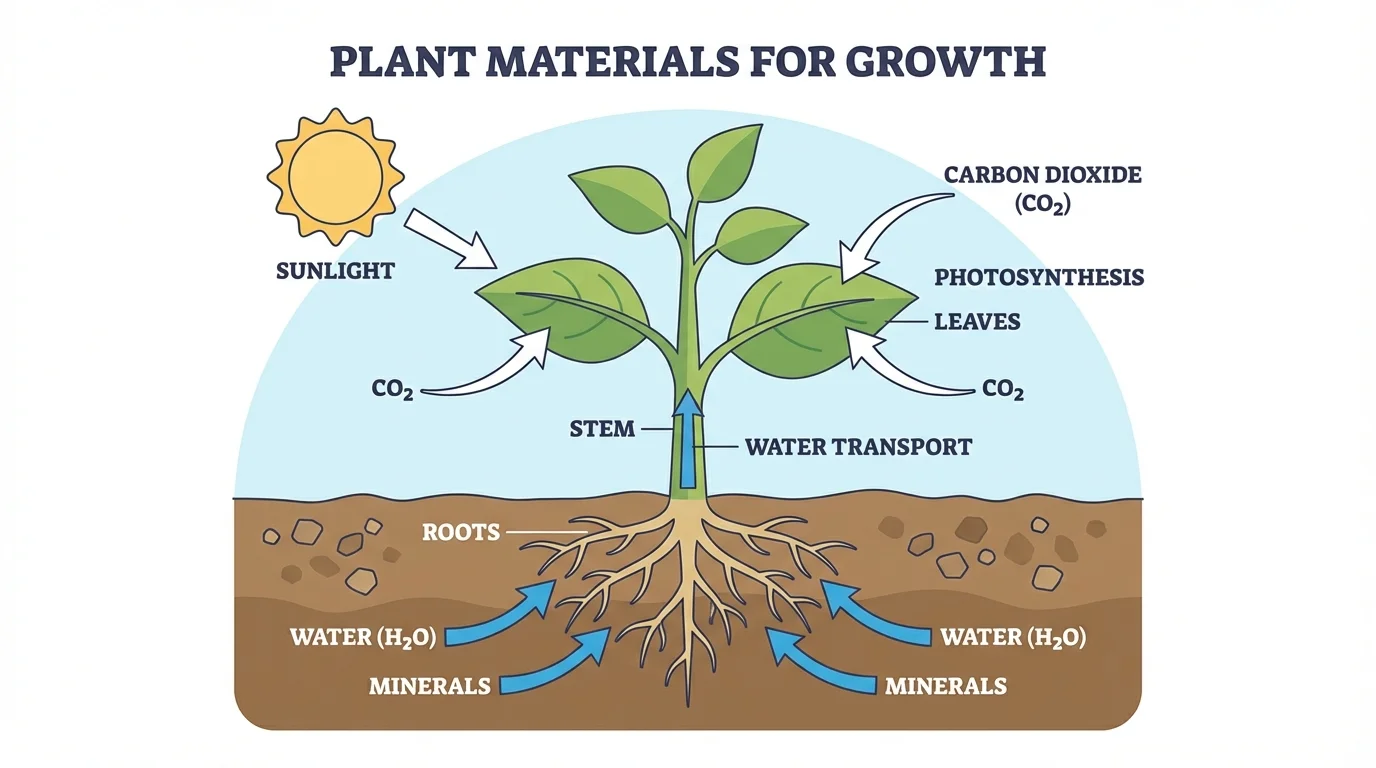
[Figure 1] Plants are living things that need certain materials and conditions to stay alive and grow. A plant needs water, air, light, and small amounts of minerals. The water usually enters through the roots. A gas in the air called carbon dioxide enters mostly through the leaves. Roots and leaves take in different materials, and the stem helps move water to the rest of the plant.
When scientists talk about growth, they mean that a living thing makes more body material and becomes larger. A plant that grows taller, makes more leaves, or forms a thicker stem has added new matter. Most of that new matter does not come from the soil itself. Instead, the chief materials come from water and from gases in the air.
Chiefly means mostly or mainly. In this topic, it means that most of a plant's growth material comes from air and water, even though plants also need minerals from soil or other sources.
Plants also need light from the Sun, but light is different from air and water. Light is a form of energy, not a material that becomes part of the plant's body. It helps the plant do the work of making food, but the focus here is on where the materials for growth come from: mostly air and water.
Small amounts of minerals are important too. Minerals such as nitrogen, potassium, and phosphorus help plants stay healthy. However, these minerals are needed in much smaller amounts than the material plants get from air and water. That is why scientists say plants get their growth materials chiefly from air and water.
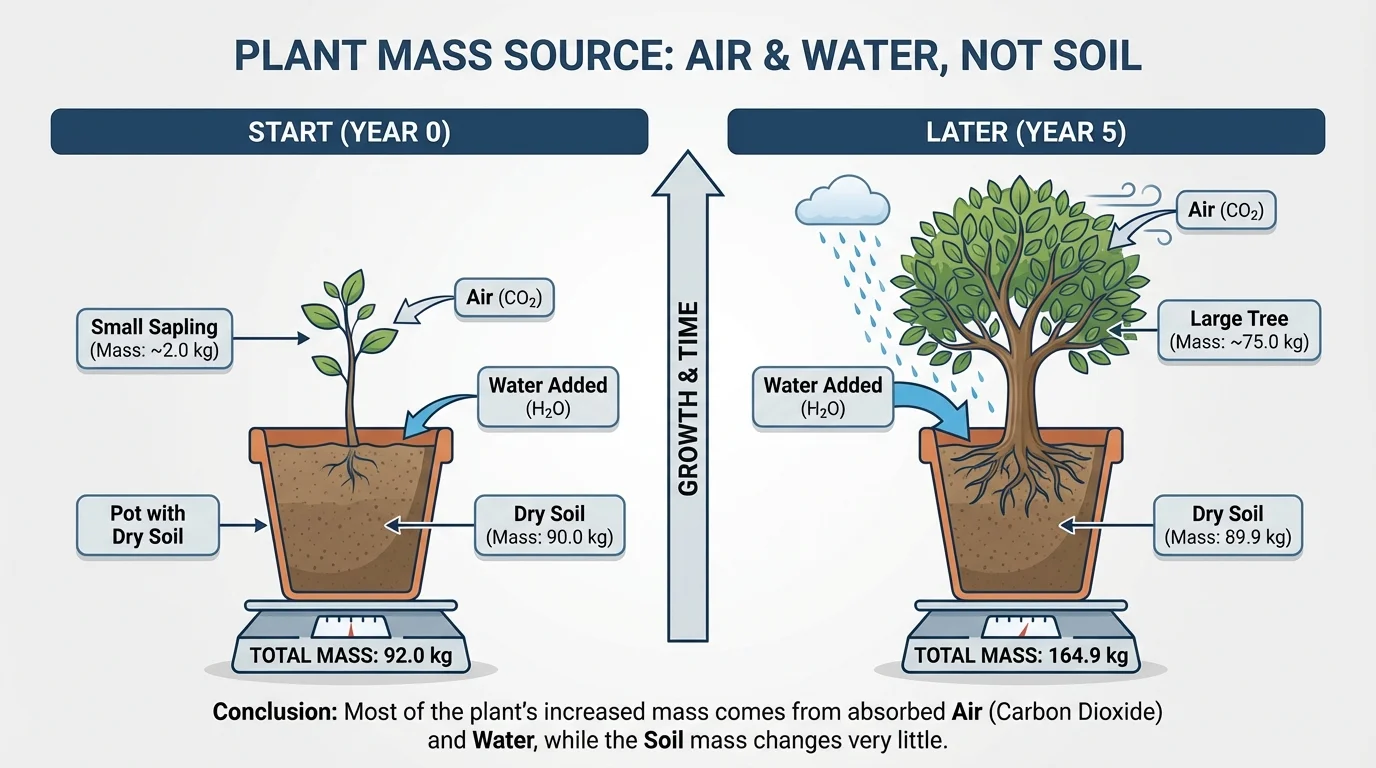
Science arguments are stronger when they are based on evidence. One famous investigation measured a young tree and the soil it grew in. After years of growth, the tree had gained a lot of mass, but the soil had changed only a little. This evidence, summarized in [Figure 2], supports the claim that the tree's new mass did not come mainly from the soil.
Think about a potted plant at school or at home. If the plant grows for weeks, it may become taller and produce more leaves. The amount of soil in the pot looks almost the same. The plant clearly gained material, but the soil did not disappear in the same amount. That tells us the plant must be getting most of its new material from somewhere else.
Another clue comes from watering. If a plant does not get enough water, it wilts and stops growing well. Water is not just something that keeps the plant wet. It is one of the main materials a plant needs. Air matters too. If leaves cannot get the gases they need from air, the plant cannot grow normally.
Using evidence to support a claim
A student says, "Plants get most of their mass from soil." Another student disagrees.
Step 1: State the claim.
The better-supported claim is: plants get most of the materials they need for growth from air and water.
Step 2: Give evidence.
A tree can gain a lot of mass while the amount of soil changes only a little. Potted plants also grow larger without using up large amounts of soil.
Step 3: Add reasoning.
If the plant's new mass came mostly from soil, the soil mass should decrease a lot. Since that does not happen, the new plant material must come mainly from air and water.
Scientists often compare starting and ending masses. If a small plant begins at one size and later becomes much larger, then the difference is the new mass added by growth. If the soil does not lose nearly that much mass, soil cannot be the chief source of the added material. [Figure 2] illustrates this idea clearly.
The roots of a plant absorb water from the soil. Along with water, roots also take in dissolved minerals. These minerals are helpful, but remember that they are only a small part of what the plant needs for growth.
The stem carries water from the roots to the leaves and other parts of the plant. You can think of the stem as a transport system. It helps move important materials to where they are needed.
The leaves take in carbon dioxide from the air through tiny openings. Leaves are important because they are the main place where the plant uses water and carbon dioxide to make sugars it needs for growth. We do not need to study the tiny molecular details here to understand the big idea: air and water provide the main materials.
How plant parts work together
Roots bring in water, leaves take in carbon dioxide, and stems help move water through the plant. When these parts work together, the plant can build more stems, leaves, roots, flowers, and fruits.
If one part of this system is damaged, growth can slow down. For example, if roots cannot absorb enough water, the leaves may droop. If leaves are badly damaged, the plant cannot take in as much carbon dioxide from the air. Healthy plant growth depends on all of these parts doing their jobs.
Soil is still very important. It holds water, stores minerals, and anchors the plant so it can stand upright. Many plants grow best in healthy soil because the soil gives support and a place for roots to spread out.
But being important does not mean being the main source of a plant's mass. Soil is like a helpful home and supply station for the roots. It provides access to water and minerals, yet most of the material that becomes the plant's body comes from air and water.
| Plant need | What it provides | Is it a chief source of growth material? |
|---|---|---|
| Air | Carbon dioxide | Yes |
| Water | Main material used in growth and plant processes | Yes |
| Soil | Support, water storage, minerals | No |
| Sunlight | Energy | No, it is not material |
Table 1. Comparison of what air, water, soil, and sunlight provide for plant growth.
A useful way to think about this is to ask, "What becomes part of the growing plant?" Water and materials from air are major sources. Soil helps the plant get what it needs, but the soil itself is not turned into most of the plant's body.
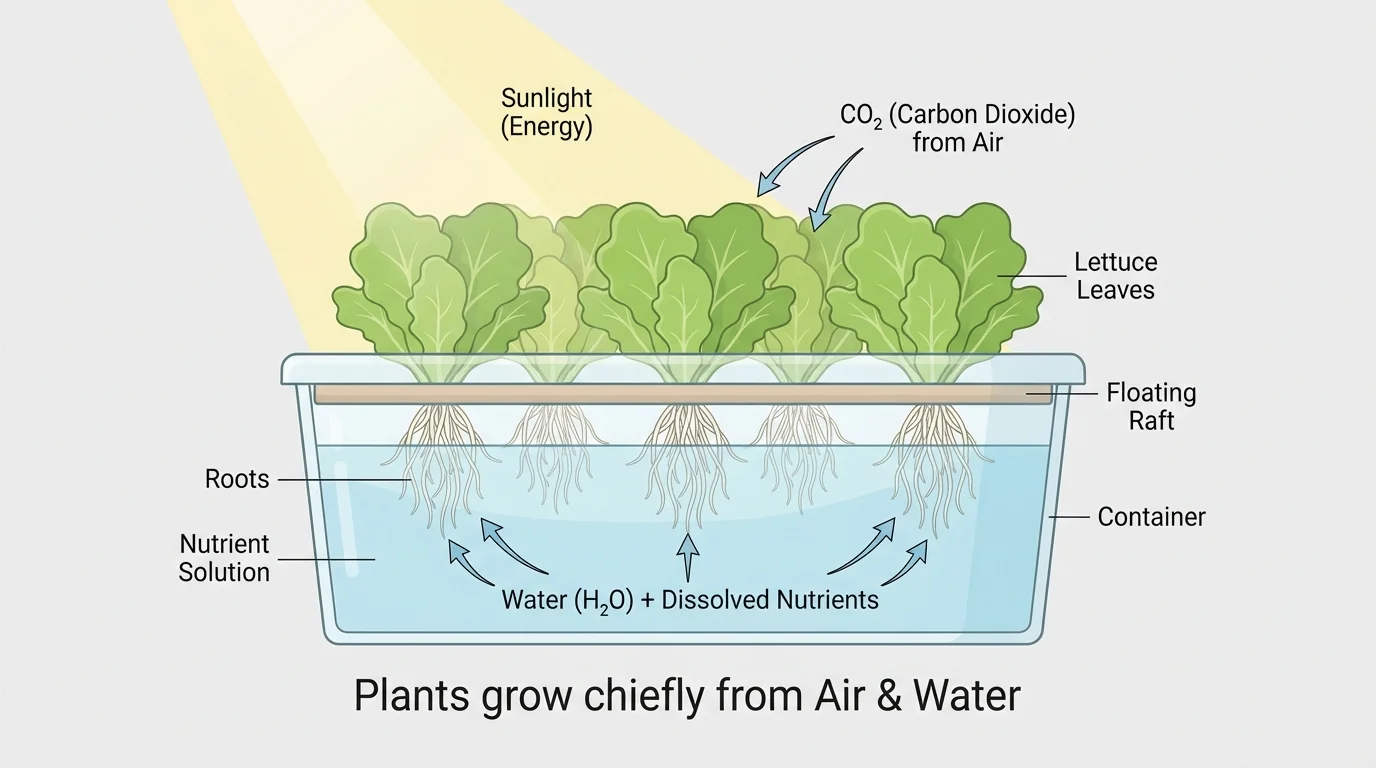
Some plants can grow with very little soil or even with no soil at all, as long as they get water, air, light, and dissolved minerals. This is one reason scientists know soil is not the chief source of plant mass.
[Figure 3] Gardeners see this idea in real life. When they water plants and make sure leaves get fresh air and sunlight, the plants often grow better. Hydroponic systems provide especially strong evidence because plants can grow in water with dissolved minerals and no regular soil at all.
Farmers also understand that healthy crops need enough water and space for leaves to get air and light. If a field is too dry, plants may stay small. If roots cannot reach water, growth is limited. Water is not just something extra. It is one of the chief materials needed for growth.
Houseplants give us another example. A plant near a sunny window often grows better than one kept in a dark closet. The better growth is not because the closet has less soil. It is because the plant cannot get the conditions it needs to use air and water well.
Forests show the same idea on a larger scale. Huge trees take in enormous amounts of carbon dioxide from the air over many years. Their roots absorb water from the ground. Those materials help build trunks, branches, and leaves. The same basic process works in a tiny bean plant and in a giant oak tree.
When people grow plants in hydroponic systems, as in [Figure 3], the roots sit in water that contains dissolved minerals. Since there is little or no soil, the plant's growth is strong evidence that most growth material does not come chiefly from soil.
In science, an argument does not mean a fight. It means using a claim, evidence, and reasoning to explain why an idea makes sense. A strong argument about plant growth has three parts.
Claim: Plants get the materials they need for growth chiefly from air and water.
Evidence: Plants gain mass while the soil changes very little. Plants need water to grow. Plants can even grow in systems with little or no soil when they still have water, air, light, and minerals.
Reasoning: If soil were the chief source of a plant's mass, then a lot of soil would have to disappear as the plant grew. Since that does not happen, most of the new plant material must come mainly from air and water.
Simple classroom argument
Step 1: Observe two similar plants.
One plant gets regular water and fresh air. The other gets too little water.
Step 2: Compare growth.
The well-watered plant usually grows better and makes more leaves.
Step 3: Explain what the observation means.
This supports the idea that water is one of the chief materials needed for plant growth.
Good science arguments use careful words. Instead of saying "plants come from dirt," it is more accurate to say that plants grow using materials chiefly from air and water, while soil provides support, minerals, and access to water.
One common misunderstanding is that plants "eat" soil. Plants do not eat soil the way animals eat food. Roots absorb water and dissolved minerals, but most of the material added during growth comes chiefly from air and water.
Another misunderstanding is that sunlight is a material. Sunlight is energy. It helps plants do the work of growth, but it is not one of the main materials that becomes part of the plant's body.
A third misunderstanding is that minerals do not matter because they are not the chief source. Minerals do matter. Plants need them to stay healthy. The key idea is about how much of the plant's mass comes from different sources. Air and water provide most of the material, while minerals are needed in smaller amounts.
Living things need matter and energy. Matter is the "stuff" that makes up bodies and objects, while energy helps things happen. For plants, air and water are chief sources of matter for growth, and sunlight provides energy.
When you look at a plant, it may not seem like air could become part of something solid like a stem or a leaf. But careful observations and investigations show that it can. This is why evidence matters in science. The answer is not always what we first guess.
