A raindrop seems tiny, but it can help carve a valley, grow a forest, and shape the ground under your feet. Earth is always changing, and many of those changes happen because different parts of Earth work together. When scientists study these changes, they often look at how Earth's systems interact in pairs. That helps us understand big changes one step at a time.
Scientists group Earth into four major systems, as shown in [Figure 1]. Each system includes different parts of our planet, but all of them are connected to Earth's surface and to one another.
The geosphere is the solid part of Earth. It includes rocks, soil, sand, mountains, and landforms. The ground you walk on is part of the geosphere.
The hydrosphere is all of Earth's water. This includes oceans, rivers, lakes, ice, groundwater, and water vapor in very small amounts when we focus on where water is found. Water can be liquid, solid, or gas, but it is still part of the hydrosphere.
The atmosphere is the layer of gases around Earth. It includes the air we breathe and the moving air that forms wind and weather.
The biosphere is all living things. Plants, animals, fungi, and tiny organisms such as bacteria are part of the biosphere.
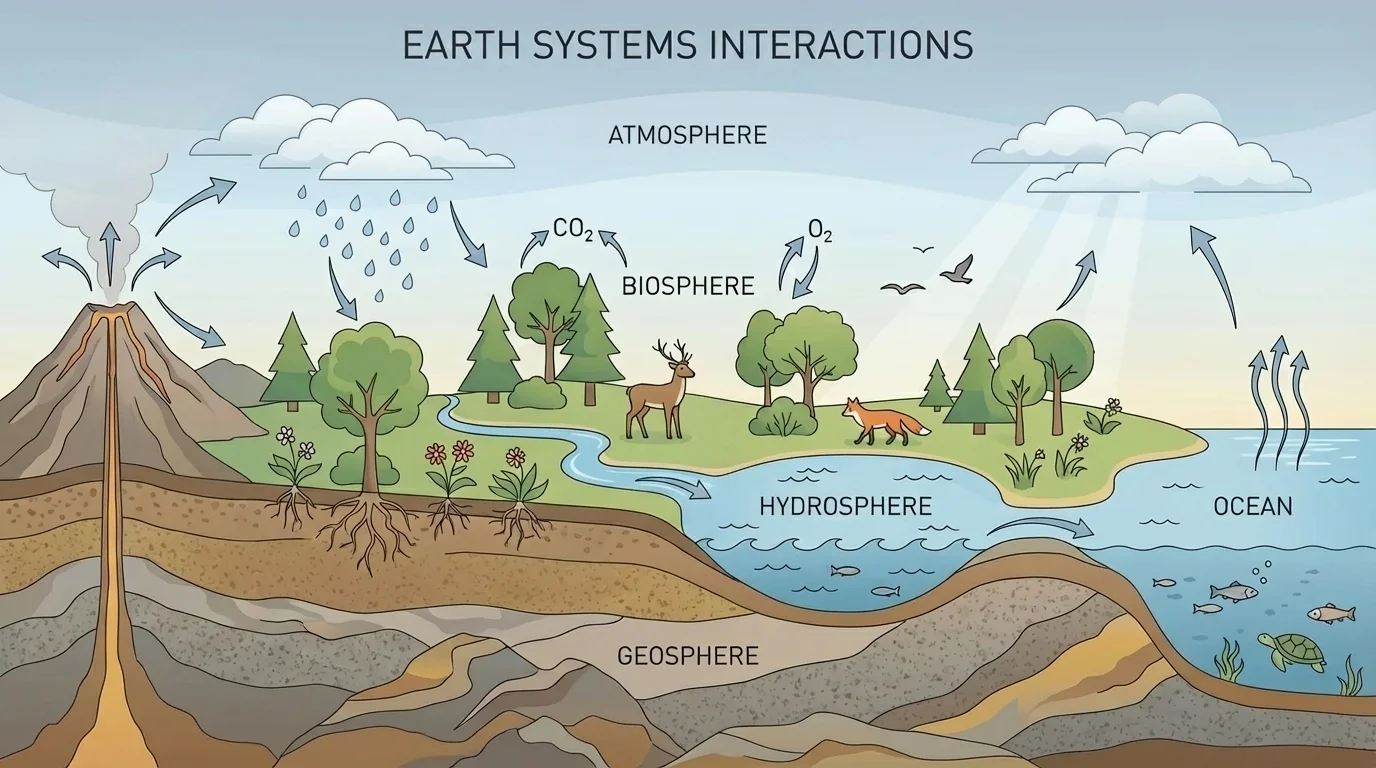
These systems are useful ways to organize what we observe in nature. A tree growing on a hillside involves the biosphere and the geosphere. Rain falling from clouds involves the atmosphere and the hydrosphere. Looking at two systems at a time helps us notice what changes and why.
Earth system means a major part of Earth that has its own materials and processes. The geosphere is land and rock, the hydrosphere is water, the atmosphere is air, and the biosphere is living things.
When scientists say systems "interact," they mean one system affects another. The effect can be slow, like roots breaking rock over many years, or fast, like heavy rain washing soil downhill in just a few hours.
A model is a simplified way to show how something works. A model can be a drawing, a diagram with arrows, a physical object, or even a set of words that explains a process clearly.
Models are helpful because the real Earth is very large and very complex. A model leaves out tiny details so we can focus on the most important parts. For this topic, a good model shows which two systems are interacting and what changes happen because of that interaction.
How a scientific model helps
A model does not need to copy every detail of the real world. Instead, it highlights the main parts and relationships. For Earth systems, arrows are often used to show movement, such as water flowing downhill or wind moving sand.
If you draw a hill, rain, and arrows showing water carrying soil downhill, that drawing is a model. It helps explain a geosphere-hydrosphere interaction. If you draw roots holding soil in place, that is a model of a geosphere-biosphere interaction.
One important Earth-system pair is the geosphere and the hydrosphere. Water can change land, as [Figure 2] illustrates, and land can guide where water moves. This interaction is easy to see after rainstorms, along rivers, and at beaches.
When rain falls on the ground, some water soaks into the soil and some flows over the surface. Moving water can pick up bits of soil, sand, and small rock. This wearing away and carrying away is called erosion.
Rivers are powerful examples. Over a long time, river water can cut channels into land. It can make valleys wider and carry sediment downstream. Sediment is small pieces of weathered rock and soil moved by water, wind, or ice.
Water also drops sediment in new places. This is called deposition. If a stream slows down, it may leave behind sand or mud. In this way, water does not just remove land material; it also builds up new landforms.
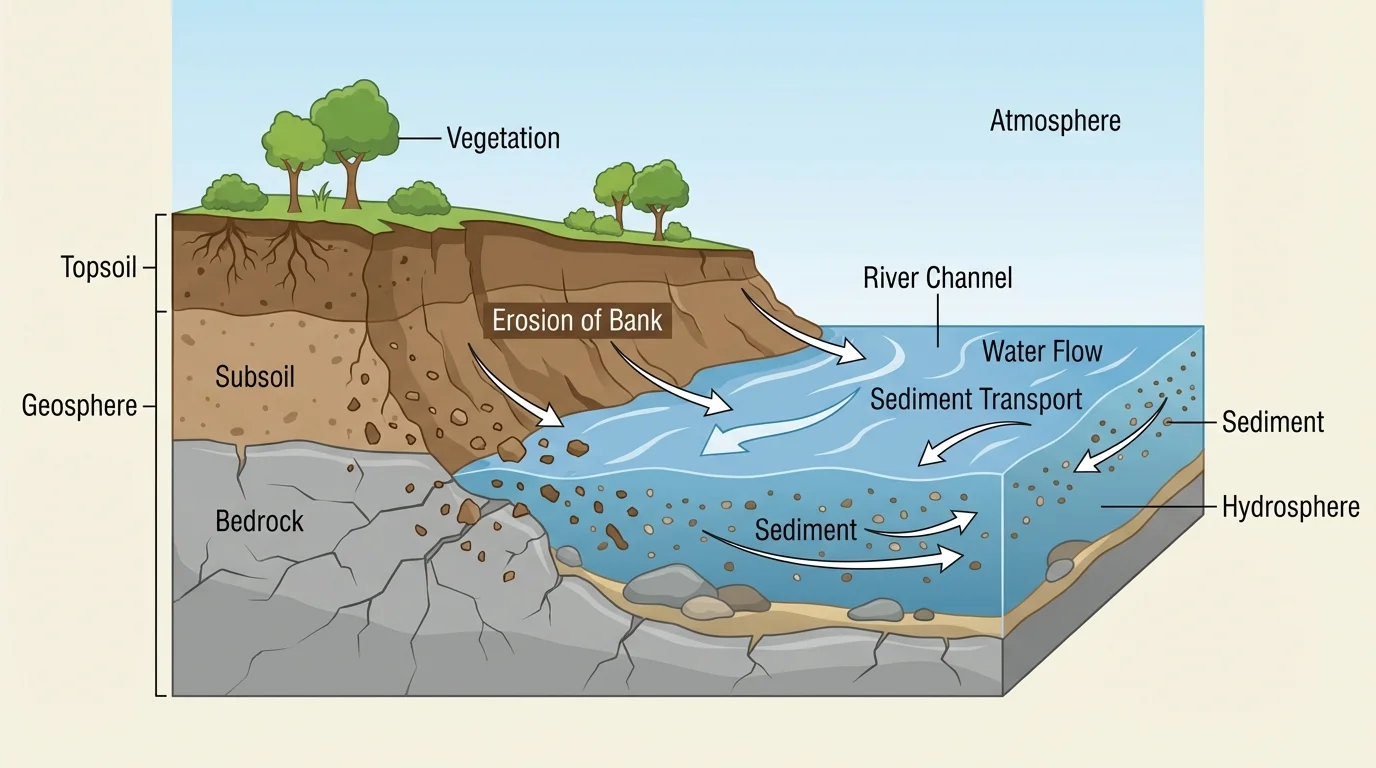
Waves along a shore are another example. They can wear down cliffs and move sand from one part of a beach to another. Groundwater can seep through cracks in rock and slowly change the shape of the land below the surface too.
A single river can carry huge amounts of sediment. Over many years, that moving sediment can help form deltas, sandbars, and wider floodplains.
As we saw in [Figure 2], water changes the geosphere by breaking, moving, and dropping Earth materials. This matters to people because erosion can wear away farmland, damage stream banks, and increase muddy runoff after storms.
The geosphere also interacts with the atmosphere. Air may seem invisible and gentle, but moving air and changing temperatures can reshape land. Wind can lift and move tiny particles of sand and dust. Over time, this can wear away rock surfaces and change dunes.
Rain is part of weather in the atmosphere, and it affects the geosphere when it falls on land. Repeated freezing and thawing can also break rock apart. If water gets into a crack, freezes, and expands, the crack can widen. Later the rock may split into smaller pieces.
This breaking down of rock into smaller pieces is called weathering. Weathering and erosion are related, but they are not the same. Weathering breaks rock down. Erosion moves the broken pieces away.
Solid rock can become smaller pieces over time. Once those pieces move to a new location, a different process is happening. Keeping those two ideas separate makes Earth changes easier to understand.
Wind and rain from the atmosphere help shape the geosphere every day. In dry places, wind may be the stronger force. In rainy places, water often does more of the moving. Either way, the atmosphere affects the land.
The hydrosphere and atmosphere interact constantly. Water moves between Earth's surface and the air, as [Figure 3] shows in a simple water-cycle model. This interaction helps form clouds, rain, snow, and many kinds of weather.
When liquid water from oceans, lakes, rivers, or puddles warms up, some of it changes into water vapor and moves into the air. This process is called evaporation. Water vapor becomes part of the atmosphere.
Higher in the air, water vapor cools and forms tiny droplets. This process is called condensation. Many tiny droplets together can form clouds. When the droplets become large and heavy enough, water falls back to Earth as precipitation, such as rain or snow.
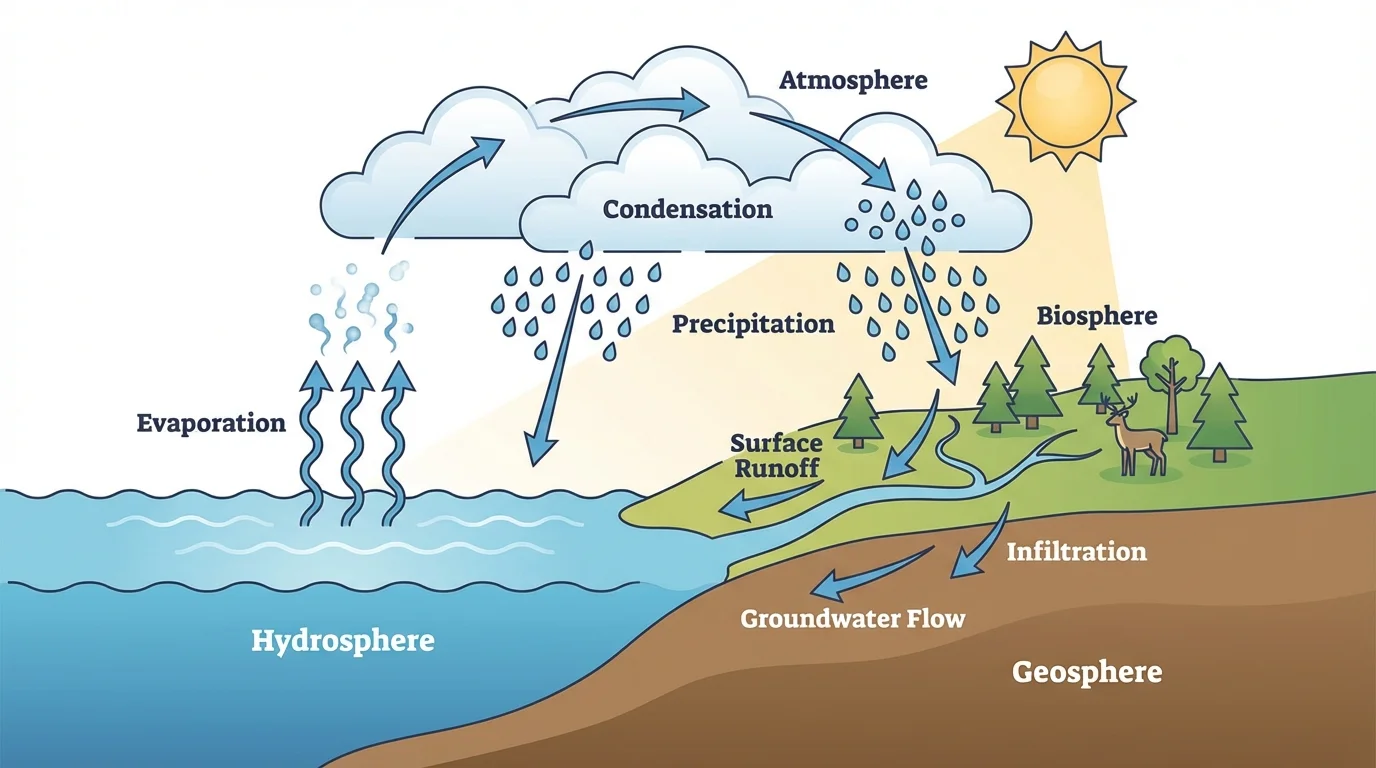
This interaction between the hydrosphere and atmosphere explains why a sunny day can help dry a puddle and why clouds can later release rain. The water itself is still \(\textrm{H}_2\textrm{O}\), but it moves between different places and states.
Real-world example: a puddle after a rainstorm
Step 1: Rain falls from clouds and lands on the ground.
Step 2: The puddle sits in the hydrosphere on Earth's surface.
Step 3: Sunlight warms the water, and some evaporates into the atmosphere.
Step 4: Later, water vapor can condense and return as precipitation.
This example focuses on how the hydrosphere and atmosphere work together.
Later in the lesson, the hillside model will use the same idea from [Figure 3] when rain from the atmosphere reaches land and starts changing surface materials.
Living things also change the land. The geosphere and biosphere interact when roots grow into soil, animals dig burrows, and decomposers help form richer soil. This is shown clearly in [Figure 4].
Plant roots can hold soil together. On a hillside with grass or trees, roots act like a net in the ground. They help keep soil from washing away as easily during rain. Bare land without plants often erodes faster.
Roots can also grow into tiny cracks in rock. As roots get thicker, they push on the rock and can slowly break it apart. This means living things in the biosphere can change the geosphere over time.
Animals such as worms, ants, and moles move soil when they dig. Their actions mix soil layers and create spaces where air and water can enter. Decayed leaves and dead organisms add organic matter to the soil, making it better for many plants.
As shown in [Figure 4], plants can protect the geosphere instead of wearing it away. This is why people plant grass on some slopes and around playgrounds or roadsides. The roots help reduce erosion.
The biosphere and atmosphere interact too. Animals breathe in oxygen from the air and breathe out carbon dioxide, written as \(\textrm{CO}_2\). Plants interact with the atmosphere in another important way. They take in carbon dioxide and release oxygen during photosynthesis.
Photosynthesis is how plants use sunlight to make food. A simple way to show this process is with the equation \[6\textrm{CO}_2 + 6\textrm{H}_2\textrm{O} \rightarrow \textrm{C}_6\textrm{H}_{12}\textrm{O}_6 + 6\textrm{O}_2\]
In this lesson, the most important idea is not memorizing the equation. The key idea is that living things and the air affect each other. Plants depend on gases in the atmosphere, and animals depend on the oxygen plants help provide.
Many forests influence local air conditions too. Large groups of plants can release water vapor from their leaves, adding moisture to the air.
This interaction helps explain why healthy plant life matters. The biosphere is not separate from the atmosphere; they are connected through gas exchange and life processes.
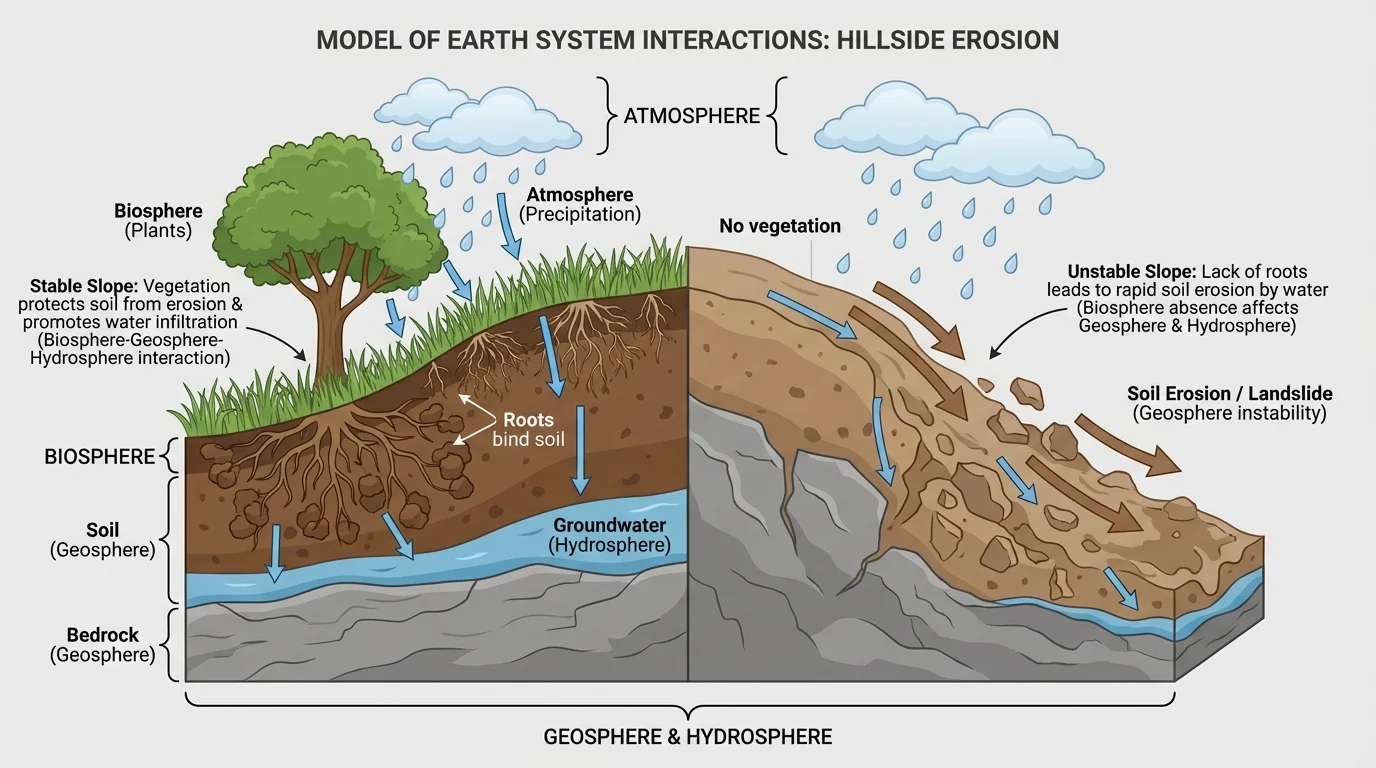
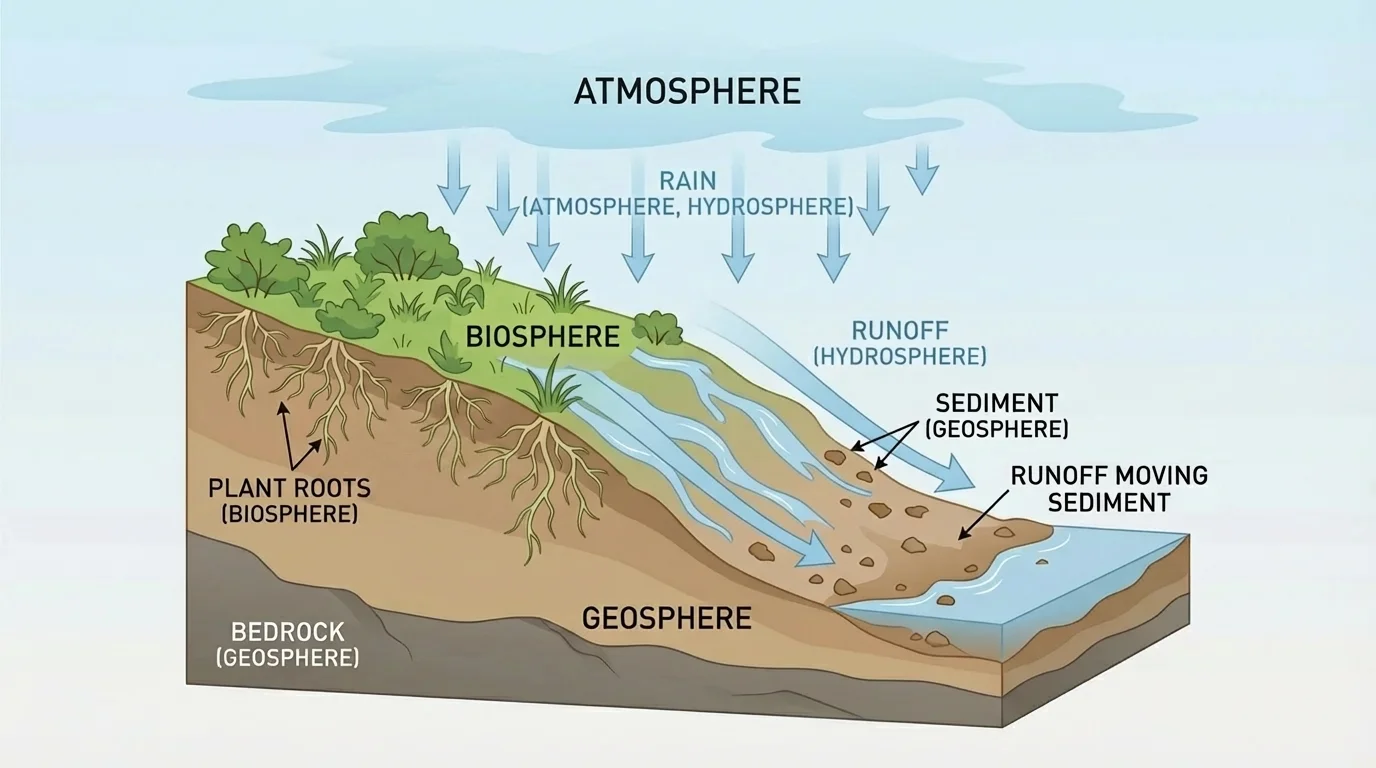
A strong way to describe Earth-system interactions is to build one model and then explain the pair interactions inside it. A hillside after a rainstorm works well, and [Figure 5] presents a simple version of that model with arrows and labels.
In the model, the hillside is part of the geosphere. The rainwater is part of the hydrosphere. The falling rain comes from clouds in the atmosphere. The grass and tree roots belong to the biosphere. Even though all four systems can be present in the same place, we describe the interactions two systems at a time.
First, look at the geosphere and hydrosphere. Rainwater flows downhill and carries loose soil with it. This shows erosion. The water changes the land by moving Earth material from one place to another.
Next, look at the geosphere and biosphere. Grass roots hold some of the soil in place. In spots with more plants, less soil slides downhill. The living roots affect the land.
Then look at the hydrosphere and atmosphere. Before the storm, water evaporated into the air. Later it condensed into clouds and fell as rain. Water moved back and forth between surface water and the air.
This model is useful because it keeps each interaction clear. We do not need to explain every possible connection all at once. We can point to one arrow and one pair of systems, then describe the change that occurs.
How to describe the hillside model clearly
Step 1: Name the two systems you are focusing on, such as geosphere and hydrosphere.
Step 2: Identify what from each system is interacting, such as soil and rainwater.
Step 3: Describe the change, such as water moving soil downhill.
Step 4: Repeat with a different pair, such as geosphere and biosphere.
This keeps the explanation organized and matches the way scientists often use models.
When you compare the bare parts of the slope with the rooted parts, the pattern from [Figure 5] becomes easy to see: water removes more soil where fewer plants are growing.
Earth-system interactions are not just ideas for science class. They matter in everyday life. Farmers care about erosion because good topsoil is important for crops. Gardeners notice that bare soil dries and washes away more quickly than soil covered by plants.
City planners and builders also pay attention to these interactions. They may plant grass on embankments, place rocks near shorelines, or build drains to guide water safely. These choices help reduce damage caused by water moving over land.
Weather forecasts matter because hydrosphere-atmosphere interactions can lead to heavy rain, snow, or drought. Understanding how water moves between the air and Earth's surface helps people prepare for floods or dry periods.
| System Pair | What Interacts | Possible Result |
|---|---|---|
| Geosphere + Hydrosphere | Soil and moving water | Erosion or deposition |
| Geosphere + Atmosphere | Rock and wind or rain | Weathering and land change |
| Hydrosphere + Atmosphere | Surface water and air | Evaporation, clouds, precipitation |
| Geosphere + Biosphere | Soil and plant roots | Less erosion, soil retention |
| Biosphere + Atmosphere | Living things and air gases | Gas exchange |
Table 1. Examples of two-system Earth interactions and common results.
Scientists, engineers, farmers, park rangers, and community leaders all use ideas like these. A simple model can help them predict what might happen after a storm, where soil may wash away, or why planting vegetation can protect land.
"Earth is always changing, and the changes make more sense when we look at how its systems affect one another."
Once you understand the systems and the pair interactions, you can explain many changes on Earth's surface. Small events, repeated over time, can create big results.
