If you pick up a huge log or look at a tall tree, it is easy to think, "All that wood must have come from the soil." That sounds reasonable, but it is mostly wrong. One of the most amazing facts in biology is that most of a plant's growing material comes from the air and water around it, not from the dirt it stands in.
Plants live in soil, so people often assume soil becomes the plant. Soil does give plants support and some important nutrients, but the biggest share of the plant's mass is built mainly from carbon dioxide in the air and water taken in by the roots. With energy from sunlight, the plant changes these simple materials into sugars and then into stems, leaves, roots, flowers, fruits, and seeds.
This idea matters because it helps explain how living things use matter and energy. Plants are not just "eating dirt." They are building themselves by combining matter from the environment in a very organized way. That is why plants are called producers: they make their own food and create the starting point for many food chains.
All living things need both matter and energy. Matter is the "stuff" that makes bodies, cells, and tissues. Energy is needed to power life processes. For plants, sunlight is the main energy source, but sunlight is not matter. It does not become part of the plant's mass.
A useful way to think about this is to ask two questions: Where does the plant get energy? and Where does the plant get material? The energy comes mainly from sunlight. The material for most growth comes mainly from air and water.
Plants need several things to survive and grow well: sunlight, air, water, and minerals. Each one has a different job. Sunlight provides energy. Air provides carbon dioxide. Water helps in photosynthesis and also carries dissolved substances through the plant. Minerals from soil, such as nitrogen, phosphorus, potassium, calcium, and magnesium, help the plant stay healthy and build important molecules.
It is important not to mix up amount with importance. Minerals are very important, but they usually make up only a small part of the total mass of a plant. A giant tree contains far more carbon, hydrogen, and oxygen in its body than mineral nutrients. Much of that carbon came from \(\textrm{CO}_2\) in the air.
Photosynthesis is the process by which plants use light energy to make sugar from carbon dioxide and water.
Glucose is a simple sugar plants make during photosynthesis and use for energy and growth.
Stomata are tiny openings in leaves that let gases move in and out.
When a plant grows, it is adding more matter to its body. New cells need atoms to build cell walls, membranes, and other parts. Those atoms do not appear from nowhere. They come from materials the plant takes in from its environment.
Plants gather materials through different body parts, as [Figure 1] shows. The roots absorb water from the soil. That water often contains dissolved minerals. The leaves, meanwhile, take in carbon dioxide from the air.
Leaves have tiny openings called stomata. These openings can open and close. When they are open, carbon dioxide enters the leaf. Oxygen and water vapor can leave. Even though stomata are tiny, they are essential because photosynthesis cannot happen without carbon dioxide.
The roots do more than anchor the plant in place. They spread through the soil, increasing the surface area for water uptake. Root hairs, which are tiny extensions on root cells, help absorb even more water. This water travels upward through the plant to the leaves, where it is used in photosynthesis.
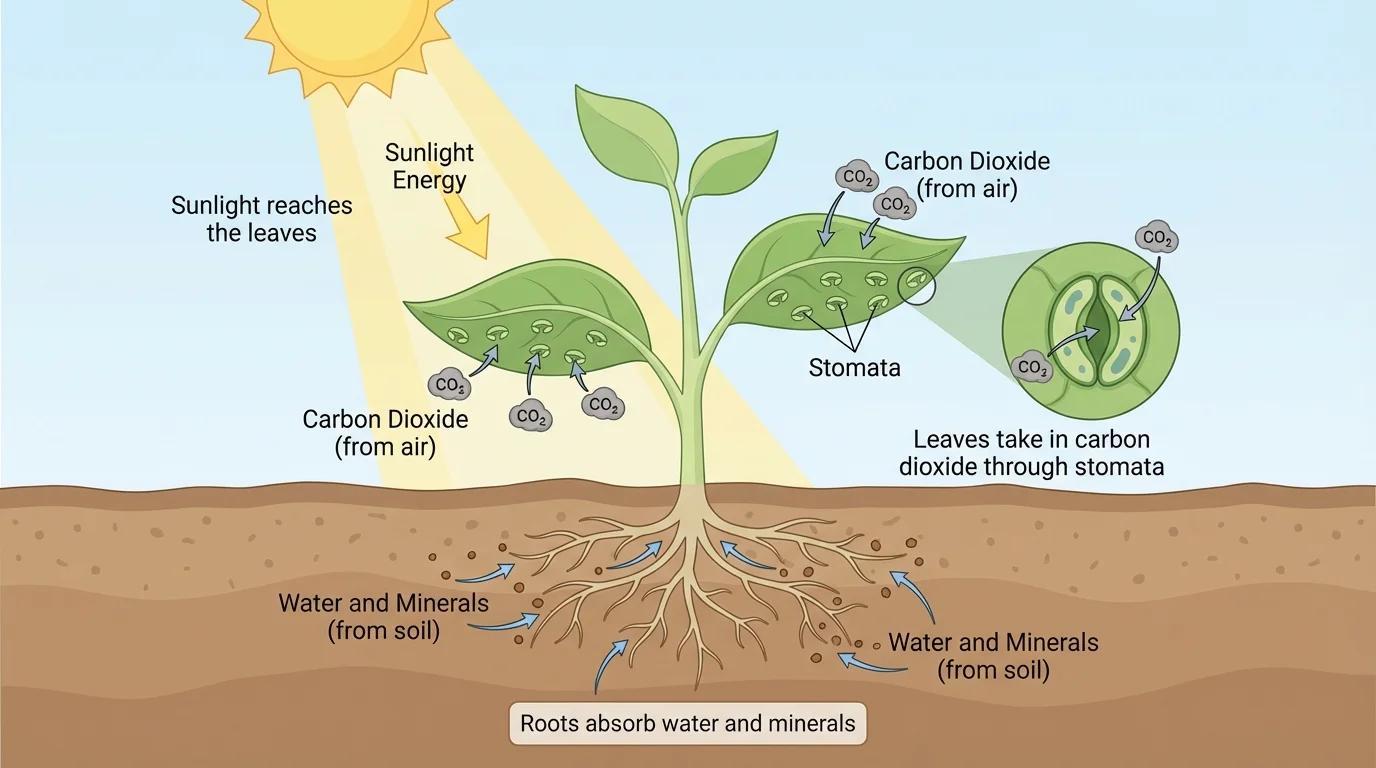
So plants collect their main ingredients in two different ways: gases enter mostly through leaves, and liquid water enters mostly through roots. This division of jobs helps the plant use matter efficiently.
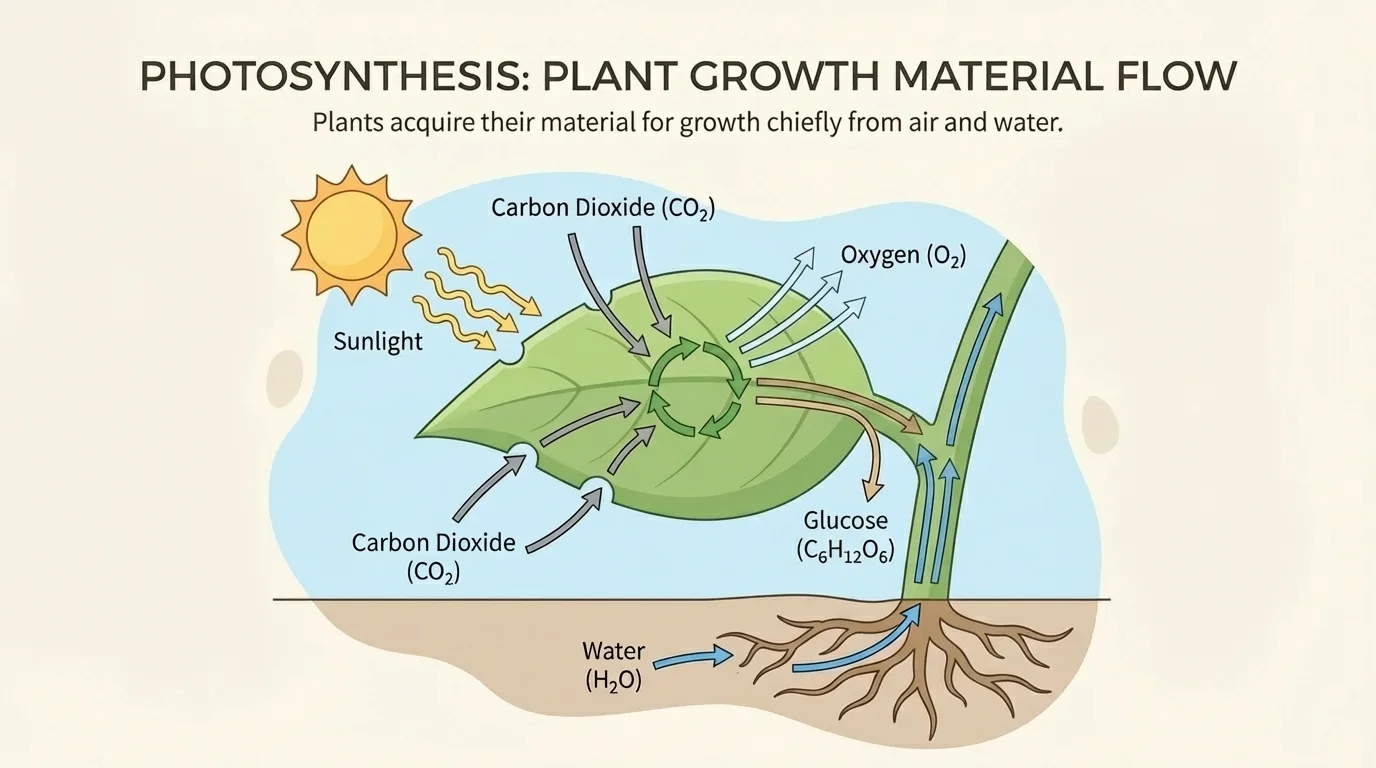
Photosynthesis, as [Figure 2] illustrates, is the key process that explains why plant growth depends mainly on air and water. Inside leaf cells, plants use energy from sunlight to combine carbon dioxide and water into glucose. Oxygen is released as a by-product.
A simple way to write this process is:
\[6\textrm{CO}_2 + 6\textrm{H}_2\textrm{O} + \textrm{light energy} \rightarrow \textrm{C}_6\textrm{H}_{12}\textrm{O}_6 + 6\textrm{O}_2\]
This equation shows the ingredients going in and the products coming out. The \(6\textrm{CO}_2\) means six carbon dioxide molecules. The \(6\textrm{H}_2\textrm{O}\) means six water molecules. The sugar produced is glucose, \(\textrm{C}_6\textrm{H}_{12}\textrm{O}_6\).
Why the equation matters
The equation for photosynthesis helps us trace matter. The carbon atoms in glucose come from \(\textrm{CO}_2\). The hydrogen atoms come mainly from \(\textrm{H}_2\textrm{O}\). The oxygen atoms in the products come from these same starting materials. This is why scientists say plant matter is built chiefly from air and water.
Photosynthesis takes place mainly in leaf cells that contain chloroplasts. Chloroplasts hold chlorophyll, a green pigment that captures light energy. This energy is used to rearrange atoms into new molecules. It is a little like using building blocks: the atoms are the blocks, and photosynthesis is the process that snaps them into new shapes.
The glucose made during photosynthesis can be used right away for energy, or it can be changed into other substances. Plants may turn it into starch for storage, cellulose for cell walls, oils in seeds, or many other compounds. That means a crunchy carrot, a juicy apple, and a strong wooden branch all contain matter that was built from the products of photosynthesis.
Later, when people burn wood in a fire, some of the carbon from that wood returns to the air as \(\textrm{CO}_2\). The same carbon may once have been in the atmosphere before the tree used it. This cycling of matter connects plants, animals, air, soil, and water.
When a seedling becomes a larger plant, its increase in mass comes mostly from atoms added during growth. Many of those atoms entered as carbon dioxide from the air. This may feel strange because air seems weightless, but gases are matter. They have mass, even if we do not notice it easily.
Think about a wooden table. Most of that table is made of carbon-containing compounds built by a tree long ago. The carbon in those compounds came mainly from carbon dioxide in the atmosphere. Water also supplied hydrogen and some oxygen used in building the plant's molecules.
The soil does not disappear in the same amount that the plant grows. If you carefully grew a plant in a pot and measured the soil, the soil would not lose mass equal to all the plant's new leaves and stems. This observation helped scientists realize that most plant mass must come from somewhere else.
Real-world example: a growing bean plant
A bean plant starts as a small seed and later grows stems, leaves, and pods.
Step 1: The roots take in water and dissolved minerals.
Step 2: The leaves take in \(\textrm{CO}_2\) from the air through stomata.
Step 3: With sunlight, the plant makes glucose by photosynthesis.
Step 4: The plant changes glucose into materials for new cells, such as cellulose and stored starch.
Most of the added mass in the larger bean plant comes from air and water, even though the plant is rooted in soil.
This is one reason forests matter so much on Earth. As trees grow, they remove carbon dioxide from the air and store carbon in wood, roots, bark, and leaves. The huge size of a forest is built over time by millions of plants doing photosynthesis again and again, much like the process shown earlier in [Figure 2].
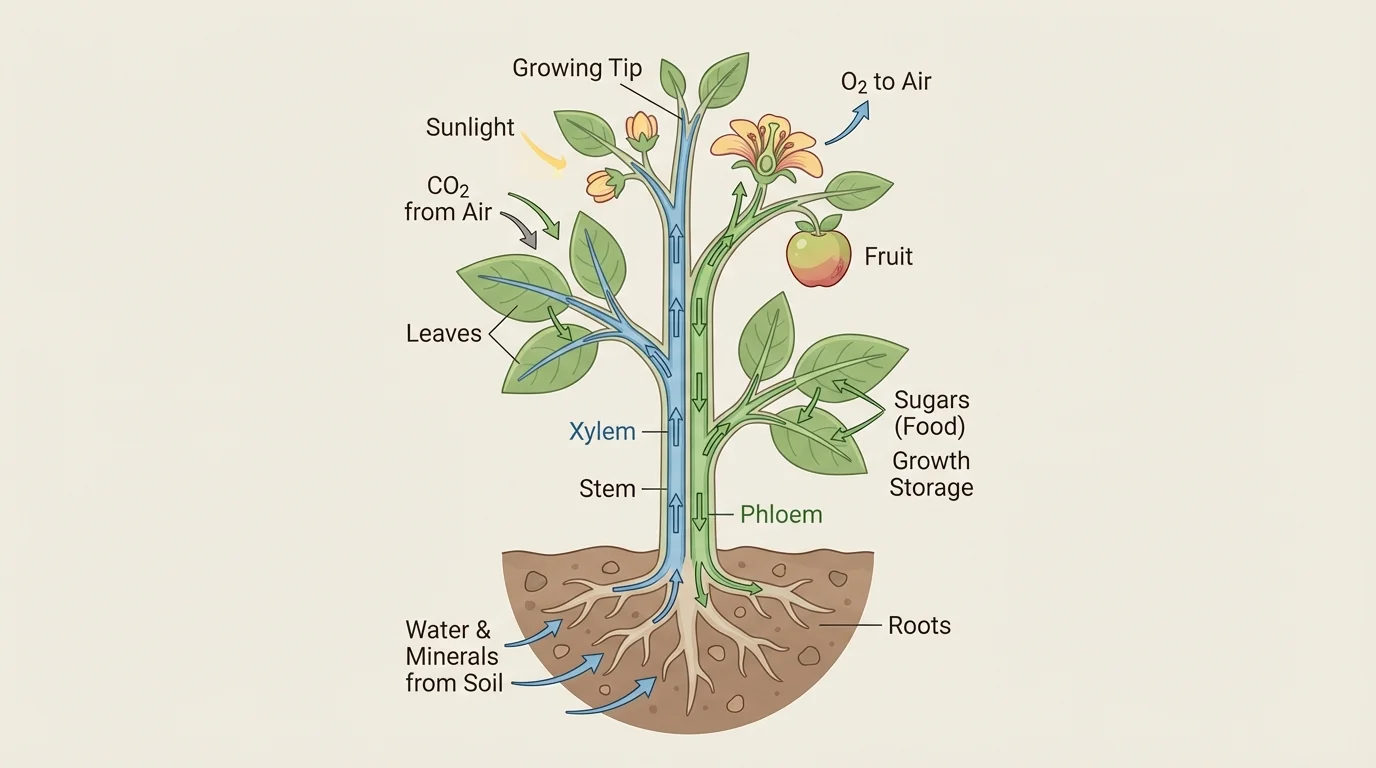
Taking materials in is only the beginning. Plants also need an internal transport system, as [Figure 3] shows, to move water, minerals, and sugars to the places where they are needed. Two important tissues are called xylem and phloem.
Xylem carries water and dissolved minerals upward from the roots. This helps supply the leaves for photosynthesis. Phloem carries sugars and other food substances from the leaves to the rest of the plant, including roots, stems, fruits, and growing buds.
This transport is important because not all parts of the plant do the same job. Leaves often make most of the sugar, but roots need sugar too. Roots usually do not photosynthesize underground, so they depend on food sent down from the leaves.
If you eat a potato, you are eating stored food the plant moved and saved underground. If you eat an apple, you are eating sugars that were made in leaves and then transported into the fruit. Internal transport helps explain how matter from air and water can end up in many different plant parts.
Minerals are still essential, even though they are not the chief source of plant mass. Plants need minerals to build proteins, support healthy growth, and carry out important chemical reactions. For example, nitrogen helps plants make proteins and other molecules. Magnesium is part of chlorophyll. Without these nutrients, plants may grow poorly or show yellow leaves.
Soil is like a supply station for these special ingredients. But unlike carbon dioxide and water, minerals usually contribute a much smaller amount of the total mass. A plant cannot build a thick trunk from minerals alone. It needs the carbon-rich compounds made through photosynthesis.
| What the plant takes in | Where it comes from | Main job |
|---|---|---|
| Carbon dioxide | Air | Supplies carbon for making sugars and much of plant mass |
| Water | Soil | Used in photosynthesis and transport |
| Sunlight | Sun | Provides energy for photosynthesis |
| Minerals | Soil | Help with health, growth, and important molecules |
Table 1. Main inputs plants need, where they come from, and what they do.
This is a great example of how "important" does not always mean "largest amount." Vitamins are important to humans, but we need much less of them than water or food. In a similar way, plants need minerals, but most of their body is built mainly from air and water.
A large tree can add a huge amount of wood over many years without "eating" huge amounts of soil. Much of that new wood is made from carbon that was once part of \(\textrm{CO}_2\) in the atmosphere.
Gardeners notice this principle even if they do not say it in scientific words. A plant with rich soil but too little light often grows poorly because it cannot photosynthesize enough. A plant with sunlight and water but missing certain minerals may survive for a while but show weak growth or pale leaves.
Farmers care about plant matter and energy flow every day. Crops need enough sunlight, water, and carbon dioxide to photosynthesize well, and they also need proper minerals in the soil. Greenhouses sometimes increase plant growth by controlling light, temperature, water, and even the amount of carbon dioxide in the air.
Houseplants show the same ideas on a smaller scale. If a plant sits in a dark corner, it may become weak because it lacks light energy. If the soil is dry, the roots cannot supply enough water. If the stomata close too much to prevent water loss, less carbon dioxide may enter, and photosynthesis can slow down. The structure shown in [Figure 1] helps explain why leaves and roots both matter.
Plants also affect animals and people. Animals cannot make food from sunlight the way plants do. They depend directly or indirectly on plants for the matter and energy stored in food. When you eat rice, corn, lettuce, or fruit, you are eating plant material built from air and water. When you eat meat, the animal you ate got its matter and energy from plants or from animals that ate plants.
Climate is connected too. Because plants take in carbon dioxide, forests, grasslands, and oceans with photosynthetic organisms play a role in Earth's carbon cycle. When many plants grow, they store carbon. When plants decay or burn, some of that carbon returns to the air.
"Plants are the bridge between the energy of sunlight and the matter that builds living things."
This is why protecting plant life is not only about scenery. It is about food, oxygen, habitats, and the movement of carbon through Earth's systems.
You can observe these ideas with a simple plant-growing setup. Grow similar seedlings in cups or pots. Keep the type of seed, amount of soil, and size of container the same. Then compare conditions such as light or water while keeping other factors as similar as possible.
If one group gets light and water and another group gets water but almost no light, the first group usually grows much better. This does not prove every detail of photosynthesis by itself, but it helps show that water alone is not enough. The plant also needs light energy to build more food from carbon dioxide and water.
Energy and matter work together
Plants need both matter and energy at the same time. Carbon dioxide and water provide the atoms that become plant tissue. Light provides the energy that drives the process. Without matter, there is nothing to build with. Without energy, the building cannot happen.
Scientists often track atoms to understand where matter goes. In plants, they can follow carbon from \(\textrm{CO}_2\) into glucose, starch, cellulose, and other molecules. They can also follow water moving through xylem, just as the transport pathways in [Figure 3] show.
The big idea is simple but powerful: plants do not grow mostly by turning soil into stems and leaves. Instead, they use sunlight to transform matter from the air and water into the living material of their bodies.
