A car bumper, a football helmet, and a package of eggs all solve the same kind of problem: how to deal with a collision. That may sound surprising, but every time two objects crash, bounce, hit, or push against each other, the same rule of nature is at work. Understanding that rule helps engineers design safer cars, better sports equipment, and packaging that protects fragile objects.
[Figure 1] A collision happens when two objects interact strongly for a short time. The objects may bounce apart, stick together, or simply push and change speed. In middle school science, it is helpful to focus on collisions that happen in a straight line: left and right on a horizontal surface, or up and down in a vertical direction. That keeps the motion in one dimension, which makes the forces easier to track.
Collisions are not only about crashes. A bat hitting a baseball, a foot kicking a soccer ball, a person jumping from a boat, and a book landing on a table are all examples of collisions or impacts. In each case, the two objects affect each other at the same time.
Force is a push or pull on an object. Motion is described relative to a reference frame, such as the ground, a table, or a hallway floor. If the total force on an object changes, its motion changes.
To solve collision problems, scientists and engineers ask questions such as: Which object changes speed more? How can the force be reduced? How can we protect people or materials? Newton's laws help answer these questions.
Newton's Third Law says that when one object exerts a force on another object, the second object exerts a force of equal size and opposite direction on the first object. In other words, forces come in pairs. If object A pushes on object B, then object B pushes back on object A with the same force magnitude in the opposite direction.
This idea is often called an action-reaction force pair. The two forces are equal and opposite, but they act on different objects. That is why they do not cancel each other out. One force affects object A, and the other force affects object B.
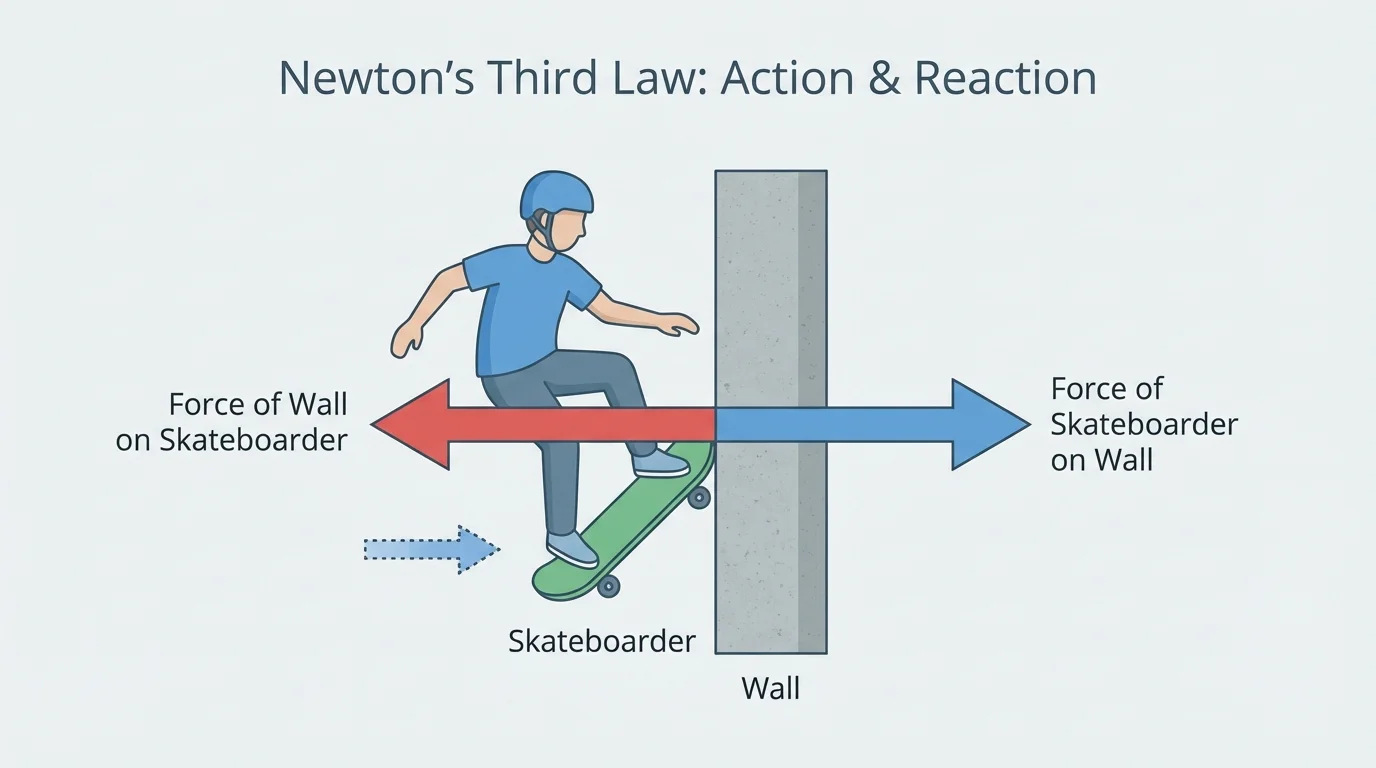
A common mistake is to think that the bigger or faster object exerts a bigger force. In a collision, that is not true. If a rolling cart hits a wall, the cart pushes on the wall and the wall pushes on the cart with equal force. If a basketball hits the floor, the ball pushes down on the floor and the floor pushes up on the ball with equal force.
Newton's Third Law states that for every force that one object exerts on a second object, the second object exerts an equal force in the opposite direction on the first object.
Collision is an interaction in which two objects push on each other strongly for a short time.
This can feel strange because the motion changes are often not equal. One object may stop suddenly while the other barely changes. That does not mean the forces were different. It means the objects may have different masses, and mass matters when motion changes.
When describing a collision, everyone must use the same reference frame. For example, if two carts move on a track, the track can be used as the reference frame. Then one direction must be chosen as positive. You might say motion to the right is positive and motion to the left is negative.
In one-dimensional collisions, the motion and forces are all along the same straight line. That means we only track one direction at a time. A horizontal example could involve carts on a track. A vertical example could involve a dropped ball striking the floor. We do not need to analyze sideways motion for this lesson.
Suppose cart A moves right and hits cart B, which is at rest. During the collision, cart A pushes cart B to the right. At the same time, cart B pushes cart A to the left. Those two forces are equal in size and opposite in direction. If the same situation happened vertically, a falling ball would push downward on the floor while the floor would push upward on the ball.
Equal force does not mean equal result. Newton's Third Law tells us about the forces during the interaction. To predict how much each object's motion changes, we also need to think about mass. A smaller mass can have a larger change in motion than a larger mass, even though the collision forces are equal.
[Figure 2] This is one reason a ping-pong ball and a bowling ball behave so differently when they collide with other objects. Both take part in equal-force interactions, but their masses are very different, so their motion changes by different amounts.
Newton's Third Law works together with Newton's Second Law. The second law connects force, mass, and acceleration with the equation \(F = ma\), where \(F\) is force, \(m\) is mass, and \(a\) is acceleration.
Now compare two carts with different masses. During the collision, each cart feels the same size force from the other cart. But if one cart has less mass, the same force causes a larger acceleration. That means the smaller cart's motion changes more.
For example, if a force of \(12 \textrm{ N}\) acts on a cart of mass \(2 \textrm{ kg}\), its acceleration is \(a = \dfrac{F}{m} = \dfrac{12}{2} = 6 \textrm{ m/s}^2\). If the same force of \(12 \textrm{ N}\) acts on a cart of mass \(6 \textrm{ kg}\), its acceleration is \(a = \dfrac{12}{6} = 2 \textrm{ m/s}^2\). The force is equal in both cases, but the lighter cart changes motion more quickly.
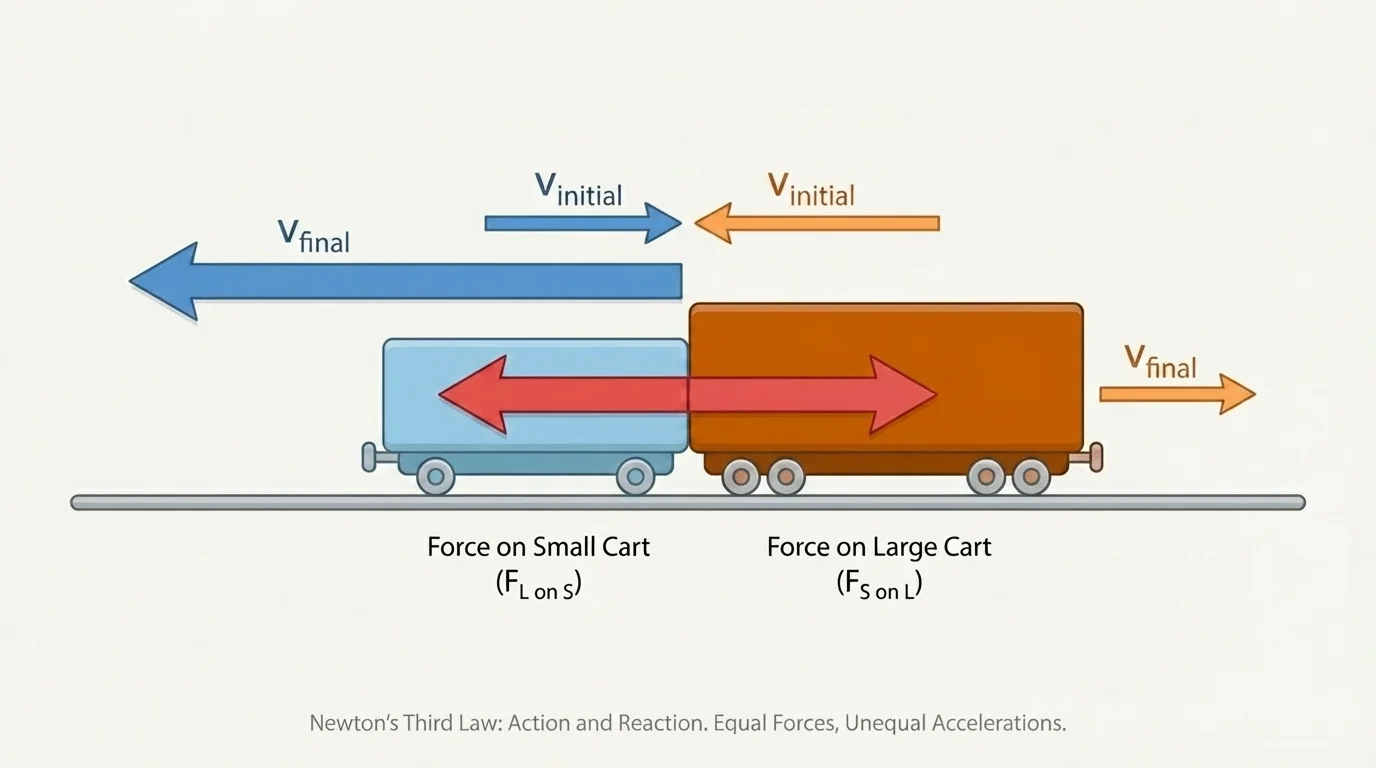
This explains many everyday observations. If a tennis ball hits a player's racket, the ball's motion changes a lot because the ball has a small mass. The racket also feels the force from the ball, but the player and racket together have much more mass, so their motion changes much less.
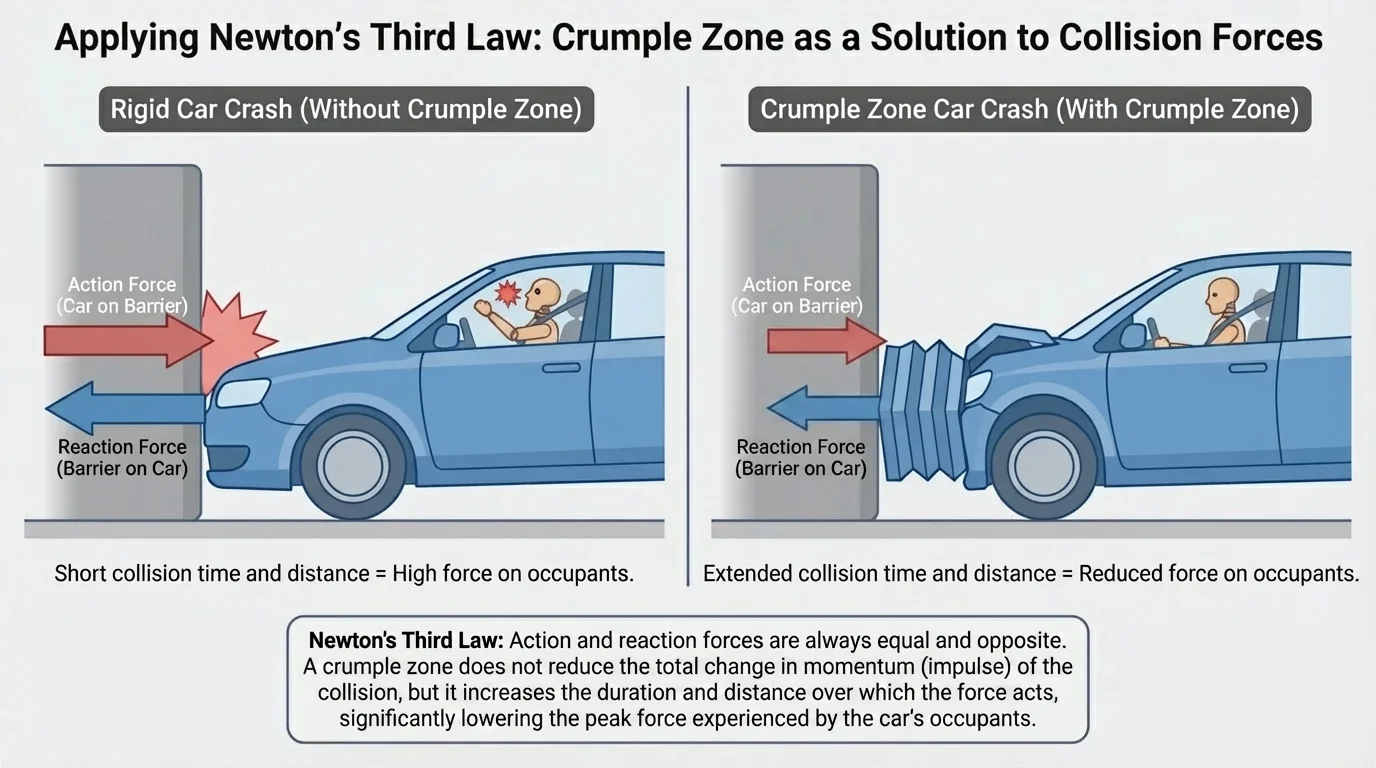
[Figure 3] We can also think about change in motion over time. A large force acting for a short time can cause a sudden change. Engineers often try to increase the time of a collision so the force is spread out more gently. That idea becomes very important in design.
Engineers use Newton's Third Law to design objects that manage collision forces. If two objects collide, each pushes on the other. Since the force pair cannot be removed, the design goal is often to reduce injury or damage by changing how the collision happens.
One important strategy is to use materials or structures that compress, bend, or crumple. A helmet has padding. A car has crumple zones. A gym floor may have a springy surface. A package may have foam or air pockets. These features increase the time of the collision and reduce the force on the person or object being protected.
If an object's motion changes from moving to stopped, that change still has to happen. But a softer or longer collision can make it happen less suddenly. For example, suppose a design change reduces the force on a rider from \(800 \textrm{ N}\) to \(400 \textrm{ N}\). The rider still stops, but the smaller force is safer for the body.
Design example: choosing a safer bumper
An engineer tests two bumpers for a \(1{,}000 \textrm{ kg}\) cart moving in a straight line. In both tests the cart stops after a collision. Bumper A causes a force of \(2{,}000 \textrm{ N}\) on the cart. Bumper B causes a force of \(1{,}200 \textrm{ N}\) on the cart. Which bumper is safer for the cart and its contents?
Step 1: Identify the design goal.
The goal is to reduce damaging force during the collision.
Step 2: Compare the forces.
Bumper B gives a smaller force because \(1{,}200 \textrm{ N} < 2{,}000 \textrm{ N}\).
Step 3: Connect to motion change.
Both bumpers stop the cart, but the smaller force means the stop happens more gently.
Conclusion: Bumper B is the safer design choice.
Newton's Third Law also reminds engineers that the protected object pushes back on the safety device. A helmet is not just something that gets hit; it also exerts force on the head. Good design controls that interaction so the head experiences less harmful force.
Design decisions often come from comparing how different masses respond during equal-force collisions. That is why engineers test prototypes and measure motion carefully.
Worked example: two carts with different masses
A \(3 \textrm{ kg}\) cart collides with a \(6 \textrm{ kg}\) cart on a straight horizontal track. During the collision, each cart experiences a force of \(18 \textrm{ N}\). Find the acceleration of each cart.
Step 1: Use Newton's Second Law.
\(a = \dfrac{F}{m}\)
Step 2: Calculate the acceleration of the \(3 \textrm{ kg}\) cart.
\(a = \dfrac{18}{3} = 6 \textrm{ m/s}^2\)
Step 3: Calculate the acceleration of the \(6 \textrm{ kg}\) cart.
\(a = \dfrac{18}{6} = 3 \textrm{ m/s}^2\)
The smaller cart has the greater acceleration, even though the forces are equal and opposite.
This result matches what we saw earlier in [Figure 2]: equal interaction forces can produce different motion changes when masses are different.
[Figure 4] Here is another design case. Suppose a company ships glass jars in boxes. If the jars collide with the box walls when dropped, the jars and the packaging exert equal forces on each other. The design challenge is to create padding that lowers the force on the jars enough to prevent breaking.
Worked example: packaging fragile objects
A jar of mass \(2 \textrm{ kg}\) experiences a collision force of \(100 \textrm{ N}\) in one package design and \(40 \textrm{ N}\) in another. Find the acceleration in each case and decide which design protects the jar better.
Step 1: Use \(a = \dfrac{F}{m}\).
Step 2: First design.
\(a = \dfrac{100}{2} = 50 \textrm{ m/s}^2\)
Step 3: Second design.
\(a = \dfrac{40}{2} = 20 \textrm{ m/s}^2\)
The second design is better because it causes a smaller acceleration and therefore a gentler change in motion.
Engineers do not only ask whether an object stops. They ask how it stops, how large the force is, and whether the materials can survive the collision.
To analyze a collision clearly, scientists choose a system, a direction, and a shared reference frame. For two blocks on a track, the system might be "block A and block B." Then the engineer marks right as positive or left as positive and describes all motion using that choice.
Next, they identify the interaction forces. If block A hits block B, there is a force of A on B and a force of B on A. Those two forces form the action-reaction pair. The arrows point in opposite directions along the same straight line.
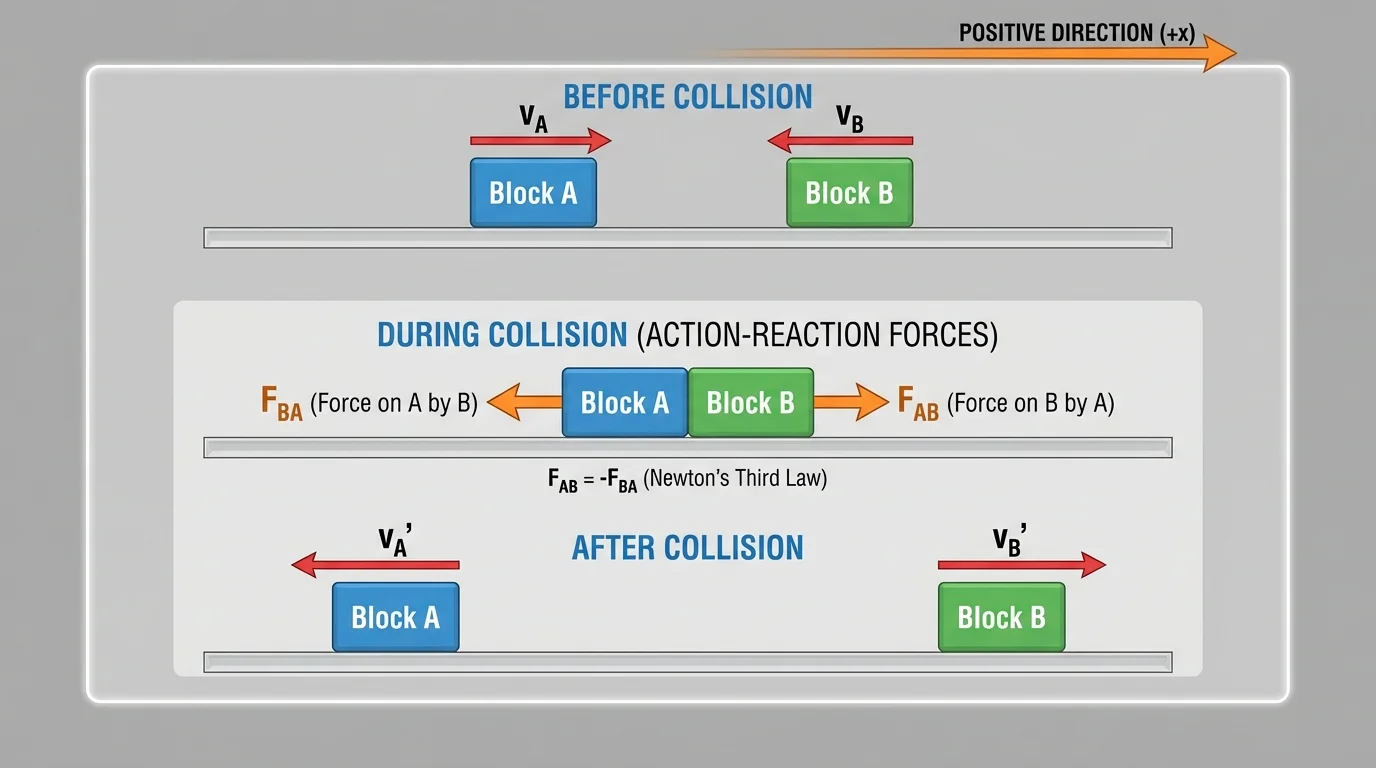
Then they measure or estimate mass and motion change. They may use slow-motion video, motion sensors, or repeated trials. These tools help answer whether the design solves the problem. For example, does a new bumper reduce force? Does a new landing pad reduce the acceleration of a falling object? Does a safer wall pad help athletes during impacts?
Airbags work together with seat belts to increase the time over which a passenger comes to a stop. That helps reduce the force on the body during a collision.
The diagram also reminds us that signs and directions matter. If one student says an object moves at \(4 \textrm{ m/s}\) to the right and another says it moves at \(-4 \textrm{ m/s}\), they may actually agree if they are using the same positive direction. Clear reference frames prevent confusion.
One common mistake is saying, "The truck hits the car harder than the car hits the truck." Newton's Third Law says that during the collision, the truck and the car exert forces on each other that are equal in size and opposite in direction. The car may have a bigger change in motion because it usually has less mass, not because it feels a bigger interaction force.
Another mistake is thinking the two forces in an action-reaction pair cancel. They do not, because they act on different objects. To find the total force on one object, only include the forces acting on that object.
A third mistake is forgetting the assessment boundary and trying to follow motion in many directions at once. In this topic, keep the analysis in one dimension: horizontal or vertical. That means one line of motion, one pair of opposite directions, and one clear force interaction along that line.
"Equal and opposite" describes the forces, not the results.
— A useful way to remember Newton's Third Law
In sports, padding on walls, helmets, shin guards, and catcher's mitts are all designed to handle collisions safely. In each collision, the two interacting objects exert equal forces on each other, so the equipment must be designed to reduce harmful motion changes.
In transportation, car bumpers, crumple zones, airbag systems, and seat belts are built with collision forces in mind. The same design thinking from [Figure 3] applies: the force pair will exist, so engineers change materials and structure to make the interaction safer.
In shipping and storage, foam inserts, cardboard structures, and shock-absorbing materials reduce damage when packages are dropped. In playgrounds, soft surfaces help lower forces when children land after jumping down. In buildings and machines, dampers and protective layers reduce damage from repeated impacts.
These designs show that science is not only about explaining what happens. It is also about solving problems. When you understand Newton's Third Law, you can look at a collision and think like an engineer: What are the two objects? What force pair acts? Which object has less mass? How can the design reduce the harmful effect of the collision?
