Why do your feet return to the ground every time you jump, while the Moon never drifts away from Earth? These seem like very different events, but they are connected by the same idea: gravity. Gravity shapes falling objects, the motion of planets and moons, ocean tides, and even the paths of spacecraft. It is one of the primary ways objects interact without direct contact.
In science, it is not enough to say, "Gravity pulls things down." A stronger scientific statement is a claim backed by evidence and reasoning. The claim for this lesson is that gravitational interactions are attractive and depend on the masses of interacting objects. To support that claim, we need observations, patterns, and careful explanations.
When scientists argue, they are not just disagreeing. They are building explanations based on facts. A good scientific argument has three parts: a claim, evidence, and reasoning.
Claim is a statement that answers a question. Evidence is the data or observations that support the claim. Reasoning explains why the evidence supports the claim using scientific ideas.
For example, if the claim is that gravity is attractive, evidence might include that dropped objects move toward Earth and that the Moon stays in orbit around Earth rather than flying away in a straight line. [Figure 1] The reasoning is that gravity pulls objects toward one another, so these motions make sense if the interaction is attractive.
Scientific arguments become stronger when they use more than one kind of evidence. For gravity, that evidence comes from everyday life, measurements, and patterns in space.
Gravitational interactions happen between objects that have mass, and the interaction is attractive. "Attractive" means the objects pull toward each other, not push apart.
When you drop a book, it moves toward Earth. Earth also moves toward the book, but Earth has so much more mass that its motion is too small to notice. This is an important idea: both objects pull on each other. Gravity is not a one-way force.
Another piece of evidence is that planets stay in orbit around the Sun and moons stay in orbit around planets. If gravity were repulsive, these objects would be pushed away. Instead, they are held in curved paths because gravity continually pulls them inward.
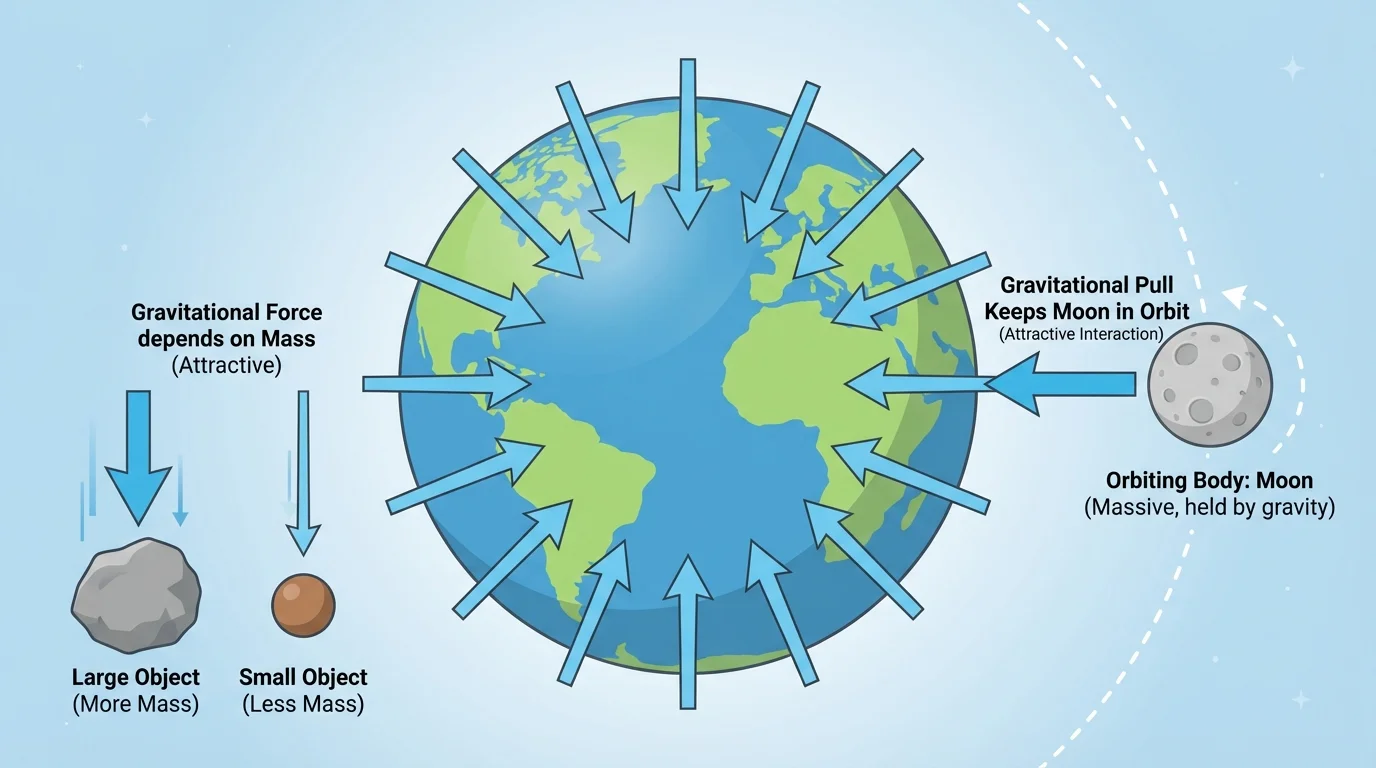
Even objects on Earth attract each other. A backpack and a desk pull on each other gravitationally, but the force is extremely small because their masses are small compared with Earth's mass. So while the attraction exists, it is hard to observe directly in everyday life.
This helps explain why gravity is sometimes misunderstood. People notice Earth pulling them down, but they do not notice themselves pulling Earth. The interaction still works both ways.
Why "down" is really "toward Earth"
People often say gravity pulls things "down," but that is only true if you are standing on Earth's surface. In a scientific sense, gravity pulls objects toward the center of the attracting mass. On Earth, that direction feels like down. On the Moon or another planet, "down" would point toward that world's center instead.
Evidence from astronauts also supports the idea that gravity acts across space. Astronauts orbiting Earth are not beyond gravity. Earth's gravity still pulls on them strongly enough to keep their spacecraft in orbit.
The strength of gravity depends on the masses of the interacting objects. Mass is the amount of matter in an object. Objects with more mass produce stronger gravitational pulls than objects with less mass.
Earth pulls more strongly than the Moon because Earth has much more mass. That is why your weight changes from one world to another even though your mass stays the same. Weight is the force of gravity acting on you.
A simple way to describe weight is with the relationship
\(W = mg\)
where \(W\) is weight, \(m\) is mass, and \(g\) is the gravitational field strength at that location.
If a student has a mass of \(40 \textrm{ kg}\), the student's weight on Earth is about \(W = 40 \times 9.8 = 392 \textrm{ N}\). On the Moon, where \(g\) is about \(1.6 \textrm{ N/kg}\), the same student's weight is \(W = 40 \times 1.6 = 64 \textrm{ N}\). The student's mass is still \(40 \textrm{ kg}\), but the gravitational pull is weaker on the Moon.
| Location | Approximate gravitational field strength | Weight of a \(40 \textrm{ kg}\) student |
|---|---|---|
| Earth | \(9.8 \textrm{ N/kg}\) | \(392 \textrm{ N}\) |
| Moon | \(1.6 \textrm{ N/kg}\) | \(64 \textrm{ N}\) |
| Jupiter | \(24.8 \textrm{ N/kg}\) | \(992 \textrm{ N}\) |
Table 1. Comparison of how the same mass has different weights in different gravitational fields.
This pattern is strong evidence that gravitational effects depend on mass. Bigger masses create stronger gravitational fields, so they exert stronger pulls.
It is also true that if one of the interacting objects has more mass, the gravitational interaction becomes stronger. A bowling ball and Earth attract each other more strongly than a tennis ball and Earth because the bowling ball has more mass.
Example: Comparing weights on two worlds
A rock has a mass of \(5 \textrm{ kg}\). Compare its weight on Earth and on the Moon.
Step 1: Use the weight relationship
On any world, weight is calculated using \(W = mg\).
Step 2: Calculate weight on Earth
Substitute \(m = 5 \textrm{ kg}\) and \(g = 9.8 \textrm{ N/kg}\): \(W = 5 \times 9.8 = 49 \textrm{ N}\).
Step 3: Calculate weight on the Moon
Substitute \(m = 5 \textrm{ kg}\) and \(g = 1.6 \textrm{ N/kg}\): \(W = 5 \times 1.6 = 8 \textrm{ N}\).
The rock has the same mass in both places, but it weighs much less on the Moon because the Moon has less mass than Earth and creates a weaker gravitational pull.
Notice what this does not mean. It does not mean the rock has lost matter. Mass stays the same unless matter is added or removed. Weight changes because gravity changes.
A gravitational field is the region around an object where another object with mass experiences gravitational force. This idea helps explain how gravity acts at a distance. Two objects do not need to touch for gravity to affect their motion.
[Figure 2] Scientists map a field by placing a small test object in different locations and observing the direction of the pull. Around a planet, the pull points toward the planet's center from every direction.
Closer to the planet, the gravitational effect is stronger. Farther away, it becomes weaker. You can think of the field as a pattern in space that tells a mass which way it would be pulled.
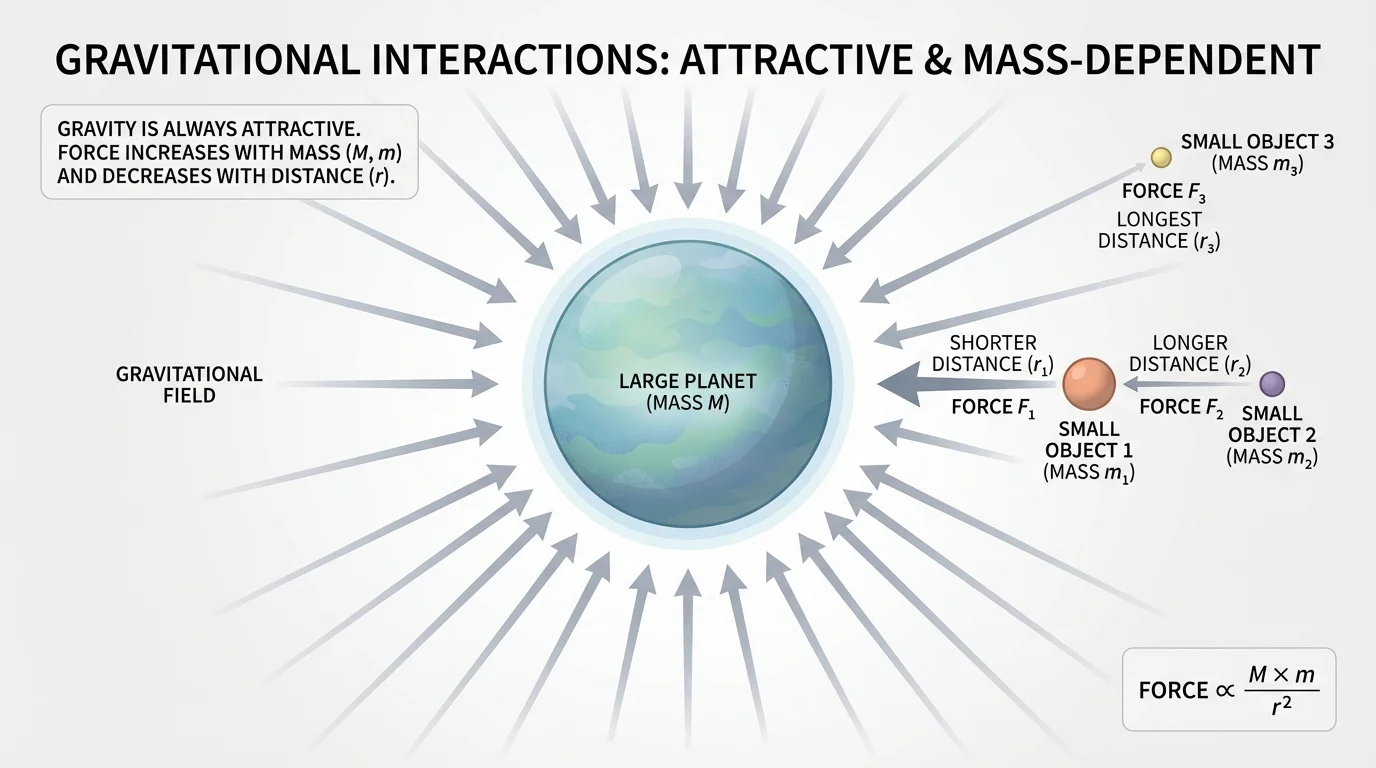
This field idea is useful because it explains both falling and orbiting. Near Earth's surface, the field causes dropped objects to move toward the ground. Farther away, the same field keeps the Moon and satellites moving in curved paths.
The field model also supports the claim that gravity depends on mass. A more massive object creates a stronger field around itself. That stronger field produces a greater gravitational pull on a test object.
Remember: A force can change an object's motion by changing its speed, its direction, or both. Gravity often changes direction of motion, which is why it can keep moons and satellites in orbit even when they are already moving.
When we connect fields to evidence, our argument becomes stronger: if a planet has greater mass, it creates a stronger gravitational field, and objects near it experience greater weight.
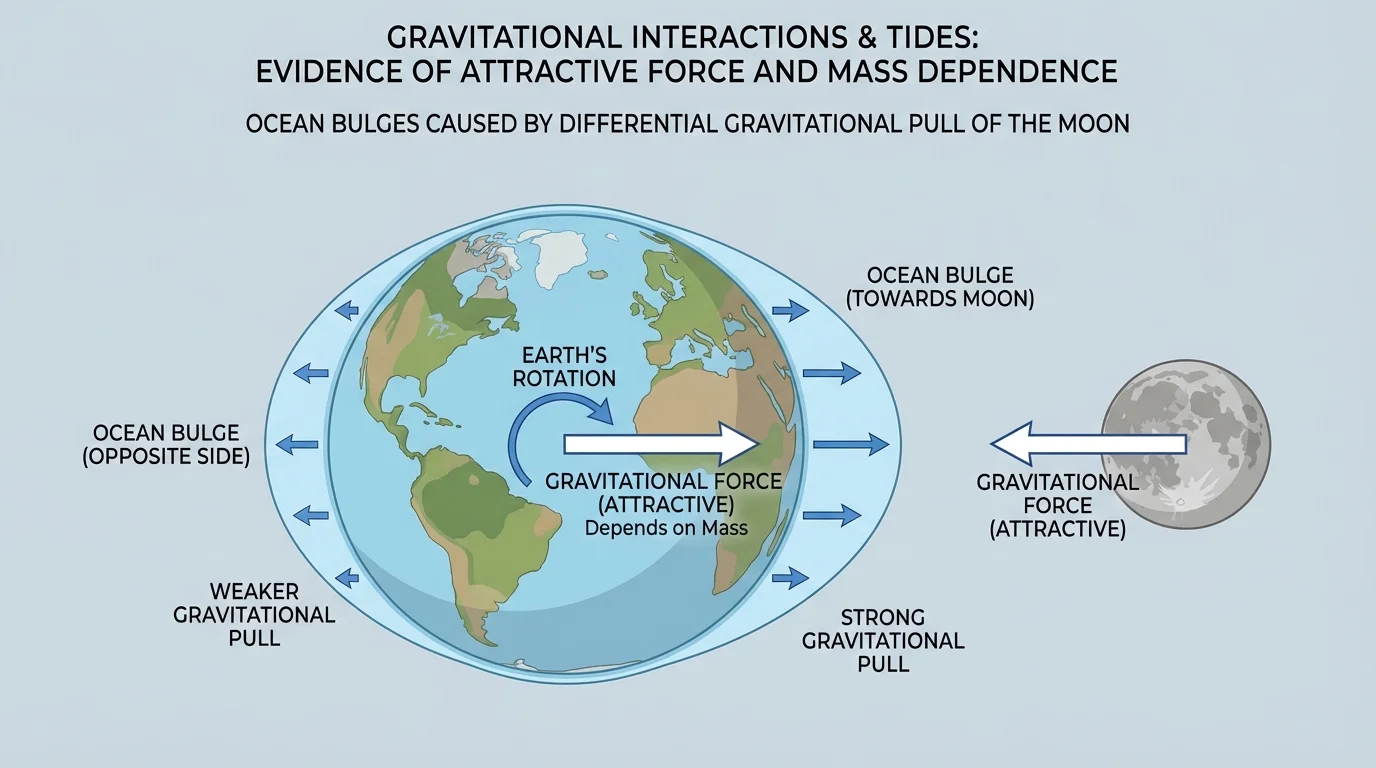
A strong scientific argument does more than repeat a definition. It uses observations and measured patterns. Here is one possible argument: gravitational interactions are attractive because dropped objects move toward Earth, the Moon remains in orbit around Earth, and tides show that the Moon pulls on Earth's oceans. Gravitational interactions depend on mass because objects weigh different amounts on different worlds, and more massive bodies such as Earth and Jupiter create stronger pulls than smaller bodies such as the Moon.
[Figure 3] Notice how the argument includes evidence from both Earth and space. That matters because one example alone can be misleading, but several related examples reveal a pattern.
Example: Turning observations into an argument
Suppose someone says, "Gravity only affects things that are falling." Build a stronger scientific response.
Step 1: State the claim
Gravity affects many motions, not only falling.
Step 2: Add evidence
The Moon orbits Earth, satellites orbit Earth, and the ocean tides change because of gravitational pull.
Step 3: Add reasoning
If gravity only affected falling objects, it could not change the motion of the Moon, satellites, or oceans. Since these are all affected, gravity must act more broadly as an attractive force between masses.
Another good habit is to compare claims with data. If a more massive planet gives the same object a greater weight, that is measurable evidence that gravitational effects depend on mass.
The pull of the Moon on Earth's oceans is one of the clearest large-scale examples that gravity acts at a distance. The Moon does not touch the oceans, but its gravity helps produce tides. The Sun also affects tides because it has enormous mass.
Engineers must account for gravity when they design bridges, roller coasters, buildings, rockets, and satellites. A satellite must move fast enough to stay in orbit while still being pulled inward by Earth's gravity. Without that inward pull, it would travel away in a straight line.
Space agencies also use knowledge of gravity to plan missions. A spacecraft traveling near a planet can have its speed and direction changed by the planet's gravitational pull. This allows missions to save fuel and travel farther.
Even sports connect to gravity. When a basketball arcs toward the hoop, gravity pulls it downward the entire time. Players learn to aim higher because they know gravity changes the ball's path.
Astronauts on the International Space Station are still under Earth's gravity. They seem weightless because they and the station are in continuous free fall while orbiting Earth.
The tide example remains especially powerful because, unlike a falling ball, it shows gravity affecting huge amounts of water over great distances.
One misconception is that gravity only exists on Earth. In reality, gravity exists wherever there is mass. Every planet, moon, star, and person has gravity.
Another misconception is that heavier objects always fall faster. If air resistance is small, objects fall at the same rate in the same gravitational field. A hammer and a feather fall differently on Earth mainly because air pushes on the feather much more. Without air resistance, they fall together.
Some students also confuse mass and weight. Mass measures how much matter is in an object. Weight measures the gravitational force on that object. Because gravity changes from place to place, weight can change while mass stays constant.
"The important thing in science is not only to obtain new facts, but to discover new ways of thinking about them."
— William Lawrence Bragg
Thinking in terms of claims, evidence, reasoning, and fields gives us a better way to understand gravity than simply memorizing that things fall down.
A complete argument now looks like this: gravitational interactions are attractive because objects with mass pull toward one another, as shown by falling objects, orbits, and tides. The strength of that interaction depends on mass because more massive objects create stronger gravitational fields and cause greater weights and stronger pulls on nearby objects.
