A shout across a field, a drumbeat in a gym, and ripples spreading across a pond all have something surprising in common: they move energy from one place to another without sending the material itself on the same trip. That idea is one of the most useful patterns in science. A wave is a disturbance that travels and transfers energy. In this lesson, we will build a simple model for waves and use math to describe what waves do.
We will focus on mechanical waves, such as sound waves, waves on a rope, and water waves. These waves need matter to travel. The scope of this lesson is limited to standard repeating waves, so we will stay with regular wave patterns and not study electromagnetic waves here.
When you toss a pebble into water, rings move outward. The water does not travel across the pond in a giant circle. Instead, the water mostly moves up and down while the disturbance spreads outward. This is a key idea: waves transfer energy, not matter over long distances.
Sound works in a similar way. If someone claps their hands, the air near the hands vibrates. That vibration passes from particle to particle through the air until it reaches your ears. The air particles do not travel from the clapper all the way to you. They jiggle back and forth, passing the energy along.
You may already know that energy is the ability to cause change. Waves are one way energy moves from place to place. A moving disturbance can make objects vibrate, splash, shake, or produce sound.
Scientists use models to describe patterns that happen again and again. A simple wave model helps us talk about regular repeating waves using a small set of important features.
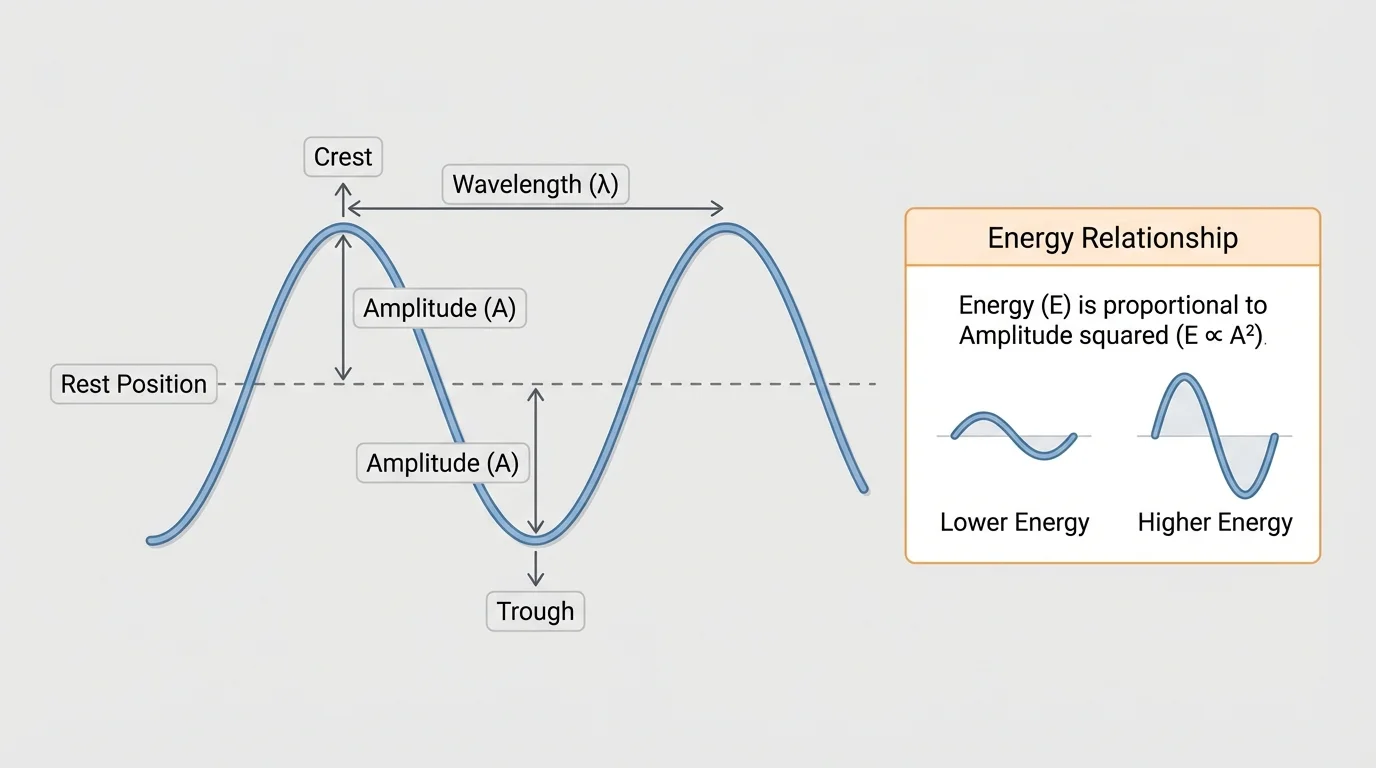
A simple wave model has a repeating pattern. For a wave drawn like an up-and-down curve, the highest point is the crest, and the lowest point is the trough. The center line the wave would rest on if it were not disturbed is called the rest position or equilibrium position.
Two especially important measurements are amplitude and wavelength. Amplitude is the distance from the rest position to a crest or to a trough. Wavelength is the distance between matching points on two nearby waves, such as crest to crest or trough to trough.
If a wave repeats over and over, one complete pattern is called a cycle. In a standard repeating wave, each cycle has the same shape. That makes it possible to compare one wave to another and describe waves with numbers.
Amplitude is the maximum distance that a point on the medium moves away from its rest position.
Wavelength is the distance between two matching points on consecutive waves, such as crest to crest.
Frequency is the number of complete waves or cycles that pass a point each second.
As you continue, keep in mind that the wave shape is a model. It helps us track the repeating disturbance clearly. Later, when we compare energy, the amplitude in [Figure 1] becomes especially important.
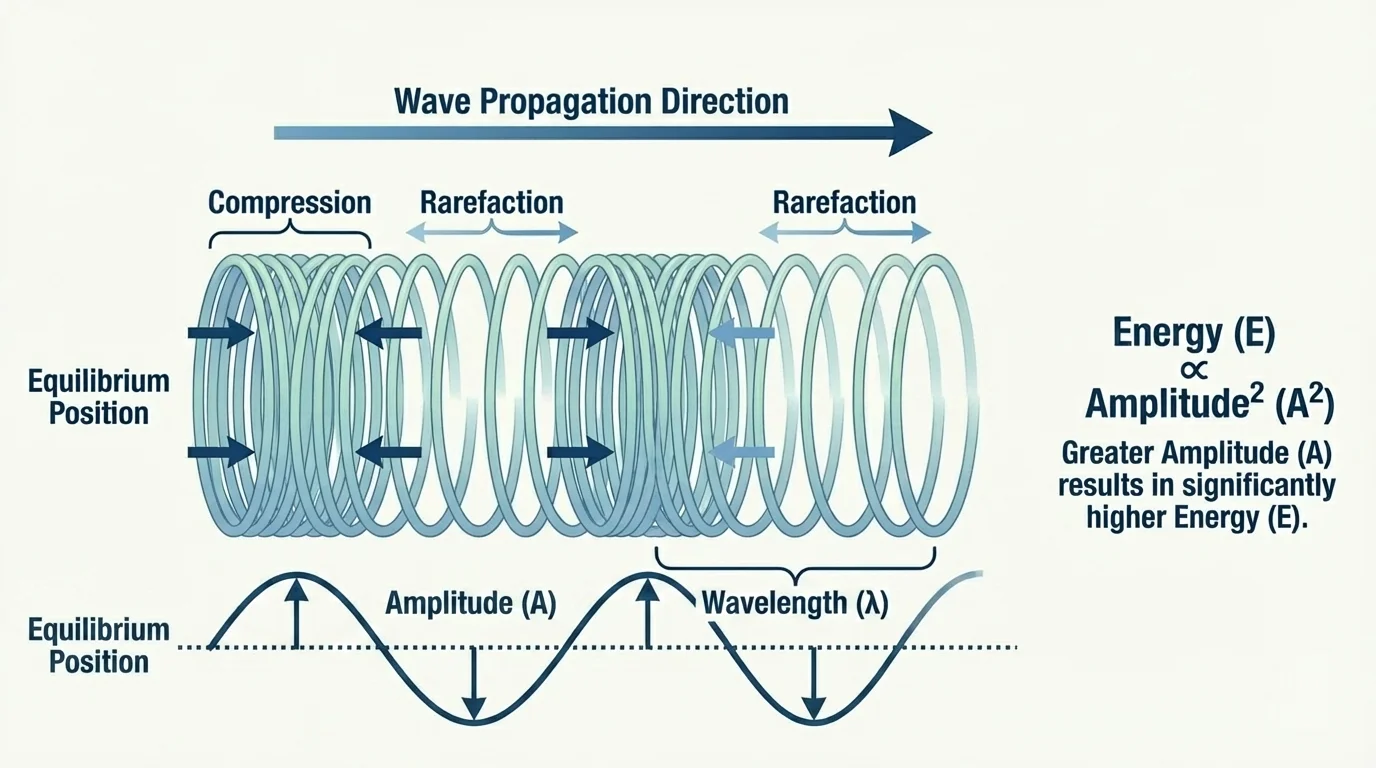
[Figure 2] shows that mechanical waves need a medium, which is the material through which the wave travels. The medium can be a solid, liquid, or gas. A rope can be a medium. Water can be a medium. Air can be a medium.
The particles in the medium do not all rush forward with the wave. Instead, each particle moves a little and affects nearby particles. This chain of interactions carries the disturbance through the material, as a slinky-like wave illustrates.
For sound, the medium is often air. A speaker pushes and pulls on nearby air, creating crowded regions and spread-out regions that move through the air. This is why there is no ordinary sound in empty space: with no medium, a mechanical sound wave cannot travel.
Water waves are a bit more complicated because the water surface can move in mixed ways, but they still fit the main idea that a disturbance moves through a medium and transfers energy.
A loud sound can make nearby objects vibrate. That happens because the sound wave transfers energy into the object, causing it to move.
The idea of a medium helps explain why different materials carry sound differently. Sound usually travels faster in solids than in gases because particles in solids are packed more closely and can pass along vibrations more quickly.
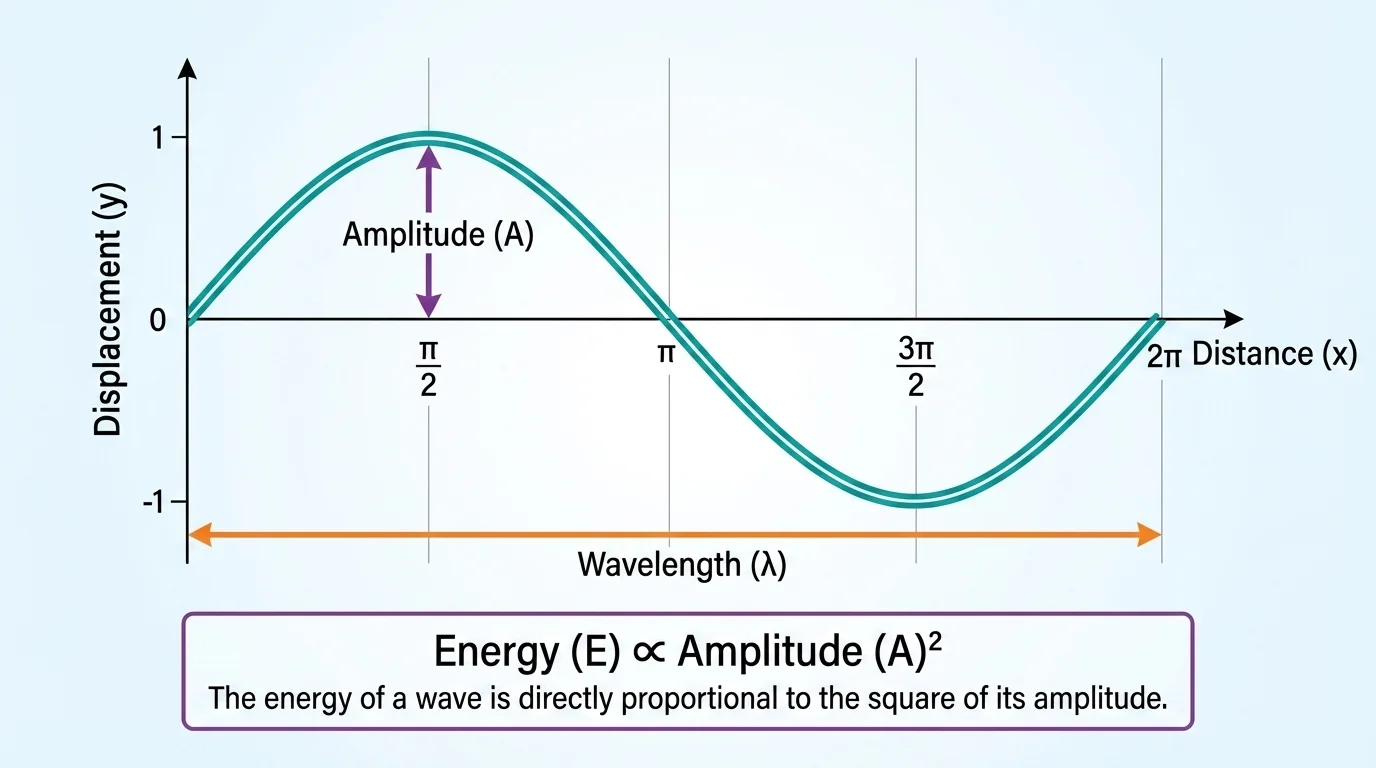
[Figure 3] helps show that waves are easier to compare when we use mathematical representations. A graph can show the shape of a wave, and numbers can describe its size and timing. On this graph, the vertical direction shows displacement from the rest position, and the horizontal direction shows distance along the wave.
The frequency of a wave tells how many cycles pass a point each second. Frequency is measured in hertz, written as \(\textrm{Hz}\). If \(5\) waves pass in \(1\) second, then the frequency is \(5 \textrm{ Hz}\).
The period is the time for one cycle. Frequency and period are related by the equation
\[f = \frac{1}{T}\]
where \(f\) is frequency and \(T\) is period. If one wave takes \(0.5 \textrm{ s}\), then \(f = \dfrac{1}{0.5} = 2 \textrm{ Hz}\).
Another very useful relationship connects wave speed, frequency, and wavelength:
\[v = f\lambda\]
In this equation, \(v\) is wave speed, \(f\) is frequency, and \(\lambda\) is wavelength. This equation says that if you know any two of these quantities, you can find the third.
Worked example: finding wave speed
A wave has frequency \(4 \textrm{ Hz}\) and wavelength \(2 \textrm{ m}\). Find its speed.
Step 1: Write the formula.
Use \(v = f\lambda\).
Step 2: Substitute the known values.
\(v = 4 \times 2\)
Step 3: Calculate.
\[v = 8 \textrm{ m/s}\]
The wave speed is \(8 \textrm{ m/s}\).
You can also use this formula in reverse. If a sound wave in a certain medium travels at \(340 \textrm{ m/s}\) and has a frequency of \(170 \textrm{ Hz}\), then its wavelength is \(\lambda = \dfrac{340}{170} = 2 \textrm{ m}\).
Wave graphs are not pictures of objects moving through space the way the graph looks. Instead, the graph is a tool that represents how far the medium is displaced from its rest position at different places or times. That is why the amplitude marked in [Figure 3] is a measurement, not the height of an object flying through the air.
One of the most important ideas in this topic is that waves with larger amplitude carry more energy. In a standard repeating wave, if you shake a rope gently, the rope wave has a small amplitude and carries less energy. If you shake it harder, the wave has a larger amplitude and carries more energy.
For middle school science, you should know this relationship clearly: greater amplitude means greater energy. Smaller amplitude means less energy. This pattern applies to common examples such as sound waves and waves on a rope.
For sound, amplitude is connected to how loud the sound seems. A louder sound wave has greater amplitude and carries more energy than a quieter sound wave. For waves on water, larger amplitude usually means bigger ripples or larger up-and-down motion, which means more energy is being transferred.
Amplitude and energy
In many wave situations, the energy increases when the amplitude increases. You do not need a complicated formula for this standard. The key model is comparative: if wave A has a greater amplitude than wave B, then wave A carries more energy.
We can still use simple math comparisons. Suppose wave A has amplitude \(1 \textrm{ cm}\), wave B has amplitude \(3 \textrm{ cm}\), and both travel through the same kind of rope in the same pattern. Wave B has the greater amplitude, so wave B carries more energy.
Worked example: comparing energy by amplitude
Three rope waves have amplitudes \(2 \textrm{ cm}\), \(5 \textrm{ cm}\), and \(4 \textrm{ cm}\). Rank them from least energy to greatest energy.
Step 1: Use the wave-energy rule.
Greater amplitude means greater energy.
Step 2: Order the amplitudes from smallest to largest.
\(2 \textrm{ cm} < 4 \textrm{ cm} < 5 \textrm{ cm}\)
Step 3: Match the energy order.
The \(2 \textrm{ cm}\) wave has the least energy, then the \(4 \textrm{ cm}\) wave, then the \(5 \textrm{ cm}\) wave.
The energy ranking is \(2 \textrm{ cm}, 4 \textrm{ cm}, 5 \textrm{ cm}\) from least to greatest.
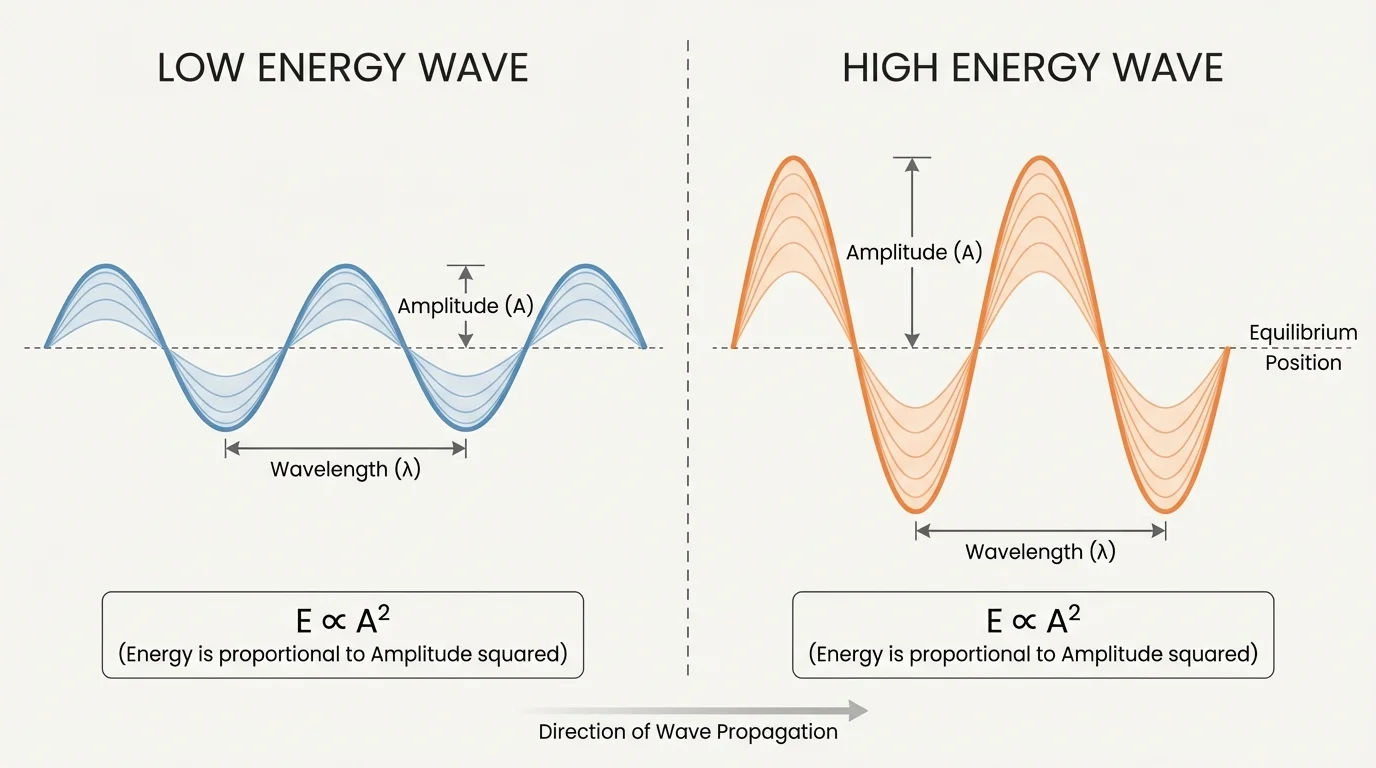
Be careful: a larger amplitude does not automatically mean a longer wavelength. The two properties measure different things. Amplitude measures how far the medium moves from rest. Wavelength measures how long one cycle is.
Later, when you compare different waves, the side-by-side pattern in [Figure 4] helps you separate these ideas: the waves can have the same wavelength but different amplitudes and therefore different energies.
Mechanical waves are often grouped into transverse waves and longitudinal waves. In a transverse wave, the medium moves perpendicular to the direction the wave travels. A wave on a rope is the usual example: if the wave moves horizontally, the rope moves up and down.
In a longitudinal wave, the medium moves parallel to the direction the wave travels. Sound in air is the main example at this level. The air particles move back and forth while the disturbance travels forward.
These two kinds of waves can still be described using the same important ideas: repeating pattern, wavelength, frequency, amplitude, and energy transfer. The exact appearance of the wave may differ, but the model still works.
| Wave type | How the medium moves | Example |
|---|---|---|
| Transverse | Perpendicular to wave travel | Wave on a rope |
| Longitudinal | Parallel to wave travel | Sound in air |
Table 1. Comparison of transverse and longitudinal mechanical waves.
The slinky pattern from earlier in [Figure 2] is a helpful reminder that not all waves look like the up-and-down shape in [Figure 1]. Different diagrams can represent different types of waves, but both are still wave models.
Musicians use wave ideas constantly. A guitar string can vibrate at different frequencies. A higher-frequency sound usually has a higher pitch. If the string is plucked harder, the amplitude is larger, and the sound is louder because more energy is carried by the wave.
At a sports stadium, the crowd may create a "wave." This is not a perfect scientific wave, but it helps show an important pattern: each person mostly moves up and down while the disturbance travels around the stadium. That is similar to how particles in a medium can move locally while energy moves across a larger distance.
Worked example: finding frequency
A repeating water wave makes \(12\) complete cycles in \(4 \textrm{ s}\). What is the frequency?
Step 1: Use the definition of frequency.
Frequency is cycles per second, so \(f = \dfrac{\textrm{number of cycles}}{\textrm{time}}\).
Step 2: Substitute the values.
\(f = \dfrac{12}{4}\)
Step 3: Calculate.
\[f = 3 \textrm{ Hz}\]
The wave frequency is \(3 \textrm{ Hz}\).
Ocean waves also show why wave energy matters. Strong winds can produce larger-amplitude waves, and those waves can transfer more energy to the shore. That energy can move sand, rock boats, and reshape coastlines over time.
Engineers and scientists also pay attention to waves during earthquakes, although earthquake wave behavior can be more complex than the simple repeating model we use here. The main idea still matters: waves transfer energy through materials.
Scientists gather data from waves in several ways. They may measure the distance from crest to crest to get wavelength, count cycles in a certain time to get frequency, or measure the maximum displacement to get amplitude. These measurements can be recorded in tables, graphs, and equations.
Suppose a rope wave has wavelength \(0.5 \textrm{ m}\) and frequency \(6 \textrm{ Hz}\). Its speed is \(v = 6 \times 0.5 = 3 \textrm{ m/s}\). This kind of simple calculation helps describe wave motion clearly.
| Quantity | Meaning | Common unit |
|---|---|---|
| Amplitude | Maximum displacement from rest position | m, cm |
| Wavelength | Length of one cycle | m, cm |
| Frequency | Cycles each second | Hz |
| Period | Time for one cycle | s |
| Wave speed | How fast the disturbance travels | m/s |
Table 2. Common quantities used to describe waves and their units.
Notice that amplitude and wavelength can both be measured in meters or centimeters, but they describe different features. Students sometimes confuse them because both are distances. Looking back at [Figure 3], amplitude is vertical from the middle line, while wavelength is horizontal from one matching point to the next.
One common mistake is thinking that a wave carries matter over long distances in the same way it carries energy. In many mechanical waves, the medium vibrates locally while the disturbance moves onward.
Another common mistake is assuming that if frequency changes, speed must always change too. In a given medium, wave speed is often determined by the medium itself. If speed stays the same, then changing frequency changes wavelength according to \(v = f\lambda\).
A third mistake is mixing up loudness and pitch in sound. Loudness is related to amplitude and energy, while pitch is related to frequency. A sound can be loud and low-pitched, or quiet and high-pitched.
The same rope can produce waves with different amplitudes and frequencies depending on how it is shaken. That means one medium can carry many different wave patterns.
Understanding these differences makes the wave model much more powerful. It lets you read graphs, compare wave behavior, and explain what happens in real systems like musical instruments and water surfaces.
