You pick up your phone, tap the screen, and a bright image appears. At the same time, you might be listening to music through headphones, blocking out the noise of the room. Behind these everyday moments lies a powerful idea: light and sound are waves, and what you see or hear depends on how those waves interact with the materials around you.
Before we talk about waves meeting materials, we need a clear picture of what a wave is. A wave is a repeating disturbance that transfers energy from one place to another without moving matter the whole distance.
Many waves in your life are mechanical waves. These waves need a medium (like air, water, or a solid) to travel. Sound is a mechanical wave: when someone speaks, vibrating vocal cords push on air particles, and that pattern of vibrations travels through the air to your ears.
Light waves are a kind of electromagnetic wave. They do not need a medium and can travel through empty space, which is why sunlight reaches Earth from the Sun.
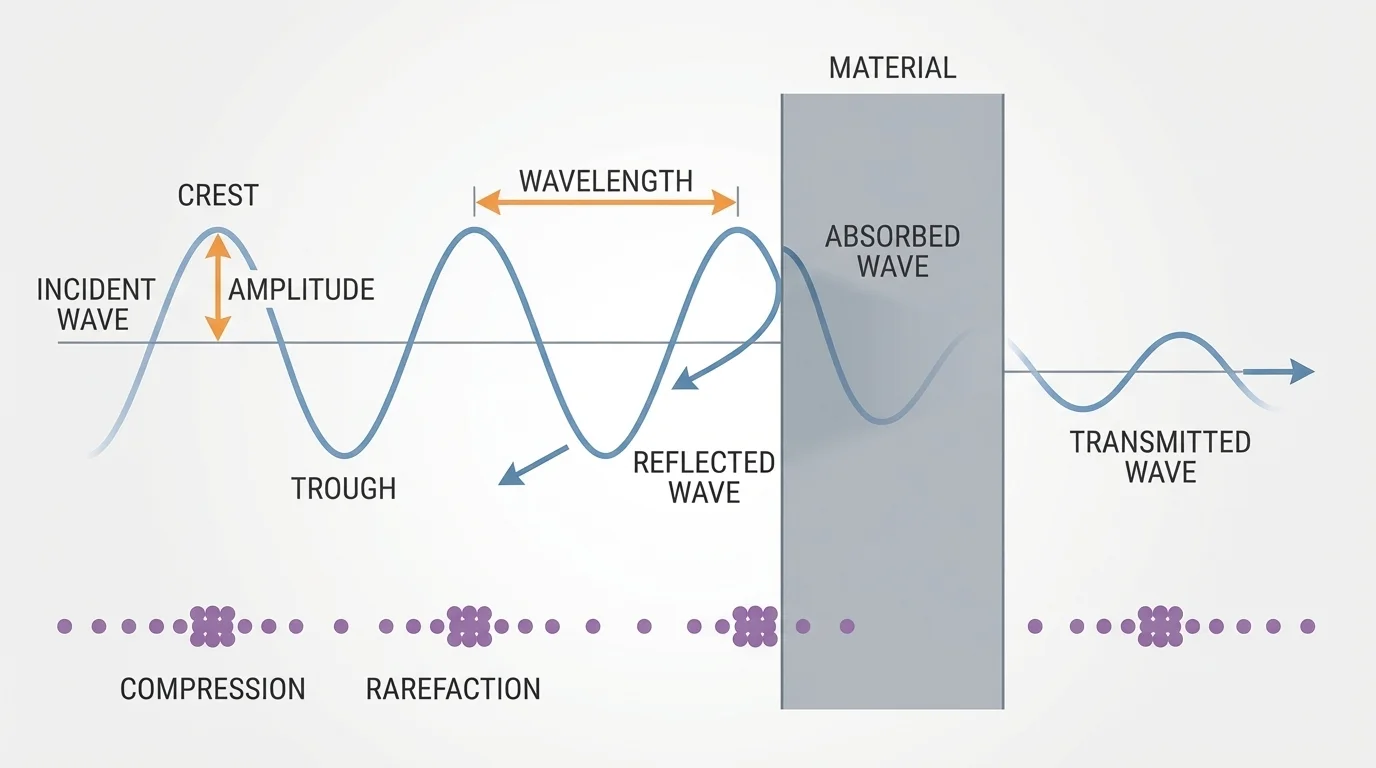
In a simple wave model, we describe a wave using three key properties, as illustrated in [Figure 1]:
For sound, higher frequency means a higher pitch, and larger amplitude means a louder sound. For light, different frequencies (or wavelengths) within visible light correspond to different colors.
Mechanical waves like sound always travel through a medium, but light can travel through some materials, and also through empty space. This difference matters a lot when we talk about what happens as waves meet different materials.
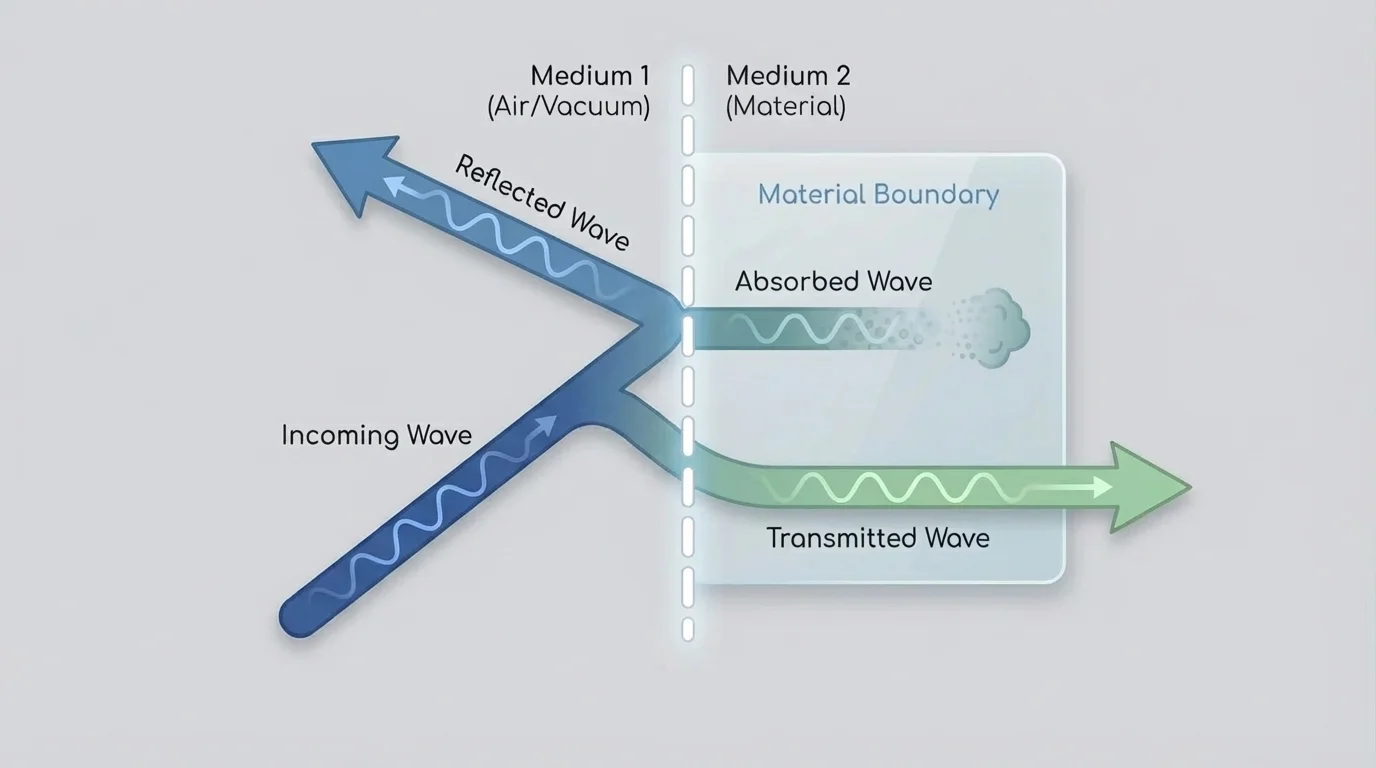
Whenever a wave hits a new material or surface (a boundary), something interesting happens. The wave can do three main things, as the path of energy in [Figure 2] shows:
Often, all three happen at once. For example, when sunlight hits your skin, some light is reflected, some passes a little way into the skin, and some is absorbed and turns into heat, making you feel warm.
The exact amounts of reflection, absorption, and transmission depend on both the type of wave (sound or light) and the properties of the material (hard, soft, shiny, dark, clear, etc.). Our goal is to build a model in our minds that helps us predict which effect will be strongest in different situations.
Reflection happens when waves bounce off a surface instead of going through it. You experience reflection all the time.
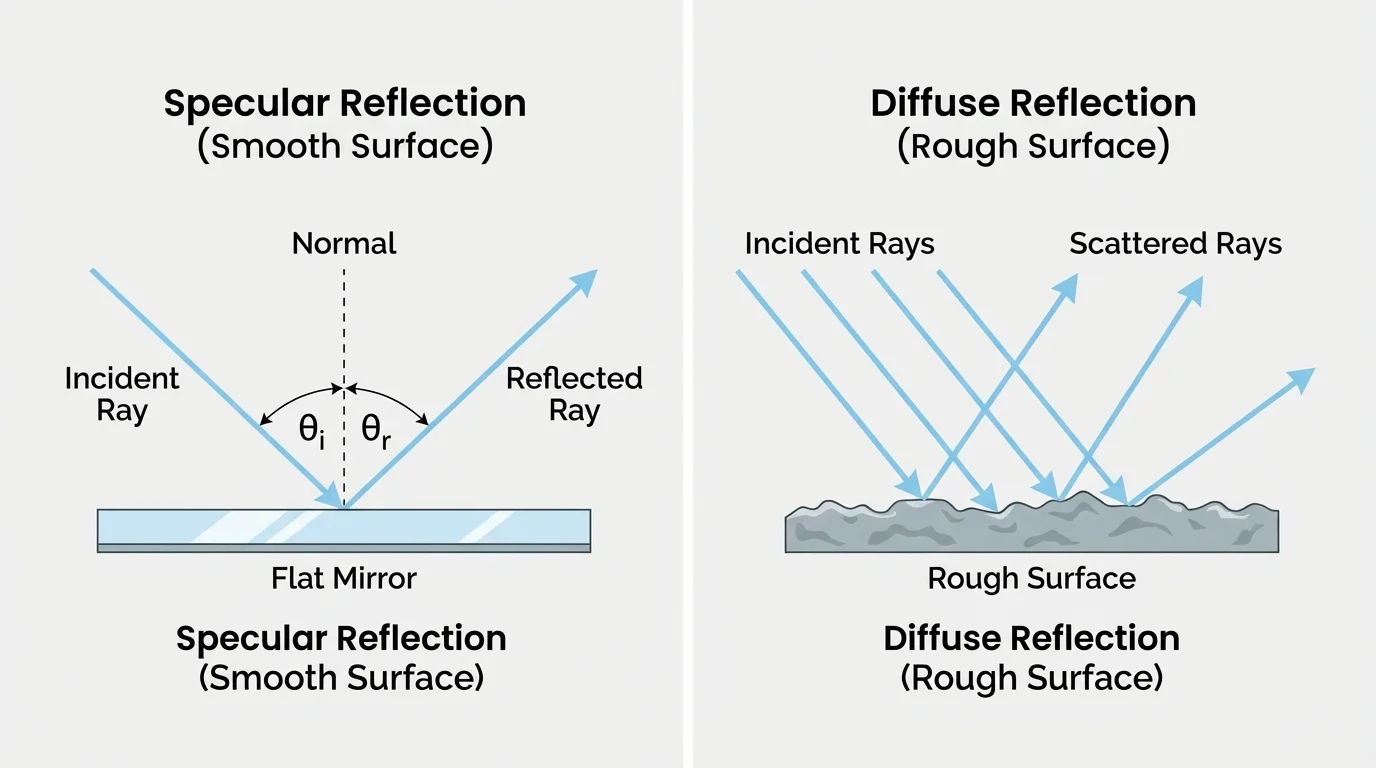
For light reflection, a very smooth, shiny surface like a mirror reflects most of the light that hits it in an organized way. A ray of light from an object hits the mirror and then bounces into your eyes, as the paths of light in [Figure 3] show. Your brain traces the light rays back in straight lines, so you see an image behind the mirror.
Two key ideas help describe this behavior qualitatively:
On rough surfaces, like a wall or a crumpled piece of foil, light still reflects, but in many different directions. This is called diffuse reflection. You can see the wall because light is bouncing off it to your eyes, but you don't see a clear image.
For sound reflection, you hear an echo when sound waves bounce off a large, hard surface, like a canyon wall or a gymnasium wall. If you clap in a small classroom, the sound quickly reaches your ears from many reflections, and it just sounds like one short clap. In a large, mostly empty hall, some sound energy returns to you after a short delay, and you hear a separate echo.
Our model for reflection is: when waves hit a boundary, especially a hard or shiny one, a large part of the energy can bounce back in a predictable way. Hard, smooth surfaces tend to produce strong reflection for both sound and light.
Absorption happens when a material takes in the wave's energy instead of letting it bounce back or pass through. This energy usually changes into other forms, often into thermal energy, which can raise the temperature of the material.
For sound absorption, think about what happens when you walk into a carpeted room filled with soft furniture versus an empty room with bare walls and floors. In the soft room, your footsteps and voice sound quieter and less echoey. Soft materials like foam, curtains, and carpets absorb sound waves. The vibration energy of the sound causes the material's particles to vibrate, and that motion turns into heat (too small a temperature change to feel, but it is there).
In contrast, in an empty hallway, your footsteps seem loud. The hard surfaces reflect more sound and absorb less, so more wave energy stays in the air as sound.
For light absorption, the color and material matter a lot:
When a material absorbs light, the wave energy makes its particles move more, increasing their kinetic energy. That is why sunlight can heat up pavement or why a solar water heater can warm water using absorbed light energy.
Our model for absorption is: certain materials and colors are good at turning wave energy into other forms (like heat), which reduces the amount of wave energy that continues past that material.
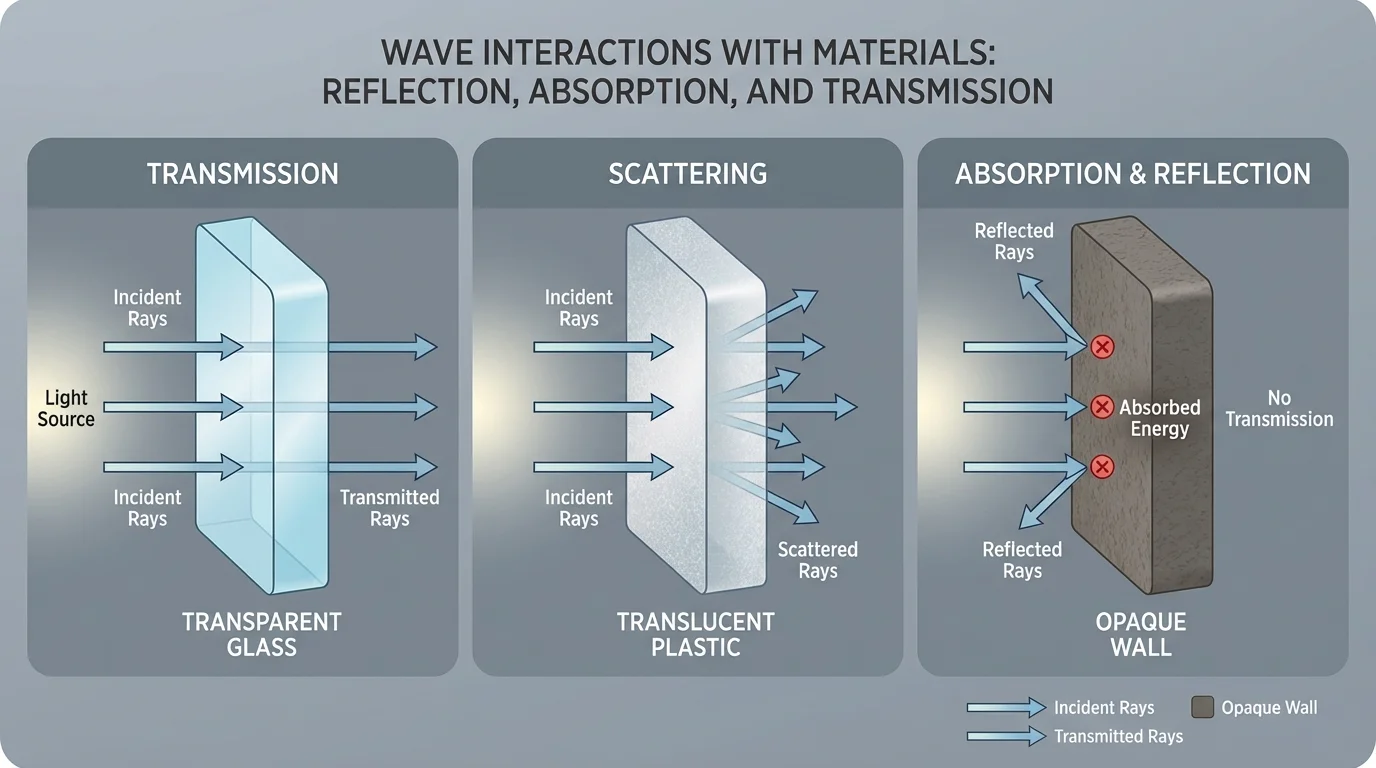
Transmission happens when a wave passes through a material and comes out the other side. For light, materials can be grouped into categories that are helpful when classifying transmission, as shown in [Figure 4]:
When light passes from one medium to another (for example, from air into water), it can also bend. This bending is called refraction. A straw in a glass of water looks "bent" at the surface because light rays change direction as they move from water to air and then into your eyes. Our focus here is qualitative: the light changes direction when it moves between different transparent materials.
Sound also transmits through materials. In fact, sound can move through solids, liquids, and gases, but not through empty space. You can test sound transmission if you put your ear on a table and tap the table: the sound reaches your ear through the solid table, often more strongly than through the air.
Our model for transmission is: materials that allow waves to pass through them (like glass for light or air for sound) let most of the wave's energy continue, sometimes changing its direction or speed.
Now we can connect reflection, absorption, and transmission into a single model. When a wave reaches a new material, imagine the starting wave carries 100% of its energy.
The material's properties decide how that energy is shared among three paths:The energy paths in [Figure 2] match this model. We do not need exact numbers in this grade level; we only need to compare which effect is stronger or weaker in different situations.
We can use words like "mostly reflected," "mostly absorbed," or "some transmitted" to describe what happens. For example:
This simple model helps us reason about many real-world situations and design better materials and devices that control waves.
Let's compare how some common materials interact with sound and light waves. This comparison deepens our model by linking it to everyday experience.
| Material | For Light | For Sound | Main Interaction (qualitative) |
|---|---|---|---|
| Polished metal (mirror) | Very reflective, opaque | Reflective, can echo | Mostly reflection for both |
| Clear glass | Transparent, small reflection | Some sound passes, some reflects | Mostly transmission for light |
| Dark cloth or foam | Opaque, absorbs light | Strongly absorbs sound | Mostly absorption |
| White wall (painted) | Reflects much light, opaque | Reflects some sound, absorbs some | Mixed reflection and absorption |
| Water | Transmits light but also reflects some (glare) | Transmits sound well | Good transmission, some reflection |
Table 1. Qualitative comparison of how common materials interact with light and sound waves.
This table supports our model: the same wave (light or sound) can behave very differently depending on the material it meets. Also, the same material can act differently for light and sound. For example, thick foam is excellent at absorbing sound but might not absorb much light unless it is also dark-colored.
Understanding how waves are reflected, absorbed, or transmitted helps scientists and engineers design useful technologies.
In each of these examples, designers choose materials that have the right combination of reflection, absorption, and transmission for the type of wave they are using.
You can explore wave interactions using simple, safe materials around you. These observations support and test your mental model.
Light interactions:
Sound interactions:
These observations help confirm the predictions from your wave interaction model without needing any complicated equipment.
Our simple wave model—with wavelength, frequency, and amplitude—helps explain what we observe when waves are reflected, absorbed, or transmitted.
Thinking in terms of energy and wave properties allows you to make sense of natural phenomena and to understand how many technologies around you are designed.
Noise-cancelling headphones use knowledge of sound waves so precisely that they create "opposite" sound waves to cancel incoming noise, drastically reducing what you hear from the outside world.
As you keep studying waves, you can make more detailed models, but this qualitative model of reflection, absorption, and transmission already explains a huge amount of what you see and hear every day.
