A strange thing happens every time you send a text, stream a song, or join a video call: your message travels through the world as patterns in waves, and yet it usually arrives clear enough to understand. That is impressive because waves are often affected by distance, obstacles, and random interference. The reason modern communication works so reliably is that much of it uses digitized information instead of analog information.
To support the claim that digitized signals are more reliable than analog signals, scientists and engineers look at evidence from many sources. They compare how signals behave when noise is added, how easily a signal can be copied, and how accurately information can be stored and sent again. When these observations are put together, a strong pattern appears: digital systems are usually better at protecting information from damage.
A signal is a pattern that carries information. Signals can travel in different kinds of waves. Sound moves through air as vibrations. Light travels as electromagnetic waves. Radio, television, and Wi-Fi also use electromagnetic waves. In all of these cases, the wave is not the message itself; the wave is the carrier that transports the message.
For example, when a person speaks into a microphone, the sound of the voice can be turned into an electrical or electromagnetic pattern. That pattern changes over time in a way that matches the information being sent. A receiving device then turns the pattern back into sound, images, or data. This is why waves are so important in communication technology.
Analog signal means a signal that changes continuously. Digital signal means a signal that uses separate, distinct states, often sent as pulses. Noise is any unwanted disturbance that changes a signal as it travels.
Even if two signals carry the same message, they do not always handle disturbances equally well. That difference is the key to understanding reliability.
An analog signal, as shown in [Figure 1], changes smoothly. It can take many values in between a low level and a high level. A classic example is a vinyl record. The grooves represent continuous changes that match the sound wave. Older radio broadcasts also used analog signals, where the wave changed continuously to represent sound.
A digital signal uses separate steps or pulses instead of a smooth range. In a simple digital system, the signal is read as one of two states, such as high or low. Instead of trying to preserve every tiny change exactly, the system sorts the wave into clear categories. That makes the message easier to recognize even if the wave is not perfect.
This difference matters because real communication systems are never perfectly clean. Wires warm up, radio waves bounce off buildings, and electronic devices create unwanted disturbances. If information is stored in every tiny detail of a wave, then small changes can hurt the message. If information is stored in clearer, more separate states, the message is often easier to recover.
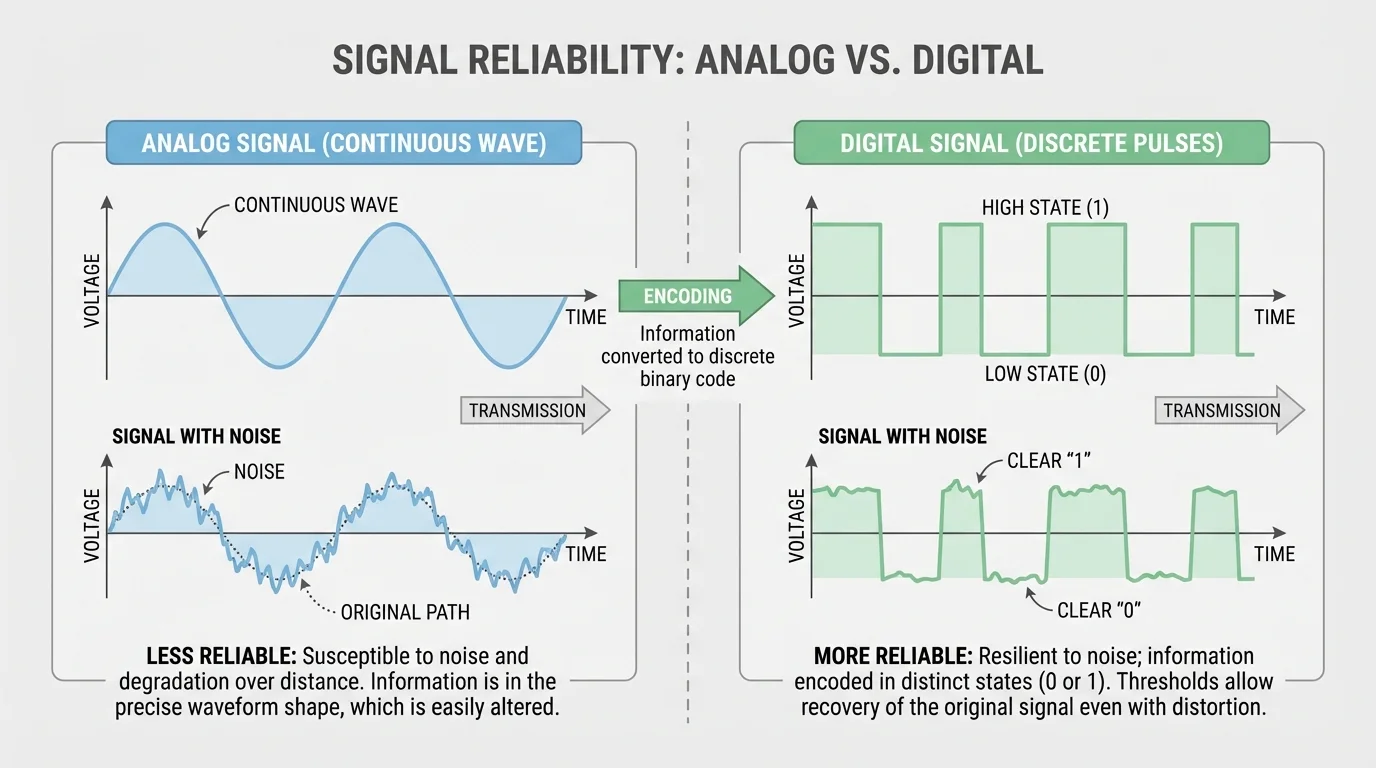
Think of it like handwriting versus a multiple-choice bubble sheet. If handwriting is messy, some letters may become hard to read because every small curve matters. But if a bubble is mostly filled in, it is still easy to decide which choice was intended. Digital communication works more like the bubble sheet.
Noise, introduced in [Figure 2], is any unwanted change added to a signal. It might come from other signals nearby, weather, electrical equipment, or even natural sources such as lightning. Noise does not carry useful information, but it mixes with the real signal and can distort it.
In an analog system, even a small amount of noise can change the exact shape of the wave. Because the information depends on smooth, continuous changes, the receiver may not know which parts came from the original message and which parts came from interference. As a result, the output may sound fuzzy, look snowy, or become slightly inaccurate.
In a digital system, noise can still affect the wave, but the receiver often only needs to decide whether each pulse should count as one state or another. If a pulse is changed a little, it can still be correctly identified. This means the message can survive disturbances that would noticeably damage an analog signal.
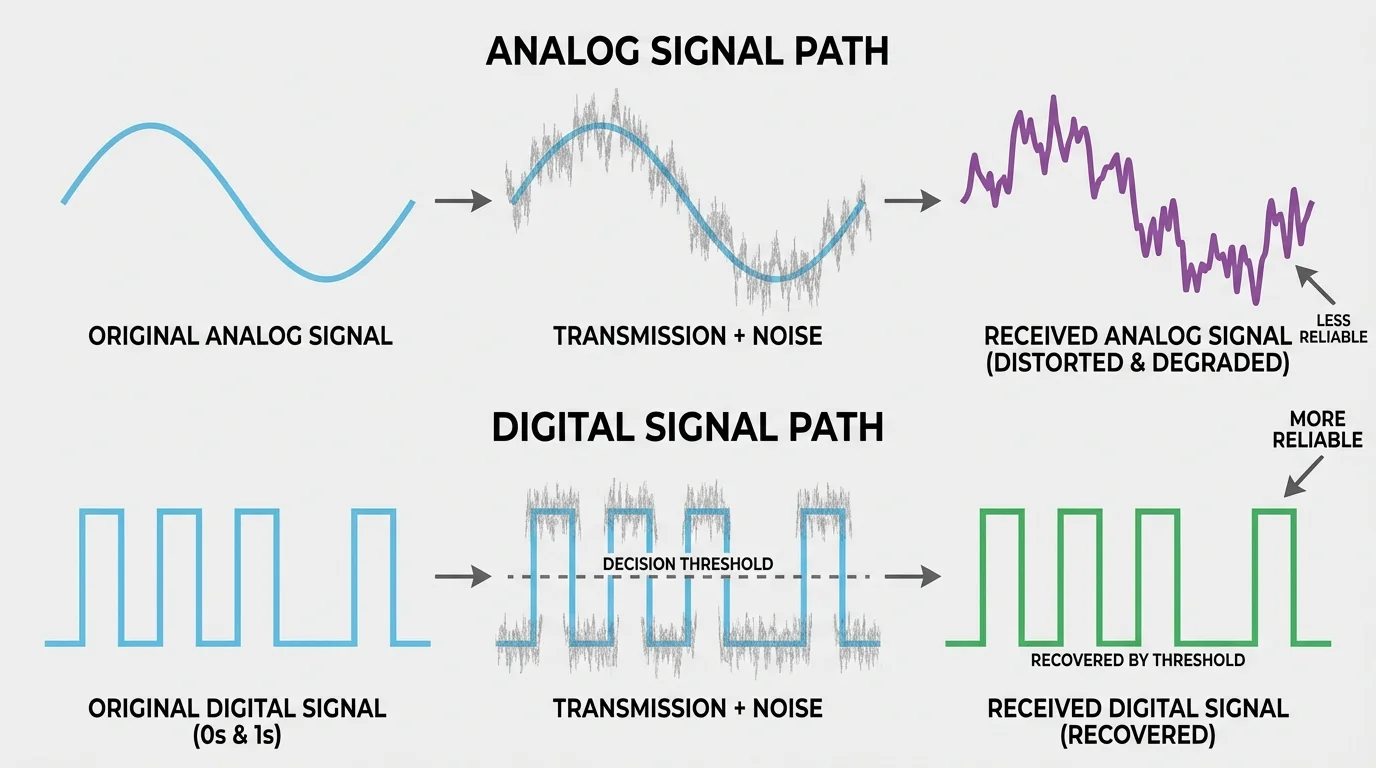
You may have heard this difference yourself. Analog radio often becomes gradually filled with static as the signal weakens. A digital audio stream usually stays clear for longer, and then if the connection becomes too poor, the sound may suddenly pause or cut out. That behavior gives evidence that digital systems handle moderate noise more successfully before finally failing.
Some of the earliest long-distance communication systems struggled with noise so badly that repeating and cleaning up the signal became one of the biggest engineering challenges. Digital methods have greatly improved that process.
This does not mean digital signals are magically immune to interference. If the noise becomes strong enough, the receiver can make mistakes. But compared with analog systems, digital systems can tolerate more distortion before the message becomes unusable.
The strongest evidence for reliability comes from several advantages working together. First, digital information can be copied again and again with much less loss of quality. If you make a copy of an analog recording, small imperfections often add up. If you copy digital data correctly, the new copy can match the original very closely.
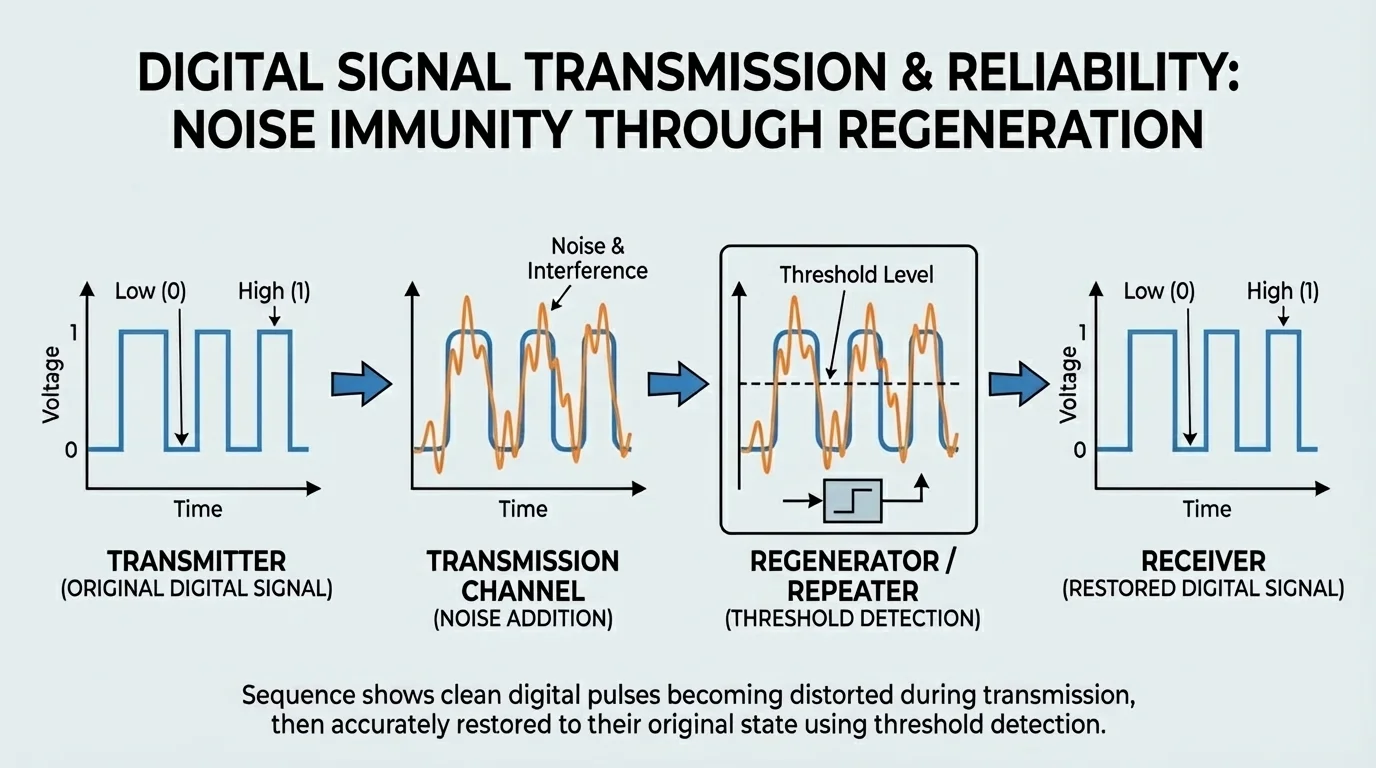
Second, digital systems can often regenerate signals. As [Figure 3] illustrates, even if the incoming pulses become a little bent, stretched, or noisy, the receiving system can decide which pulses are supposed to be high and which are supposed to be low, then rebuild a cleaner version before sending the information onward. This is a major reason digital communication works so well over long distances.
Third, digital information is easier to store and check for mistakes. A scratched analog tape may permanently change the sound in a gradual way. Digital storage can often detect when part of the information does not match what is expected. Engineers design systems so that errors can sometimes be spotted and corrected, which increases reliability.
Fourth, digital signals are better for combining many kinds of information. Sound, pictures, and text can all be turned into pulse patterns and transmitted through the same kinds of networks. Once information is digitized, computers can process it quickly and consistently.
Why clear categories help
Reliability improves when a receiver does not need to preserve every tiny variation in a wave. If the receiver only needs to decide between distinct states, then many small distortions do not matter. This makes digital communication much less sensitive to gradual damage.
A simple numerical example helps show the idea. Suppose a digital system uses a scale from low to high, and the receiver treats values below a middle point as one state and values above it as another. If a pulse that should be high is sent at level 9 and noise lowers it to 7, it may still be recognized as high. But in an analog system, a change from 9 to 7 changes the message itself because the exact value matters.
Another way to say this is that digital systems care more about categories than tiny details. Analog systems care about the exact shape all along the wave. That makes digital systems more dependable when the signal travels through an imperfect environment.
Many everyday technologies encode and send information as digital wave pulses, as shown in [Figure 4]. Cell phones turn voices into digital data before sending them through radio waves. Wi-Fi routers transmit digital information between devices in your home or school. Streaming services send digitized music and video across huge networks. Even when the wave itself is an electromagnetic wave in the air, the information riding on it can still be digital.
Medical technologies also depend on digital reliability. A hospital monitor that sends heart-rate information must deliver clear data quickly. Space communication is another strong example. Signals from spacecraft travel enormous distances and can become weak, so engineers rely on digital methods to help the message survive noise and be reconstructed accurately.
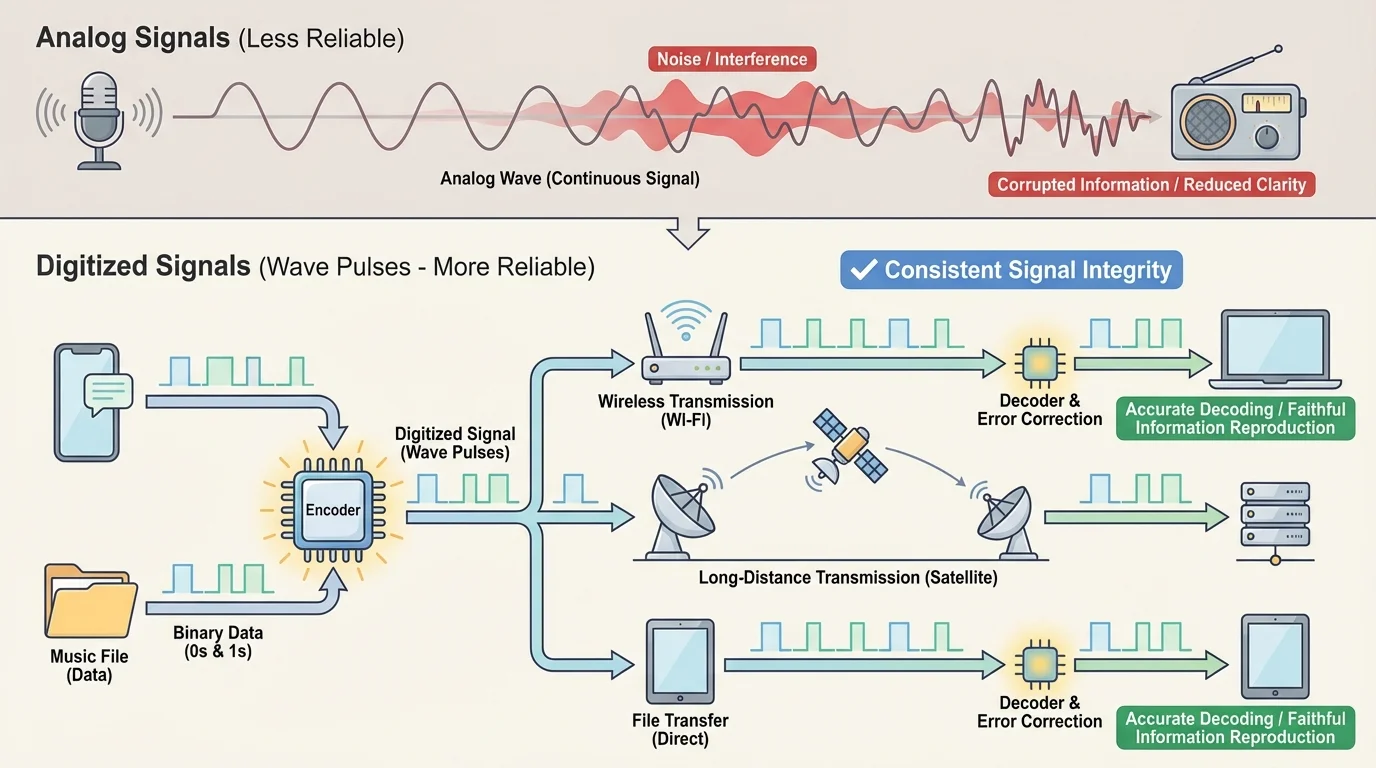
Stored media show the same pattern. Digital music files can be copied many times without the growing hiss that often appears in analog copies. Digital photos can be shared widely while keeping sharp details, as long as the data are preserved correctly. This is another important piece of technical evidence supporting the claim.
Real-world comparison case
Consider two ways of sending a song from one place to another: one analog and one digital.
Step 1: In the analog version, the wave shape changes continuously to match the sound. If static or distortion is added during transmission, the shape changes directly, so the received sound also changes.
Step 2: In the digital version, the song is encoded into separate pulse states. If small disturbances affect some pulses, the receiver can still identify many of them correctly.
Step 3: If the digital system includes ways to detect errors, it may restore the original information more accurately than the analog system can.
This comparison supports the claim that digitized signals are usually more reliable for communication.
The same idea applies to text messages, navigation systems, weather satellites, and internet searches. Modern society depends on information arriving accurately, and digital signaling helps make that possible.
Although digital signals are more reliable in many situations, that does not mean analog information is useless. Many things in nature, such as sound waves and light intensity, are continuous. To digitize them, a system must measure them and turn them into digital form. If the original measurements are too rough or too limited, some detail can be lost.
So the claim is not that digital is perfect. The claim is that for encoding, storing, and transmitting information through real-world systems with noise and interference, digital signals are generally more reliable. They are easier to detect, easier to copy accurately, and easier to restore after moderate distortion.
Waves can transfer energy and information. In communication systems, the important question is not only whether a wave can travel, but whether the pattern carrying the message can still be recognized at the end of the trip.
This is why a weak digital connection may still produce a clear result for a while, while a weak analog connection often becomes steadily less clear. Evidence from audio systems, computer networks, and long-distance communication all points in the same direction.
In science, a strong claim is supported by more than one observation. Here, the claim is that digitized signals are more reliable than analog signals. The evidence includes the way digital systems resist moderate noise, the way they can be regenerated, the way copies keep their quality better, and the way many technologies depend on them for accurate communication.
We can also compare outcomes. Analog systems often show gradual quality loss: more static, blur, or distortion. Digital systems often maintain quality longer because the receiver can still sort signals into distinct states. This pattern, which connects what we observe with how the systems work, makes the claim scientifically convincing.
Looking back at [Figure 1], the smooth analog wave carries information in every little change, while the pulse-based digital signal uses clearer categories. Looking back at [Figure 2], noise disturbs both kinds of signals, but the digital one remains easier to interpret. Looking back at [Figure 3], regeneration restores useful pulse patterns, and [Figure 4] connects these ideas to the technologies people use every day.
"A message is only useful if it arrives in a form that can still be understood."
That principle explains why digitized signals have become so important in the modern world. Their reliability helps people communicate across classrooms, cities, oceans, and even space.
