A slice of pizza can become part of your muscles, help your brain send signals, and later leave your body as waste. That sounds strange at first, but it is exactly what living organisms do every day. Food does not simply "sit" in the body. Its matter is taken apart, rearranged through chemical reactions, and used to build new molecules or to release energy for life processes.
Every organism needs a steady supply of matter and energy. Matter is the "stuff" that makes up bodies: atoms and molecules. Energy is needed for motion, growth, repair, body temperature control, and many other processes. When you eat, you take in both matter and stored chemical energy.
Food contains substances such as carbohydrates, proteins, and fats. These are made of atoms like carbon, hydrogen, oxygen, and sometimes nitrogen. Inside the body, these food molecules do not stay in their original form forever. They are changed into smaller parts and then rearranged into molecules the body can use.
Matter is anything that has mass and takes up space. In living things, matter includes water, gases, food molecules, and the molecules that make up cells and tissues.
Chemical reaction is a process in which atoms are rearranged to form new substances. The atoms are not created or destroyed; they are just connected in new ways.
Molecule is a group of atoms bonded together. Food, water, gases, and many materials in living things are made of molecules.
If you skip meals, your body does not get enough matter to build and repair tissues, and it does not get enough energy to keep working efficiently. That is why growing students, athletes, and even resting people all need food.
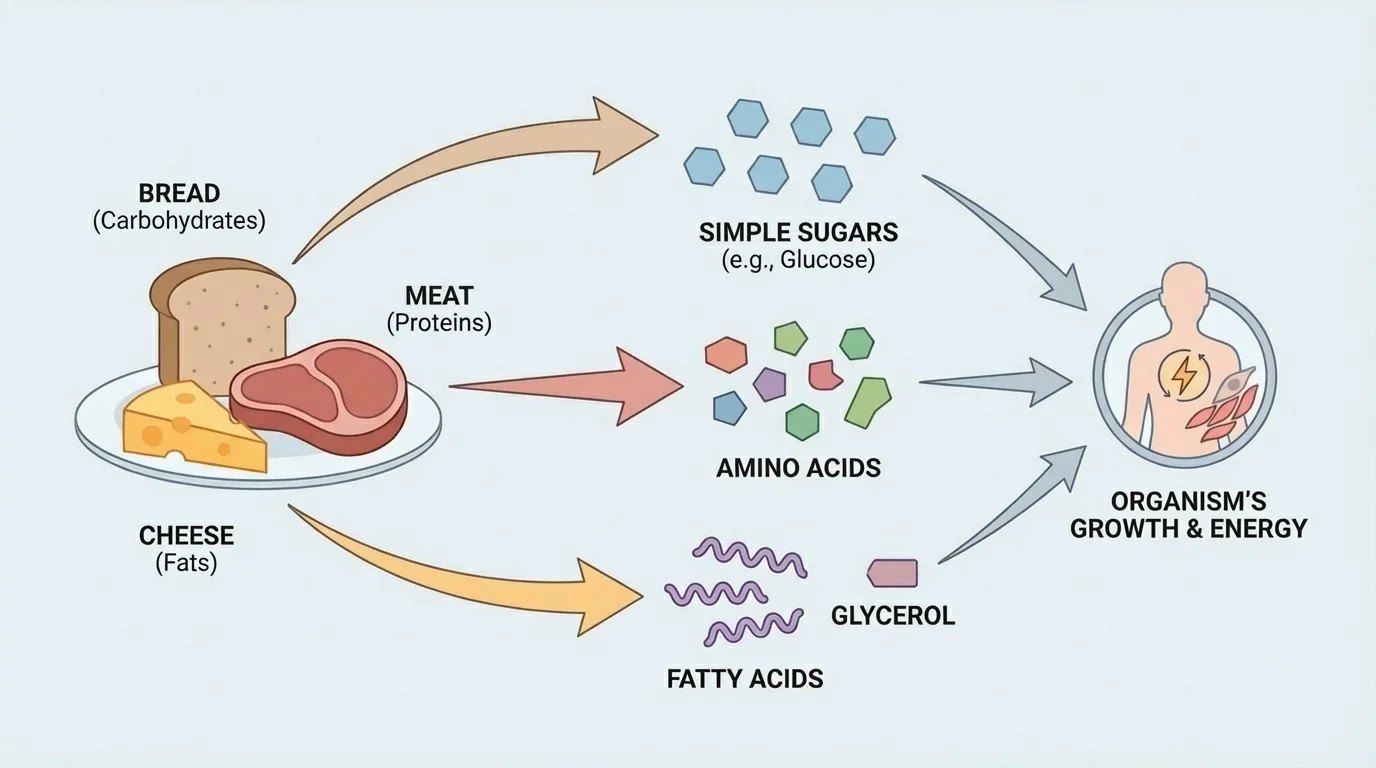
A meal may look simple from the outside, but inside it are many kinds of molecules. A sandwich, for example, contains bread rich in carbohydrates, meat or beans rich in protein, and perhaps cheese or mayonnaise rich in fats. These materials are later separated into smaller parts, as shown in [Figure 1], so the body can absorb and use them.
During digestion, large food molecules are broken into smaller molecules. Carbohydrates are broken into simple sugars such as glucose. Proteins are broken into amino acids. Fats are broken into fatty acids and glycerol. These smaller molecules are small enough to pass through the digestive system and enter the blood.
Water, vitamins, and minerals also matter. Water helps transport substances and is part of many reactions. Minerals such as calcium and iron are not energy sources, but they are important matter inputs because they become part of bones, blood, and other body structures.
At this stage, it may seem like food is only being "cut up" into smaller pieces. But that is only part of the story. The smaller molecules can later be joined and changed into new molecules that your body needs.
Your body is constantly replacing parts of itself. Skin cells wear out, blood cells are replaced, and tiny damaged parts inside cells are repaired using matter that originally came from food.
That means yesterday's lunch may help form molecules in your body today. Matter from food literally becomes part of you.
The key idea is not just digestion. The bigger idea is chemical reactions inside cells. In these reactions, atoms are rearranged. Some bonds break, and new bonds form. The result is new molecules with new roles in the organism.
For example, amino acids from digested protein can be rearranged and joined together to make new proteins in your body. Those proteins may become part of muscle fibers, enzymes, hair, or skin. Simple sugars can be used to build larger storage molecules, or they can be used in processes that release usable energy.
A very important science rule helps us understand this: matter is conserved. The atoms in food do not disappear. If atoms from a food molecule end up in a body cell, in carbon dioxide, or in waste, they are still present. They are just in different molecules than before.
You may already know that physical changes, such as melting ice, do not make a new substance. Chemical reactions are different because they form new substances by rearranging atoms.
This is why the body can turn food into body parts. It is also why food can help release energy. The same atoms are being used in new ways.
A useful model tracks where matter goes and what happens to it over time. In this model, food enters the body, is digested into small molecules, moves into the blood, reaches cells, and is then either built into new body molecules or used in reactions that release energy, as shown in [Figure 2].
Start with the mouth and stomach, where food is chewed and mixed. Then move to the small intestine, where many small molecules pass into the bloodstream. The blood transports those molecules throughout the body.
When the molecules reach cells, the cells can use them in different ways. Some become part of new cell structures. Some are stored for later. Some are involved in reactions that release energy the cell can use for work.
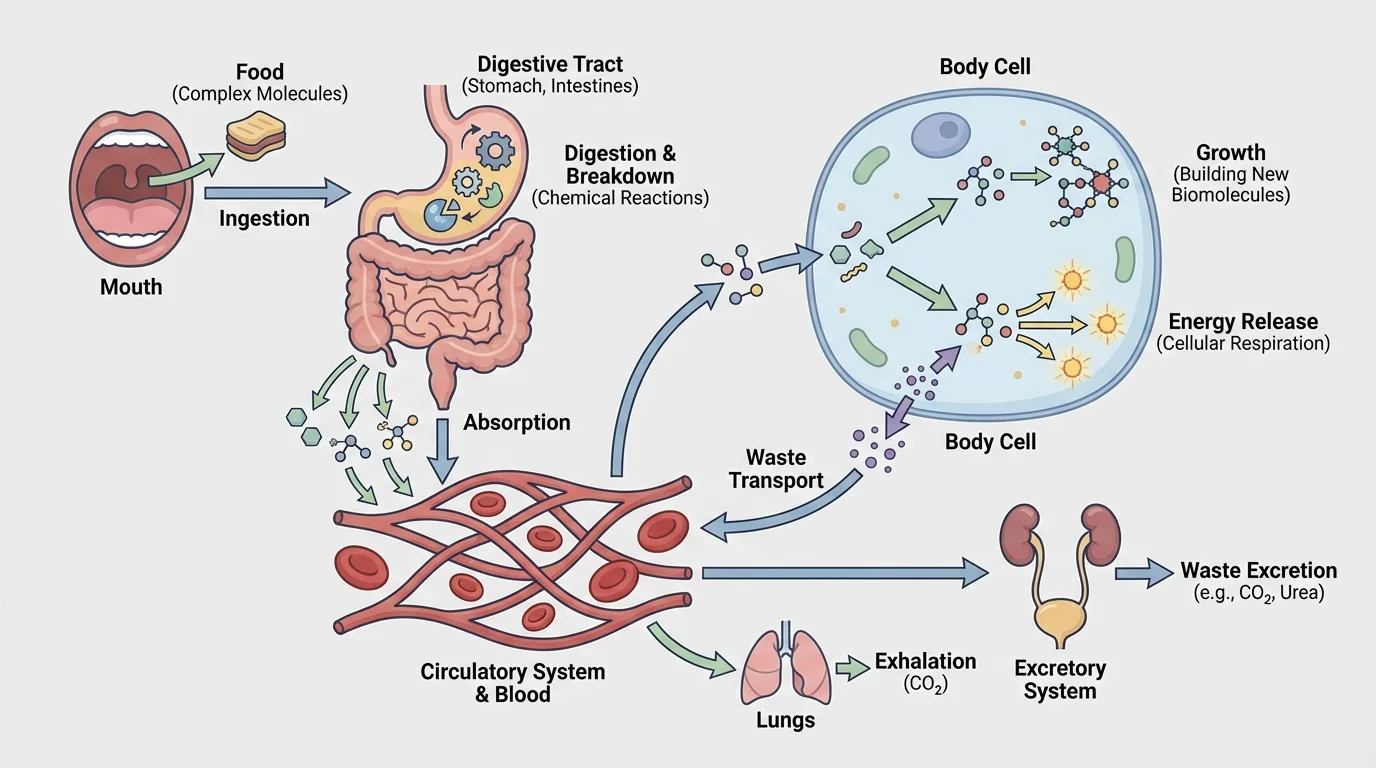
A good model also includes outputs. Not all matter from food stays in the body. Some leaves as feces if it is never absorbed. Some leaves as urine after the body processes wastes. Some leaves the body through the lungs as carbon dioxide. This shows that matter moves through the organism rather than simply vanishing.
Notice that this model includes both movement and change. Matter moves from one place to another, and chemical reactions change which molecules that matter is part of.
Growth does not happen because a body magically gets bigger. Growth happens because cells take in small molecules and use them to build larger molecules and structures, as [Figure 3] illustrates. This is one of the clearest examples of food matter being rearranged.
If you are growing taller, building muscle, healing a scrape, or replacing old cells, your body needs raw materials. Amino acids can be linked into body proteins. Fatty acids can become part of cell membranes. Sugars can help form molecules used in cells and can also be stored for later use.
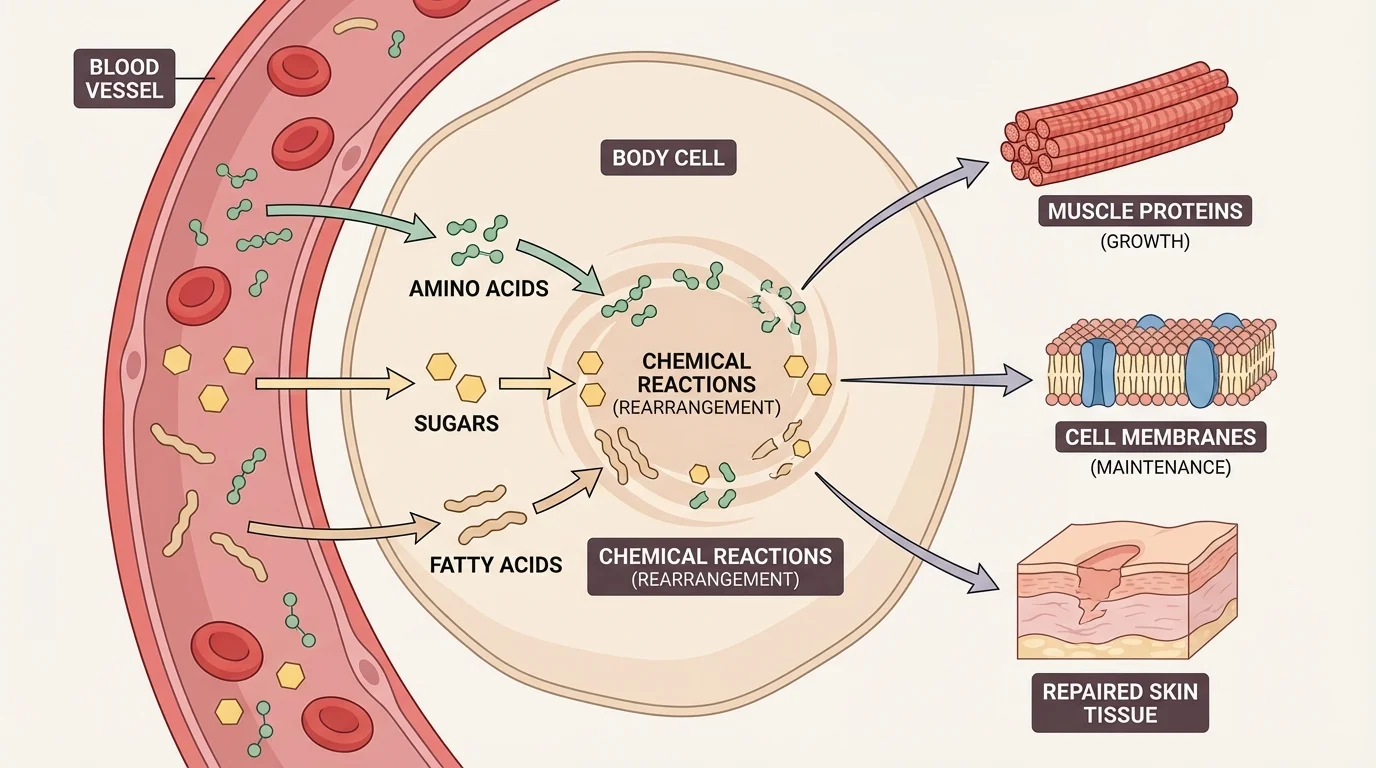
Think about a cut on your finger. New skin must be made to close the wound. The matter for that new skin comes from molecules your body absorbed from food. Healing is a sign that your body is actively building new molecules.
The same is true in animals. A puppy growing into a dog, a chick growing feathers, or a fish repairing damaged tissue all depend on taking in food matter and turning it into body matter.
Growth means rearranging matter
Organisms grow when they add matter to their bodies. That added matter usually comes from food. Cells use small molecules from digested food as building materials to create new proteins, fats, and other molecules that become part of tissues and organs.
When we look back at [Figure 1], we can see why digestion matters so much. Large food molecules must first be broken into smaller parts before cells can rebuild them into useful body molecules.
Food also helps living things release energy. The energy is stored in chemical bonds within food molecules. Inside cells, chemical reactions rearrange these molecules in ways that release usable energy.
That usable energy powers activities such as muscle movement, nerve signaling, active transport in cells, growth, and repair. Even when you are sleeping, your body still needs energy to keep your heart beating, your lungs working, and your cells alive.
It is important to be precise here: food does not create energy from nothing. Instead, the chemical energy stored in food molecules is transformed into forms the organism can use. Matter and energy are related in life processes, but they are not the same thing. Matter becomes part of molecules, while energy is released during certain chemical changes.
Real-world example: running a race
A student eats a banana before a race. The banana contains carbohydrates that are digested into simple sugars.
Step 1: Digestion breaks larger carbohydrate molecules into smaller sugar molecules such as glucose.
Step 2: The sugar molecules enter the blood and travel to muscle cells.
Step 3: In muscle cells, chemical reactions involving those molecules release usable energy.
Step 4: The energy helps the muscles contract during the race.
The matter from the food may also later be stored, used to build molecules, or leave the body in waste products.
This is why athletes need both enough food and enough oxygen. Their bodies are carrying out many energy-releasing reactions during exercise, especially in muscle cells.
One of the strongest ways to explain this topic is to track inputs and outputs. [Figure 4] Matter enters the body as food, water, and oxygen. It moves through the organism and leaves as wastes. This makes it easier to see that matter is conserved.
For humans and many animals, important inputs include food molecules, \(H_2O\), and \(O_2\). Important outputs include \(CO_2\), urine, and feces. Some input matter stays in the body for growth and repair, while some leaves after the body has used or changed it.
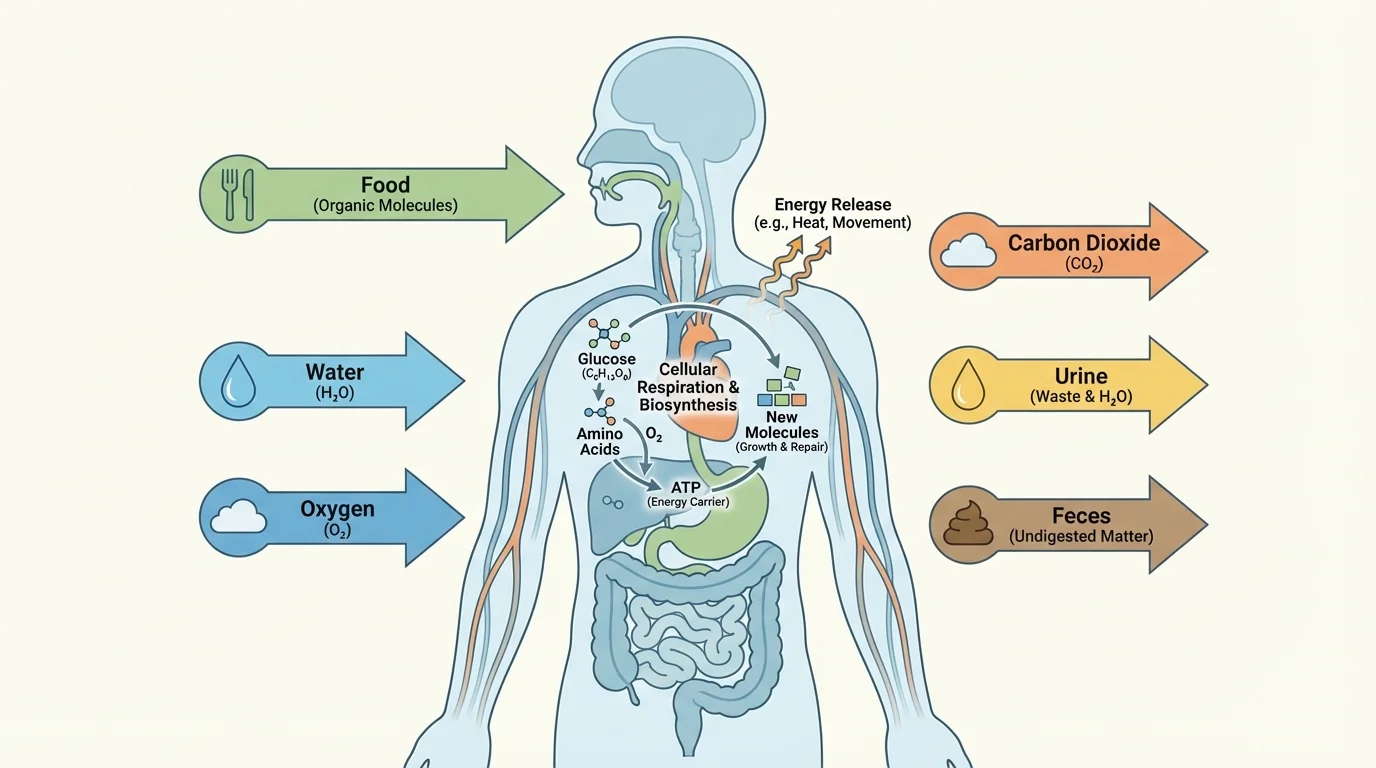
This explains why body mass can change over time. If an organism takes in more matter than it loses, it may grow. If it loses more matter than it takes in, it may lose mass. The matter has to go somewhere; it cannot simply disappear.
When we compare [Figure 2] and [Figure 4], we see two parts of the same story: matter moves through transport systems inside the organism, and matter also crosses the boundary between the organism and its environment.
| Input or Output | Example | What happens to it |
|---|---|---|
| Input | Food | Provides matter for new molecules and stored chemical energy |
| Input | Water | Helps transport substances and supports reactions |
| Input | Oxygen | Used in energy-releasing processes in cells |
| Output | Carbon dioxide | Leaves the body through breathing |
| Output | Urine | Removes dissolved wastes and excess water |
| Output | Feces | Removes undigested material and some waste |
Table 1. Examples of matter entering and leaving an organism and what happens to that matter.
Scientists often use models to explain systems that are too small, too complex, or too slow to observe all at once. For this topic, a model should include inputs, changes, movement, and outputs.
A simple model might use arrows and boxes like this in words: food enters the organism; digestion breaks food into small molecules; those molecules move in the blood to cells; cells use them to build new molecules or release energy; wastes leave the organism. This kind of model is powerful because it connects many facts into one organized explanation.
A strong model should also make clear that atoms are rearranged during chemical reactions. For example, carbon atoms from food can become part of muscle proteins, fat stores, or carbon dioxide released from the body. The atoms are the same atoms, but they end up in different molecules.
"Living things do not just take in food; they transform it."
That idea is at the heart of this topic. Food is not only fuel. It is also building material.
Consider a student going through a growth spurt. Their body needs extra matter to make new bone, muscle, skin, and blood cells. The matter for those new tissues comes from the molecules in food, rearranged by chemical reactions inside the body.
Now think about someone recovering from illness or injury. Repairing damaged tissue requires raw materials and energy. The body uses food molecules both to build new cell parts and to power the repair processes.
Pets show the same pattern. A growing kitten needs food matter to build fur, claws, muscles, and organs. A bird uses food matter to replace worn feathers. In each case, food matter is transformed into body matter.
Even a resting organism is busy. Cells are always transporting materials, making molecules, breaking molecules apart, and releasing energy. Life depends on these nonstop chemical changes.
