A wetland can look almost the same from one month to the next, yet the number of frogs, dragonflies, or fish in it may change a lot. That happens because ecosystems are not frozen in place. A small shift in rainfall, temperature, available food, or the arrival of a new species can ripple through the whole system. Scientists study these changes by gathering evidence from the real world and then using that evidence to support an argument about what happened and why.
An ecosystem is a community of living things and the nonliving environment around them, all interacting together. Forests, coral reefs, ponds, grasslands, deserts, and even a school garden are ecosystems. They change over time because weather changes, organisms grow and die, seasons shift, and sometimes humans alter the environment.
Within an ecosystem are populations, which are groups of the same species living in the same area. A pond might contain a population of minnows, a population of frogs, and a population of cattail plants. When one part of the ecosystem changes, these populations may increase, decrease, move away, or even disappear from that area.
Ecosystems are called dynamic because their conditions and relationships are always shifting. A rainy season can increase plant growth. A cold winter can reduce insect numbers. A disease can lower one animal population and leave more food for another. Change is normal in nature, but some changes are much larger and more disruptive than others.
Biotic factors are the living parts of an ecosystem, such as plants, animals, fungi, and bacteria.
Abiotic factors are the nonliving parts of an ecosystem, such as water, sunlight, soil, air, temperature, and nutrients.
Empirical evidence is information collected through observation or measurement, such as counting organisms, measuring water depth, or recording temperature.
[Figure 1] To explain ecosystem change, scientists look closely at both biotic and abiotic components in a pond example. The abiotic components include things like the amount of sunlight, the temperature of the water, the pH level, the amount of dissolved oxygen, and how much water is present. The biotic components include producers, consumers, and decomposers.
Producers such as grasses, algae, and trees make their own food, usually by photosynthesis. Consumers eat other organisms. Decomposers, including many fungi and bacteria, break down dead material and recycle nutrients. If one group changes, the others may be affected too.
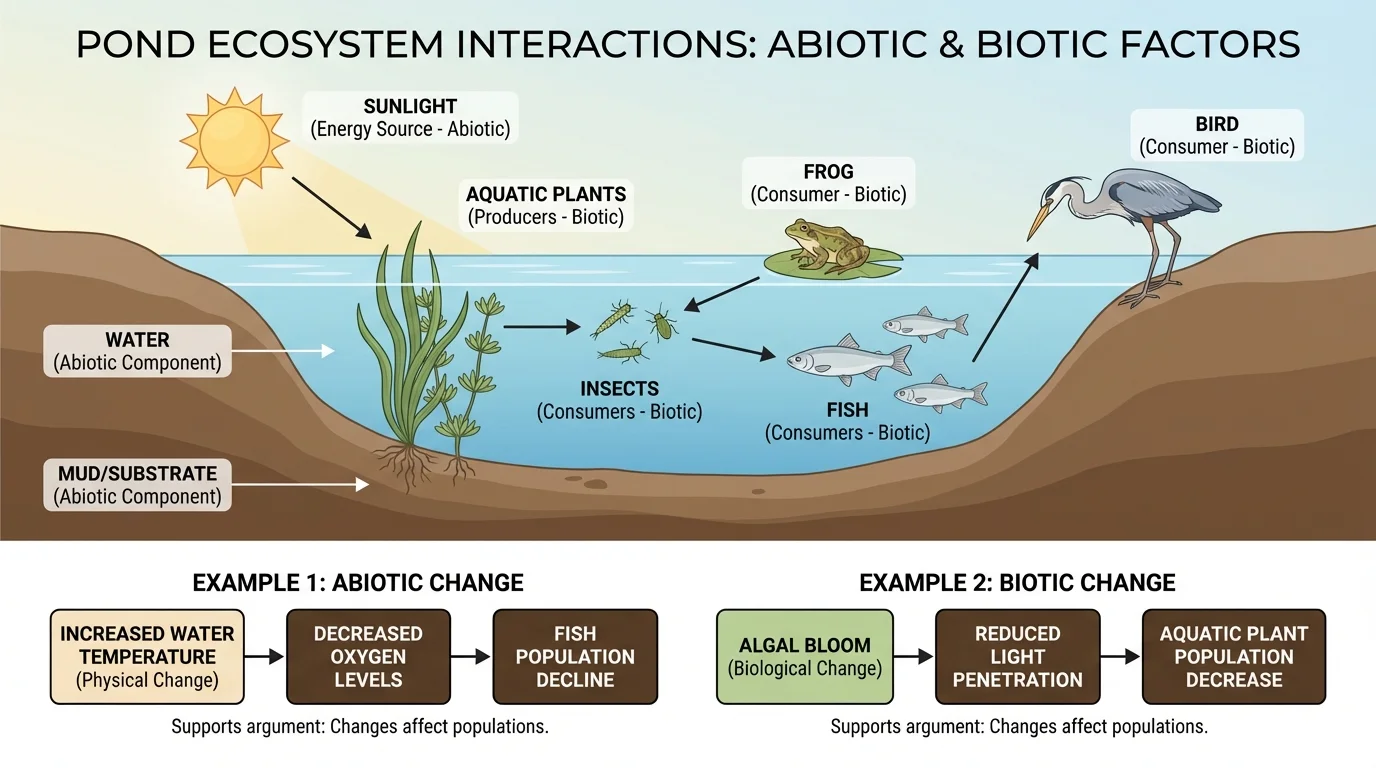
A population depends on the conditions around it. Fish need enough oxygen in the water. Plants need sunlight, water, and nutrients. Frogs need breeding sites and food such as insects. If a required resource becomes scarce, the population may shrink. If conditions improve, it may grow.
In science, an argument is not a fight. It is a clear explanation supported by evidence. Empirical evidence comes from what people can observe and measure. Scientists might count the number of birds nesting in a marsh, measure the depth of a pond, test the amount of oxygen in water, or compare plant growth before and after a fire.
Suppose students count frogs in a pond over three months and record the results: Month 1 has 24 frogs, Month 2 has 15, and Month 3 has 6. Those counts are evidence. If they also measure water depth and find that the pond depth changed from \(0.9\ \textrm{m}\) to \(0.5\ \textrm{m}\) to \(0.2\ \textrm{m}\), they now have another piece of evidence. Together, those observations may support an argument that drought conditions reduced frog habitat and caused the frog population to drop.
Earlier science learning helps here: organisms need resources to survive, populations change when resources change, and food webs connect many organisms. This topic builds on those ideas by asking you to support explanations with evidence instead of just stating them.
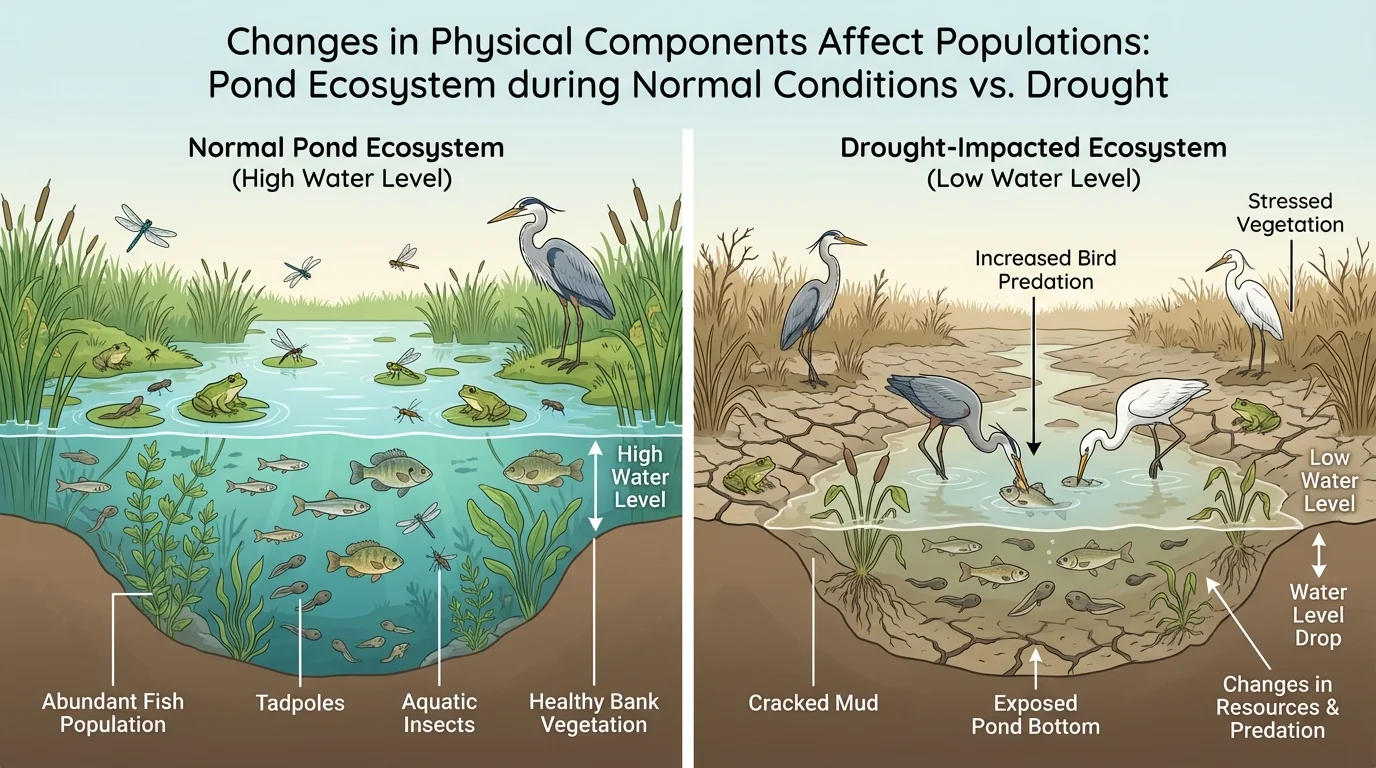
Changes in ecosystem components affect populations through cause-and-effect relationships. A physical change such as less rainfall can lower the water level in a pond. Less water can mean less living space, warmer water, and lower oxygen levels. These new conditions may stress fish and amphibians. At the same time, predators may find prey more easily in the smaller pond.
Biological changes can also matter. If an insect-eating bird population increases, the insect population may decrease. If disease kills many trees in a forest, animals that depend on those trees for shelter or food may decline. If a new plant species spreads quickly, it may block sunlight from other plants and reduce their populations.
Not every population responds the same way. One species may decrease while another increases. For example, if wolves return to an area, deer numbers may go down, but some plant populations may recover because fewer deer are eating them. This is why scientists look at the whole ecosystem rather than just one species.
Cause-and-effect in ecosystems means that a change in one factor can trigger changes in many others. The effects may be direct, such as fish dying when oxygen becomes too low, or indirect, such as bird numbers falling after insect numbers decrease. Many ecosystem effects happen as chains of connected events rather than as one simple step.
[Figure 2] A pond during a dry season provides a strong example of how an abiotic change affects populations. When rainfall decreases for many weeks, the pond loses water. The shoreline shrinks, shallow areas dry up, and water temperature may rise more quickly during the day.
These physical changes can lead to biological changes. Aquatic plants may have less space to grow. Insect larvae that live in the water may decline if breeding areas disappear. Fish may have trouble because warmer water often holds less dissolved oxygen. Frogs may lay fewer eggs if there are fewer safe wet places for breeding.
Birds that eat fish or insects may also change in number. Some might leave the area because food becomes scarce. Others may briefly gather at the smaller pond because prey is easier to catch. This shows why scientists need more than one observation before deciding what the main effect is.
Using data to support a claim
Students study a pond in early summer and again during drought.
Step 1: Collect measurements
Water depth drops from \(0.8\ \textrm{m}\) to \(0.3\ \textrm{m}\). Dissolved oxygen drops from \(8\ \textrm{mg/L}\) to \(4\ \textrm{mg/L}\). Frog counts fall from \(18\) to \(7\).
Step 2: State a claim
The drought caused conditions that reduced the frog population.
Step 3: Link evidence to the claim
Lower water depth means less habitat. Lower oxygen and hotter water can stress aquatic life. The measured drop in frog numbers matches these environmental changes.
This is stronger than saying, "The frogs just disappeared," because it uses observed evidence.
The pond example connects to the broader idea shown earlier in [Figure 1]: populations depend on both living and nonliving parts of their habitat. Change the habitat, and you often change the population.
Now consider a biological change. Suppose a lake receives an invasive species, a species that enters an area where it is not native and spreads quickly. If the new species eats the same food as a local species, competition may increase. If it has no natural predators there, its population can grow rapidly.
For example, an invasive plant may cover the water surface and block sunlight from underwater plants. Those underwater plants may decline. Small fish that use those plants for shelter may become easier for predators to catch, so their population may fall. The invasive species changed a biological component, but its effects spread through physical conditions too, such as light availability.
A new predator can have a similar effect. If a predator begins eating large numbers of rabbits in a grassland, rabbit numbers may decrease. With fewer rabbits feeding on plants, some grasses may increase. Insects that use those grasses may increase too. One biological change can create a cascade of population shifts.
Sea otters help protect kelp forests by eating sea urchins. When otter numbers drop, urchin populations can explode and eat so much kelp that the whole habitat changes for many other organisms.
Humans can alter both physical and biological components of ecosystems. Building roads, draining wetlands, cutting forests, releasing pollution, and moving species from one place to another can all affect populations.
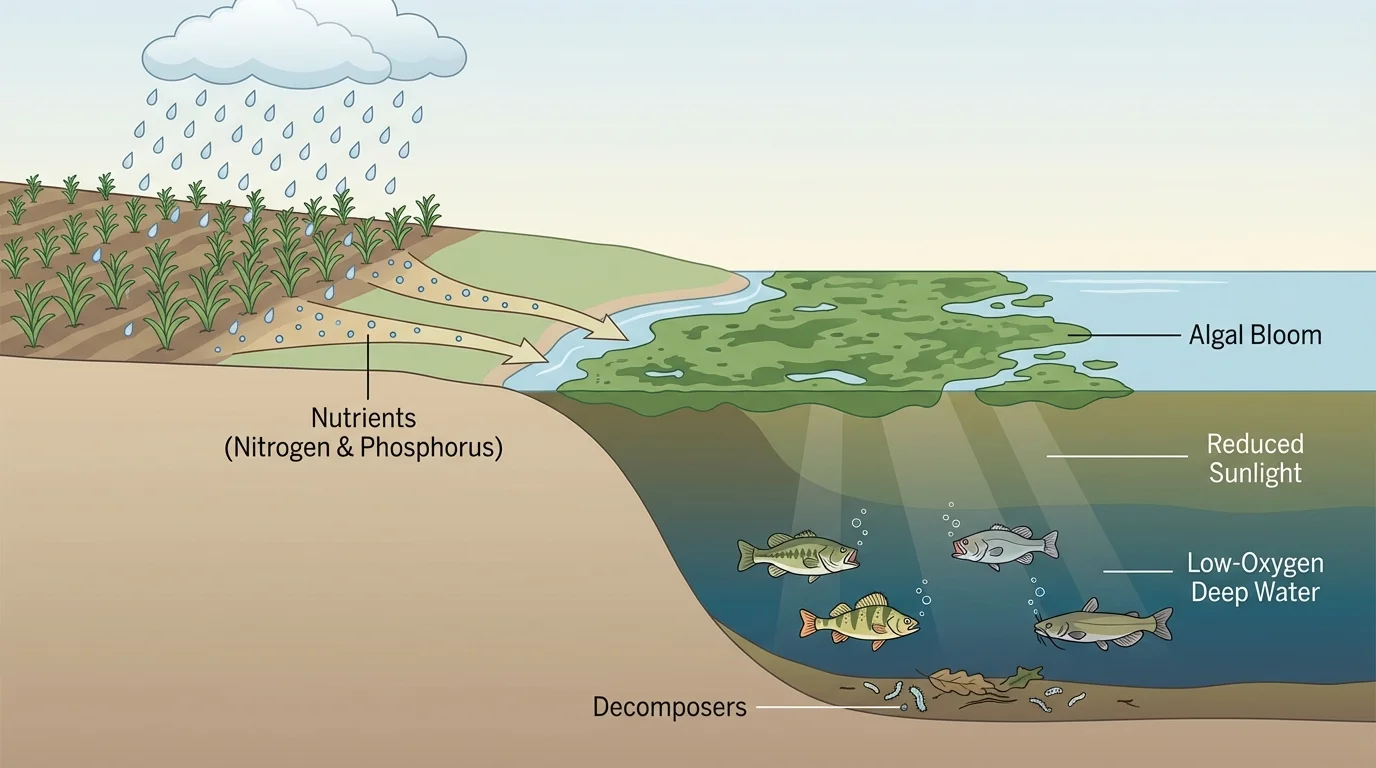
[Figure 3] One important example is nutrient runoff. Fertilizers from farms or lawns may wash into ponds and lakes during rain. Extra nutrients can cause rapid algae growth, called an algal bloom. At first, this seems like more plant life, but the result can be harmful. When large amounts of algae die and decompose, decomposers use oxygen in the water. Fish and other aquatic organisms may then struggle to survive if oxygen levels fall too low.
Pollution can also change populations directly. Oil spills harm birds and marine life. Plastic waste can injure animals. Chemicals may make water unsafe for sensitive species. Habitat destruction is another major force. If a forest is cleared, birds that nest in old trees may disappear from that area even if other animals remain.
The nutrient runoff example can be supported with measurements: algae coverage increases from \(10\%\) of the lake surface to \(60\%\), dissolved oxygen falls from \(8\ \textrm{mg/L}\) to \(3\ \textrm{mg/L}\), and fish counts fall from \(20\) to \(5\). Those numbers do not just tell us that a change happened. They help us argue that the change in water chemistry affected the fish population.
| Change in ecosystem | Type of component changed | Possible population effect |
|---|---|---|
| Drought lowers pond water | Abiotic | Fish and frog populations may decrease |
| New predator enters area | Biotic | Prey population may decrease |
| Invasive plant spreads | Biotic | Native plant and fish populations may decrease |
| Fertilizer runoff changes water quality | Abiotic and biological | Fish population may decrease after algal bloom |
| Forest clearing removes shelter | Abiotic and biological | Bird and mammal populations may move or decline |
Table 1. Examples of ecosystem changes and likely effects on populations.
To construct an argument in science, a useful structure is claim, evidence, and reasoning. The claim is what you say is true. The evidence is the data or observations. The reasoning explains why the evidence supports the claim using science ideas.
Here is a model argument: Claim: The fish population in the lake decreased because nutrient runoff changed water conditions. Evidence: After heavy rains, algae coverage increased, dissolved oxygen fell from \(8\ \textrm{mg/L}\) to \(3\ \textrm{mg/L}\), and fish counts dropped from \(20\) to \(5\). Reasoning: Excess nutrients caused algae growth; when algae decomposed, oxygen levels dropped; fish need oxygen in the water, so lower oxygen led to a population decrease.
This kind of argument is stronger than an opinion because it is based on evidence. It also connects back to the process seen in [Figure 3], where a physical and chemical change in the water leads to a biological effect on fish.
Another argument example
Scientists observe fewer rabbits after fox numbers increase in a grassland.
Step 1: Make the claim
The rabbit population decreased because predation increased.
Step 2: Use evidence
Fox counts rose from \(4\) to \(9\) over one season, while rabbit counts fell from \(35\) to \(18\).
Step 3: Explain the reasoning
Foxes prey on rabbits. More foxes can lead to more rabbits being eaten, so the rabbit population declines.
Notice that the argument uses measured changes in both populations.
Good scientists are careful. A change in two things at the same time does not always prove that one caused the other. For example, if bird numbers drop during the same month that rainfall drops, drought might be involved, but scientists should also check food availability, nesting success, temperature, and the presence of predators.
That is why repeated observations matter. If the same pattern appears again and again, confidence grows. Looking at different types of evidence helps too: organism counts, water tests, weather records, photographs, and maps of habitat area. In the drought pond case from [Figure 2], water depth alone is helpful, but water depth plus oxygen data plus frog counts make a much stronger argument.
Scientists also compare ecosystems or compare one site across time. A pond before drought and during drought can be compared. A polluted stream can be compared with a cleaner stream nearby. These comparisons help show which factor is most likely affecting the population.
Understanding ecosystem change is not just for scientists in laboratories. Farmers monitor soil and water because crop health depends on ecosystem conditions. Fishery managers track fish populations to prevent overharvesting. Park rangers watch for invasive species. Local communities test water quality to protect drinking water and wildlife.
When people make decisions about land use, pollution, or conservation, evidence matters. If a wetland is drained, what happens to frogs, insects, and birds? If a river warms because shade trees were removed, how will that affect fish? Answers to these questions should come from careful observation and data, not guesses.
Learning to build arguments from evidence helps you think like a scientist. You look for patterns, identify causes, and explain changes using facts. Ecosystems are always changing, and the best way to understand those changes is to support your ideas with real evidence from the world around you.
