A forest can keep thousands of organisms alive, a pond can support fish, insects, frogs, and plants, and even a patch of grass by a sidewalk can be part of a busy ecosystem. What keeps all of that going? The answer is not just food. Ecosystems survive because energy flows through them and matter cycles within them. Those two ideas sound similar, but they are not the same, and understanding the difference helps explain how life continues on Earth.
When scientists build a model of an ecosystem, they are trying to show the most important parts and the relationships between them. A model may be a drawing, a diagram, a chart, or even a physical setup. The goal is to make a complex system easier to understand. In this topic, the main pattern to notice is this: energy enters, moves through, and leaves, while matter is used, reused, and recycled.
An ecosystem includes all the living things in an area and the nonliving surroundings they interact with. That means organisms such as plants, animals, fungi, and bacteria are connected to air, water, soil, sunlight, and temperature. No organism lives completely alone. Every living thing depends in some way on both other organisms and the physical environment around it.
Biotic factors are the living or once-living parts of an ecosystem, such as trees, worms, fungi, and dead leaves.
Abiotic factors are the nonliving parts of an ecosystem, such as sunlight, water, air, rocks, soil, and temperature.
Model is a simplified representation used to explain or predict how a system works.
Think about a school garden. The tomato plants need sunlight, water, and minerals from the soil. Insects may pollinate flowers or eat leaves. Worms mix the soil. Fungi and bacteria break down dead plant material. Even the wind can carry seeds. This is why ecosystems are often described as systems: many parts interact, and a change in one part can affect the others.
To understand how an ecosystem works, it helps to sort its parts into living and nonliving categories, as [Figure 1] shows in a pond example. The living parts include organisms that make food, eat food, or break down dead material. The nonliving parts include sunlight, water, gases in the air, and minerals in the soil or mud.
These parts are connected by movement. Water moves into plant roots. Animals drink water. Fish take in dissolved oxygen from water. Plants use light energy from the sun. Dead organisms sink to the bottom of a pond and are broken down. Matter and energy are constantly being transferred, but in different ways.
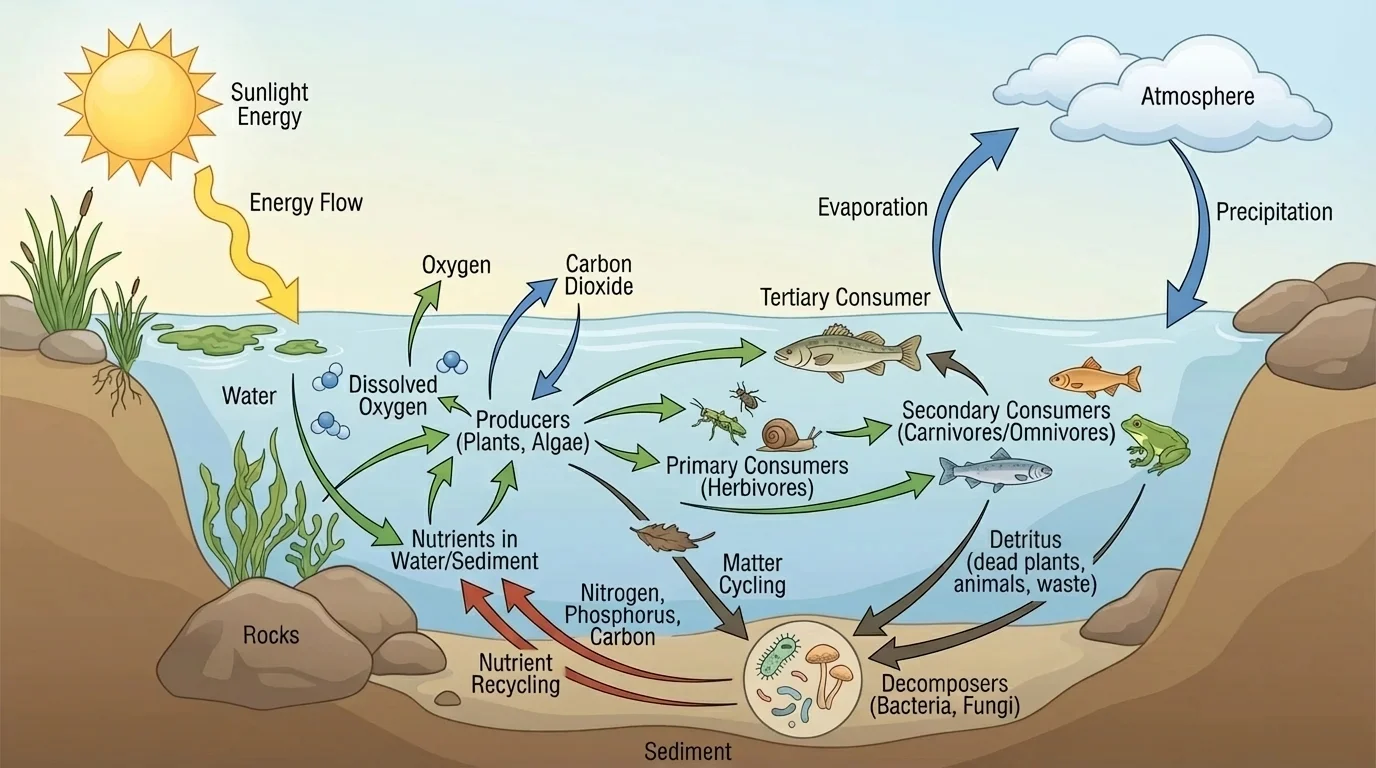
In a pond, for example, algae and water plants are important producers. Small fish may eat algae. Larger fish may eat smaller fish. Insects may feed on plants or become food for frogs. At the same time, water, mud, oxygen, and sunlight are not alive, but they are essential to the system. If the pond dries up or becomes polluted, the living parts are affected quickly.
One useful way to think about ecosystems is to ask two questions: Where does the energy come from? and Where does the matter go? Those questions help scientists create models that explain what is happening in a clear way.
Most ecosystems on Earth get their energy from the sun. Organisms such as plants, algae, and some bacteria capture sunlight and store that energy in food. These organisms are called producers because they produce food that can support themselves and other organisms.
Energy begins mostly with sunlight. Producers capture light energy and store it in food. When other organisms eat producers, some of that stored energy is transferred. As organisms use energy for movement, growth, repair, and keeping warm, much of it leaves the system as heat. That is why energy does not cycle back the same way matter does.
Animals cannot make their own food from sunlight, so they must get energy by eating plants, other animals, or both. Organisms that obtain energy by eating are called consumers. A rabbit gets energy by eating grass. A hawk gets energy by eating a mouse. A human may get energy from both plants and animals.
It is important to notice that energy is not reused forever in the same form. As organisms live, move, grow, and stay alive, they use energy. Some of the energy transferred in feeding relationships becomes less available to the next organism because it leaves as heat. This is why ecosystems need a constant energy input, mostly from the sun.
A food chain is a simple model that shows one path of energy transfer from one organism to another. For example, sunlight reaches grass, the grass is eaten by a rabbit, and the rabbit is eaten by a fox. The arrows in a food chain point in the direction that energy moves.
[Figure 2] Most real ecosystems are more complex than a single chain. A mouse might eat seeds and insects. A snake might eat mice and frogs. A hawk might eat snakes and rabbits. When many food chains connect, the model is called a food web. Food webs are more realistic because organisms usually have more than one source of food and more than one predator.
Scientists also use an energy pyramid to show that the amount of available energy decreases at higher feeding levels. Producers form the wide base because they capture the most energy entering the ecosystem. Primary consumers, such as rabbits or grasshoppers, occupy the next level. Secondary and tertiary consumers are higher up, but there are usually fewer of them because less energy is available at each step.
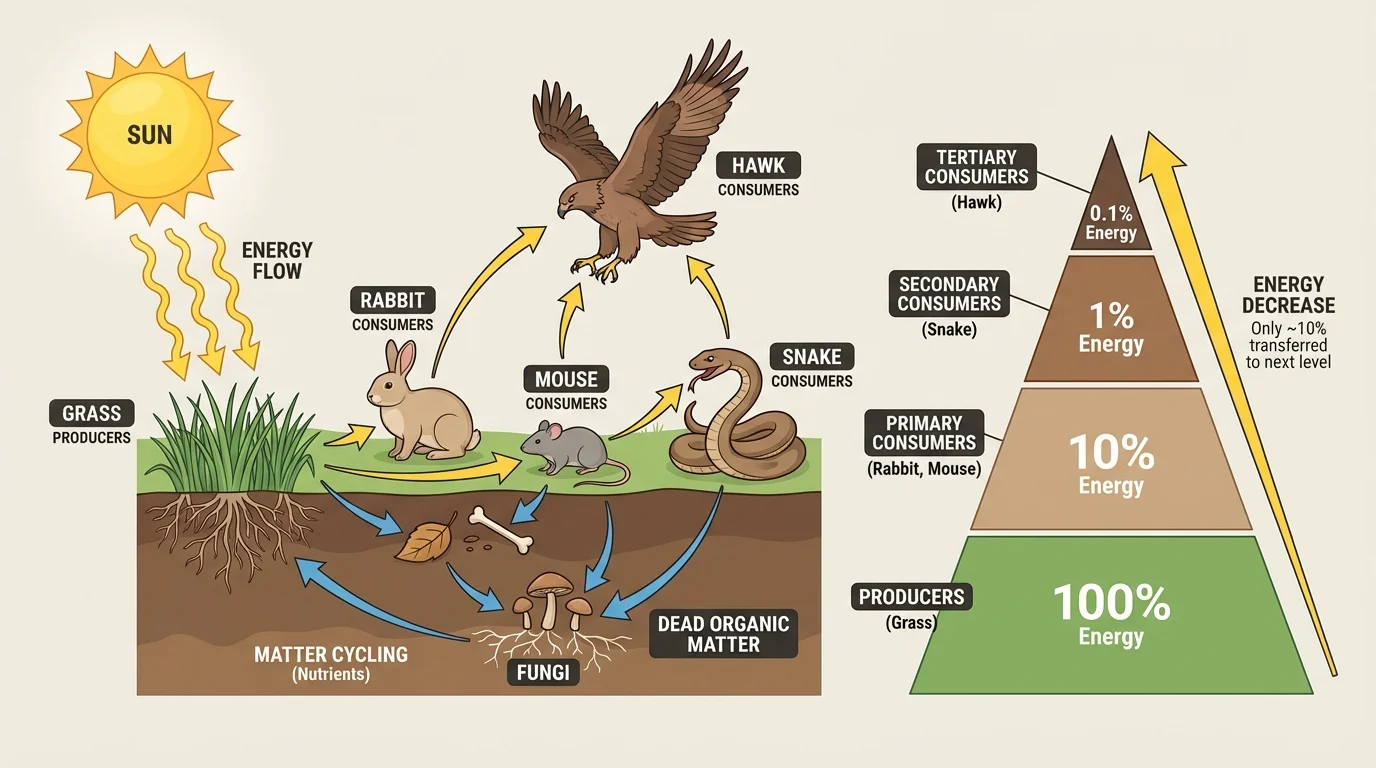
This pattern explains why a grassland can support many plants, fewer rabbits, and even fewer hawks. It is not simply about size or strength. It is about how much usable energy remains as it moves through the system. The higher the feeding level, the less energy is available to support large numbers of organisms.
When you look back at [Figure 1], you can also see that the pond works the same way. Plants and algae capture energy, herbivores and omnivores take in some of it, and predators receive even less. The exact organisms may differ from one ecosystem to another, but the pattern of one-way energy flow remains the same.
Matter follows a different pattern from energy, and [Figure 3] helps show this important contrast. Matter is anything that has mass and takes up space. In ecosystems, matter includes water, gases in the air, and nutrients such as carbon, oxygen, and nitrogen-containing materials. Unlike energy, matter is not simply used once and lost from the ecosystem. It moves in cycles.
For example, water can fall as rain, soak into soil, enter plant roots, move into leaves, pass to animals when they drink or eat, and return to the environment through waste, evaporation, or release from plants. The same water molecules may be used again and again in different parts of the ecosystem.
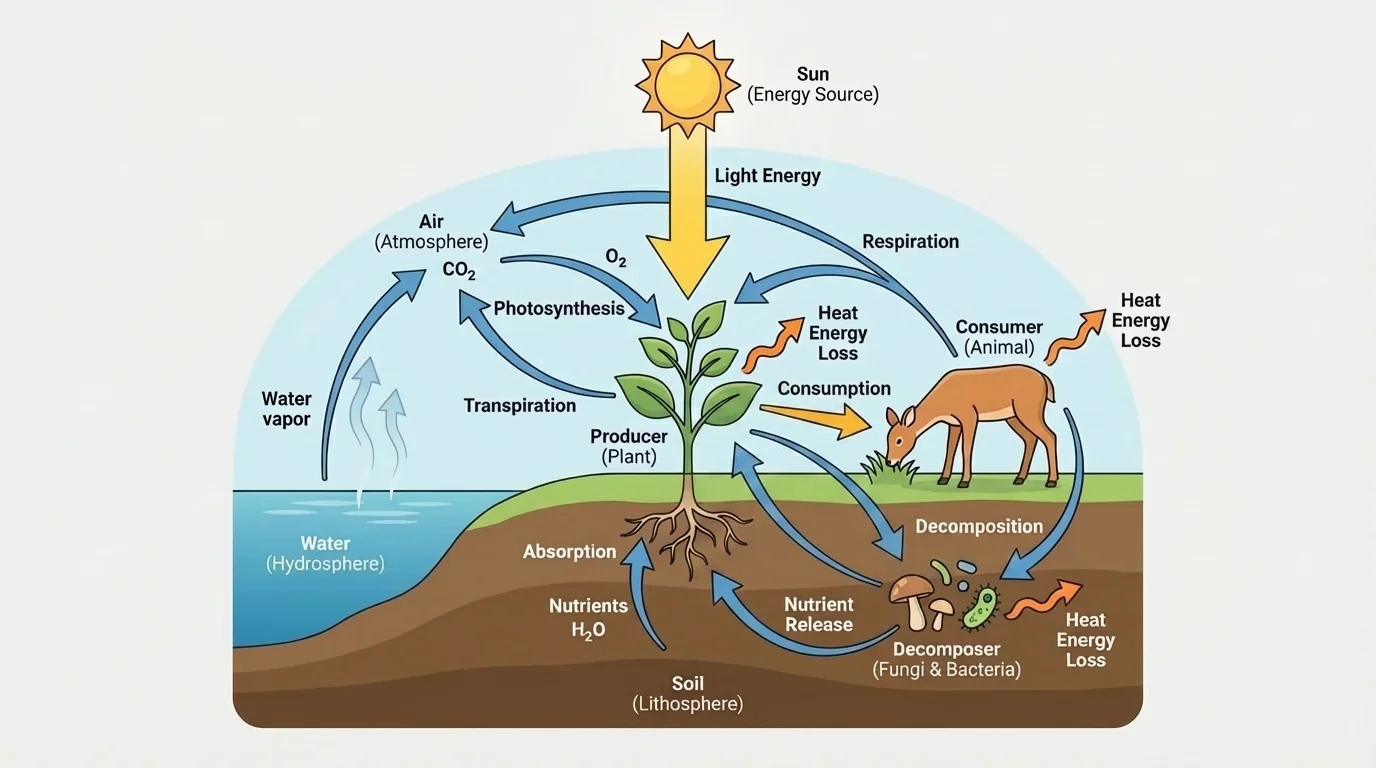
Carbon also cycles. Carbon-containing matter can be part of a tree trunk, a berry, an animal's body, dead leaves on the forest floor, or gases in the atmosphere. When one organism eats another, carbon-containing matter is transferred. When organisms die or produce waste, decomposers return carbon-containing materials to soil, water, and air. The details can be complex, but the key idea is simple: the atoms that make up living things are reused.
Minerals and nutrients in soil work in a similar way. Plants take them in through roots. Animals get them by eating plants or other animals. Decomposers return many of those nutrients to the soil when they break down dead matter and wastes. Then plants can use them again. This recycling is one of the main reasons ecosystems can continue over long periods of time.
The water you drink today may contain some of the same water molecules that once passed through clouds, rivers, dinosaur bodies, or ocean waves. Matter in Earth systems is constantly being reused.
So the big difference is this: energy flows in one direction, while matter cycles in loops. That contrast is one of the most important ideas in ecology.
Decomposers are organisms such as fungi and many bacteria that break down dead organisms and wastes. Without decomposers, dead material would pile up and nutrients would stay locked in remains much longer. Decomposers help return matter to the nonliving environment, where it can be used again.
Picture autumn leaves falling onto a forest floor. At first, the leaves are part of once-living matter. Over time, fungi spread through them, insects shred them, and bacteria help break them down. The leaf matter becomes part of the soil, where plant roots can absorb useful nutrients. In this way, decomposers connect the living and nonliving parts of the ecosystem.
Real-world example: A fallen log in a forest
Step 1: A tree falls and becomes dead organic matter on the forest floor.
Step 2: Insects, fungi, and bacteria feed on and break down the wood.
Step 3: Matter from the log returns to the soil and air.
Step 4: Nearby plants absorb nutrients from the soil and continue growing.
The matter from the tree is not gone. It has changed location within the ecosystem and become available again.
Decomposers are also part of energy flow. They obtain energy from the material they break down, but as with all organisms, that energy eventually leaves as heat. Matter is recycled; energy is not recycled in the same way.
A good model does not include every tiny detail. Instead, it focuses on the most important parts and relationships. For this topic, a strong model should show both the movement of energy and the cycling of matter.
[Figure 4] One way to build the model is to begin with major parts of the system: sun, producers, consumers, decomposers, air, water, and soil. Then add arrows. Arrows for energy should begin with the sun, move to producers, and then move to consumers and decomposers. Some arrows should also indicate that energy leaves as heat at each stage.
Arrows for matter should form loops. Water moves among air, soil, plants, animals, and bodies of water. Nutrients move from soil to plants, then to animals, then to decomposers, and back to soil. Carbon-containing matter moves among air, organisms, wastes, and decomposers. This type of model makes the difference between flow and cycle visible.
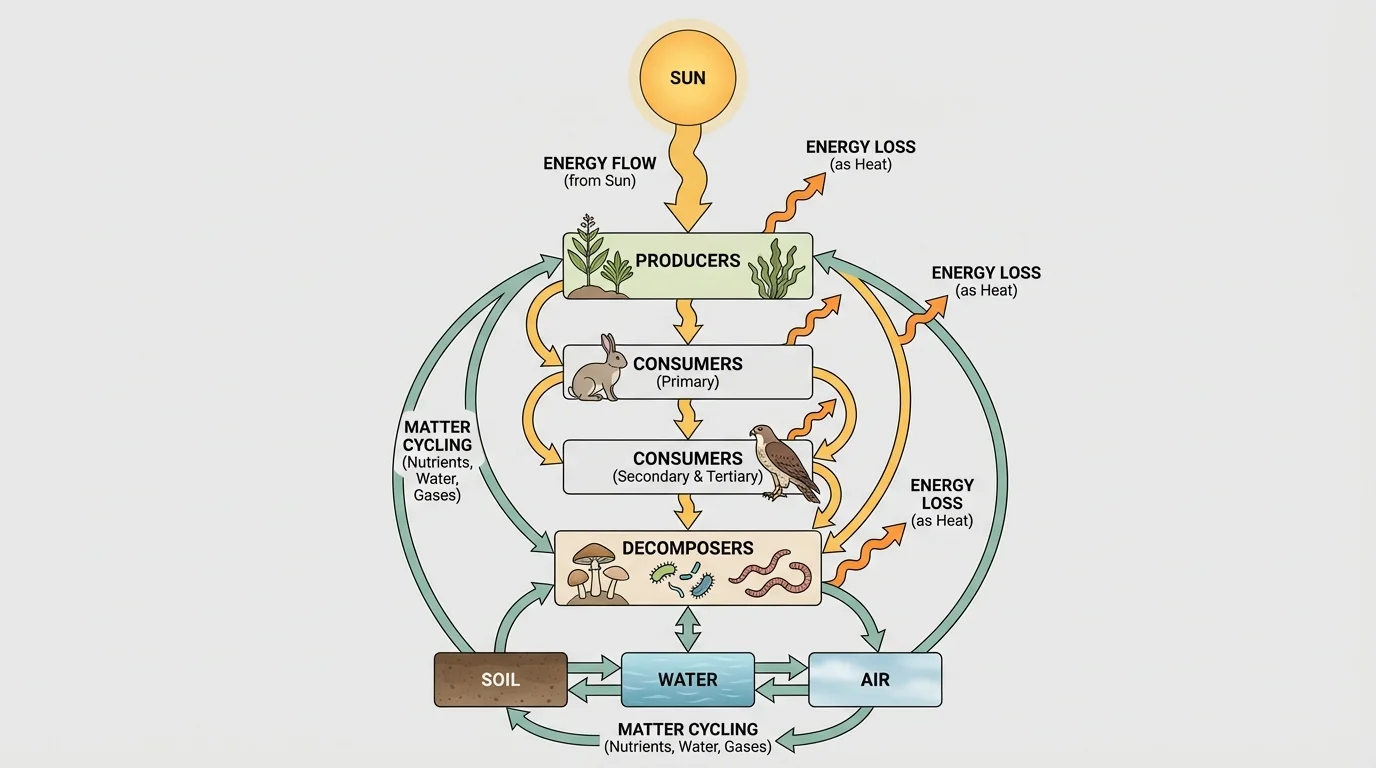
When students develop models, one common mistake is drawing energy as a loop that returns to the sun or keeps cycling forever. That is not accurate. Another common mistake is forgetting to include nonliving parts such as soil, water, and air. But matter moves through those abiotic parts all the time, so they must be included.
Looking again at [Figure 3], you can see why ecosystems are not just collections of organisms. The air, water, and soil are active parts of matter cycling. And when you compare that to [Figure 2], the one-way movement of energy through food relationships becomes easier to recognize.
In a forest ecosystem, trees capture sunlight. Deer eat leaves. Wolves may prey on deer. Mushrooms and bacteria decompose fallen leaves, dead insects, and animal remains. Water moves from soil into roots, into leaves, into the air, and back again through precipitation. Carbon-containing matter moves among trees, animals, dead logs, and the atmosphere.
In a pond ecosystem, algae and aquatic plants are producers. Insects, snails, and small fish may feed on them. Larger fish, turtles, or birds may feed on those consumers. When organisms die, decomposers in mud and water break them down. Nutrients return to the water and sediment, where producers can use them again.
In a desert ecosystem, energy still enters mainly from the sun, but water is much harder to get. That changes how matter cycles. Cacti store water, animals may be active at night to avoid heat, and decomposition can happen more slowly when conditions are very dry. The same overall model still works, but the details depend on the environment.
Living things need both matter and energy. Matter provides the materials to build bodies and carry out life processes. Energy powers those processes. Ecosystems depend on both.
These ideas also matter in real human decisions. Farmers care about nutrient cycling in soil. Park rangers monitor food webs to protect endangered species. Engineers designing water-treatment systems need to understand how matter moves through environments. Protecting ecosystems depends on understanding the connections between living and nonliving parts.
If one part of an ecosystem changes, the effects can spread. Suppose pollution reduces the number of algae in a pond. Then small fish may lose a food source. Larger fish may decline because fewer small fish are available. Decomposers may also be affected if the pollution changes water chemistry. Because ecosystems are connected systems, one disruption can affect energy flow and matter cycling at the same time.
Removing decomposers would also cause major problems. Dead material and waste would build up, and nutrients would return more slowly to soil or water. Producers would have less access to the materials they need, which could reduce the energy entering the food web in the first place.
Changes in abiotic factors matter too. A drought reduces available water. Less water can limit plant growth. Fewer plants mean less energy captured from sunlight. At the same time, water cycling slows and animals may struggle to survive. This shows why a model must include both biotic and abiotic factors.
A strong ecosystem model, then, should help answer questions such as: Where does the energy enter? Which organisms transfer it? Where does matter move after organisms eat, grow, produce waste, or die? If the model clearly shows those pathways, it can explain a great deal about how ecosystems work.
