A city can spend millions of dollars building bigger flood walls, but sometimes a restored wetland does part of the job for free. A farm can grow crops, but if pollinators disappear, harvests may drop. Forests, rivers, coral reefs, and grasslands are not just places where organisms live. They are living systems that help clean water, store carbon, support food webs, protect coastlines, and provide materials people use every day. That is why scientists, engineers, and communities often have to decide which solutions best protect nature while also meeting human needs.
When people hear the word "nature," they may think of something separate from human life. In reality, humans depend on healthy ecosystems constantly. The air we breathe, the water we drink, the food we grow, and even medicines developed from living organisms are connected to the variety of life on Earth. Protecting that variety is not only about saving rare species. It is also about keeping systems strong, stable, and useful.
To make good decisions, we need to evaluate competing design solutions. That means comparing different plans or technologies to see which one works best for a specific problem. A solution that is cheap may not be very effective. A solution that helps one species might accidentally harm another. A solution that works quickly in one habitat may fail in a different climate. Good evaluation requires evidence, not guesses.
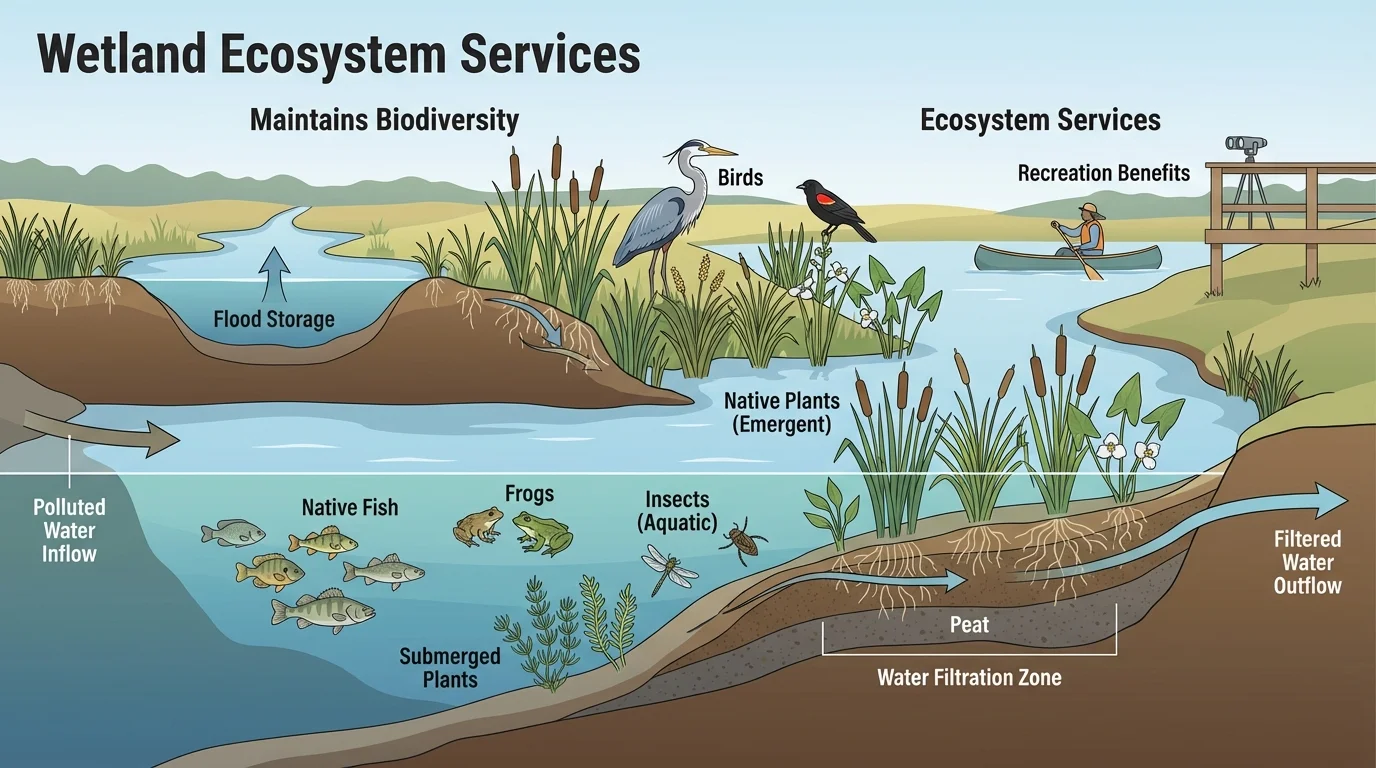
Biodiversity means the variety of life in an area, including different species, genetic differences within a species, and different ecosystems. Ecosystem services are the benefits people obtain from ecosystems. In a wetland, for example, many species interact in ways that also help humans by filtering water, storing floodwater, and supporting habitat, as [Figure 1] shows.
Biodiversity is the wide range of living things and the differences among them. It includes many species, the genes within those species, and the ecosystems where they live.
Ecosystem services are the ways natural systems benefit people, such as pollination, clean water, soil formation, climate regulation, food, and recreation.
Scientists often group ecosystem services into categories. Provisioning services provide products such as food, wood, and fresh water. Regulating services help control environmental conditions, such as flood reduction, water purification, and climate regulation. Supporting services include soil formation and nutrient cycling, which make other services possible. Cultural services include recreation, tourism, and the importance of nature in traditions and identity.
High biodiversity often makes ecosystems more resilient. If one species declines, another may partly fill the same role. For example, several different insect species may pollinate flowers. If only one pollinator species existed and it disappeared, the whole system would be at greater risk. In this way, biodiversity acts a little like built-in backup in a team: more players with useful skills can make the system stronger.
Think about a pond near a neighborhood. Plants at the edge slow down runoff. Tiny organisms break down waste. Insects feed fish and amphibians. Birds nest in nearby shrubs. The pond is not just a collection of species. It is a network of interactions. When one part is damaged, the effects can spread through the system.
Some medicines have been discovered by studying living organisms in forests, oceans, and soils. Protecting biodiversity can also protect future medical discoveries that humans have not found yet.
Because ecosystems do many jobs at once, protecting biodiversity often protects ecosystem services too. But the exact relationship is not always simple. A forest with many species may still be harmed by pollution. A farm field may produce food but support less biodiversity than a prairie. This is why scientists compare solutions carefully instead of assuming that every "green" action works equally well.
Before choosing solutions, we need to understand the problems causing biodiversity loss. One major cause is habitat fragmentation, when a large habitat is broken into smaller pieces by roads, buildings, or farms. Fragmented habitats make it harder for organisms to find food, mates, and safe shelter.
Other major causes include pollution, invasive species, overfishing, deforestation, and climate change. Pollution can poison water and soil. Invasive species can outcompete native species. Overuse of natural resources can remove organisms faster than populations can recover. Climate change can shift temperatures and rainfall, making some areas less suitable for the species that live there.
These causes often interact. For instance, a species already stressed by habitat loss may be less able to survive a drought or disease outbreak. That is why a single solution may not be enough. Sometimes a combination of designs works better than one plan alone.
A design solution is a planned way to solve a problem. In biodiversity protection, design solutions can include engineered structures, changes in land use, habitat restoration, new farming methods, rules about fishing or hunting, and systems for monitoring populations. Some solutions are physical structures, such as wildlife crossings. Others are management strategies, such as setting aside protected areas.
Engineering and ecology work together
People sometimes think engineering is only about machines or buildings. In environmental science, engineering can also mean designing systems that work with natural processes. A rain garden, for example, is carefully designed to absorb runoff and support native plants. A fish ladder is engineered so fish can move around a dam. The best designs often combine human planning with the needs of living systems.
Good design starts with a clear problem. Is the goal to protect one endangered species? Improve water quality? Reduce flooding while restoring habitat? Increase pollination on farms? Different goals lead to different solutions, and sometimes to competing solutions.
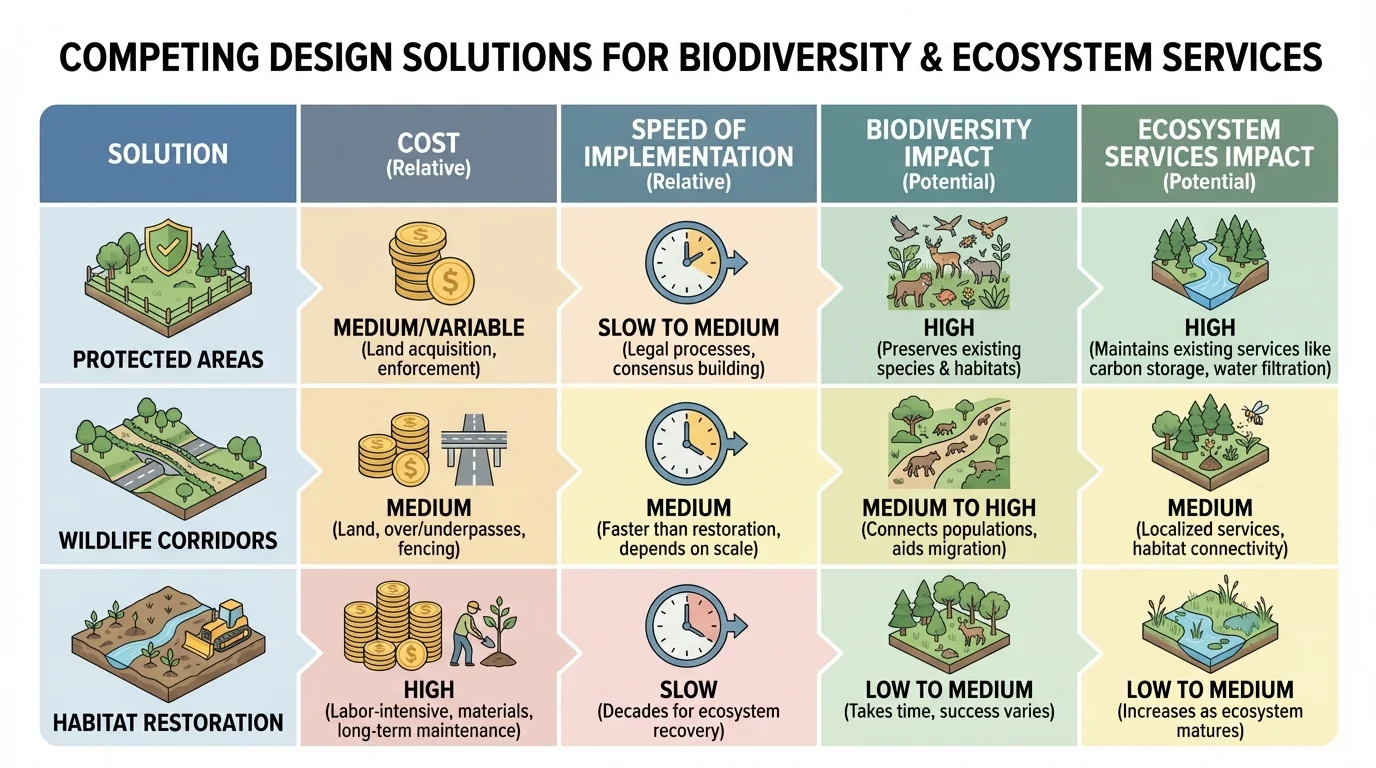
[Figure 2] shows how scientists and planners usually compare solutions using several criteria at once through side-by-side decision factors. A strong evaluation does not ask only, "Does it help?" It asks, "How much does it help, how long does it take, what does it cost, who benefits, and what side effects might happen?"
Common evaluation criteria include effectiveness, cost, time, feasibility, fairness, and unintended consequences. Effectiveness means how well the solution protects biodiversity or ecosystem services. Cost includes money, labor, and maintenance. Time matters because some ecosystems need urgent action. Feasibility asks whether the plan can realistically be built or enforced. Fairness considers whether different groups of people are affected in reasonable ways.
Scale is also important. A pollinator garden may help in a neighborhood, but it cannot replace a whole forest. A marine protected area may help fish populations over a large region, but it may not solve pollution coming from land. A solution should match the size of the problem.
Monitoring is another key part of evaluation. If a wetland is restored, scientists might measure water clarity, plant growth, bird populations, and flood levels over time. Data collected before and after the project help show whether the solution is actually working.
Comparing three solutions for a fragmented forest
A town wants to protect local wildlife and reduce runoff after new roads split a forest into separate patches.
Step 1: Identify the main problem
The forest is fragmented, animals have trouble crossing roads, and stormwater runs quickly off pavement.
Step 2: List possible solutions
The town considers a wildlife bridge, planting more street trees, and restoring a wetland nearby.
Step 3: Compare the solutions
The wildlife bridge directly helps animals move safely. Street trees help shade and absorb some water but do less for large animal movement. Wetland restoration improves runoff and water storage but may not reconnect the forest patches.
Step 4: Choose based on goals
If the main goal is reconnecting habitats, the wildlife bridge is strongest. If the town also wants flood control, combining the bridge with wetland restoration may be better than choosing only one.
This example shows that the "best" solution depends on the specific problem and criteria.
One common solution is creating protected areas, such as parks, wildlife refuges, or marine reserves. These areas limit harmful human activities and allow habitats to remain more intact. Protected areas can be very effective, especially when they are large enough and well managed. However, they may be harder to create in places where land is already heavily used.
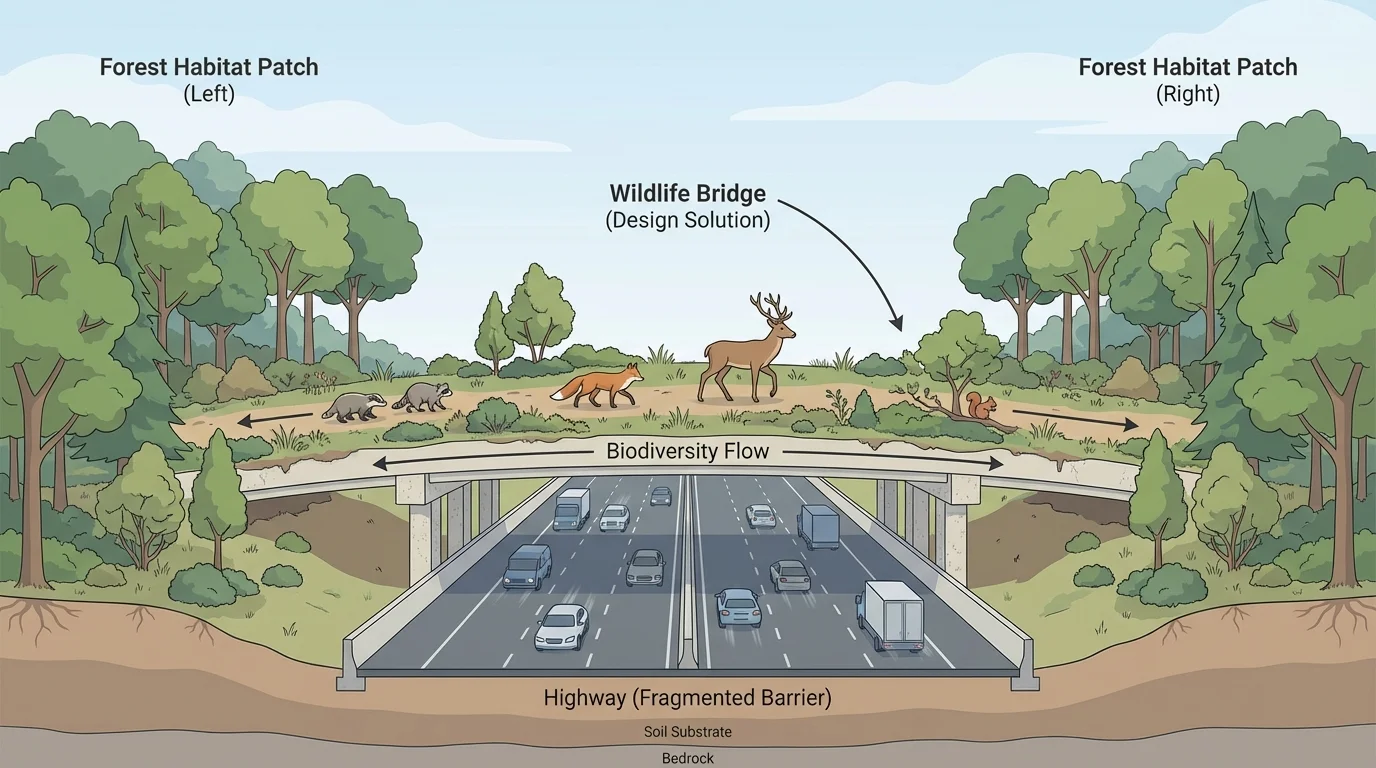
[Figure 3] shows one example of another solution: the use of wildlife corridors. Many species need connected habitats to survive. Corridors can be strips of habitat, river edges, underpasses, or bridges that link separated areas. They reduce the effects of fragmentation by helping organisms move, find mates, and spread to new areas.
Habitat restoration means repairing damaged ecosystems. This can include replanting native vegetation, removing dams, restoring stream banks, or rebuilding wetlands. Restoration can greatly improve biodiversity and ecosystem services, but it often takes time. A forest cannot regrow overnight.
Sustainable farming and fishing methods are also important design solutions. On farms, planting hedgerows, reducing pesticide use, rotating crops, and protecting soil can help pollinators and soil organisms. In fisheries, catch limits and protected breeding areas can allow populations to recover. These solutions can support both biodiversity and human food systems.
Green infrastructure includes designs such as rain gardens, green roofs, permeable pavement, and urban trees. These systems help manage water, reduce heat, and create habitat in cities. They may not replace wild ecosystems, but they can improve ecosystem services where many people live.
Some species need special help through captive breeding, seed banks, or gene banks. These methods can prevent extinction, especially when populations are very small. However, they usually work best as backup strategies, not as the only plan. Species still need healthy habitats to survive in the wild.
| Solution type | Main strength | Possible limitation | Best used when |
|---|---|---|---|
| Protected areas | Protect large habitats | May be hard to establish | Important habitat still exists |
| Wildlife corridors | Reconnect fragmented habitats | May help only certain species | Roads or development split habitats |
| Habitat restoration | Repairs ecosystem functions | Takes time | Habitat is damaged but recoverable |
| Sustainable farming or fishing | Supports nature and human use | Needs long-term cooperation | Working landscapes or fisheries |
| Green infrastructure | Improves urban ecosystem services | Usually smaller scale | Cities and suburbs |
| Captive breeding or seed banks | Prevents total loss | Does not replace habitat | Species are at high risk |
Table 1. Comparison of major solution types for maintaining biodiversity and ecosystem services.
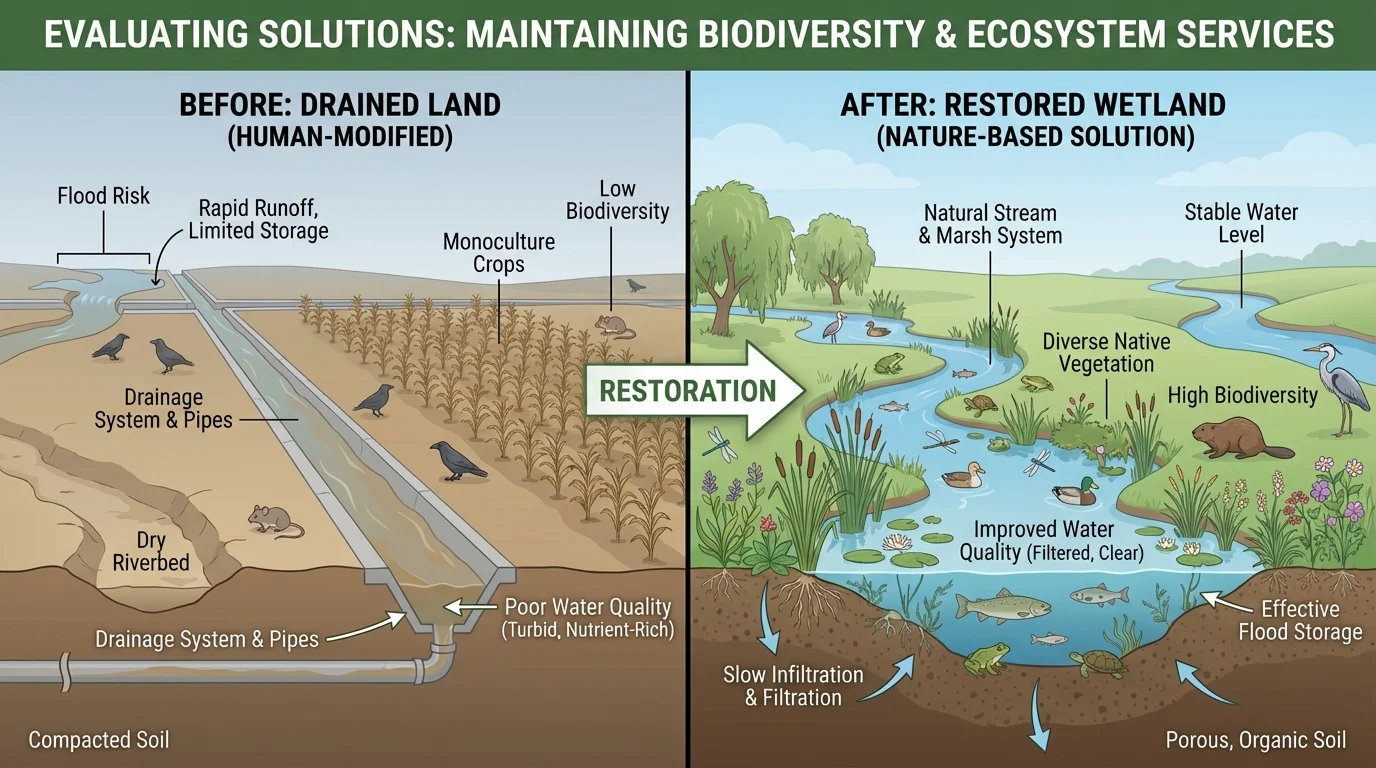
[Figure 4] provides a before-and-after comparison showing that restored wetlands often provide several benefits at once. A drained wetland may support fewer species and store less water. When native plants return and water flow is improved, the area can again filter pollutants, reduce flooding, and provide habitat for birds, amphibians, and insects.
In some regions, highways cut through animal migration routes. Wildlife overpasses and underpasses have reduced collisions between vehicles and animals such as deer, elk, and bears. These structures can save human lives, reduce damage to cars, and help populations remain connected. This is a good example of one design serving both people and biodiversity.
Pollinator gardens in schools, parks, and neighborhoods are another practical case. By planting native flowering species that bloom at different times, communities support bees, butterflies, and other pollinators. This helps local biodiversity and can benefit gardens and farms nearby. Still, a pollinator garden alone cannot solve large-scale habitat loss. It works best as part of a larger plan.
Marine protected areas offer another example. In some coastal regions, limiting fishing in key breeding habitats allows fish populations to recover. Over time, this can improve biodiversity and even help nearby fisheries through population growth and movement. But if pollution continues or water temperature changes strongly, protected zones may need to be combined with other solutions.
Living things are connected through food webs, habitats, and cycles of matter. If one part of a system changes, other parts can change too. This earlier idea is essential when judging whether a design helps only one part of an ecosystem or strengthens the whole system.
A trade-off happens when a choice brings a benefit but also a cost or drawback. For example, a dam can provide electricity and water storage, but it may block fish migration and change river habitats. A seawall can protect buildings from waves, but it may reduce coastal habitat. Evaluating solutions means noticing these trade-offs clearly.
Systems thinking helps us look at interactions instead of isolated parts. A single action can affect species populations, soil, water, and people all at once. Earlier, [Figure 1] shows that a wetland performs several services at the same time. Because ecosystems are connected systems, changing one feature may alter many outcomes.
Trade-offs do not always mean a solution is bad. They mean decision-makers must weigh evidence carefully. Sometimes a combined solution works best. A city may restore wetlands, limit building in flood-prone areas, and install green infrastructure. Together, these actions may outperform any one action alone.
Case study comparison: seawall or marsh restoration?
A coastal town wants to reduce storm damage.
Step 1: Identify the two competing solutions
The town considers building a seawall or restoring coastal marsh habitat.
Step 2: Compare benefits
A seawall can provide fast, direct protection to buildings. Marsh restoration can absorb wave energy, provide habitat, trap sediment, and support fisheries.
Step 3: Compare drawbacks
A seawall may be expensive and can damage shoreline habitats. Marsh restoration may take longer to become fully effective and needs enough space.
Step 4: Make an evidence-based choice
If the coast is densely built and needs immediate protection, a seawall may be necessary in some locations. If there is room and long-term habitat recovery is a goal, marsh restoration may offer more ecosystem services.
This comparison shows why the best answer can depend on location, timing, and goals.
Evidence can come from field observations, satellite images, population counts, water tests, soil measurements, and long-term monitoring. Scientists may count how many bird species are present before and after restoration, or compare stream water before and after reducing runoff. Better evidence leads to better decisions.
Sometimes simple calculations help. Suppose a restored site supports 18 bird species, while the damaged site supported 9. The increase is from 9 to 18, which means the number doubled because \(18 \div 9 = 2\). If runoff volume drops from 60 units to 30 units after adding green infrastructure, that is a reduction of half because \(30 = \dfrac{1}{2} \times 60\). These changes can help show whether a solution improves ecosystem function.
Decision-makers also need to think about uncertainty. Nature is complex, and results are not always immediate. A corridor may help one species quickly, while plants in the same area take years to recover. Good planning includes adaptive management, which means adjusting the plan as new evidence is collected.
When comparing corridors, protected areas, and restoration, a comparison chart remains useful because it organizes multiple criteria at once. Real decisions are rarely based on only one number. They are based on patterns in evidence over time.
Adaptive management
Adaptive management means "plan, act, monitor, and improve." Instead of assuming a solution is perfect from the start, scientists and communities gather data and revise the design when needed. This is especially important in ecosystems because conditions can change with seasons, weather, and human activity.
Maintaining biodiversity is not only the job of scientists. Engineers design crossings and water systems. Farmers and fishers adjust practices. Governments write rules. Communities vote on land use, plant native species, and support restoration. Students can also observe local habitats and understand how evidence is used in environmental decisions.
Strong solutions usually respect both ecological needs and human needs. If a plan protects wildlife but ignores the people who live nearby, it may not last. If it focuses only on short-term human convenience, ecosystems may weaken and people may lose important services later. Durable solutions are often cooperative and based on shared goals.
When you evaluate competing design solutions, you are really asking a powerful question: which choice protects life's variety and keeps natural systems functioning best over time? That question matters in forests, farms, cities, rivers, oceans, and neighborhoods everywhere.
