Your arm, a bird wing, and a whale flipper do not look alike at first glance. One throws a ball, one helps with flight, and one moves through water. Yet inside, they share a surprisingly similar pattern of bones. That hidden pattern is one of the clues scientists use to answer a huge question: how are living things related to one another, and how have they changed over time?
Scientists study anatomy, fossils, and other evidence to build explanations about evolution. Evolution is the change in populations of organisms over many generations. By comparing the bodies of organisms alive today with each other and with organisms known from fossils, scientists can infer which groups share common ancestors. They do not need to guess. They look for patterns, compare evidence, and form explanations supported by observations.
Evolutionary relationship describes how closely different organisms are related through shared ancestors in the past.
Common ancestry means that two or more groups of organisms descended from the same earlier population.
Fossils are preserved remains, mineral replacements, or traces of organisms that lived in the past.
These ideas help explain both the unity of life and its diversity. Life shows unity because many organisms share basic features, such as cells, DNA, and similar body plans. Life shows diversity because different environments and different ways of living lead organisms to develop many different traits over time.
When scientists compare organisms, they pay close attention to structures that have the same basic arrangement. A similar structure can be important evidence that organisms are related. This is because inherited body plans can be modified over time for different jobs. A structure may change shape, size, or function, but still keep traces of the older pattern.
Suppose two organisms both have a backbone, a skull, and limbs built from similar sets of bones. Even if one climbs, another swims, and another flies, those shared features suggest a connection in ancestry. The more detailed the match, the stronger the evidence can be. Similarities do not automatically prove a relationship by themselves, but when many features line up, scientists gain confidence in their explanation.
Differences matter too. Organisms that share a common ancestor are not exact copies of one another. Over many generations, populations experience changes. Some traits become useful in one environment but not another. This means related organisms can end up looking very different on the outside while still keeping deeper structural similarities underneath.
Inherited traits are passed from parents to offspring. Natural selection can make certain inherited traits become more common if those traits help organisms survive and reproduce in a particular environment.
A good scientific explanation uses both similarities and differences. Similarities can point to shared ancestry, while differences can show how populations changed after they split from a common ancestor. In other words, scientists ask not only, "What is the same?" but also, "What changed, and why might those traits have changed?"
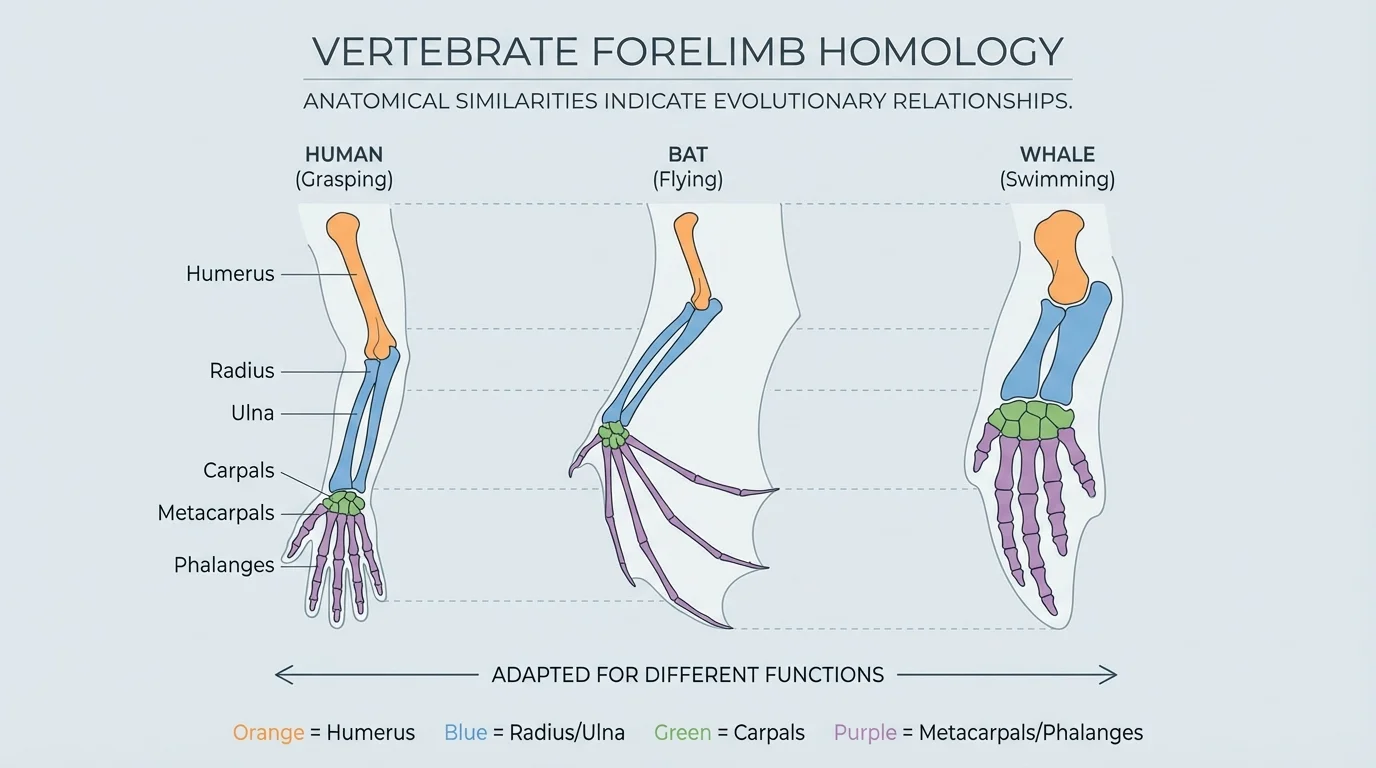
[Figure 1] One major kind of evidence comes from homologous structures. These are body parts in different organisms that share a similar underlying structure because they were inherited from a common ancestor. The same basic forelimb pattern can appear in very different animals even when those limbs do different jobs.
For example, one organism may use its forelimb for grasping, another for swimming, and another for flying. The bones may be stretched, shortened, thickened, or fused, but the same general arrangement remains. This tells scientists that these organisms likely inherited that body plan from an earlier ancestor and then changed over time.
Another useful idea is analogous structures. These are features that do similar jobs but do not come from the same ancestral structure. For example, two organisms might both have wings for flight, but the wings may be built very differently. In that case, the similar function does not necessarily mean a close evolutionary relationship. It may mean that different groups adapted in similar ways to similar challenges.
This difference is important. If scientists only focused on what a structure does, they might miss the deeper story. A function can evolve more than once, but an inherited body plan leaves clues in structure. That is why scientists compare internal arrangements, not just outward appearance.
Scientists also study vestigial structures, which are reduced body parts that had important functions in ancestors but have little or different function in modern organisms. A vestigial structure is like a historical clue inside the body. It suggests that the organism's ancestors lived differently from how the organism lives today.
Why homologous structures are powerful evidence
Homologous structures are powerful because they combine similarity with variation. The same basic structure appears again and again, but it has been modified for different ways of life. This pattern makes sense if related organisms inherited a shared body plan and then changed over many generations.
Scientists may also compare early development. In some groups, young embryos share patterns that suggest common ancestry. Students should remember, though, that no single piece of evidence stands alone. Scientists build stronger explanations when anatomical evidence matches fossil evidence and other lines of evidence.
Later, when scientists compare fossils to living organisms, the same logic still applies. The structural pattern seen in living forelimbs, first introduced in [Figure 1], helps them recognize related body plans even when a fossil organism looks different from any organism alive today.
Some body structures reveal history better than appearance does. Two organisms can look very different on the outside but still share a hidden skeletal pattern that points to common ancestry.
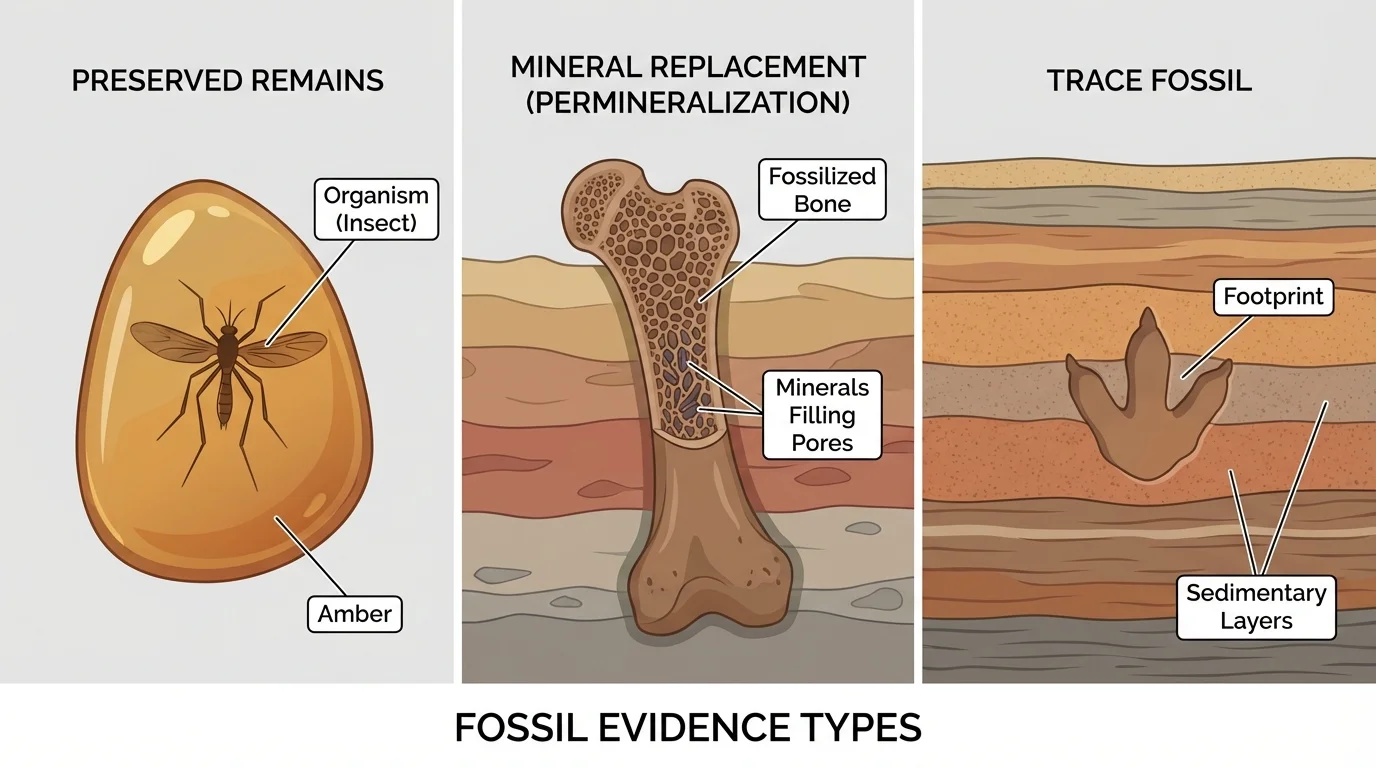
[Figure 2] Fossils provide evidence from organisms that lived long ago and include several major kinds of fossil evidence. Fossils are not only bones or shells. They can also be traces, such as footprints, burrows, or marks left by movement. These clues let scientists compare ancient organisms with modern ones.
Some fossils are preserved remains, meaning actual parts of the organism are kept in some form. Other fossils form when minerals replace or fill in parts of the organism over time. This process can preserve details of shape. Trace fossils record activity rather than body parts. A footprint can reveal how an organism moved, and a burrow can suggest how it lived.
Fossils are especially important because they show that life on Earth has changed. Some fossil organisms resemble organisms living today, while others have combinations of features that are no longer common. A fossil may show traits that are similar to one modern group and other traits that are similar to a different modern group. This can help scientists infer how groups are related through shared ancestors.
Scientists compare fossil anatomy with modern anatomy carefully. If a fossil skeleton has a skull, backbone, and limb pattern that match a group living today, that similarity can be evidence of relationship. If the fossil also has differences, those differences may show how the ancient organism represents an earlier form in the history of that lineage.
Fossil evidence also helps explain why some traits appear gradually in related groups. Instead of seeing only living organisms, scientists can add ancient evidence to the picture. That makes the explanation of evolutionary relationships stronger, because the fossil record provides snapshots from the past.
| Type of evidence | What scientists observe | What it can suggest |
|---|---|---|
| Body structure in living organisms | Bone patterns, body parts, body plans | Shared ancestry or adaptation to different environments |
| Fossil body remains | Preserved or mineralized parts | What ancient organisms looked like |
| Trace fossils | Footprints, burrows, feeding marks | Behavior and movement of past organisms |
| Vestigial structures | Reduced or altered body parts | Evidence of change from ancestors |
Table 1. Types of evidence scientists use to infer evolutionary relationships.
The fossil examples in [Figure 2] also remind us that not every organism becomes fossilized. Fossil evidence is incomplete, so scientists combine it with evidence from living organisms to make the best explanation possible.
[Figure 3] Science is not just collecting facts. It is also explaining what those facts mean. Scientists often build explanations using a pattern called claim, evidence, and reasoning. They move from observations to comparisons to an inference about relatedness.
A claim is the statement being argued, such as "These two organisms share a common ancestor." Evidence is the set of observations that support the claim, such as matching bone arrangements in limbs or similarities between a fossil structure and a modern structure. Reasoning explains why the evidence supports the claim. For example, if complex structures share the same basic pattern, that pattern is more reasonably explained by inheritance from a common ancestor than by chance.
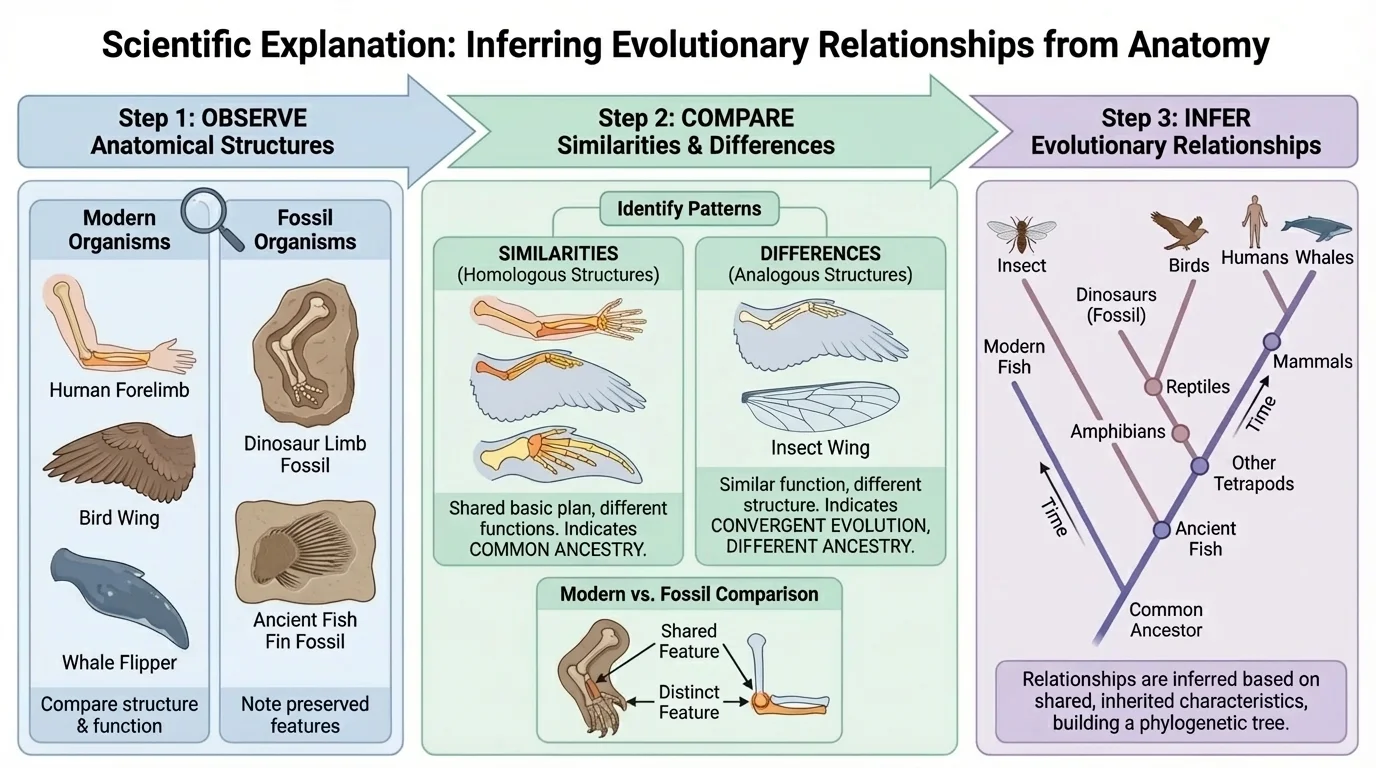
To construct a strong explanation, scientists usually follow a process. First, they observe structures carefully. Next, they record similarities and differences. Then, they ask whether the similarities involve deep structure or only surface function. Finally, they connect those observations to the idea of inherited traits and common ancestry.
Case study: comparing a fossil limb to modern limbs
Step 1: Observe the fossil.
A fossil forelimb has one upper bone, two lower bones, and several smaller bones at the end.
Step 2: Compare it with modern organisms.
Several modern organisms have the same basic bone arrangement, even though one swims, one flies, and one walks.
Step 3: Make a claim.
The fossil organism is likely related to those modern organisms through common ancestry.
Step 4: Explain the reasoning.
The shared internal pattern suggests inheritance of a body plan, while differences in shape suggest changes over time for different functions.
Good explanations also consider other possibilities. Could the similarity have evolved independently because of similar environments? If only the function matches, that may be possible. But if many detailed structural parts match, common ancestry becomes a stronger explanation.
The process in [Figure 3] is useful beyond fossils. It can also be used when comparing living organisms only. Scientists always aim to match the explanation to the evidence as closely as possible.
Evolution helps explain why organisms are both alike and different. They are alike because related groups inherited traits from common ancestors. They are different because populations changed over long periods of time. Changes in environment, food sources, movement, protection, and reproduction can all influence which traits become more common.
Natural selection is one process that helps explain these changes. If certain inherited traits make survival and reproduction more likely, organisms with those traits tend to leave more offspring. Over generations, those helpful traits may become more common in the population. This does not happen because organisms choose to change. It happens because some inherited variations are better suited to certain conditions.
Now the pattern becomes clearer. Homologous structures show unity because they point to shared ancestry. Different shapes and functions show diversity because descendants changed over time. Vestigial structures reveal that bodies carry signs of past ways of life. Fossils add historical evidence by showing that organisms in the past had some traits seen in modern groups and some traits that differ.
This is why scientists often talk about life as a branching tree. Groups that share a more recent common ancestor are usually more closely related. Groups that share a more distant ancestor are less closely related, even though they are still connected somewhere further back in the history of life.
"Nothing in biology makes sense except in the light of evolution."
— Theodosius Dobzhansky
That statement matters because anatomy and fossils are easier to understand when viewed as evidence of change through time. Without evolution, many body patterns would seem like random coincidences. With evolution, those patterns form a connected explanation.
This topic is not only about the distant past. Comparing anatomy helps scientists today in medicine, environmental science, and conservation. For example, when researchers study body structures in different organisms, they can learn how certain organs or limbs function and how similar systems may have developed.
Fossils also help scientists reconstruct ancient environments. A footprint fossil may suggest whether an organism walked on soft mud or firm ground. A fossil shell found in rock can suggest that the area was once underwater. By combining anatomical evidence with fossil evidence, scientists build a more complete picture of past life and past environments.
In conservation, understanding evolutionary relationships helps scientists recognize biodiversity more clearly. Closely related groups may share certain needs or vulnerabilities. Knowing how groups are related can help researchers make better decisions about protecting habitats and maintaining the variety of life on Earth.
Even in everyday life, people use ideas about anatomy without always noticing. Doctors compare human body structures to understand function. Engineers study animal movement to design robots, tools, and machines. These comparisons do not all focus on evolution directly, but they depend on the careful observation of structure and function that is central to evolutionary science.
What makes an explanation scientific?
A scientific explanation must be based on observable evidence and logical reasoning. In evolution, that means pointing to structures, fossils, and patterns that can be studied, compared, and tested, rather than relying on guesses or opinions.
When scientists infer evolutionary relationships, they are not claiming to see the entire history of life directly. Instead, they construct the best explanation from available evidence. Modern organisms provide living examples of body plans. Fossils provide evidence from the past. Together, they allow scientists to explain why life on Earth shows both shared patterns and remarkable variety.
