A basketball falls to the floor, rain falls from clouds, and when you jump, you come back down. The same force that causes those familiar events also helps govern the motion of planets, moons, and even stars in giant galaxies. Space may look empty and chaotic, but much of its motion is surprisingly organized. That organization comes largely from gravity.
When people first look at the night sky, the motions of objects in space can seem mysterious. Planets move around the Sun. Moons circle planets. Stars in galaxies travel around a central region. These motions are not random. They follow patterns because gravity constantly pulls objects toward one another.
To understand these patterns, scientists often create a model. A model is a simplified representation of something real. It might be a drawing, a physical object, a computer simulation, or even a set of ideas. A good model helps us focus on the most important relationships. In this topic, the most important relationship is between gravity and motion.
Gravity is the force of attraction between objects that have mass. Mass is the amount of matter in an object. The more mass an object has, the stronger its gravitational pull. Gravity also depends on distance: when two objects are farther apart, the gravitational pull between them becomes weaker.
On Earth, gravity pulls objects toward the planet's center. In space, gravity acts between the Sun and planets, between planets and moons, and between huge collections of stars inside galaxies. Even though space is very large, gravity still reaches across those distances.
Every object with mass pulls on every other object with mass. A pencil pulls on your notebook, your notebook pulls on the desk, and the desk pulls on Earth. But in everyday life, these tiny forces are too small to notice. Earth's pull is easy to notice because Earth has so much mass.
Scientists often describe gravitational force with the relationship
\[F = G\frac{m_1m_2}{r^2}\]
In this formula, \(F\) is gravitational force, \(m_1\) and \(m_2\) are the masses of the two objects, \(r\) is the distance between their centers, and \(G\) is a constant used in science. For middle school science, the most important idea is not the constant itself. The key ideas are that larger masses create stronger gravity and greater distance makes gravity weaker.
Simple gravity comparison
Step 1: Compare mass.
If one object becomes twice as massive while the other stays the same, the product \(m_1m_2\) becomes twice as large.
Step 2: Predict the effect.
Because \(F = G\dfrac{m_1m_2}{r^2}\), doubling one mass doubles the gravitational force.
Step 3: Try a distance change.
If the distance changes from \(r\) to \(2r\), then the denominator becomes \((2r)^2 = 4r^2\).
Step 4: Predict again.
The new force becomes one-fourth as strong.
This shows why distance matters so much in space.
Here is a numeric example. Suppose the force between two objects at a certain distance is \(20\) units. If the distance doubles and the masses stay the same, the new force is \(\dfrac{20}{4} = 5\) units. If instead one mass doubles while distance stays the same, the force becomes \(2 \times 20 = 40\) units.
The solar system, shown in [Figure 1], is a useful place to begin because it is our own region of space. In a gravity model of the solar system, the Sun is the most massive object, so its gravity has the strongest effect on the planets. The planets move around the Sun in curved paths called orbits, and many planets have moons that orbit them.
A simple model does not need to show every asteroid, comet, or moon. It only needs to show the main idea: the Sun's gravity helps keep planets moving around it, and planets' gravity helps keep moons moving around them. This is why the solar system has an organized structure instead of objects moving in random directions.
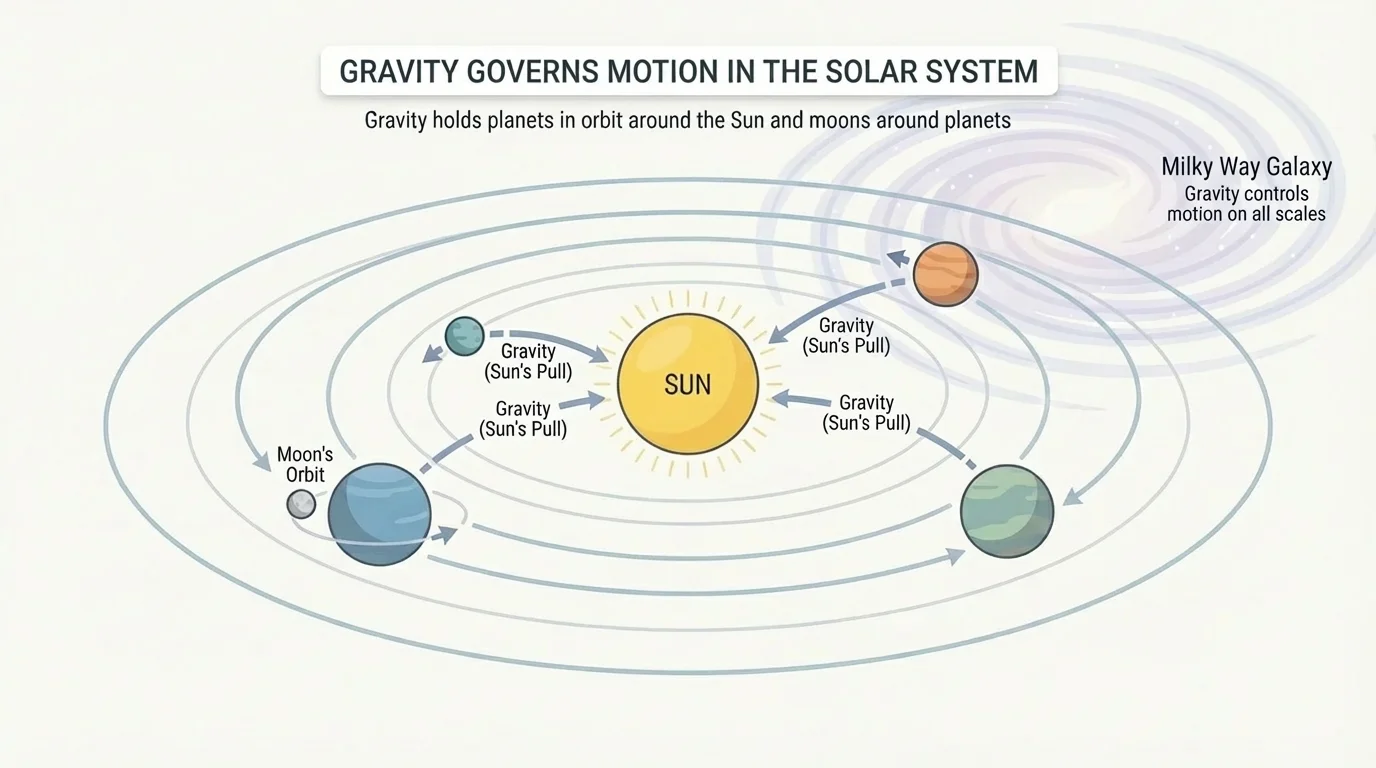
The path of a planet is not a straight line because gravity constantly pulls the planet toward the Sun. At the same time, the planet is already moving forward. The combination of forward motion and inward pull creates an orbit. If there were no gravity from the Sun, a planet would continue moving in a straighter path rather than staying in orbit.
Moons behave in a similar way. Earth's Moon moves forward through space, but Earth's gravity pulls it inward. Because of this continuous pull, the Moon keeps orbiting Earth instead of drifting away. This model shows that gravity organizes motion at more than one level at the same time: planets around the Sun and moons around planets.
You already know that a force can change an object's motion by changing its speed, direction, or both. Gravity is a force, so it can change the direction of moving objects in space even when those objects do not crash into anything.
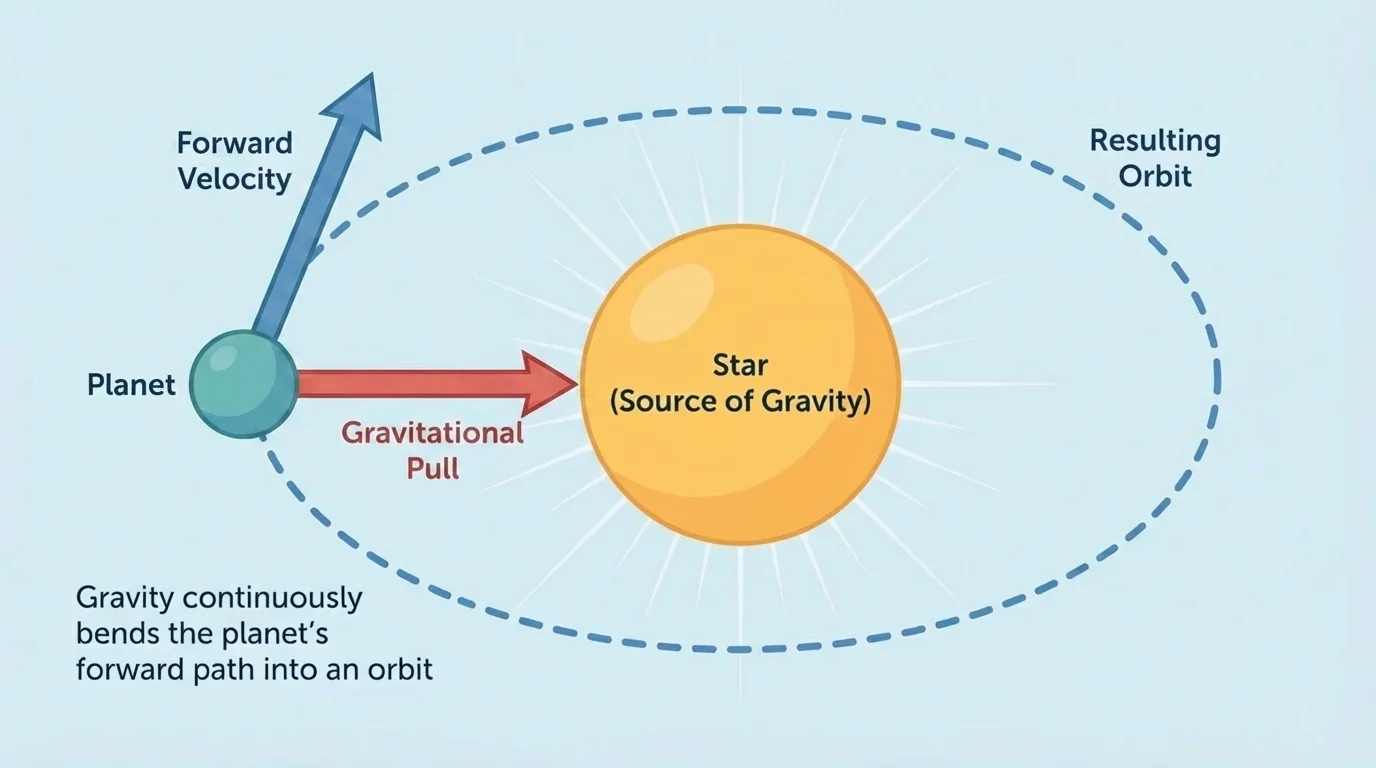
One important idea is that orbiting is a kind of falling. A planet is always being pulled toward the Sun, but because it is also moving sideways, it keeps missing the Sun and traveling around it instead. This may sound strange, but it helps explain why orbital motion can continue for a very long time.
[Figure 2] illustrates that an orbit is the path one object follows around another object because of gravity. In orbital motion, gravity acts like a constant inward pull. Without that pull, a moving object would not keep curving around another object.
Think about swinging a ball on a string in a circle. Your hand pulls inward on the string, and that inward pull changes the ball's direction. If you let go, the ball flies off instead of continuing in a circle. In space, gravity plays a role similar to the string's pull. It changes direction over and over, keeping planets and moons in orbit.
This does not mean planets are hanging still in space. They are moving very fast. Earth, for example, moves around the Sun while the Moon moves around Earth. The reason these objects do not just fly away is that gravity continually bends their motion. The reason they do not fall straight inward is that they have forward motion at the same time.
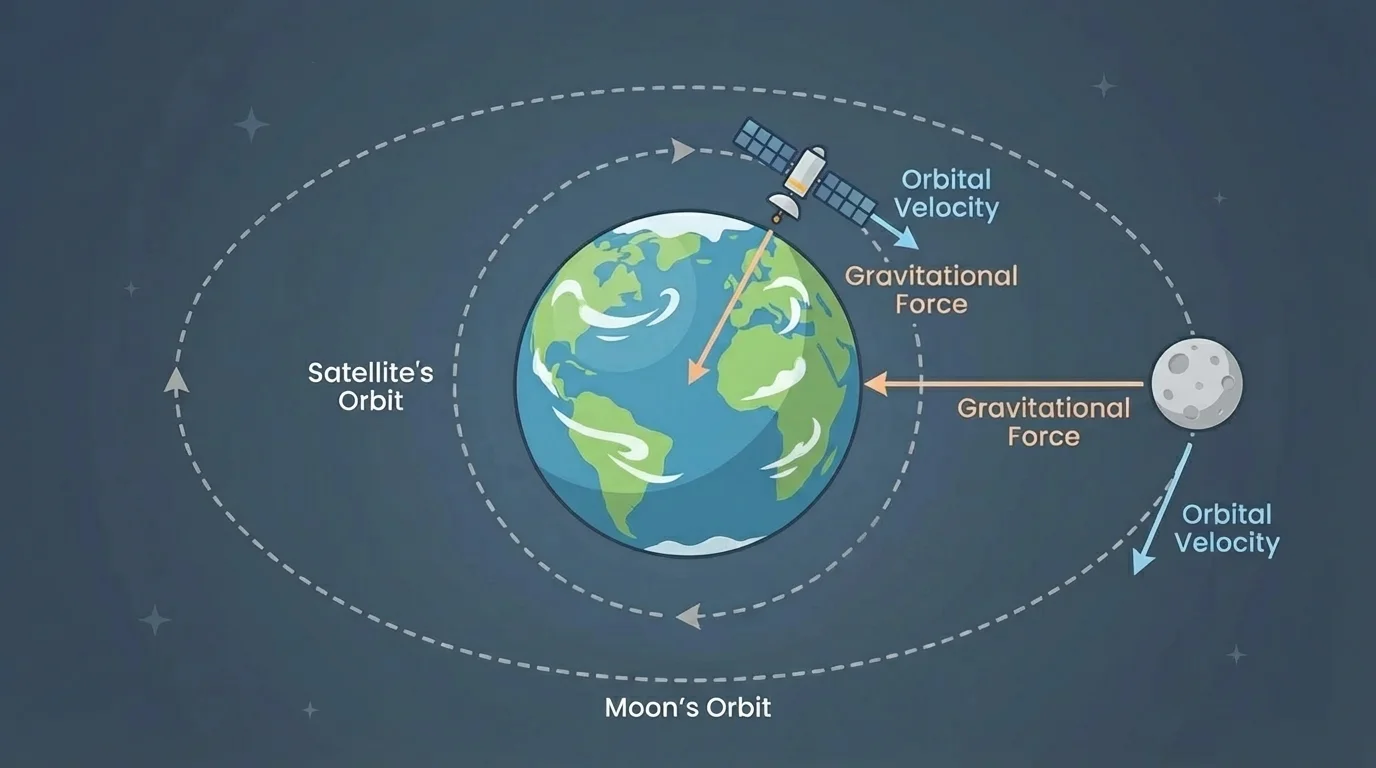
The same idea explains why artificial satellites stay around Earth. A satellite launched at the right speed moves forward while Earth's gravity pulls it inward. As a result, it circles Earth. If its motion or altitude changes too much, its orbit can change as well.
Scientists can also use a simple model to compare different situations in the solar system. Objects closer to a massive body usually feel stronger gravity than objects farther away. This is one reason why the inner parts of a system can behave differently from the outer parts. You do not need advanced laws of motion to understand the main pattern: gravity and motion together create stable, predictable paths.
Some astronauts seem to float in spacecraft not because gravity has disappeared, but because they and the spacecraft are falling around Earth together while in orbit.
A common misconception is that there is no gravity in space. In reality, gravity exists throughout space. If gravity truly disappeared, the Moon would not orbit Earth, Earth would not orbit the Sun, and galaxies would not stay together.
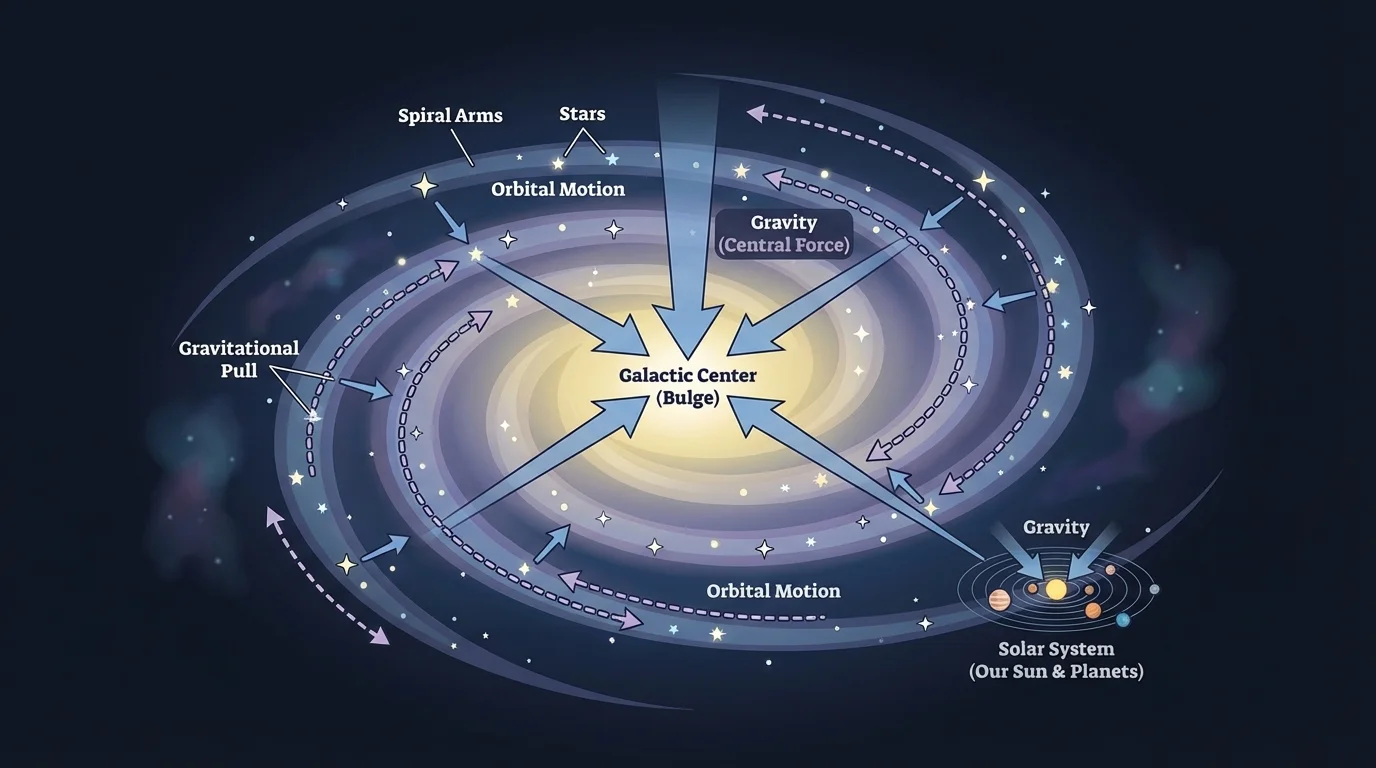
[Figure 3] shows that the role of gravity does not stop with the solar system. A galaxy is a huge group of stars, gas, dust, and other matter held together by gravity. In a galaxy, stars move in large-scale patterns because gravity is shaped by the galaxy's overall distribution of matter.
Our solar system is part of the Milky Way galaxy. The Sun is not sitting still. It moves through the galaxy, pulled by the gravity of all the matter in the Milky Way. Other stars do the same. So gravity shapes motion on both the smaller scale of a solar system and the much larger scale of a galaxy.
There is a pattern here: larger structures in space are built from smaller parts that gravity helps organize. Moons orbit planets, planets orbit stars, and stars move within galaxies. These motions may happen over enormous distances and times, but the same basic idea keeps appearing. Gravity is the force that connects mass and motion.
Although galaxies and solar systems are very different in size, they can both be described with models that show objects moving under the influence of gravity. In the galaxy diagram from [Figure 3], the stars are not all piled into the center because they are moving while gravity pulls on them. That balance between motion and gravitational pull helps explain why galaxies have structure.
One force, many scales
Gravity acts the same basic way whether it is pulling an apple downward, holding the Moon near Earth, guiding planets around the Sun, or keeping stars moving inside a galaxy. What changes from one situation to another are the masses involved, the distances between objects, and the resulting motion.
This is one of the powerful ideas in science: a single rule can help explain many different natural phenomena. The same force that affects you every day on Earth also helps explain some of the largest structures in the universe.
Models are useful because space is too large and too complex to observe all at once. A model lets us focus on the most important features. For this topic, a model should show objects with mass, the gravitational pulls between them, and the resulting motion.
But every model leaves out something. A textbook drawing may not show correct sizes or distances. A computer simulation might simplify the number of objects included. A physical model with balls and strings cannot fully represent empty space. This does not make the model wrong. It means models are tools with strengths and limits.
When you develop or use a model, ask two questions: What does this model help me see clearly? and What details are missing? A solar system model may clearly show that the Sun's gravity organizes planetary motion, but it may not show the true spacing between planets. A galaxy model may show stars moving around a center, but it may not show all the matter present.
Using a model carefully
Step 1: Identify the main purpose.
If the purpose is to explain motion, the model should focus on paths and gravitational relationships.
Step 2: Ignore less important details.
The exact color of a planet or the artistic shape of a star is not important for explaining gravity.
Step 3: Check for limitations.
If all distances are compressed, the model may help with structure but not with scale.
Good science uses models thoughtfully, not blindly.
Scientists often revise models when new observations appear. This reflects the ongoing process of scientific investigation. Better evidence can lead to better models and deeper understanding.
[Figure 4] shows that gravity models are not only for astronomy textbooks. They help scientists and engineers do important work. Satellites used for weather maps, communication, and GPS stay in orbit because of gravity and motion. The Earth-Moon satellite system shows how one planet can have both a natural satellite and human-made satellites moving under gravity.
When engineers launch a satellite, they must choose a path and speed that will place it in the correct orbit. Too slow, and the satellite may fall back toward Earth. Too fast or in the wrong direction, and it may enter the wrong orbit. Gravity models make these predictions possible.
Gravity also affects tides on Earth through the pull of the Moon and, to a lesser extent, the Sun. This is another reminder that gravity acts over distance. You cannot see the force itself, but you can observe its effects.
Space agencies use gravity when planning missions. A spacecraft may travel near a planet or moon and use that body's gravity to change direction or speed. Even when students are not calculating mission paths, it is important to understand the basic idea: knowing how gravity affects motion allows humans to navigate space more effectively.
Later, when thinking again about [Figure 4], notice that the same principles apply to many systems. Earth orbits the Sun, the Moon orbits Earth, and satellites orbit Earth too. Different objects, same core rule: gravity shapes motion.
Formulas can help us describe patterns more precisely. The key relationship to remember is that gravitational force increases with mass and decreases as distance increases.
Suppose two space objects have a gravitational force of \(12\) units at a certain distance. If one object's mass triples and the distance stays the same, the new force is \(3 \times 12 = 36\) units.
Now suppose the original force is \(16\) units, but the distance doubles. Because distance is squared in the denominator, the force becomes \(\dfrac{16}{4} = 4\) units.
Worked numeric example
A moon and a planet attract each other with a force of \(24\) units at a certain distance.
Step 1: Double one mass.
If one mass doubles, the force doubles too: \(2 \times 24 = 48\).
Step 2: Return to the original force and double the distance.
Doubling distance makes the force one-fourth as large: \(\dfrac{24}{4} = 6\).
Step 3: Compare the two changes.
Changing mass has a strong effect, but changing distance can have an even larger effect because the distance is squared.
This helps explain why gravity becomes much weaker across great distances.
These examples are simplified, but they reveal an important pattern. Scientists can use math to support models, test predictions, and compare different situations in the solar system and in galaxies.
One misconception is that gravity only matters when something falls downward. In fact, "downward" is just the direction toward the center of a planet or other object. In space, gravity can pull objects into curved paths, not just straight down.
Another misconception is that an orbiting object has escaped gravity. The opposite is true. An orbit exists because gravity is still acting. Without gravity, the orbit would not exist.
A third misconception is that models are exact copies of reality. They are not. A model is useful because it highlights the most important features of a system. For this topic, the crucial features are masses, distances, gravity, and motion.
When students develop and use models in science, they are doing what scientists do: looking for patterns, testing ideas, and explaining natural phenomena. A well-designed model of the solar system or a galaxy can show that gravity is one of the major forces shaping the universe.
| System | Main Objects | How Gravity Affects Motion |
|---|---|---|
| Earth system | Earth, Moon, satellites | Gravity keeps the Moon and satellites in orbit around Earth. |
| Solar system | Sun, planets, moons | The Sun's gravity organizes planetary motion; planets' gravity organizes moon motion. |
| Galaxy | Stars, gas, dust, other matter | Gravity holds the galaxy together and influences how stars move within it. |
Table 1. Comparison of how gravity shapes motion at different scales.
The main idea is clear: from moons circling planets to stars moving through galaxies, gravity helps create predictable motion across the universe.
