A road cut, canyon wall, or cliff face can act like a history book written in stone. Instead of pages, it has layers. Instead of sentences, it has rocks, fossils, ash beds, and cracks. Earth is about 4.6 billion years old, which is such a huge number that no human could watch all of that history happen. So how do scientists organize that enormous story? They study rock strata, the layers of rock that preserve clues about what happened long before people existed.
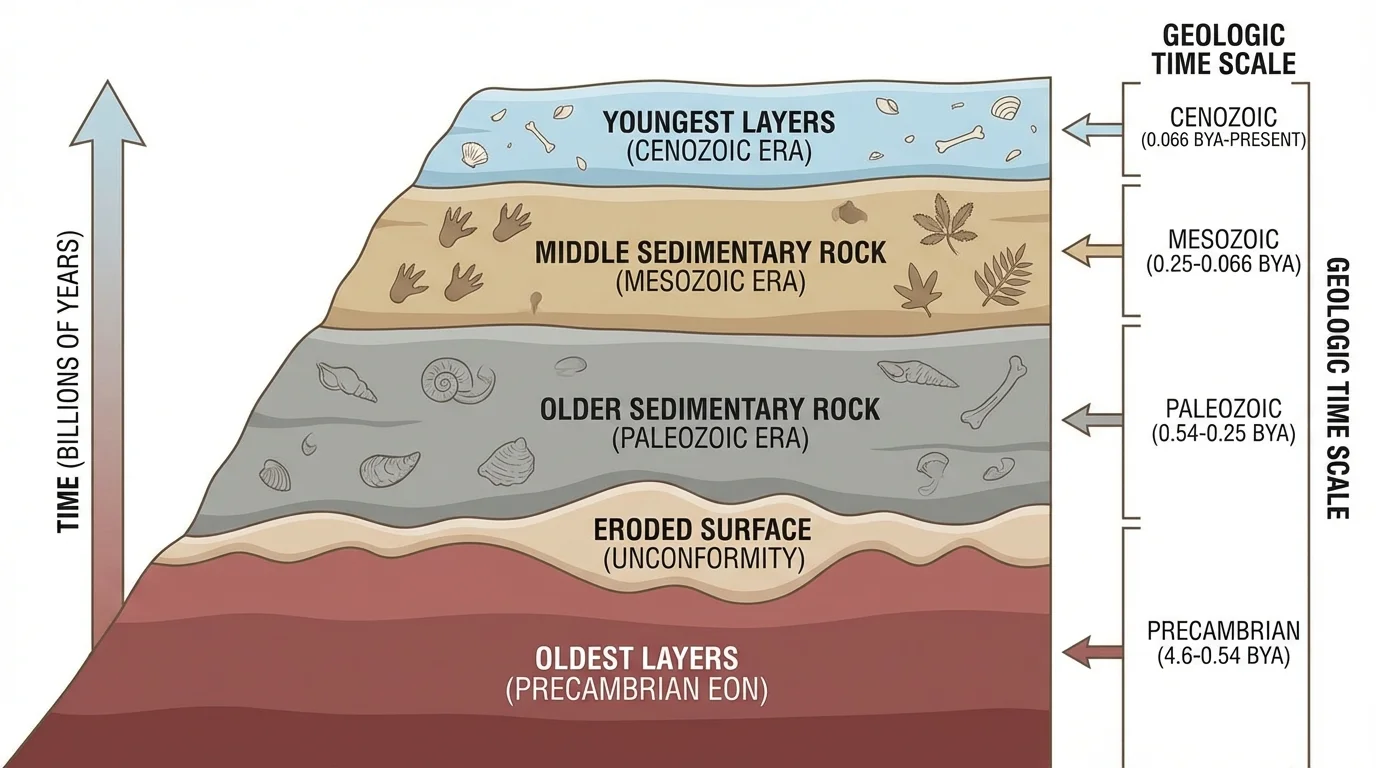
When sediments such as sand, mud, and tiny shells settle over time, they can harden into sedimentary rock. New layers often pile on top of older ones, creating a stack that records change through time, as [Figure 1] shows. A quiet sea might leave one kind of layer, while a river flood or volcanic ash fall might leave a very different one. By studying the order and features of these layers, scientists can reconstruct parts of Earth's past.
This idea works because of a basic principle called superposition. In an undisturbed sequence of sedimentary rock layers, the oldest layer is at the bottom and the youngest is at the top. That does not mean every rock layer on Earth is perfectly stacked forever. Layers can be tilted, broken, folded, or worn away by erosion. Still, if scientists carefully examine the rocks, they can often figure out the original order.
Think of it like making a sandwich. If you put bread down first, then cheese, then lettuce, then tomato, the bread at the bottom was there before the tomato at the top. Rock layers are not lunches, of course, but the stacking idea is similar. The order of layers gives evidence for relative age, which means whether something is older or younger than something else.
Relative age tells the sequence of events, not the exact number of years ago they happened. Absolute age gives a numerical estimate of age, often in millions or billions of years. Both are useful, but they answer different questions.
Sometimes a rock layer is missing because erosion removed it before newer layers formed above it. This missing piece is called an unconformity. An unconformity is important evidence because it tells scientists that something happened there, such as uplift, erosion, or a pause in deposition. Earth's history is not a perfect, complete archive. It has gaps, and those gaps are clues too.
As seen earlier in [Figure 1], geologists do more than simply read from bottom to top. They also look for tilted layers, broken surfaces, and signs of erosion to understand whether the history has been disturbed.
Relative age is one of the most important tools for organizing Earth's history. If one layer is below another, it is usually older. If a crack, fault, or vein cuts across several layers, that feature is usually younger than the layers it cuts. This is called cross-cutting relationships. These ideas help scientists arrange events in order even when they do not yet know the exact dates.
For example, imagine four events in one rock outcrop: mud is deposited, then sand is deposited on top of it, then the rocks harden, and later a crack cuts through both layers. Even without numbers, the sequence can be explained: first the mud layer formed, then the sand layer formed, and finally the crack happened. The crack must be younger because it cuts through the older rocks.
Scientific explanations depend on evidence, not guesses. A scientist does not say, "I think this layer is older because it looks old." Instead, the scientist points to observable evidence: location in the stack, fossils inside the rock, whether another feature cuts across it, and whether erosion removed part of the sequence.
Rocks form in different ways. Sedimentary rocks often form in layers from deposited sediments. Igneous rocks form from cooled molten rock, and metamorphic rocks form when existing rocks change under heat and pressure. Layered sedimentary rocks are especially useful for reading relative order in Earth's history.
Relative dating does not require memorizing the names of many time intervals. The main goal is understanding how evidence from rocks helps scientists place major events in order, such as when certain organisms appeared, when seas covered an area, or when a volcano deposited ash over older sediments.
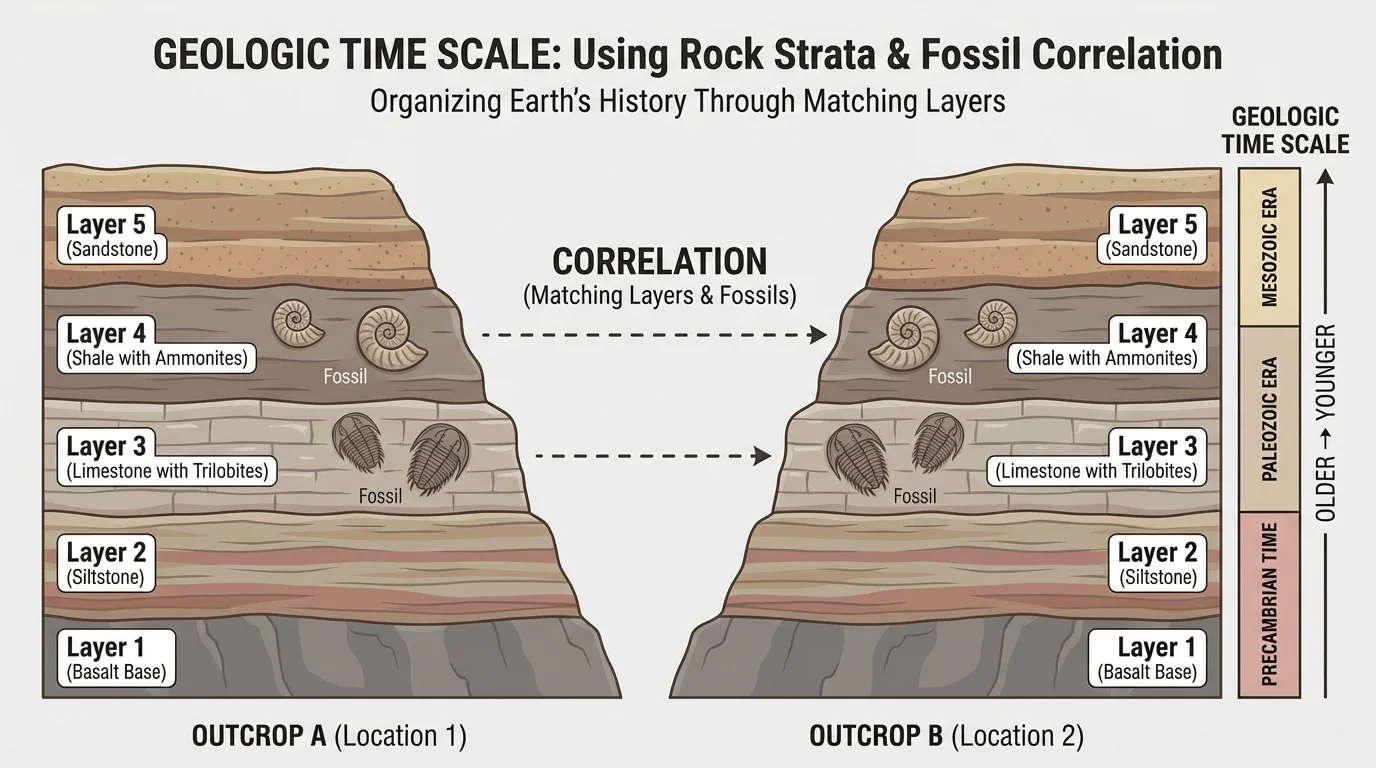
Rocks tell part of the story, but fossils make the story much richer. A fossil record is the collection of fossils and their positions in rock layers. [Figure 2] Fossils show that life on Earth has changed over time. Some layers contain only simple organisms, while younger layers may contain more complex forms of life. This pattern helps scientists organize major events in Earth's history.
Fossils are especially useful because some organisms lived during only a limited span of time but were widespread. A fossil of such an organism can help identify rock layers of about the same age in different places. These are called index fossils. If geologists find the same index fossil in two distant outcrops, they can often correlate those layers, meaning they can match them as parts of the same interval of geologic time, as [Figure 2] illustrates.
Suppose one cliff in one state contains a certain fossil in a shale layer, and a distant cliff contains the same fossil in a similar shale layer. Even if the cliffs are miles apart, the matching fossil evidence suggests those layers formed during the same general time. This helps scientists connect Earth's history across large areas.
Fossils also reveal major changes in Earth's environments. A layer full of marine shells in the middle of a dry land area suggests that a sea once covered that region. Plant fossils in coal-rich layers suggest ancient swampy environments. Footprints, bones, pollen, and shells all add different kinds of evidence.
Some fossil evidence comes from tiny organisms that can only be seen clearly with magnification. These microscopic fossils are extremely useful because they can be abundant and spread over wide regions, making rock layers easier to compare.
Later, when scientists compare many sites, the matching patterns of fossils become even more powerful. The same idea shown in [Figure 2] lets them connect separated rock layers into a much bigger picture of Earth's history.
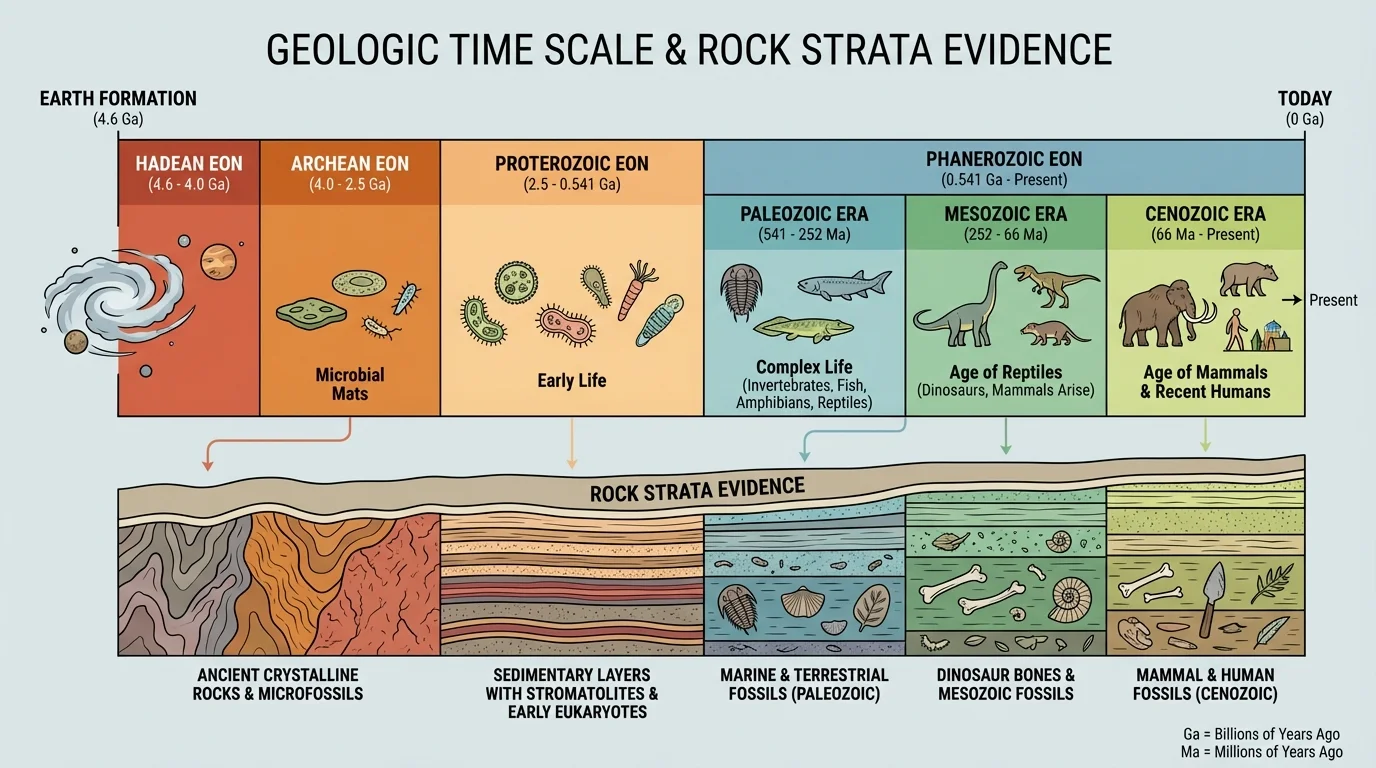
The geologic time scale is a system scientists use to organize Earth's 4.6-billion-year history into sections based on major changes recorded in rocks and fossils. [Figure 3] It is like dividing a very long book into chapters so the story is easier to study, and the figure displays this idea as a simplified timeline. The time scale does not come from one rock layer in one place. It is built from evidence gathered from many rock sequences around the world.
Scientists look for major patterns. For example, they identify boundaries where fossil groups change a lot, where rocks show large environmental shifts, or where major geologic events appear in the record. These patterns allow Earth's history to be divided into broad intervals. The purpose is organization: it helps scientists talk about "when" events happened relative to one another, even across huge spans of time.
The geologic time scale is not just a list of names. It is a framework based on evidence. It organizes events such as the appearance of major groups of organisms, large changes in climate, mountain building, volcanic activity, and mass extinctions. Students do not need to memorize many specific interval names to understand the main idea: the scale arranges Earth's long history using evidence from rock strata and fossils.
One important thing to remember is that Earth's history is uneven. Human history is only a tiny fraction of the whole timeline. If Earth's 4.6 billion years were compressed into a single calendar year, humans would appear very near the end. That helps explain why rocks and fossils are so important: they are the main evidence for almost all of Earth's story.
| Evidence from strata | What it helps scientists determine |
|---|---|
| Position of layers | Which events are older or younger |
| Fossils in layers | How to compare layers and identify major changes in life |
| Volcanic ash or igneous rock | Materials that may be dated numerically |
| Eroded surfaces or missing layers | Where part of the record is missing |
| Faults or intrusions cutting layers | Which geologic features happened later |
Table 1. Types of evidence from rock strata and what each kind of evidence can reveal about Earth's history.
The framework in [Figure 3] helps scientists compare events from different regions. A fossil change found on one continent can be connected to evidence from another place when the rock record supports the same broad interval of time.
Relative age tells sequence, but scientists also want numbers. To estimate numerical ages, they may use radiometric dating, a method based on the predictable decay of radioactive elements in certain minerals. [Figure 4] This gives an absolute age estimate. In many cases, sedimentary layers themselves are harder to date directly, but nearby ash layers or igneous rocks can provide ages that help anchor the sequence.
Radioactive decay happens at a steady rate called a half-life. A half-life is the time it takes for half of a radioactive parent material to change into a daughter material. Scientists measure the amounts of parent and daughter materials in a mineral and use that information to estimate age.
Why numerical ages strengthen the time scale
Rock layers first tell scientists the order of events. Radiometric dating then adds time values to some of those events. When relative dating and numerical dating agree, the geologic time scale becomes much more reliable. One method gives sequence; the other helps measure how long ago the sequence occurred.
A simple numerical example can show the idea. If a mineral starts with a radioactive material and after one half-life only half remains, then after two half-lives one-fourth remains. In fraction form, that is \(\dfrac{1}{2}\) after one half-life and \(\dfrac{1}{4}\) after two half-lives. If one half-life were 10 million years, then two half-lives would be \(2 \times 10 = 20\) million years. Real dating is more complex, but the basic pattern is the same.
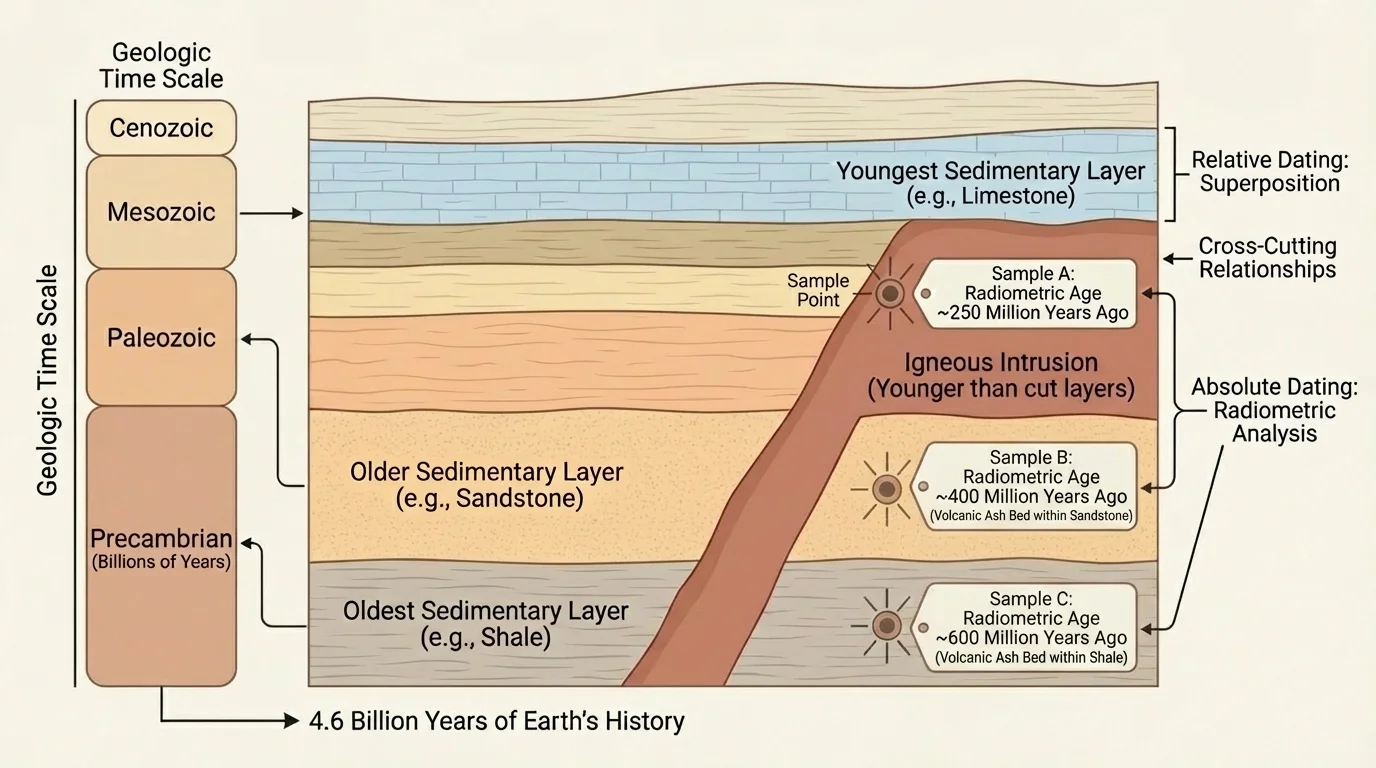
Cross-cutting relationships matter here too. If an igneous intrusion cuts through sedimentary layers, the intrusion is younger than the layers it cuts. If the intrusion is dated, that age helps place limits on the ages of nearby layers. In this way, rock order and numerical dating work together.
Case study: using layers and dated ash to organize events
A geologist studies a cliff with three sedimentary layers and a volcanic ash bed.
Step 1: Observe the order of layers
The lowest sedimentary layer is oldest, the middle layer is younger, and the top layer is youngest because of superposition.
Step 2: Add fossil evidence
The middle layer contains a fossil type known from a certain interval of Earth's history. That helps compare this layer with similar layers elsewhere.
Step 3: Add numerical age evidence
The ash bed above the middle layer is radiometrically dated at \(120\) million years. That means the middle layer must be older than \(120\) million years, and the top layer must be younger than the ash bed.
By combining layer order, fossils, and a dated ash bed, the geologist creates a much stronger explanation than by using only one clue.
The relationship displayed in [Figure 4] is one reason geologists value volcanic ash and igneous rocks in sedimentary sequences. These materials can provide the numerical anchors that the layered record alone cannot always supply.
In science, an explanation is stronger when it includes three parts: a claim, evidence, and reasoning. A claim is the answer to a question. Evidence is the data or observations. Reasoning connects the evidence to the claim using scientific ideas.
Here is a model explanation: Claim: The geologic time scale is used to organize Earth's history by placing major events in order from oldest to youngest. Evidence: In sedimentary rock sequences, lower layers are older than upper layers, fossils appear in a consistent order, and matching fossils can be used to correlate rock layers from different places. Radiometric dating of ash or igneous rock provides numerical ages that support this order. Reasoning: Because rock strata and fossils preserve evidence of changing environments and changing life over time, scientists can arrange events into a sequence and use that sequence to build the geologic time scale.
A weak explanation might say only, "The geologic time scale is a chart of time." A stronger explanation points to specific evidence from rocks. For example, a student could explain that a shell-rich layer below a dinosaur footprint layer is older, and that matching fossils in distant places help connect local rock records into a global framework.
"The present is the key to the past."
— A guiding idea in geology
This geology idea means scientists study processes happening now, such as sediment being deposited in rivers or ash falling from volcanoes, to help interpret similar patterns preserved in ancient rocks.
The geologic time scale is not only about the distant past. It helps people today. Geologists use rock history to search for groundwater, coal, oil, natural gas, and important minerals. They also use it to understand hazards such as earthquakes, volcanoes, and landslides. Knowing the order of rock layers can show where an old fault moved, where lava once flowed, or where flood deposits were left behind.
Studying strata also helps scientists track long-term climate change. Layers of rock, sediments, and fossils can reveal whether a region was once warm, cold, wet, dry, underwater, or covered by ice. These clues help scientists compare past Earth systems with changes happening today.
Real-world application: reading local rock history
Suppose builders want to place a tunnel through a hillside.
Step 1: Geologists map the rock layers.
They identify which layers are strongest, which are fractured, and which may contain water.
Step 2: They study the order of events.
If a fault cuts the layers, the fault is younger than the rocks and may still be a weak zone.
Step 3: They compare with regional geologic history.
If nearby rocks of the same age are known to shift or erode easily, engineers can plan safer construction.
Understanding Earth's layered history helps protect people and infrastructure.
Earth is constantly changing, but the changes are not random. Rock strata preserve patterns. Fossils preserve the history of life. Numerical dating adds age estimates. Together, these tools allow scientists to organize 4.6 billion years of history into a meaningful timeline based on evidence.
