A glass of water on your desk may contain molecules that were once part of a cloud, a glacier, a dinosaur's drinking water, or deep ocean water. That sounds unbelievable, but it is possible because Earth's water is always on the move. It changes location, changes state, and travels through different parts of our planet in a giant connected system called the water cycle.
Water does not stay in one place for long. It moves between oceans, lakes, rivers, soil, the atmosphere, ice, and living things. Some of this movement happens quickly, like rain falling from a cloud. Some happens slowly, like groundwater seeping through rock or ice locked in a glacier for many years.
To understand this motion, scientists build models. A model is a simplified way to show how something works. A water cycle model helps us track where water goes, what causes it to move, and how different parts of Earth are connected.
Water can exist as a solid, liquid, or gas. Ice is solid water, liquid water is the form in rivers and oceans, and water vapor is the gas form in the air. Changes among these states are an important part of the cycle.
Two major forces drive the whole system. Energy from the sun heats water and causes it to change into vapor. Gravity pulls water downward, causing rain to fall, rivers to flow downhill, and groundwater to move through Earth. Without these two drivers, the water cycle would not operate the way it does.
The water cycle is a connected set of processes, as [Figure 1] illustrates, linking the ocean, land, air, and underground water. One important process is evaporation, which happens when liquid water gains energy and changes into water vapor. This happens from oceans, lakes, rivers, puddles, and even wet sidewalks after rain.
Another major process is condensation. When water vapor rises and cools, it changes back into tiny liquid droplets or ice crystals. These droplets form clouds. If enough water collects in clouds, it falls as precipitation, which includes rain, snow, sleet, or hail.
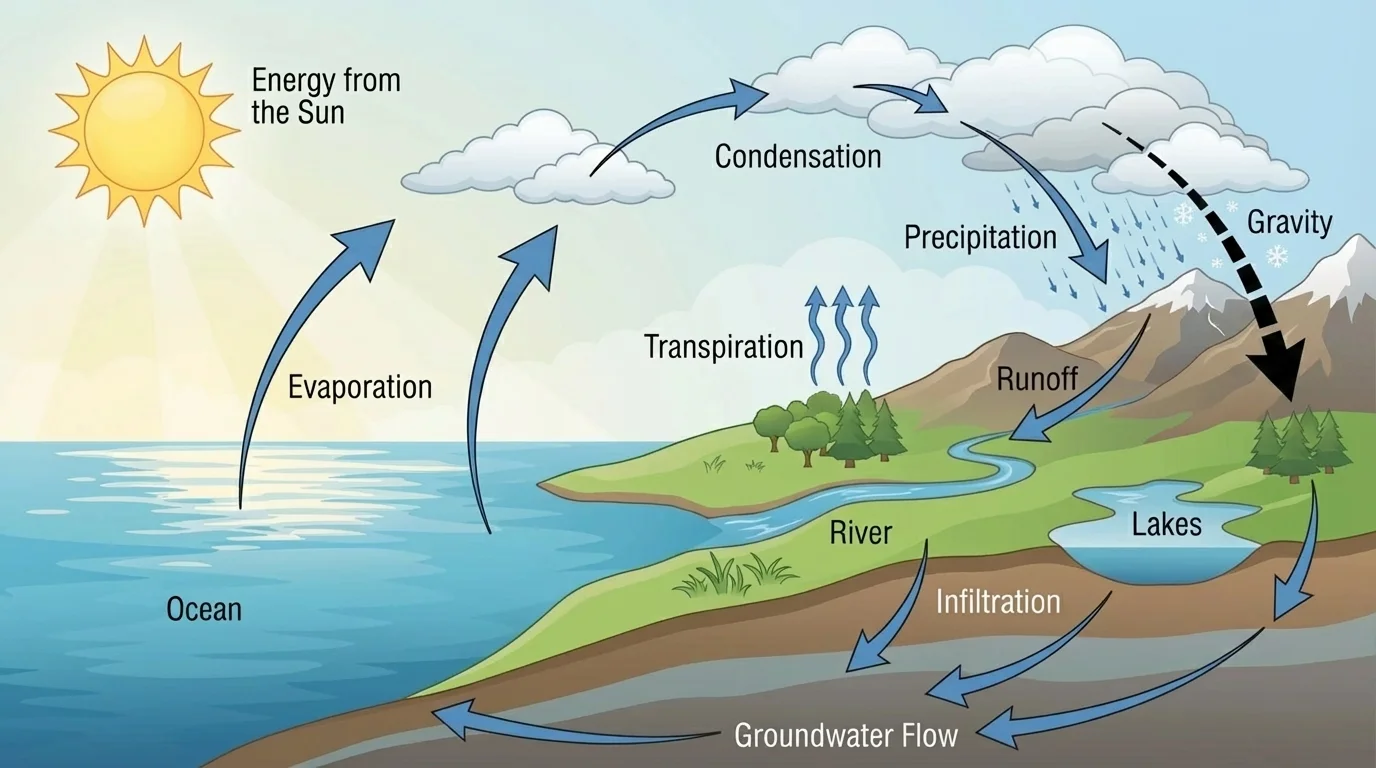
After precipitation reaches the ground, water can follow several paths. Some flows across the land as runoff into streams, rivers, lakes, and eventually the ocean. Some soaks into the ground in a process called infiltration. Water that moves downward and is stored beneath Earth's surface becomes groundwater.
Plants are also part of the cycle. They absorb water through their roots and release some of it into the atmosphere as vapor. This process is called transpiration. In forests and grasslands, transpiration adds large amounts of water vapor to the air.
Water can also collect in many places: oceans, lakes, rivers, wetlands, glaciers, soil, underground aquifers, and even in living organisms. These storage places are often called reservoirs in a model because they hold water for shorter or longer amounts of time.
Water cycle is the continuous movement of water through Earth's systems.
Reservoir is a place where water is stored, such as an ocean, lake, glacier, cloud, or underground aquifer.
Process is an action that moves water from one reservoir to another, such as evaporation or precipitation.
If you think back to [Figure 1], you can see that the cycle is not really a perfect circle. Water may take many different paths. A raindrop might fall into the ocean right away, or it might land on a mountain, freeze as snow, melt months later, flow into a stream, sink underground, and only much later return to the sea.
Water links all of Earth's major systems, as [Figure 2] shows with arrows between air, land, living things, and bodies of water. The atmosphere includes the air, clouds, and water vapor. The hydrosphere includes all water on Earth, whether it is liquid, solid, or gas. The geosphere includes rocks, soil, landforms, and sediments. The biosphere includes all living things.
When rain falls from clouds onto soil, water moves from the atmosphere to the geosphere. When it enters a river or lake, it becomes part of the hydrosphere. When a plant absorbs it and later releases it, the biosphere becomes part of the story too. The same water can move through all four systems.
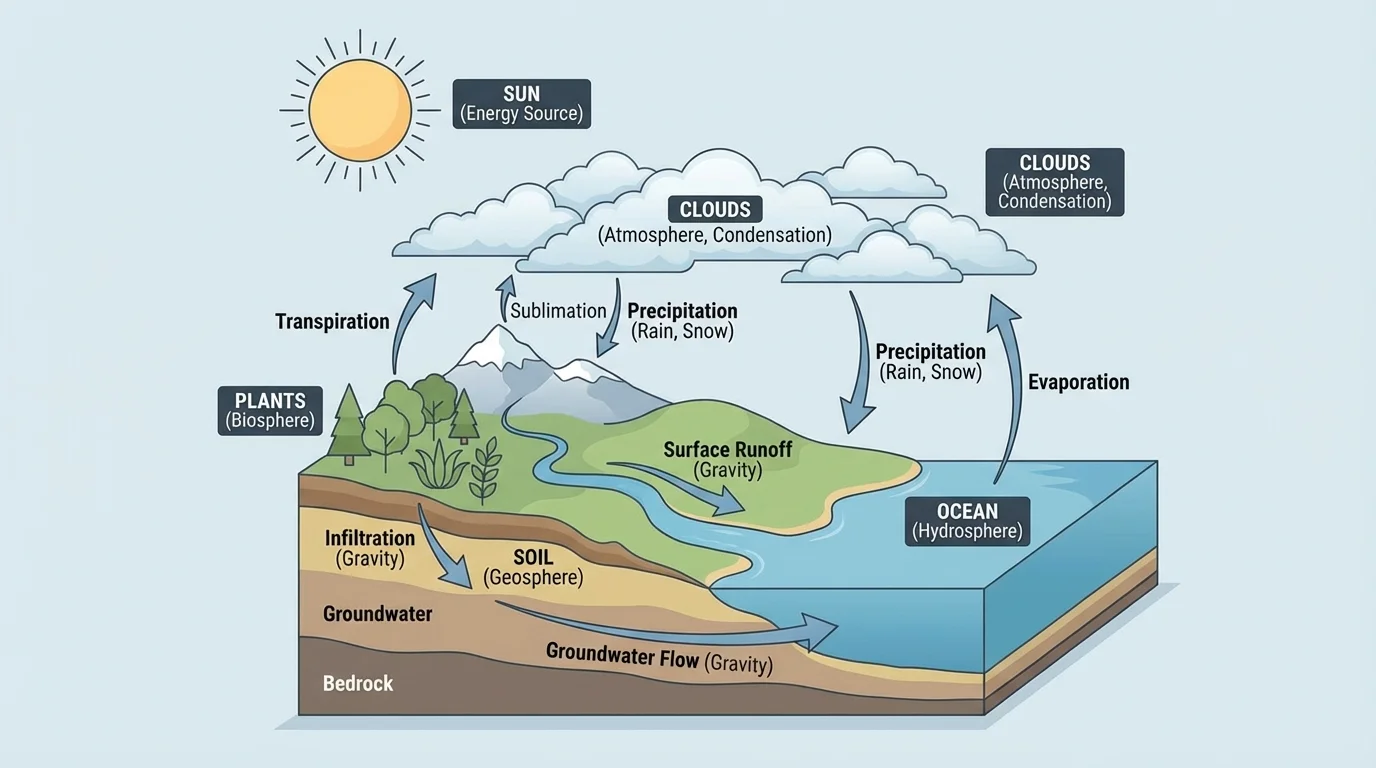
This is why the water cycle is more than just "rain and clouds". It is a system of interactions. Changes in one system often affect the others. For example, if less rain falls on land, soils may dry out, plants may release less water vapor, and streams may shrink.
Human activities can also affect the movement of water through Earth's systems. Paved roads and parking lots reduce infiltration and increase runoff. Cutting down forests can reduce transpiration and increase erosion. Dams change how water moves through rivers.
The sun is the main energy source for the water cycle. Solar energy warms Earth's surface, especially oceans, lakes, and wet soil. As water molecules gain energy, some escape into the atmosphere as vapor. This is why evaporation happens faster on hot, sunny, and windy days.
Even though we do not need to calculate the detailed energy required for phase changes here, we do need to understand the idea: when water changes from liquid to gas, it must gain energy, and the sun provides much of that energy. When water vapor cools and condenses, clouds can form.
How the sun drives upward movement
The sun does not pull water upward directly. Instead, it provides energy that allows liquid water to change into water vapor. Because warm air tends to rise, water vapor is carried upward into the atmosphere, where it can cool, condense, and later fall as precipitation.
A simple way to think about this is to compare wet clothes drying outside. On a warm sunny day, they dry faster because more water evaporates. The same idea works on a much larger scale over oceans and lakes.
Different surfaces absorb solar energy differently. Dark land may heat quickly, while large bodies of water heat more slowly. These differences can affect local weather by changing how much evaporation occurs in different places.
If the sun helps move water upward, gravity brings it back down and keeps it moving across Earth. Gravity pulls precipitation from clouds to the ground. It makes rivers flow downhill from mountains to valleys. It also causes groundwater to move from higher areas toward lower areas.
When snow and ice melt on mountains, gravity helps that water travel downhill into streams and rivers. In flat areas, water may move more slowly, collect in wetlands, or seep underground. In steep areas, runoff can be fast and powerful.
Gravity is also why the ocean is the final destination for much of Earth's flowing water. Streams join rivers, and rivers often empty into seas or oceans. Then the sun can begin the upward part of the cycle again.
Water does not always return to the ocean quickly. Some groundwater may remain underground for years, decades, or even much longer before emerging through a spring or entering a river.
Without gravity, rain would not fall, and water would not flow downhill to shape landscapes. The water cycle depends on both drivers working together: the sun provides energy, and gravity directs much of the movement back toward lower elevations.
[Figure 3] A scientific model of the water cycle simplifies the real world so that the most important parts stand out. In a clear model, reservoirs such as the ocean, atmosphere, river, glacier, plants, and groundwater are shown as connected parts of one system. Arrows show the movement of water between those reservoirs.
A good model should include the main reservoirs, the main processes, and the drivers of motion. For example, arrows can be labeled evaporation, condensation, precipitation, runoff, infiltration, groundwater flow, melting, freezing, and transpiration. The sun should be shown as the energy source for evaporation, and gravity should be shown as the force driving downward movement and flow.
Models can be diagrams, physical setups, or even computer simulations. No model includes every tiny detail. Instead, the goal is to explain the most important relationships clearly and accurately.
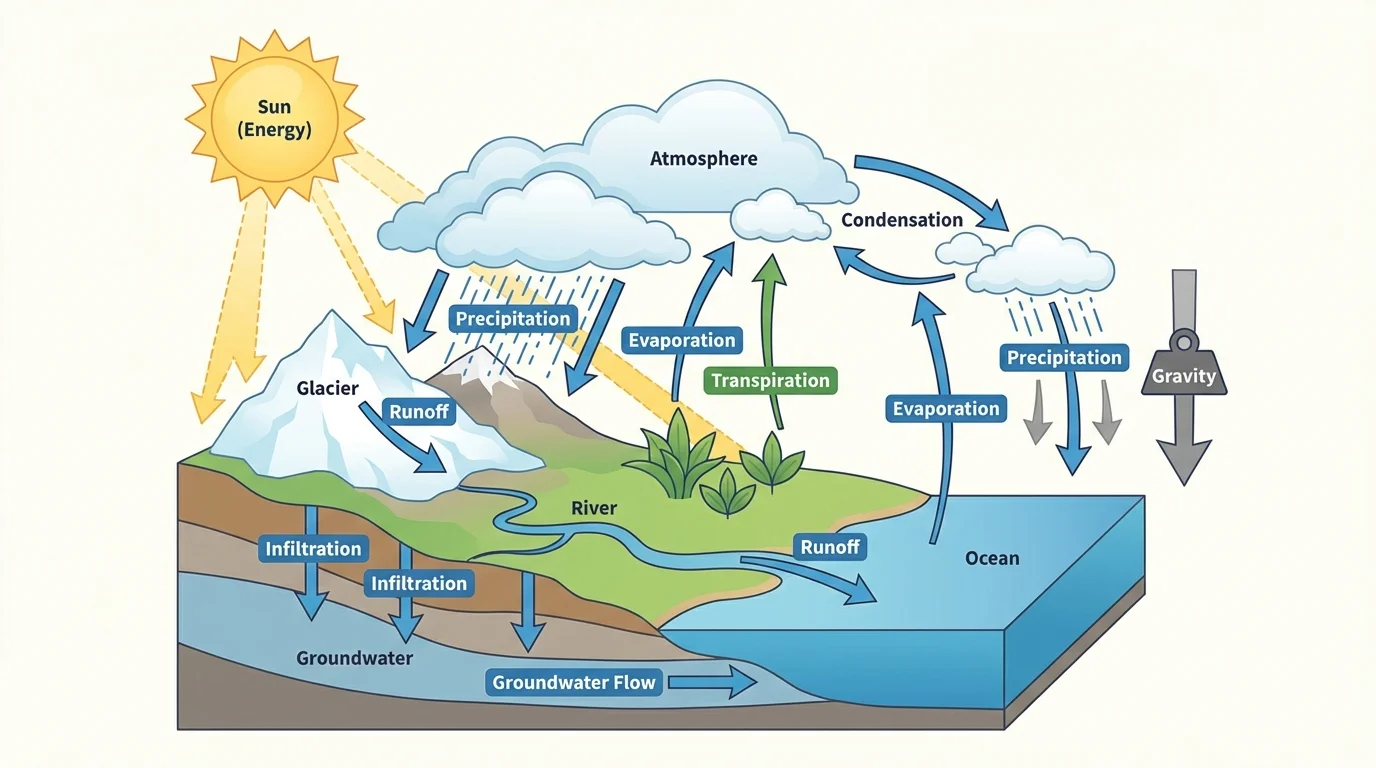
One strength of a model is that it helps us predict what might happen if conditions change. For example, if temperature rises, evaporation may increase. If the ground is frozen, infiltration may decrease and runoff may increase. Models help scientists test ideas about weather, flooding, drought, and climate.
Example: Describing a simple water cycle model
Step 1: Identify the reservoirs.
Suppose the model includes an ocean, a cloud, a mountain, a river, soil, and plants.
Step 2: Add the processes.
Water evaporates from the ocean, condenses into clouds, falls as precipitation on the mountain, flows as runoff into the river, infiltrates into soil, and returns to the air through transpiration.
Step 3: Add the drivers.
The sun provides the energy for evaporation, and gravity pulls water downhill and back toward the ocean.
This model explains both where water goes and why it moves.
Looking again at Figure 3, notice that arrows are just as important as the boxes. The boxes show storage, but the arrows show change. In Earth science, understanding change is often the key to understanding the whole system.
Not all water in the cycle is liquid or vapor. In cold environments, water freezes into snow and ice. Some snow melts quickly in spring. Some becomes part of glaciers or ice sheets and may stay frozen for a very long time.
Frozen water is still part of the water cycle. Snow can fall as precipitation, remain on a mountain, and later melt into streams. Water can also freeze in the ground, in lakes, and at the poles. These frozen reservoirs temporarily store freshwater.
Seasonal changes matter a lot. In some regions, mountain snowpack acts like a natural storage system. Water falls in winter, remains frozen, and then melts in spring and summer. This meltwater supplies rivers, farms, and cities.
Freezing and melting are state changes in the cycle, but we do not need a detailed quantitative study of the energy involved. What matters here is understanding that temperature changes can shift water between solid, liquid, and gas, which changes how and where it moves.
Not all water movement happens in clouds and rivers. The ocean also circulates, and [Figure 4] illustrates how differences in density help move seawater in connected patterns. Density is how much mass is packed into a certain volume. In simple terms, denser water tends to sink below less dense water.
Seawater density changes mainly because of temperature and salinity. Salinity means how much dissolved salt is in the water. Cold water is usually denser than warm water, and saltier water is usually denser than less salty water. So, cold, salty water tends to sink, while warmer or less salty water tends to stay nearer the surface.
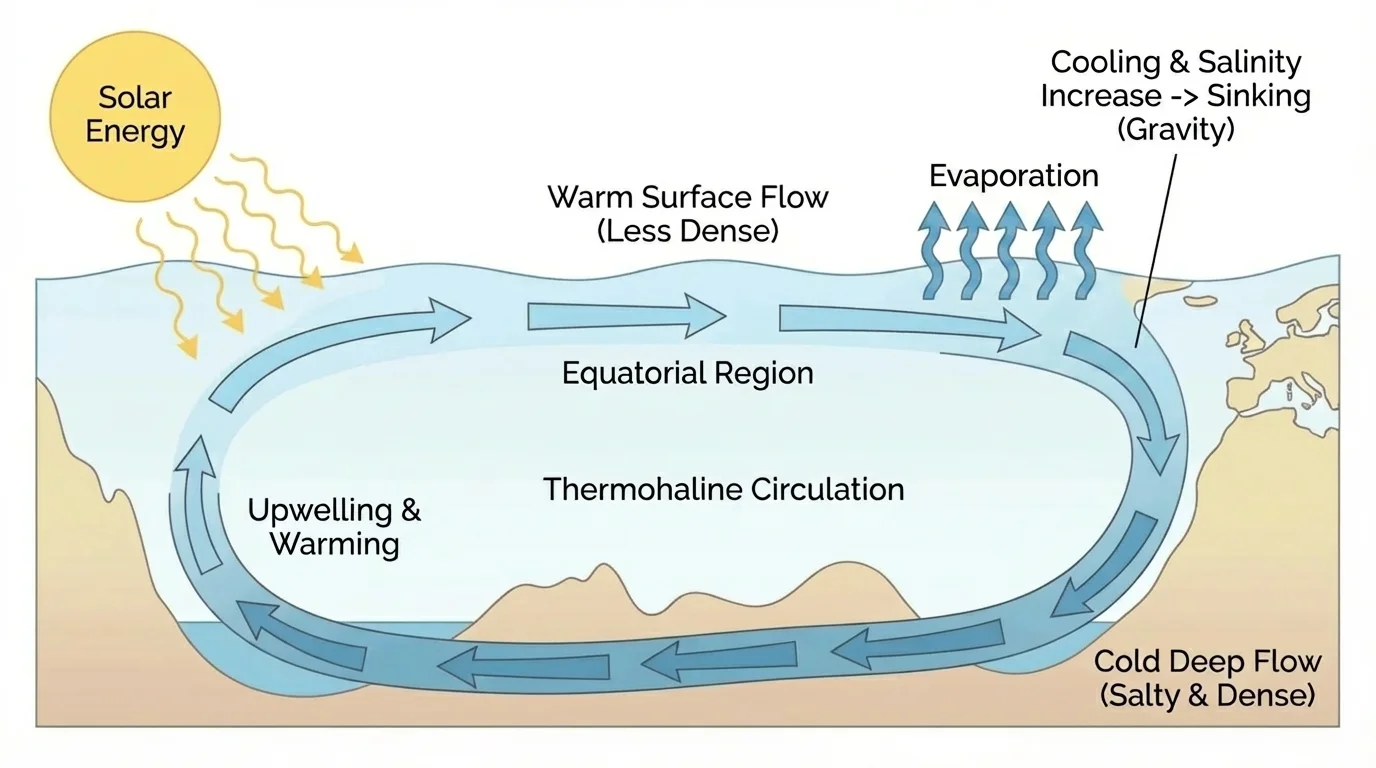
These density differences help drive large-scale ocean currents. Surface currents are also affected by wind, but deep currents are strongly connected to density. Together, surface and deep currents form a global circulation system that moves heat, salt, and water around the planet.
This matters because ocean currents affect climate and weather. A current that carries warm water can make nearby coasts milder. A current that brings colder water can cool nearby air. Ocean circulation is part of Earth's broader water and energy systems.
| Factor | Effect on Seawater Density | Typical Result |
|---|---|---|
| Higher temperature | Density decreases | Water tends to stay nearer the surface |
| Lower temperature | Density increases | Water tends to sink |
| Higher salinity | Density increases | Water is more likely to sink |
| Lower salinity | Density decreases | Water is more likely to remain above denser water |
Table 1. How temperature and salinity affect seawater density and movement.
The circulation shown in [Figure 4] helps explain why the ocean is not a giant still pool. It is a moving system, connected to the atmosphere above it and influenced by heating, cooling, freezing, evaporation, and the addition of freshwater from rivers and melting ice.
Moving water is not just a traveler in the cycle. It is also a powerful agent of change, as [Figure 5] illustrates with water wearing away land and carrying sediment. Water causes weathering, which is the breaking down of rock, and erosion, which is the movement of rock and soil from one place to another.
Rain falling on bare soil can loosen particles. Runoff can carry those particles downhill into streams. Rivers can cut valleys and canyons over long periods of time. Waves can wear away coastlines. Groundwater can dissolve some rock underground, helping form caves in certain places.
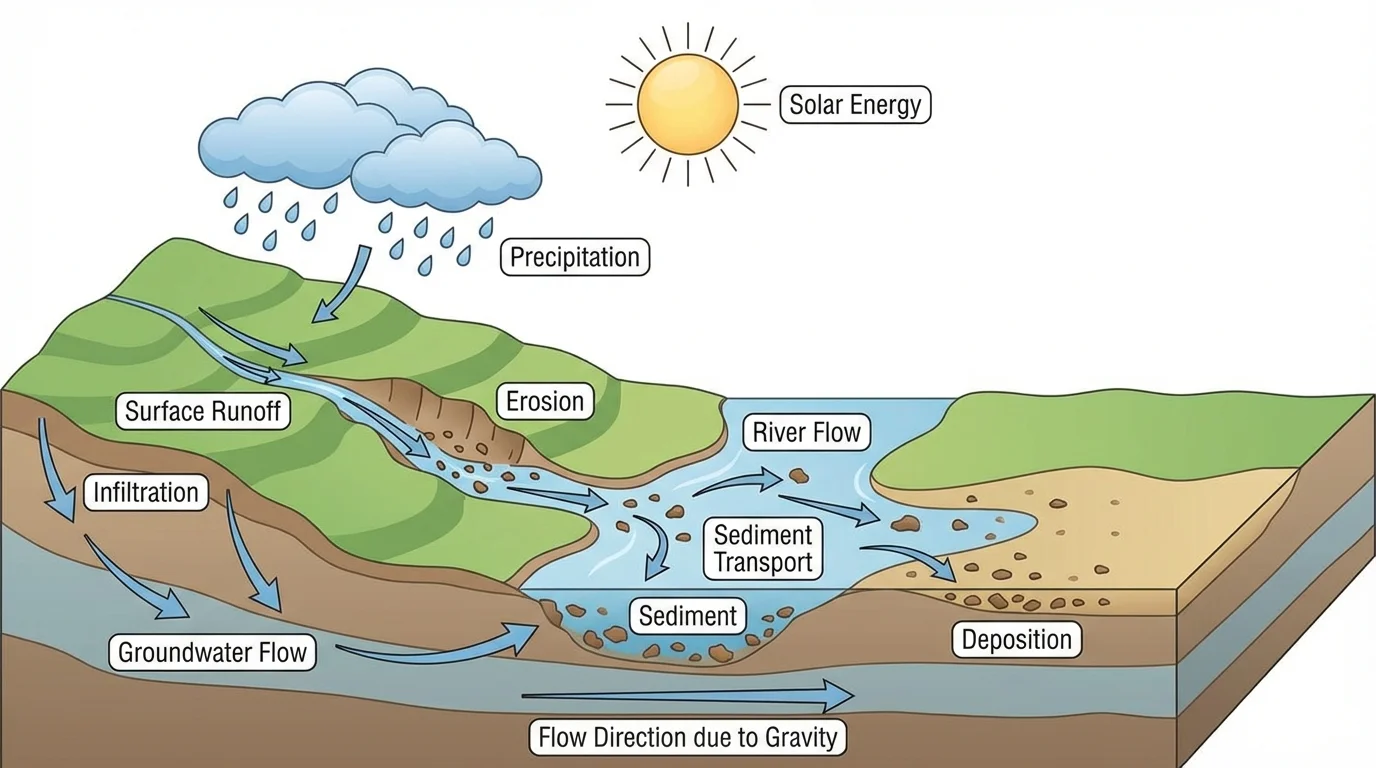
Water also deposits sediment. When flowing water slows down, it can drop the material it was carrying. This can build deltas, sandbars, floodplains, and other landforms. So water can both remove and build parts of Earth's surface.
Real-world example: A river after heavy rain
Step 1: Rain increases runoff.
After a strong storm, more water flows over land into streams and rivers.
Step 2: Faster water carries more sediment.
The stronger current can pick up sand, soil, and small rocks from the banks and streambed.
Step 3: Slower water deposits material.
When the river reaches a flatter area, the flow may slow and drop some of the sediment.
This is one way rivers reshape the land over time.
As seen earlier in [Figure 5], the steepness of land affects how fast water moves. Steeper slopes usually mean faster runoff and greater erosion. Plant roots can reduce erosion by holding soil in place, which is one reason vegetation is important on hillsides and riverbanks.
The water cycle affects weather forecasts, farming, city water supplies, and flood planning. If meteorologists expect strong evaporation and rising moist air, they may predict cloud formation and storms. Farmers need to understand precipitation, soil moisture, and runoff. Engineers designing roads, drainage systems, and dams must consider how water moves across land.
Communities also depend on groundwater. Wells draw water from underground reservoirs, but recharge depends on infiltration. If too much land is covered by concrete, less water can soak in. This can reduce groundwater recharge and increase flooding.
Climate change can influence parts of the cycle too. In some places, warming can increase evaporation. In others, changing precipitation patterns can lead to drought or more intense storms. Melting snowpack and glaciers can also change the timing of river flow.
Why modeling matters
A model helps scientists and communities understand a complicated system with many connected parts. By tracing water through reservoirs and processes, people can predict hazards, manage water resources, and explain changes in landscapes and climate.
When you develop a model of the water cycle, the most important idea is connection. Water moves among Earth's systems, changes state, stores in different places for different amounts of time, and reshapes the planet as it moves. The sun provides energy, gravity guides much of the movement, and together they keep Earth's water in constant motion.
