A soccer ball does not speed up by itself. A bicycle does not suddenly stop without a cause. Every time an object starts moving faster, slows down, or changes how it moves, something important has happened: energy has been transferred. That idea helps explain what we see all around us, from a skateboard rolling down a ramp to a phone vibrating in your hand.
When scientists study motion, they do more than describe whether something is fast or slow. They also ask what caused that change. If a toy car rolls faster after being pushed, its motion has changed because energy moved from the pusher to the car. If the same car slows down on carpet, energy moves from the car to the carpet and surroundings.
Motion is closely connected to energy. An object that is moving has kinetic energy. The faster it moves, the more kinetic energy it has. For middle school science, the key idea is not calculating exact amounts. The important point is recognizing a pattern: when kinetic energy changes, energy must have been transferred.
Kinetic energy is the energy an object has because it is moving.
Potential energy is stored energy due to position, shape, or arrangement.
Energy transfer happens when energy moves from one object or system to another.
This idea is part of a bigger rule in science: energy is conserved. That means energy does not just appear from nowhere or vanish into nothing. Instead, it moves between objects or changes form. A moving object may gain kinetic energy from a push, from gravity, or from a motor. It may lose kinetic energy because of friction, air resistance, or a collision.
One useful way to understand energy is to compare energy of motion with stored energy. [Figure 1] shows this contrast with familiar objects: a rolling ball has kinetic energy, while a lifted ball or stretched object has stored energy that can later become kinetic energy. These are not random categories; they help explain why objects speed up or slow down.
Suppose you hold a ball above the ground. While you hold it still, it is not moving, so it has no kinetic energy from motion. But because of its position, it has gravitational potential energy. If you let go, that stored energy changes as the ball falls. The ball speeds up, so its kinetic energy increases. That increase is evidence that energy has been transferred into the object's motion.
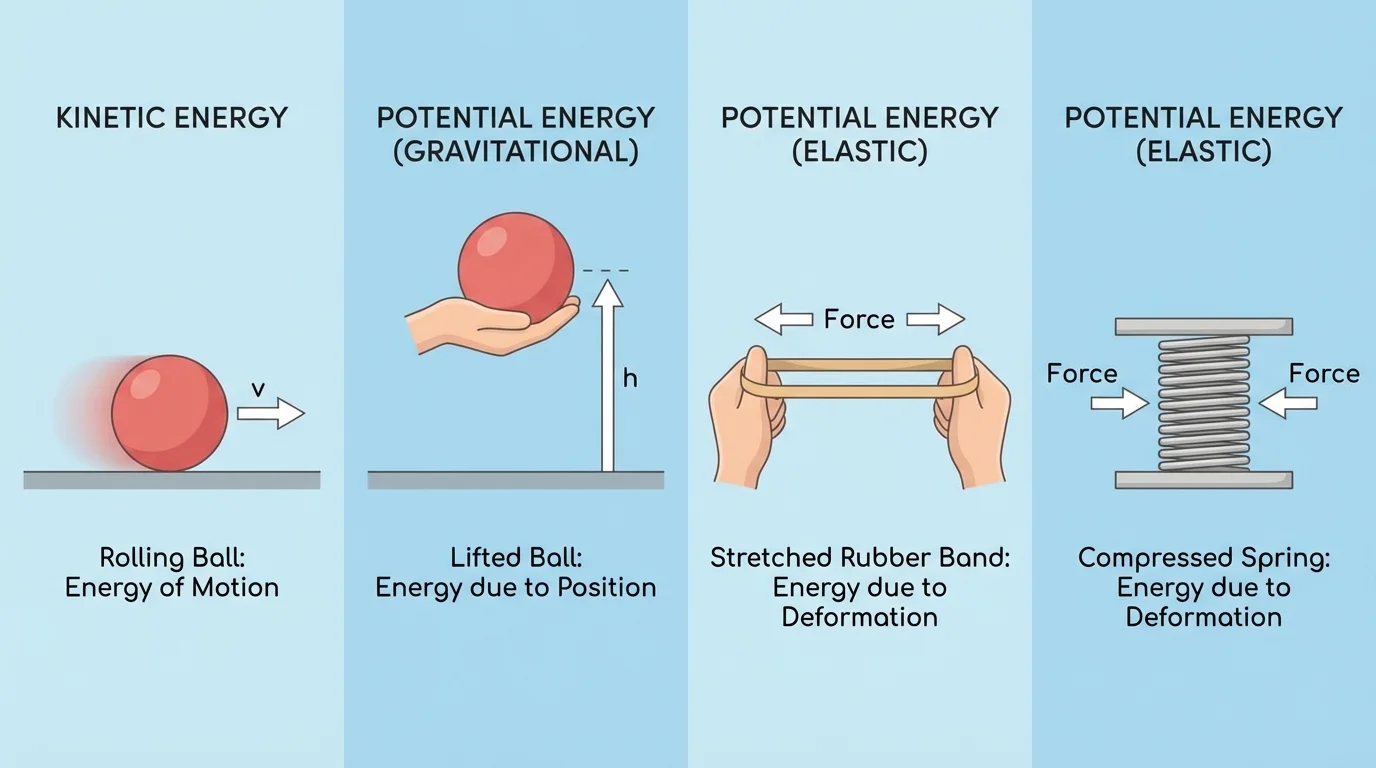
Potential energy can come from more than height. A stretched rubber band stores energy because of its shape. A compressed spring stores energy too. When released, that stored energy can make an object move. Then kinetic energy increases. This helps us see that kinetic energy can be distinguished from various forms of potential energy: one is energy of motion, while the other is energy stored and ready to be released.
Later, when we examine ramps, swings, and falling objects, the same pattern appears again. Stored energy and kinetic energy often trade places, but the total energy is still tracked through transfer and transformation.
You already know that a force can change an object's motion. Energy ideas build on that knowledge: when a force causes an object to speed up or slow down, energy is often being transferred at the same time.
A rolling basketball, a flying paper airplane, and a speeding train all have kinetic energy because they are moving. A book on a shelf, water behind a dam, and a stretched bow all store potential energy. The categories are different, but they are connected because one form can become another.
To support the claim that a change in kinetic energy means energy was transferred, scientists use evidence and reasoning. [Figure 2] A change in speed is not just a description; it is a clue. When a skateboarder speeds up after a push, energy has moved into the skateboarder. When the rider brakes and slows down, energy has moved away from the rider's kinetic energy into other forms.
Consider these observations. A ball at rest is kicked and starts moving quickly. A bike goes downhill and speeds up. A toy car rolls across a rough rug and slows down. In every case, the kinetic energy changes. The best explanation is that energy was transferred to or from the object.
When kinetic energy increases, energy is transferred to the object. This can happen from a person pushing, a motor turning, or gravity pulling an object downward. When kinetic energy decreases, energy is transferred from the object. This often happens through friction, air resistance, sound, or heating of surfaces during contact.
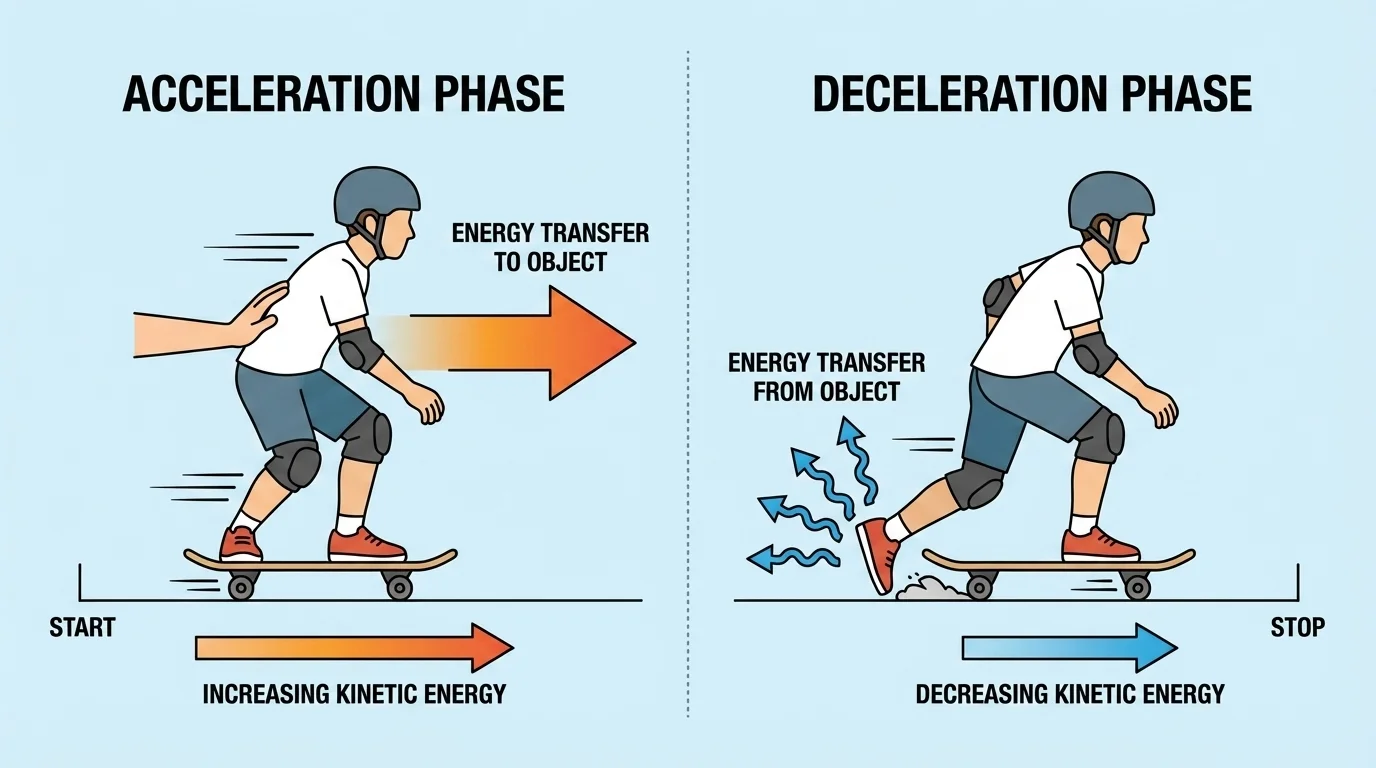
We can state the claim clearly: when the kinetic energy of an object changes, energy is transferred to or from the object. If kinetic energy increases, energy enters the object's motion. If kinetic energy decreases, energy leaves the object's motion and appears somewhere else.
This is not just a guess. It is based on repeated patterns in nature. The same idea explains why hands feel warm after rubbing together, why car brakes get hot, and why a ball eventually stops bouncing. The object's kinetic energy decreases, but the energy has not disappeared. It has been transferred.
Think about a player serving a tennis ball. Before the hit, the ball may be still or moving slowly. After the racket strikes it, the ball moves much faster. The ball's kinetic energy increases because energy is transferred from the player's muscles, through the racket, to the ball.
A shopping cart behaves the same way. If you push it gently, it rolls slowly. If you push harder and longer, it rolls faster. The increased motion shows that energy moved from your body to the cart. In a machine, a battery can transfer energy to a motor, and the motor can transfer energy to a fan blade. The spinning blade has kinetic energy.
Case study: Kicking a soccer ball
Step 1: Observe the starting motion.
The soccer ball is resting on the ground, so its kinetic energy is very small or zero.
Step 2: Identify the interaction.
A player's foot pushes on the ball.
Step 3: Observe the result.
The ball moves fast across the field, so its kinetic energy increases.
Step 4: Make the scientific claim.
Energy was transferred from the player to the ball.
Gravity can also increase kinetic energy. When a skateboard rolls down a ramp, the rider speeds up. Energy associated with height changes, and the skateboarder's kinetic energy increases. No one has to keep pushing after the drop begins. Gravity transfers energy into motion as the rider moves downward.
Even tiny objects show the same rule. Raindrops fall faster as they move downward at first. Their kinetic energy increases because energy is transferred into their motion by gravity, until air resistance balances the effect and the speed stops increasing.
Now think about motion that fades away. A rolling marble on a smooth floor may travel far, but on carpet it slows quickly. The marble's kinetic energy decreases because energy is transferred from the marble to the carpet and nearby air, often as thermal energy and a little sound.
Bicycle brakes are a strong example. When brake pads press on the wheel, friction reduces the bike's motion. The kinetic energy of the bike decreases. That energy is transferred mainly into heating the brake pads, wheel, and surrounding air. This is why brakes can become hot after heavy use.
Collisions also show energy transfer. If two bumper cars hit and then move more slowly, some kinetic energy has been transferred into sound, heating, and changes in shape. The important idea is that less kinetic energy after the crash means the energy went somewhere else.
Spacecraft returning to Earth face extreme heating because they lose enormous amounts of kinetic energy as they push through the atmosphere. That lost motion energy is transferred mostly into thermal energy.
Air resistance matters too. A tossed sheet of paper slows more quickly than a tossed ball because the air pushes more strongly against the paper's motion. In both cases, when the object slows, energy is transferred from the object to the surroundings.
Science is not only about knowing facts. It is also about supporting ideas with logical arguments. A strong scientific argument often includes three parts: a claim, evidence, and reasoning.
The claim is the statement you want to support. Here, the claim is that when the kinetic energy of an object changes, energy is transferred to or from the object.
The evidence is what you observe. For example, a ball speeds up after being hit, or a bike slows when the brakes are used. You may also observe heating, sound, or deformation after motion changes.
The reasoning connects the evidence to the claim. If an object moves faster, it has more kinetic energy, so energy must have been transferred to it. If it slows down, it has less kinetic energy, so energy must have been transferred from it. This reasoning uses the rule that energy is conserved.
Cause and effect in energy transfer
Changes in kinetic energy do not happen without a cause. A push, pull, collision, gravitational drop, frictional contact, or motor action causes energy to move. Looking for the cause helps scientists explain where the energy came from and where it went.
Here is an example of a short argument: The toy car rolled faster after being released from a steeper ramp. That is evidence that its kinetic energy increased. Since energy cannot appear from nowhere, the best explanation is that energy was transferred into the car's motion as it moved down the ramp.
A second argument might sound like this: The sliding book slowed and the table became slightly warmer. The book's kinetic energy decreased. The warming shows that energy was transferred from the moving book to the table and surroundings through friction.
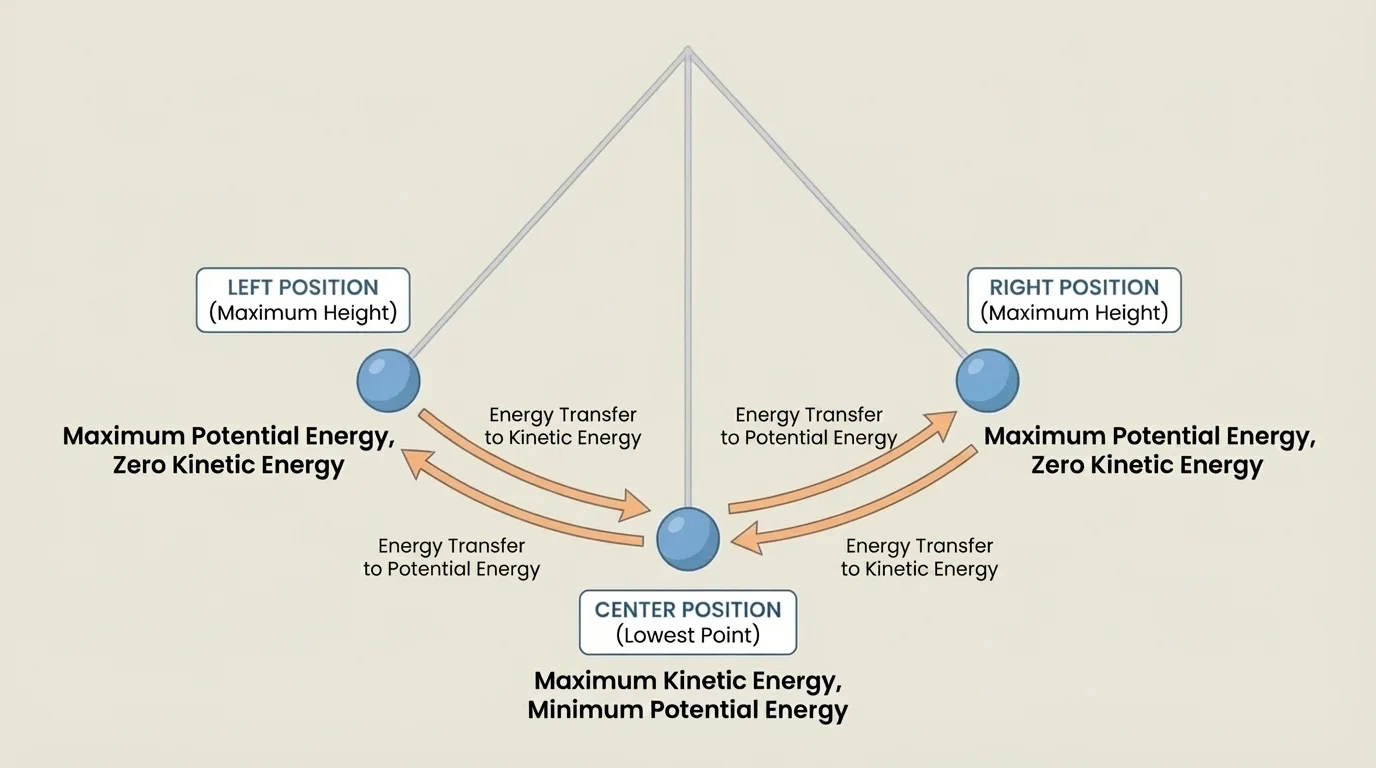
[Figure 3] Some of the best examples of energy transfer involve kinetic energy and stored energy changing back and forth. A swinging pendulum rises, slows, falls, and speeds up in a repeating pattern. This makes it easier to see how kinetic energy and potential energy are different but connected.
At the highest point of a swing, the pendulum is momentarily almost still. Its kinetic energy is very small, while its gravitational potential energy is greater because of height. As it swings downward, kinetic energy increases. At the lowest point, the pendulum is moving fastest, so its kinetic energy is greatest. As it rises again, kinetic energy decreases and potential energy increases.
A ball thrown upward follows a similar pattern. Right after it leaves your hand, it has kinetic energy from its motion. As it rises, it slows down. Its kinetic energy decreases while gravitational potential energy increases. At the top, it has very little kinetic energy. On the way down, the process reverses.
The same relationship appears on roller coasters and skate ramps. Cars or riders high above the ground have more gravitational potential energy. As they descend, kinetic energy increases. As they climb again, kinetic energy decreases. The same pattern helps explain these larger systems too.
Understanding kinetic energy changes is useful in engineering and safety design. Car manufacturers design seat belts, airbags, and crumple zones to manage energy transfer during a crash. In a collision, the vehicle's kinetic energy changes quickly. Safety features help transfer that energy in ways that reduce harm to people inside.
Sports equipment also uses energy ideas. Helmets, pads, gym mats, and catching gloves are designed to spread out forces and absorb energy transfers. When a baseball is caught, the ball's kinetic energy decreases. Some of that energy is transferred into the glove and the player's hand, but protective equipment helps reduce injury.
Engineers who build elevators, amusement rides, and factory machines must understand how objects gain and lose kinetic energy. If a ride speeds up too quickly or stops too suddenly, energy is transferred too harshly for comfort or safety. Careful design controls these transfers.
| Situation | What happens to kinetic energy? | What does that tell us? |
|---|---|---|
| Ball is kicked | Increases | Energy is transferred to the ball |
| Bike brakes | Decreases | Energy is transferred from the bike |
| Cart pushed by hand | Increases | Energy is transferred from person to cart |
| Marble slows on carpet | Decreases | Energy is transferred to carpet and surroundings |
| Object falls | Usually increases | Energy is transferred into motion by gravity |
Table 1. Everyday situations showing how changes in kinetic energy indicate energy transfer.
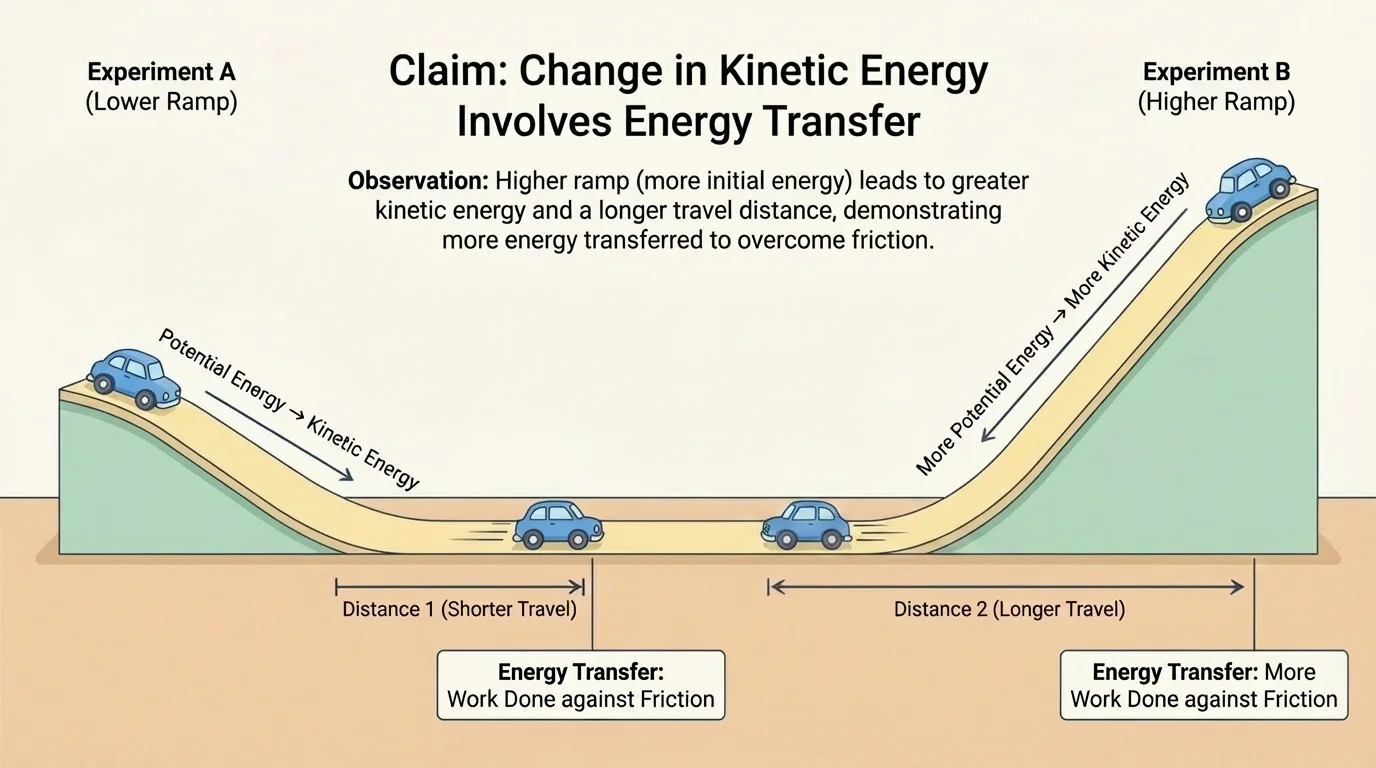
[Figure 4] You can gather evidence for this idea by comparing how a toy car moves from different ramp heights. This investigation does not require calculations of energy. Instead, it focuses on observations that support a scientific argument.
Place one end of a board on a stack of books to make a ramp. Release a toy car from a lower height and watch how fast it seems to move and how far it travels across the floor. Then raise the ramp and repeat. If the car moves faster or travels farther after the steeper release, that is evidence that its kinetic energy increased more during the descent.
You can also test different surfaces. Let the car roll onto tile, cardboard, or carpet. If it slows sooner on rougher surfaces, its kinetic energy is decreasing more quickly there. That supports the idea that energy is being transferred from the car to the surface and surroundings.
Using observations to form an argument
Step 1: State the observation.
The toy car released from the higher ramp moved faster and rolled farther.
Step 2: Identify the energy change.
The car's kinetic energy increased more during the trip down the higher ramp.
Step 3: Explain the transfer.
Energy was transferred into the car's motion as it descended.
Step 4: Write the argument.
Because the car from the higher ramp had greater motion afterward, the evidence supports the claim that a change in kinetic energy means energy was transferred.
Investigations like this matter because they connect ideas to evidence. Scientists do not just repeat a rule; they observe patterns, compare situations, and build explanations from what actually happens.
One common mistake is saying that energy is "used up" or "gone" when an object stops. A moving object may stop, but the energy has not vanished. It has been transferred into other forms, often thermal energy, sound, or changes in shape.
Another misunderstanding is thinking that only living things transfer energy. In fact, nonliving interactions do this constantly. Gravity, friction, springs, motors, and collisions all transfer energy.
A third misunderstanding is confusing speed with energy itself. Speed tells you about motion, but kinetic energy is the energy associated with that motion. We often use changes in speed as evidence that kinetic energy changed. For example, the skateboarder in [Figure 2] speeds up after a push and slows during braking, so we know energy is transferred even without calculating exact values.
"Energy cannot be created or destroyed, only transferred or transformed."
— A core scientific principle
Once you start looking for this pattern, it appears everywhere: in falling objects, bouncing balls, moving vehicles, vibrating speakers, swinging doors, and spinning fans. Changes in kinetic energy are not isolated facts. They are clues that reveal how energy moves through the world.
