Your body looks solid and continuous, a tree trunk looks like one giant piece of wood, and a mushroom seems like a single smooth object. But under a microscope, each of these is built from tiny living units. This is one of the most powerful ideas in science: all living things are made of cells. Some living things are only one cell, while others are made of enormous numbers of cells working together. Scientists did not discover this by guessing. They gathered evidence through careful investigations.
When scientists study life, they look for certain traits. Living things grow, use energy, respond to their surroundings, and reproduce. To understand how living things do all of this, scientists ask a basic question: what is the smallest part of a living thing that is still alive?
The answer is the cell. A cell is not just a tiny piece of a living thing the way a crumb is a tiny piece of bread. A cell is itself alive. It can take in materials, use energy, get rid of waste, and help an organism continue living.
Cell means the smallest unit that can be said to be alive. A living thing may be made of one cell or many cells, but cells are the basic building blocks of life.
This idea helps explain why a fallen leaf is made of living units while a rock is not. A rock may have grains or crystals, but it does not have cells. The presence of cells is one major piece of evidence that something belongs to the living world.
Scientists developed a major idea called cell theory. At the middle school level, the most important part of this idea is that all living things are made of one or more cells, and the cell is the basic unit of life.
Even though cells are tiny, they are highly organized. Each cell has a boundary that separates it from its surroundings, and inside that boundary are materials that allow life processes to happen. You do not need to identify many specific cell parts to understand the big idea. What matters most is that cells are real, observable units, not imaginary ones.
Some organisms complete every life function in a single cell. Other organisms divide jobs among many cells. In both cases, the evidence points to the same conclusion: life is cellular.
A single drop of pond water can contain many microscopic living things. Even though they are too small to see without magnification, each one can still carry out the functions of life.
This is one reason microscopes changed science so much. Before microscopes, people could describe living things only at the scale visible to the eye. After microscopes, scientists could see that living tissues are not smooth masses. They are made of repeating tiny units.
[Figure 1] Scientists rely on evidence, and special tools let them collect it at scales our eyes cannot reach. A microscope magnifies tiny objects, and a thin sample placed on a slide can reveal many separate units rather than one continuous sheet of material.
When scientists investigate whether living things are made of cells, they observe thin samples from organisms such as onion skin, leaf tissue, or cells from the inside of the cheek. Under a microscope, these samples show repeated small compartments or individual units. Those visible units are evidence of cells.
Good scientific evidence is based on observation, careful recording, and repeatability. If many students examine the same kind of sample and each sees a similar pattern of tiny units, the claim becomes stronger. If scientists examine many different organisms and keep finding cells, the evidence becomes even stronger.
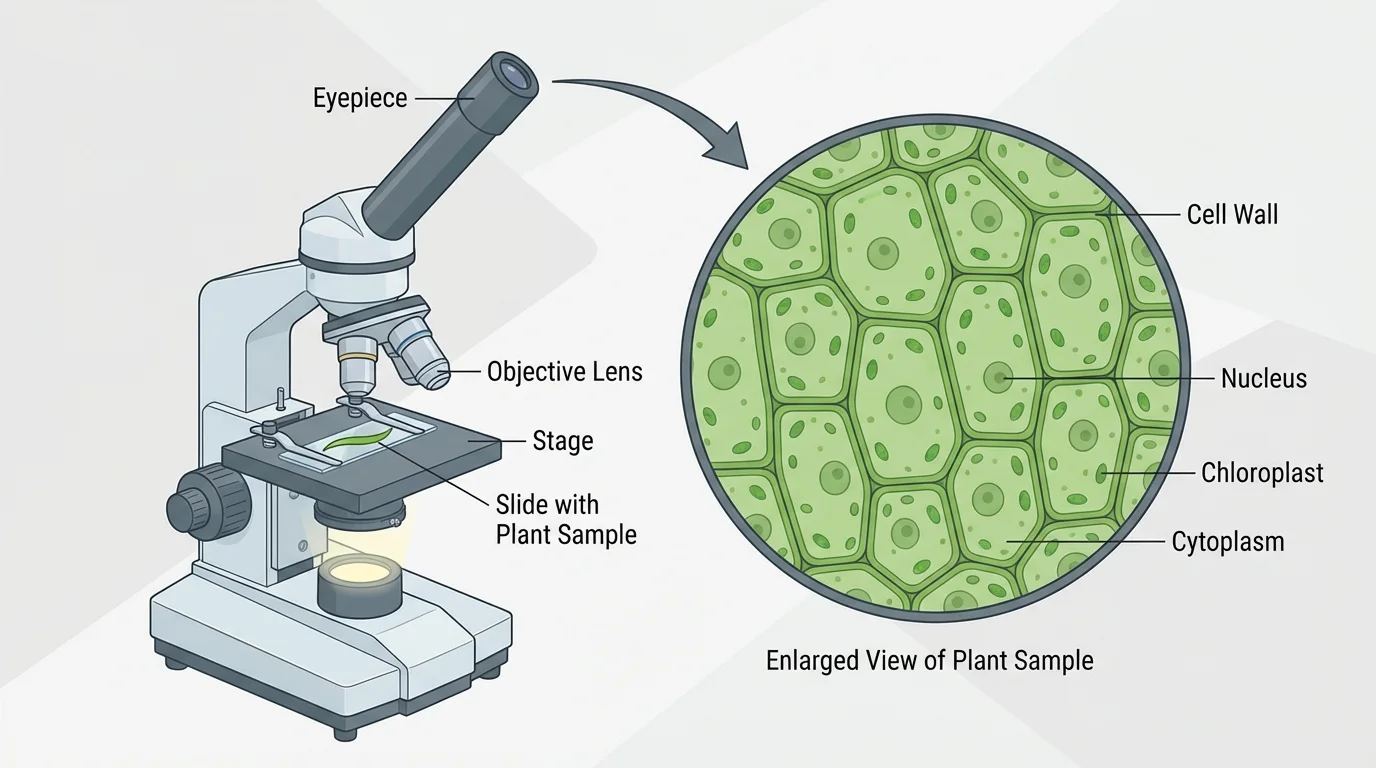
Investigations also require careful technique. Samples must be thin enough for light to pass through. The microscope must be focused properly. Observers should sketch what they see or write clear notes. Science is not just looking; it is observing with purpose.
Observation versus inference
An observation is something directly noticed, such as seeing many tiny box-like spaces in a plant sample. An inference is a conclusion drawn from those observations, such as concluding that the plant is made of cells. Strong science connects observations to conclusions clearly.
When students gather observations from several living samples, they are doing the same kind of reasoning scientists use. They are not expected to memorize many cell names. Instead, they use evidence to support a claim about life.
[Figure 2] A simple investigation can provide strong support for the idea that living things are made of cells. In a typical classroom setup, students examine a very thin onion peel or a small leaf sample. The sample is placed on a slide with a drop of water and covered carefully before being viewed under a microscope.
At low magnification, the sample may look like a pale sheet. At higher magnification, repeating units become visible. In onion tissue, the units often look like tiny brick-like compartments arranged side by side. In a leaf, students may see many tightly packed cells. In a cheek sample, the cells may look more irregular in shape. The important pattern is not the exact shape. The important pattern is that the living sample is made of separate cells.
Evidence-based investigation example
Question: Are living tissues made of cells?
Step 1: Observe a thin sample from a living thing, such as onion skin, under a microscope.
Step 2: Record what is seen. For example, note that many small repeating units appear, each with a boundary.
Step 3: Observe a different living sample, such as a leaf or cheek lining, and record whether similar tiny units are present.
Step 4: Compare the observations. If multiple living samples all show tiny units, use that evidence to support the claim that living things are made of cells.
The conclusion is based on repeated observation, not on guessing.
If one sample alone showed tiny units, that would be interesting. But when many kinds of living things show the same pattern, the evidence becomes much more convincing. This repeated pattern across organisms supports a broad scientific idea.
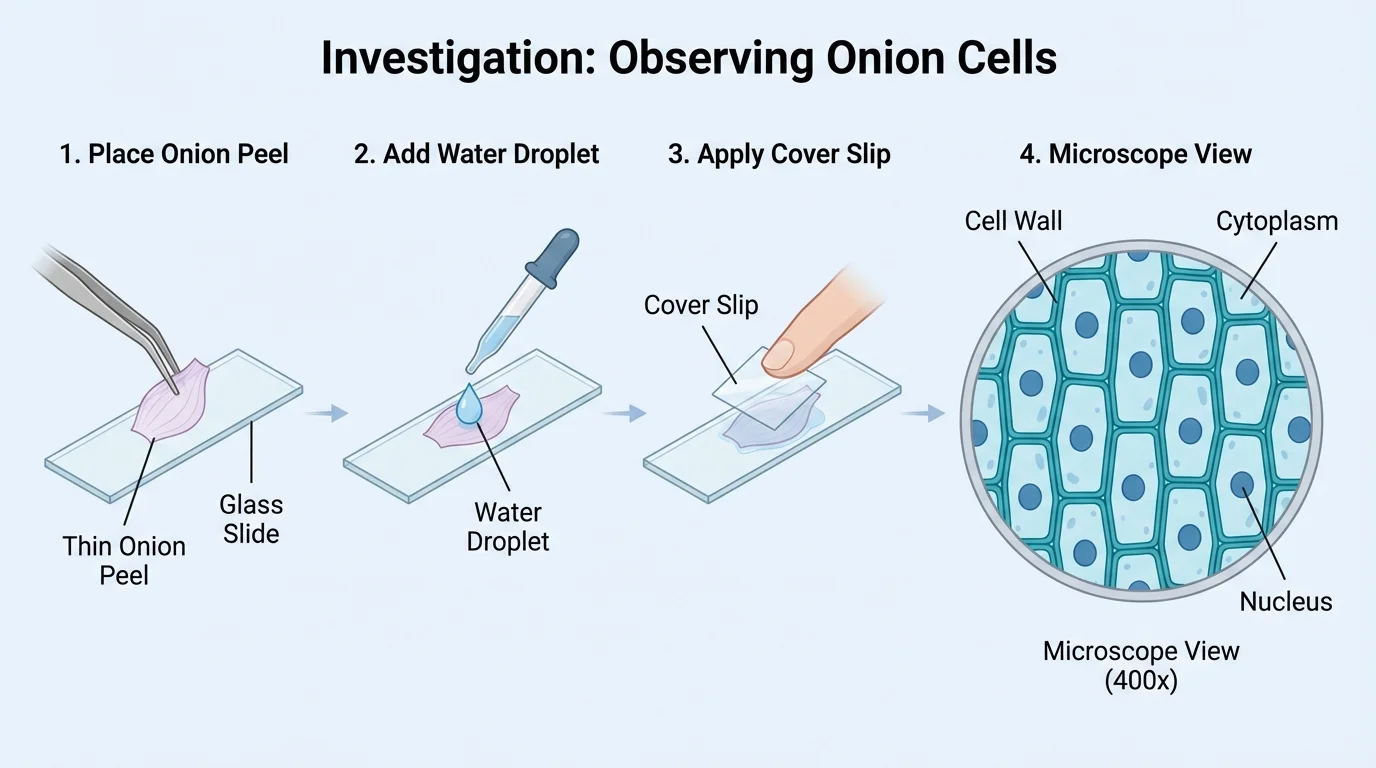
Investigations can also include comparing living and nonliving materials. A student might observe onion tissue and then observe a grain of sand. The onion tissue shows many cells. The sand grain does not. This contrast helps students see that cells are a feature of living things, not of all matter.
[Figure 3] Life exists in more than one arrangement. Some organisms are unicellular, meaning they are made of just one cell. Others are multicellular, meaning they are made of many cells. This contrast is one of the most important patterns in biology.
A unicellular organism carries out all life processes in a single cell. That one cell must take in nutrients, remove waste, respond to the environment, and reproduce. Many microscopic organisms live this way. Even though they are only one cell, they are fully alive.
A multicellular organism has many cells, often an enormous number of them. A human, a dog, a tree, and a mushroom are all multicellular. In these organisms, cells work together. No single cell does everything alone.
| Feature | Unicellular organism | Multicellular organism |
|---|---|---|
| Number of cells | One | Many |
| How life functions happen | One cell performs all functions | Different cells share the work |
| Typical size | Usually microscopic | Often large enough to see easily |
| Examples | Many bacteria, some protists, yeast | Plants, animals, most fungi |
Table 1. Comparison of organisms made of one cell and organisms made of many cells.
The microscope evidence still fits both groups. In a unicellular organism, the whole organism is one cell. In a multicellular organism, the organism is built from many cells. Either way, cells are the basic units of life.
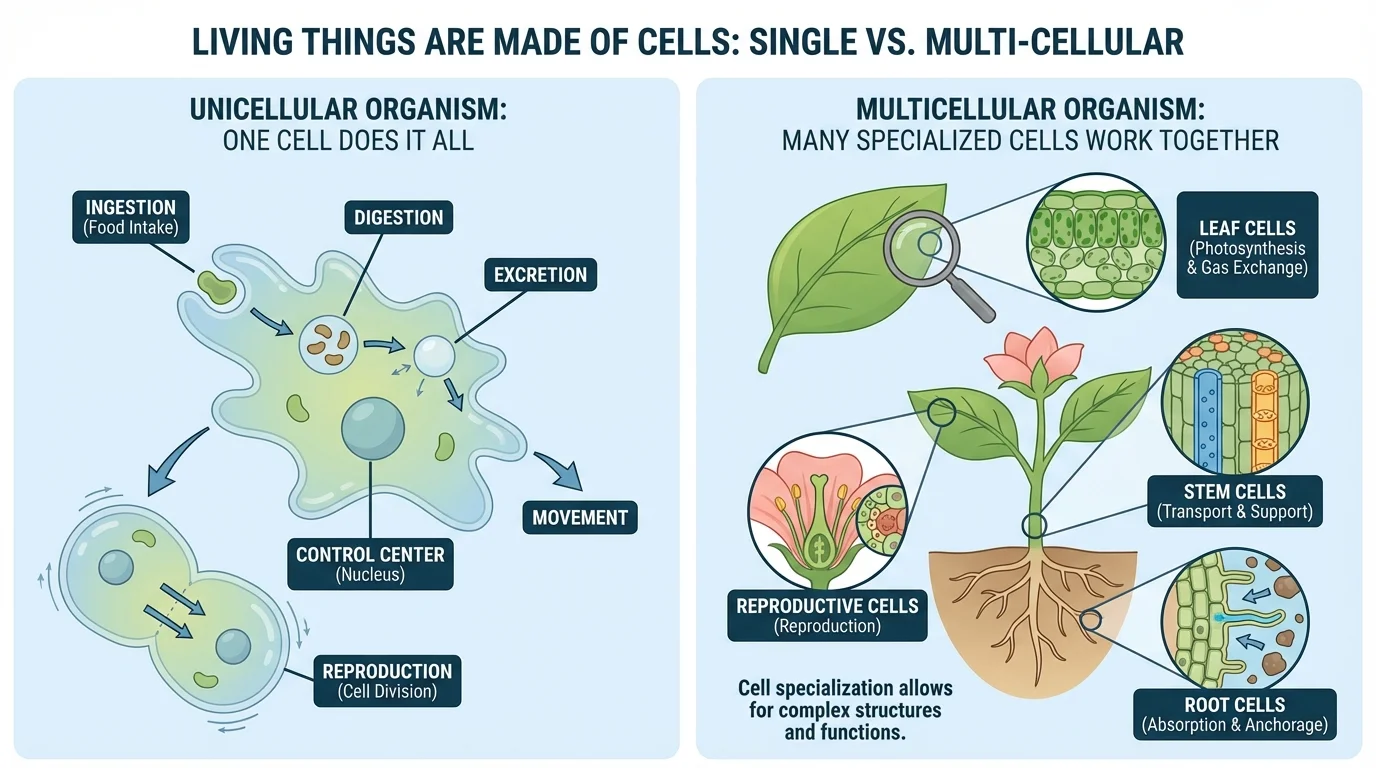
Living things may look very different in size, shape, and behavior, but science often looks for shared patterns beneath those differences. Cells are one of the most important shared patterns across life.
Scientists can test this idea in many environments. Pond water, forest leaves, human tissue, and fungi from soil all lead back to the same basic evidence: living organisms are cellular.
[Figure 4] In multicellular organisms, cells are not all exactly alike. Different cells can have different shapes, sizes, and jobs. Groups of cells can work together in tissues and larger body structures, allowing an organism to do far more than a single cell could manage alone.
For example, some cells may help with support, some with movement, some with transport, and some with protection. In plants, some cells help support stems while others help with transport or the exchange of gases. In animals, cells also share jobs. The exact names of these cell types are less important here than the pattern: multicellular life depends on many kinds of cells working together.
This division of labor makes complex organisms possible. A tall tree can stand upright because many cells contribute to support. A runner can move because many cells cooperate in tissues and organs. A mushroom can grow and spread because its cells function together as one living system.
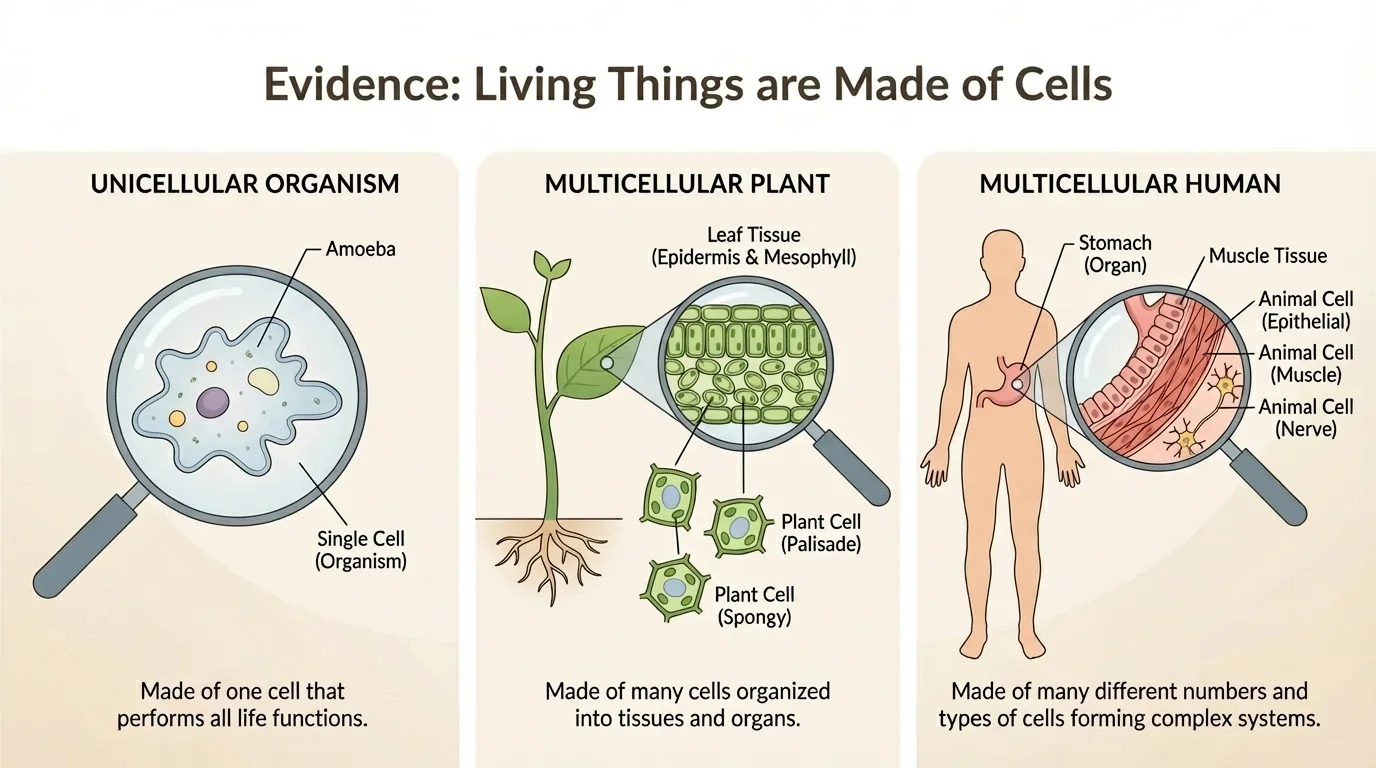
Later, when you study more biology, you may learn more about specific tissues and organs. For now, the key idea is that multicellular organisms do not just have many cells; they also have different kinds of cells organized for different functions.
The contrast with unicellular life is important. A one-celled organism is complete in a single cell. A multicellular organism is complete because many cells cooperate.
Science depends on claims being supported by evidence. The claim here is: living things are made of cells. What evidence supports it? Repeated observations from microscope investigations. When many living samples are examined and all reveal cells, the claim becomes strong.
A single observation can start an idea, but many observations across different organisms are more powerful. This is why scientists investigate plants, animals, fungi, and microscopic life. The pattern keeps appearing. The same repeating units are visible again and again.
The microscope view introduced earlier in [Figure 1] matters because it turns an abstract statement into direct evidence. Instead of simply hearing that plants are made of cells, students can actually observe those units. The investigation sequence from [Figure 2] also matters because a claim in science gains strength when others can repeat the method and see similar results.
"Science is a way of thinking much more than it is a body of knowledge."
— Carl Sagan
This way of thinking includes asking a question, gathering evidence, comparing observations, and making a claim that matches the evidence. That process is just as important as the conclusion itself.
Understanding that living things are made of cells has real-world importance. In medicine, doctors study tissue samples to learn about health and disease. They look for changes in cells because problems in the body often begin at the cellular level.
In farming, scientists study plant tissues to understand growth, damage, and disease. If crop leaves are injured or infected, the evidence can often be seen by examining cells and tissues closely. In food science, yeast is used in bread making, and yeast is a living unicellular organism. Even though each yeast organism is only one cell, large numbers of them can make dough rise.
Environmental scientists also rely on cellular evidence. Water quality investigations may include checking for microscopic living organisms. Observing unicellular life in water can reveal important information about the environment.
Why microscopes matter beyond the classroom
Microscopes allow scientists to test ideas about life directly. Whether they are examining plant disease, healing tissues, or microorganisms in water, they are using evidence from cells to understand living systems.
The comparison between one-celled and many-celled life, introduced in [Figure 3], also helps explain why life can survive in so many forms. Tiny unicellular organisms can live in places where larger organisms cannot, while multicellular organisms can develop complex body structures because many cells work together, as shown earlier in [Figure 4].
Most of the living world fits the cell-based pattern very clearly. However, science also includes careful discussion of borderline cases. For example, viruses are not considered living in the same way as cells because they cannot carry out life processes on their own. This does not weaken the central idea about living things. Instead, it shows that scientists define life carefully and use evidence when deciding what belongs in a category.
For the organisms students commonly investigate in class, the evidence is clear: plant tissues, animal tissues, fungi, and many microorganisms all show cellular organization. That is why the statement that living things are made of cells is such a foundational idea in life science.
When you observe repeated tiny units in a living sample, compare more than one sample, and connect those observations to a scientific claim, you are doing more than learning a fact. You are using evidence to understand one of the deepest patterns in biology.
