Your body contains trillions of cells, yet a single cell is so small that you would need a microscope to see most of them. That is the surprising part: something tiny enough to be nearly invisible can still carry out the basic jobs of life. Cells take in materials, get rid of waste, respond to their environment, and help organisms grow and survive. When scientists study cells, they often use models because cells are too small and too busy to understand all at once.
A cell is the smallest unit that can be said to be alive. Some organisms, such as many bacteria, are made of just one cell. Other organisms, including plants and animals, are made of many cells. Even in large organisms, every structure depends on cells doing their jobs. Skin, leaves, muscles, and roots are all built from cells.
Cells matter because they are not just tiny blobs. Each cell is organized. Different parts inside the cell have different jobs, and together those parts keep the cell functioning. This is why scientists talk about structure and function. A part's shape, location, or material can help explain what it does.
Cell means the smallest living unit. Structure refers to the way something is built, and function means the job it does. In biology, structure and function are closely connected.
One important idea in science is that we can understand something complex by using a model. A model may be a drawing, a 3D object, a digital image, or even an analogy. A model does not include every detail. Instead, it highlights the most important features so we can explain how a system works.
A cell can be treated as a system of interacting parts, as [Figure 1] shows. In a system, each part affects the others. If one part does not work well, the whole system may have trouble. That is true for a bicycle, a school, a computer, and a cell.
One helpful analogy is to think of a cell as a small city. The city has boundaries, storage areas, instructions, energy sources, and workers. A cell also has boundaries, storage spaces, instructions, energy-producing structures, and tiny structures that help make materials the cell needs. No analogy is perfect, but this model helps us see that a cell is more than a collection of separate parts. It is a coordinated whole.
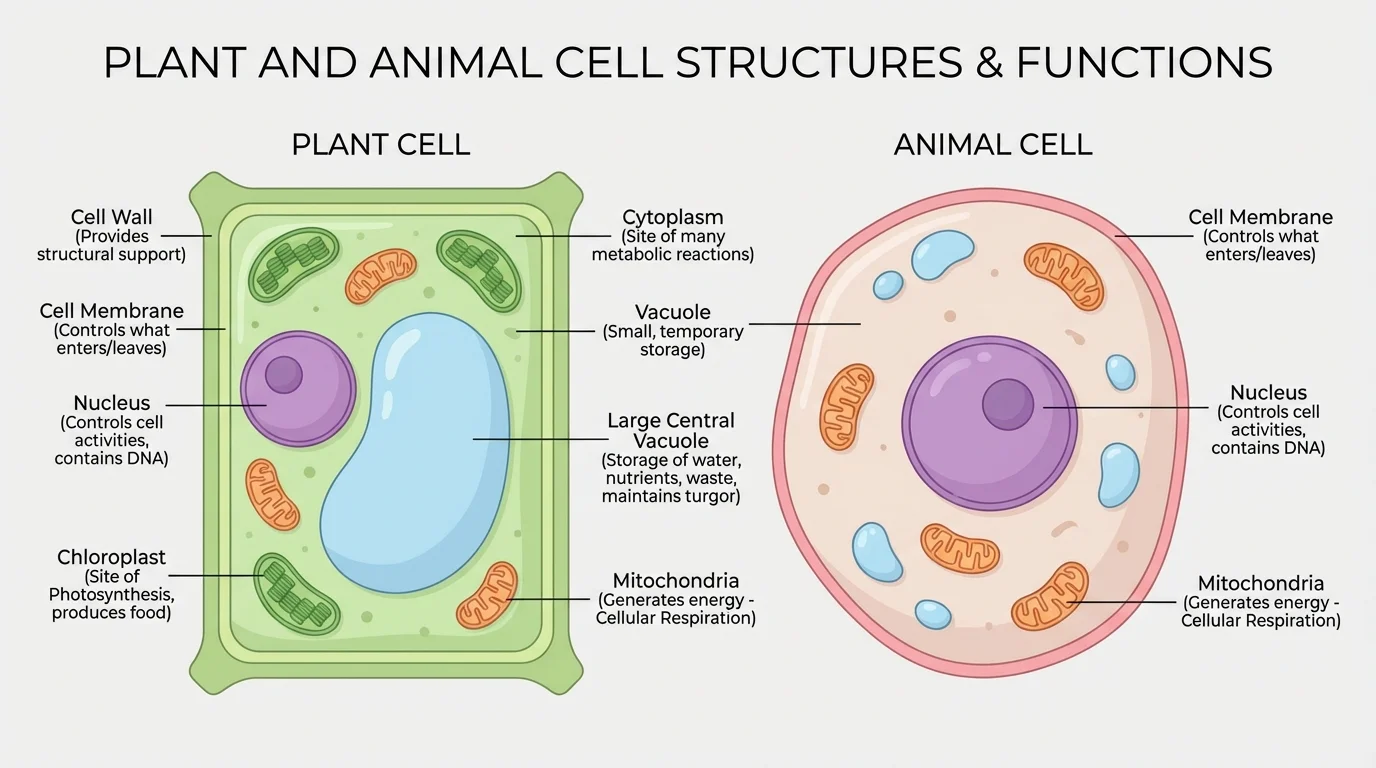
When using a model of a cell, we ask questions such as: What enters or leaves the cell? Which parts help control activities? Where are materials stored? Which structures are found in plant cells but not animal cells? These questions help us describe the cell as a working unit instead of memorizing a list of parts.
Living things are made of cells. Some organisms have one cell, and others have many. No matter how large the organism is, the cell is still the basic unit that carries out life functions.
Scientists also compare different kinds of cells. For example, a leaf cell and a muscle cell are both cells, but they are organized in ways that fit their jobs. At this level, the most important idea is not to memorize every tiny detail. It is to understand how a cell's parts support the life of the whole cell.
As shown in [Figure 2], every cell has a cell membrane, and many plant cells also have a cell wall. These outer structures are especially important because they define the cell's boundary. The boundary is not just the edge of the cell; it helps the cell survive.
The cell membrane is a thin covering around the cell. It separates the inside of the cell from the outside environment. It also controls what enters and what leaves. You can think of it like a security gate. Useful materials can move in, wastes can move out, and the cell maintains an internal environment that supports life.
The cell wall is a rigid outer layer found in plant cells. It lies outside the cell membrane. Its structure helps support and protect the cell. A plant does not have bones like an animal, so many plant cells rely on cell walls to help the plant stand upright and keep its shape. The cell membrane is flexible, while the cell wall is more rigid. That difference in structure helps explain the different jobs of these two layers.
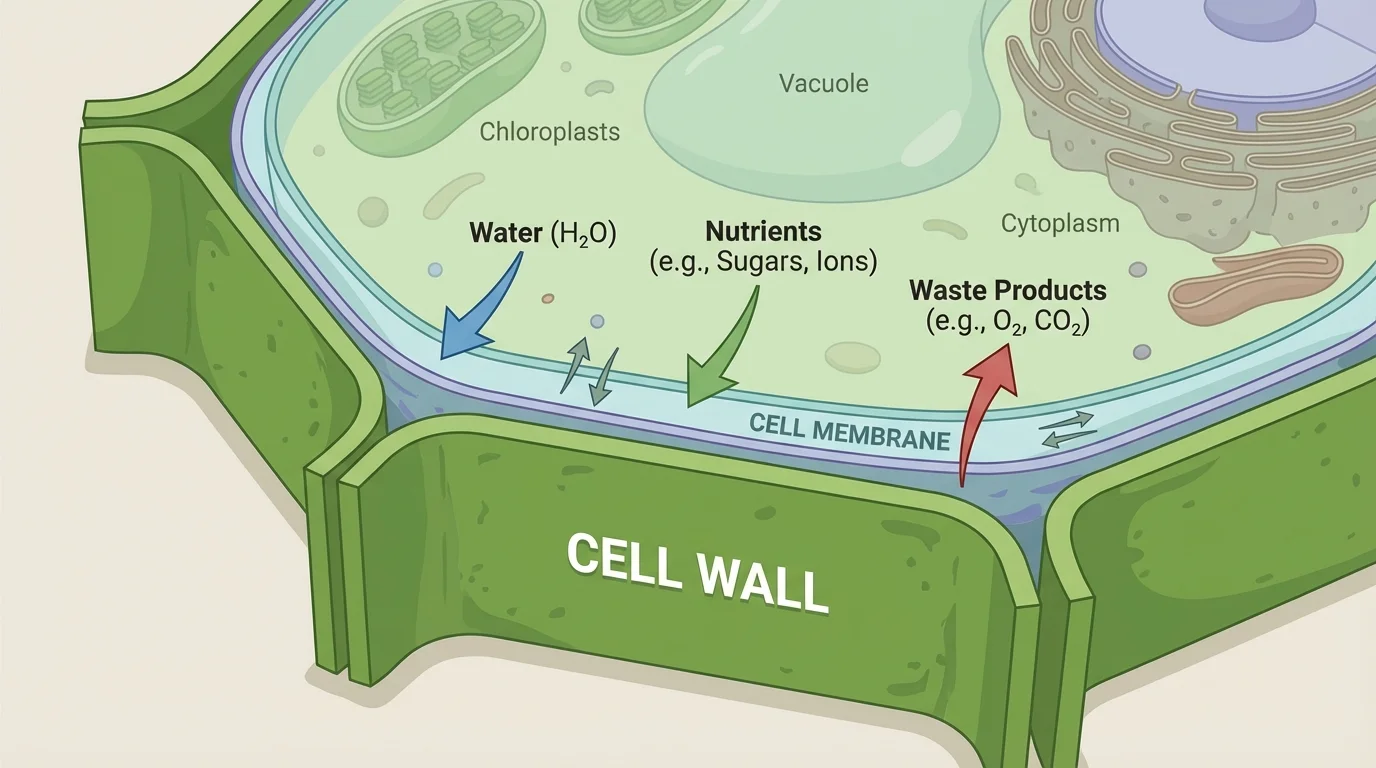
If you compare a plant stem to a soft animal tissue, the importance of support becomes easier to understand. Plant cells need strong outer support because the organism often stays rooted in one place and must hold leaves and stems up toward sunlight. The cell wall helps with this. Animal cells do not have a cell wall, which gives many animal cells more flexibility in shape.
Boundaries help cells stay alive. The cell membrane manages exchange with the environment, while the cell wall in plant cells adds support and protection. These structures are part of the reason plant and animal cells can behave differently.
Later, when we compare whole plant and animal cells, the difference between membrane and wall remains important. As seen earlier in [Figure 2], the membrane is present in both plant and animal cells, but the wall is a special feature of plant cells.
Inside the cell are structures called organelles. For this topic, the key idea is that organelles contribute to the work of the whole cell. We do not need to focus on detailed chemistry to understand their roles. Instead, we ask how each part helps the entire cell stay alive and function.
The cytoplasm is the material inside the cell that surrounds the other parts. It helps hold organelles in place and provides the internal space where many cell activities happen. If the cell were a room, the cytoplasm would be the space and material filling most of it.
The nucleus contains the cell's genetic instructions and helps direct cell activities. In a model, the nucleus can be thought of as the office that stores the important plans for what the cell does and how it grows.
Mitochondria help the cell obtain usable energy from food. For middle school students, it is enough to understand that cells need energy to do work, and mitochondria contribute to that need. Cells that are very active often need many mitochondria because they require a lot of energy.
Vacuoles are storage areas. They can store water, food, or wastes. In many plant cells, the vacuole is large and helps the cell keep its shape. This shows how a structure can support the whole cell in more than one way: by storing materials and by helping maintain form.
Ribosomes are tiny structures involved in making proteins the cell needs. At this level, the main idea is that they help the cell build important materials. You do not need to memorize chemical steps to understand their role in the system.
Plant cells also contain chloroplasts, which are structures that allow plants to capture light energy for making food. This is one reason plant cells differ from animal cells. A green leaf cell has chloroplasts because the plant must make its own food.
Some single-celled organisms can move, find food, and respond to danger even though only one cell is doing all the work. That shows how powerful one well-organized cell can be.
When you look back at the whole cell model in [Figure 1], the important pattern is cooperation. The nucleus helps guide activities, the membrane manages exchange, mitochondria help provide energy, vacuoles store materials, and the cytoplasm holds the internal system together.
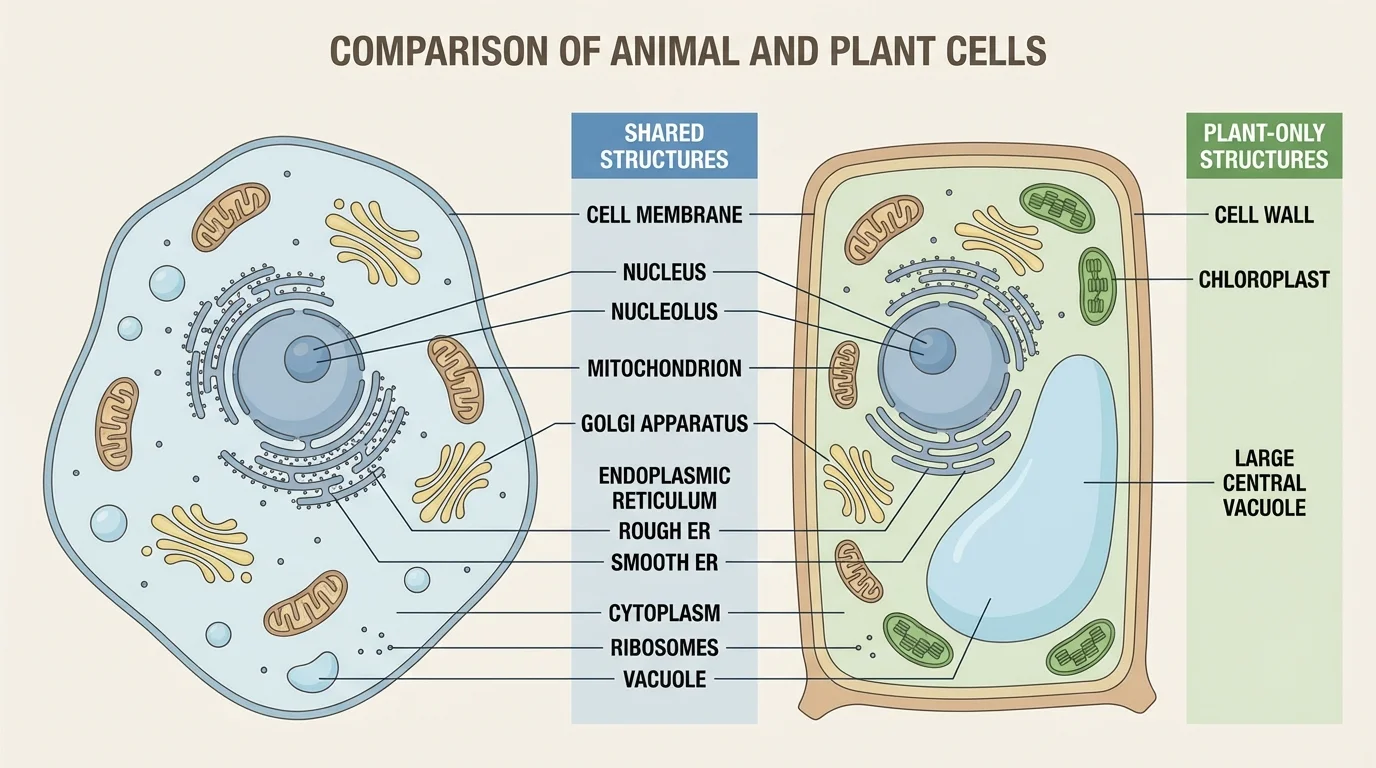
Plant cells and animal cells share many features, but they also differ in ways that relate to function, as [Figure 3] shows. Both have a cell membrane, cytoplasm, a nucleus, ribosomes, mitochondria, and vacuoles. These shared parts remind us that both kinds of cells are living systems.
Plant cells usually have a cell wall, chloroplasts, and often one large central vacuole. Animal cells do not have a cell wall or chloroplasts, and their vacuoles are often smaller. These differences are related to what plants and animals need to do.
| Cell part | Plant cell | Animal cell | How it helps the whole cell |
|---|---|---|---|
| Cell membrane | Yes | Yes | Controls what enters and leaves |
| Cell wall | Yes | No | Provides support and protection |
| Nucleus | Yes | Yes | Stores instructions and helps direct activities |
| Cytoplasm | Yes | Yes | Holds organelles and supports internal activities |
| Mitochondria | Yes | Yes | Help the cell obtain usable energy |
| Vacuole | Yes | Yes | Stores materials |
| Ribosomes | Yes | Yes | Help build materials the cell needs |
| Chloroplasts | Yes | No | Capture light energy for making food |
Table 1. Comparison of major structures in plant and animal cells and how each contributes to whole-cell function.
A root cell in a plant may not look exactly like a leaf cell, and a nerve cell in an animal may not look like a blood cell. Even so, the model of plant versus animal cell is still useful because it helps us explain broad patterns. The comparison in [Figure 3] makes it easier to see which structures are shared and which are not.
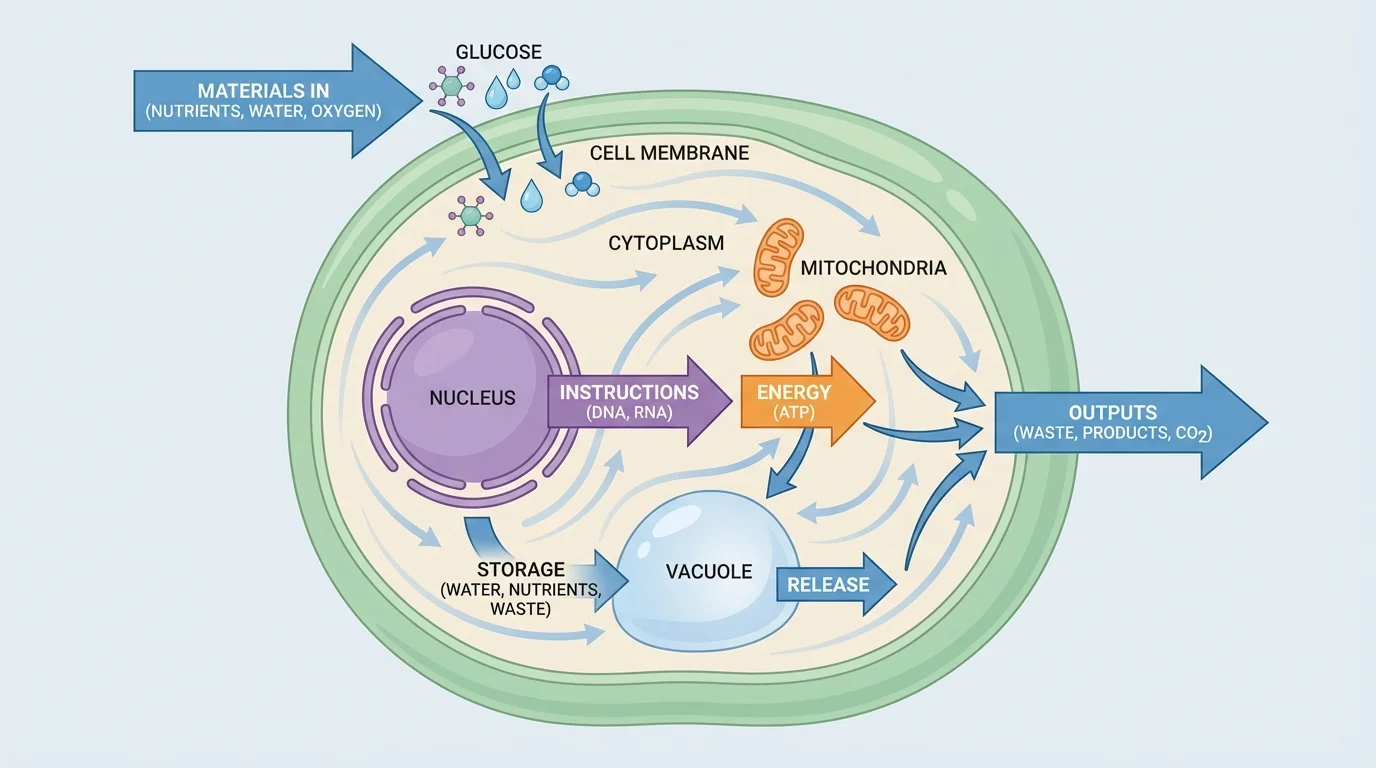
No organelle works alone. A cell survives because its parts interact, as [Figure 4] illustrates. This is one of the most important ideas in cell biology: the function of the whole cell depends on the combined work of all its parts.
Suppose a cell needs materials from its surroundings. The cell membrane helps bring some materials in. Those materials move through the cytoplasm. The nucleus provides instructions that guide cell activities. Ribosomes help build materials the cell needs. Mitochondria help supply usable energy. Vacuoles store some materials, and wastes may later leave through the membrane. In plant cells, the cell wall adds support, and chloroplasts help the cell make food if the cell is in a green part of the plant.
This is why the city analogy works well. A city needs roads, storage, power, rules, and boundaries. If any one system fails, the city is affected. A cell is similar. The cell remains alive because all the parts contribute to the whole system.
Modeling a plant leaf cell
A scientist wants to explain why a leaf cell can help a plant survive outdoors.
Step 1: Identify the structures that matter most for the cell's job.
The model includes the cell membrane, cell wall, chloroplasts, nucleus, cytoplasm, vacuole, and mitochondria.
Step 2: Connect each part to a function of the whole cell.
The membrane controls exchange, the wall supports the cell, chloroplasts help make food, the vacuole stores water, the nucleus provides instructions, and mitochondria help provide usable energy.
Step 3: Explain the whole system.
Together, these structures let the leaf cell take in materials, stay supported, capture light energy, store water, and carry out the activities needed to stay alive.
This is what it means to use a model: not just naming parts, but explaining how they work together.
The same kind of reasoning works for animal cells. An animal muscle cell may not have chloroplasts or a cell wall, but it still depends on a membrane, nucleus, mitochondria, cytoplasm, and other parts acting together. When students explain the whole system clearly, they are thinking like scientists.
Cell models matter outside the classroom. Doctors study cell damage to understand disease and healing. Farmers and plant scientists study plant cells to improve crop growth. Engineers design microscopes and imaging tools so scientists can build better models of cells.
If a plant wilts, one clue may involve what is happening in its cells. A large vacuole in plant cells helps maintain firmness, and the cell wall provides support. If the cells lose too much water, the plant can droop. This shows how cell structures connect directly to something you can observe in a garden or field.
In medicine, damaged cells may not control materials properly across the membrane. Since the membrane helps regulate what goes in and out, problems at the boundary can affect the whole cell. This is another reminder that a cell's survival depends on coordinated parts, not on one structure acting by itself.
"The cell is the basic unit of life."
— A core idea of modern biology
Technology also depends on cell knowledge. Microscopes, cell imaging, and computer models help scientists see structures that are otherwise too small to study directly. Those models become tools for asking better questions and testing explanations.
When scientists build a model of a cell, they choose details that help answer a question. If the question is about support and protection in plants, the model should clearly show the cell wall and cell membrane. If the question is about how the whole cell functions, the model should include the main organelles and show how they interact.
A good model is useful, but it is also limited. A drawing may show the main parts clearly, but it cannot display every movement happening inside a living cell. A 3D model may help show shape, but it may leave out tiny structures. Scientists know that models are simplified on purpose. The goal is understanding, not copying every detail.
Using a model means explaining relationships. A strong cell model does more than label parts. It helps answer questions such as why plant cells have walls, how the membrane protects the cell, and how organelles contribute to the life of the whole cell.
As you think back to [Figure 4], the flow of materials and information in the model helps explain why the cell acts like a system. That same systems idea connects all the figures in this lesson. The model of the whole cell, the plant cell boundary, and the plant-animal comparison all support the same big idea: life depends on organized parts working together.
