Your body is doing thousands of jobs right now, even if you are sitting still. Your heart is pumping blood, your lungs are exchanging oxygen and carbon dioxide, your stomach and intestines are processing food, your kidneys are filtering wastes, your muscles are holding you upright, and your nervous system is sending messages at high speed. None of these parts works alone for long. The remarkable thing is that your body stays alive because it acts as one connected whole.
All living things are made of cells. A cell is the smallest unit of life. In a human body, similar cells work together in groups. These groups form tissues, tissues build organs, and organs work together in organ systems. The whole body is an organism. This organization, shown clearly in [Figure 1], helps explain why the body is called a system of interacting subsystems rather than just a collection of separate parts.
For example, muscle cells can join to form muscle tissue. Muscle tissue is part of organs such as the heart. The heart is one organ in the circulatory system. The circulatory system then works with many other systems to keep the organism alive. This pattern repeats throughout the body: small living units combine into larger structures that perform more complex jobs.
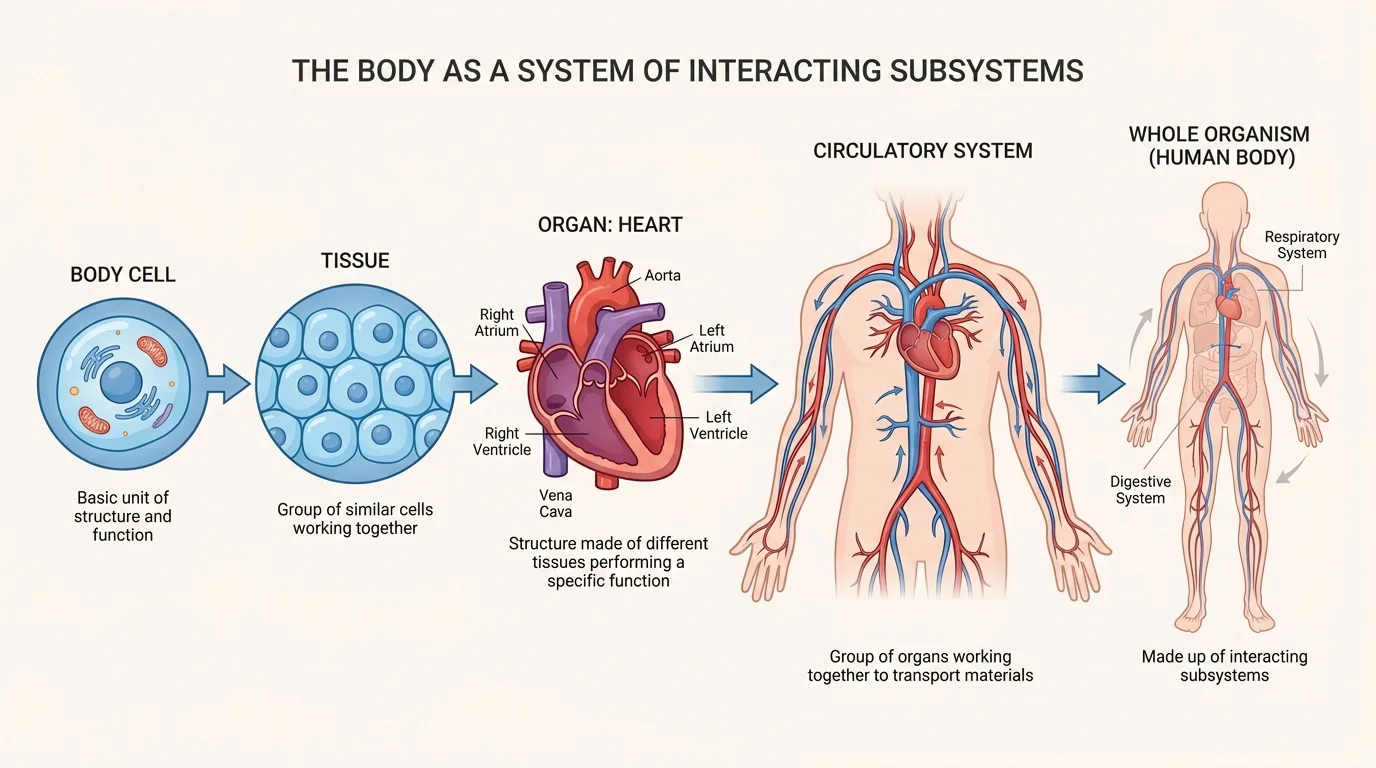
This level-by-level organization is important evidence that the body is a system. If the body were not organized in this way, it would be much harder for materials and signals to move where they are needed. Cells need oxygen, water, and nutrients. They also produce wastes. No single cell in a human can do all the jobs needed to supply every other cell. Instead, specialized groups share the work.
Tissue is a group of similar cells that work together to do a specific job.
Organ is a structure made of different tissues working together.
Organ system is a group of organs that work together to carry out a major body function.
Subsystem is a smaller system that is part of a larger system.
The body can therefore be described as a system composed of interacting subsystems. Each body system is a subsystem because it has its own structures and jobs, but it also depends on other systems. The circulatory system, for instance, transports materials, but it must receive oxygen from the respiratory system and nutrients from the digestive system. That is strong evidence of interaction, not independence.
A system is a set of parts that work together. In science, we often identify a system by looking for interactions between parts. One part affects another part. In the body, interactions happen constantly. Blood carries materials. Nerves send signals. Muscles respond to signals. Kidneys remove substances from blood. These actions connect the subsystems into one functioning organism.
To make an argument in science, it helps to use a simple structure: claim, evidence, and reasoning. A claim is what you say is true. Evidence is the data or observations that support it. Reasoning explains why the evidence supports the claim. For this topic, a strong claim is: The human body is a system of interacting subsystems composed of groups of cells.
How evidence supports the claim
If body systems did not interact, cells would not receive the materials they need, and wastes would build up. Observations such as faster breathing during exercise, increased heart rate during running, and increased urine production after drinking lots of water all show that multiple systems respond together, not separately.
Scientists support this claim with many kinds of evidence. For example, after you eat, nutrients move from the digestive system into the blood. After you breathe, oxygen moves from the respiratory system into the blood. The blood then delivers both nutrients and oxygen to cells throughout the body. Meanwhile, wastes from those cells are carried in the blood to organs that remove them. These linked steps show direct connections among systems.
When you eat a sandwich or a bowl of rice, your body does much more than fill your stomach. The digestive system and circulatory system work together closely, as shown in [Figure 2]. The digestive system breaks food into smaller molecules that the body can use. But digestion alone is not enough. Those nutrients must travel to body cells, and that is where the circulatory system joins the process. This partnership is one of the clearest examples of interacting subsystems.
Food is broken down mechanically and chemically as it moves through the digestive tract. In the small intestine, useful molecules from food pass into the blood. This process is called absorption. Tiny fingerlike structures help increase the surface area for absorption, allowing many nutrient molecules to enter nearby blood vessels.
Once nutrients enter the blood, the circulatory system carries them throughout the body. Cells in your brain, muscles, skin, and every other organ need these materials for energy, growth, and repair. If nutrients stayed only in the digestive tract, body cells could not use them. That observation is evidence that the digestive system depends on the circulatory system.
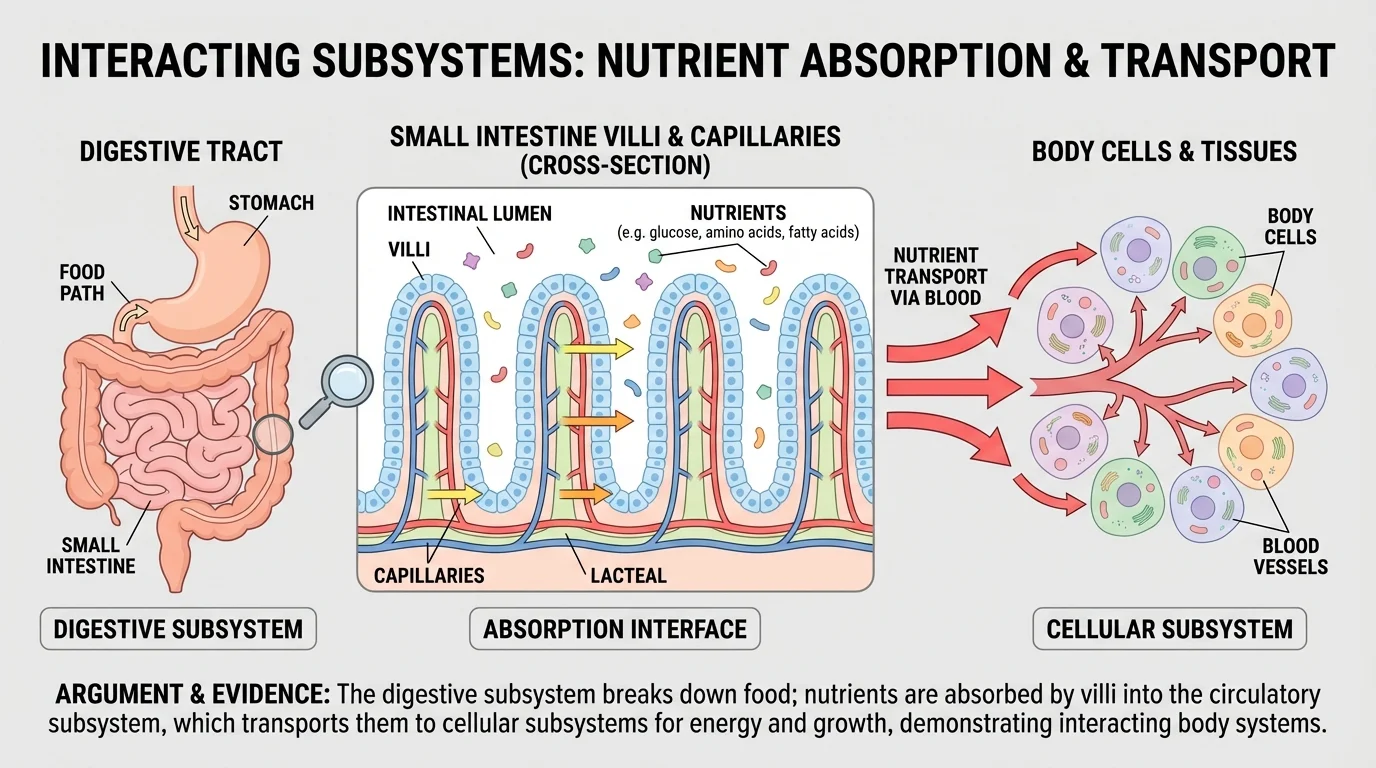
This interaction becomes easy to notice in daily life. If you have not eaten for a long time, your body may feel weak. That is because cells are receiving fewer incoming nutrients. After a meal, the digestive system increases the supply, and the circulatory system distributes it.
Using evidence from eating lunch
Step 1: Make a claim
The digestive and circulatory systems interact to supply body cells with nutrients.
Step 2: Add evidence
Food is broken down in the digestive tract, and nutrients pass from the small intestine into blood vessels.
Step 3: Add reasoning
Because blood carries those nutrients to cells all over the body, the digestive system cannot fully support cells without the circulatory system.
Later, when we look at exercise, the same idea appears again. Muscles need nutrients delivered in blood, just as shown earlier in [Figure 2], and they use those materials more quickly when you are active.
Take a deep breath. The respiratory system brings in oxygen and removes carbon dioxide, as shown in [Figure 3]. But oxygen in the lungs helps the body only if it reaches cells. The circulatory system makes that possible.
Inside the lungs are tiny air sacs where gases move between air and blood. Oxygen moves into the blood, and carbon dioxide moves out of the blood to be exhaled. This gas exchange is possible because blood vessels are closely associated with the lung structures.
Once oxygen enters the blood, the heart pumps that oxygen-rich blood through the body. Cells use oxygen to release energy from food molecules. At the same time, cells produce carbon dioxide as a waste product. The blood picks up this carbon dioxide and carries it back to the lungs, where it leaves the body when you breathe out.
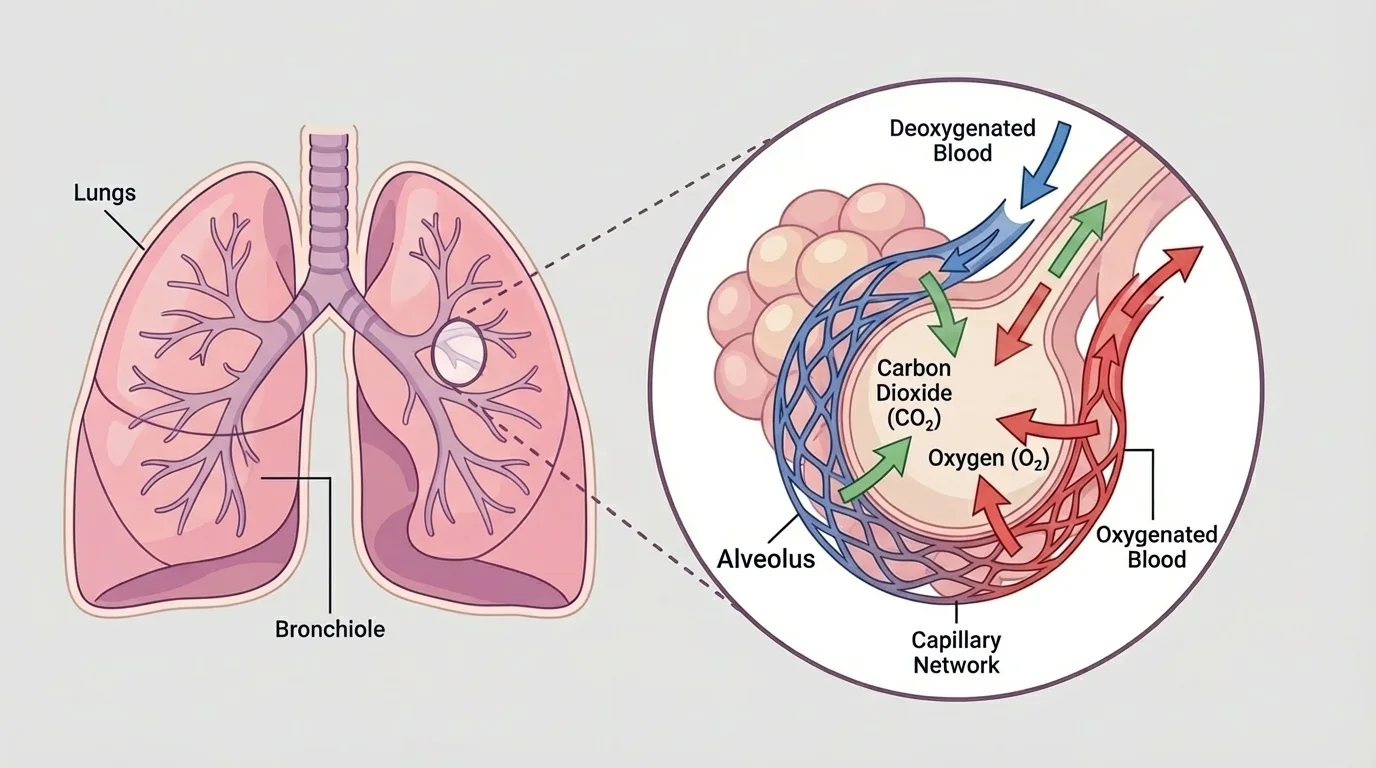
You can observe this interaction during exercise. When you run, your muscles need more oxygen and produce more carbon dioxide. Your breathing rate increases, and your heart rate increases too. Those two changes happening together are strong evidence that the respiratory and circulatory systems are interacting subsystems.
Your brain can survive only a few minutes without a continuous oxygen supply. That shows how strongly every organ depends on system interactions that deliver materials to cells.
The connection to the digestive system also matters. Cells often use oxygen together with nutrients such as glucose from food. In a simplified form, cells use \(\textrm{C}_6\textrm{H}_{12}\textrm{O}_6\) and \(\textrm{O}_2\) and produce \(\textrm{CO}_2\) and \(\textrm{H}_2\textrm{O}\). Even without studying every chemical step, this shows that food and oxygen must both reach cells. That is another reason the body must be understood as interacting systems rather than isolated organs.
Cells do not only need supplies; they also produce wastes. The urinary system removes certain waste materials from the body and helps keep internal conditions balanced. The kidneys are major organs in this system. They filter blood, removing certain wastes and extra water to make urine.
This is an important example of subsystem interaction because the kidneys do not collect waste directly from every cell. Instead, the circulatory system brings blood containing dissolved wastes to the kidneys. If the blood did not transport these materials, the urinary system could not remove them efficiently.
Water balance is part of this interaction too. After drinking a large amount of water, the circulatory system carries that water through the body, and the kidneys adjust how much water leaves as urine. On a hot day, if you sweat a lot, the body may conserve more water. The response involves communication among body systems and shows coordinated regulation.
Earlier science learning about cells matters here: cells need a stable internal environment to stay alive. Too much waste or too little water can damage cells, so body systems must work together to maintain conditions cells can survive in.
The urinary system also connects indirectly with the respiratory system. Carbon dioxide is a waste that leaves mainly through the lungs rather than the kidneys. This shows that waste removal is shared across interacting systems. Different subsystems handle different wastes, but all of them protect cells.
If you touch a hot pan, you pull your hand away very fast. The nervous system and the muscular system work together closely, as shown in [Figure 4]. The nervous system detects information, processes it, and sends signals. Muscles respond by contracting. This coordination lets the body move and react to the environment.
The brain, spinal cord, and nerves make up the nervous system. Sensory structures detect changes such as heat, sound, or pressure. Signals travel through nerves to the central nervous system, which then sends instructions outward. Muscle cells receive the signals and shorten, producing movement.
The muscular system depends on this control. A muscle does not decide on its own to catch a ball or step over a puddle. It responds to signals. At the same time, the nervous system depends on other systems to keep nerve cells alive. Nerve cells need oxygen and nutrients delivered by blood.
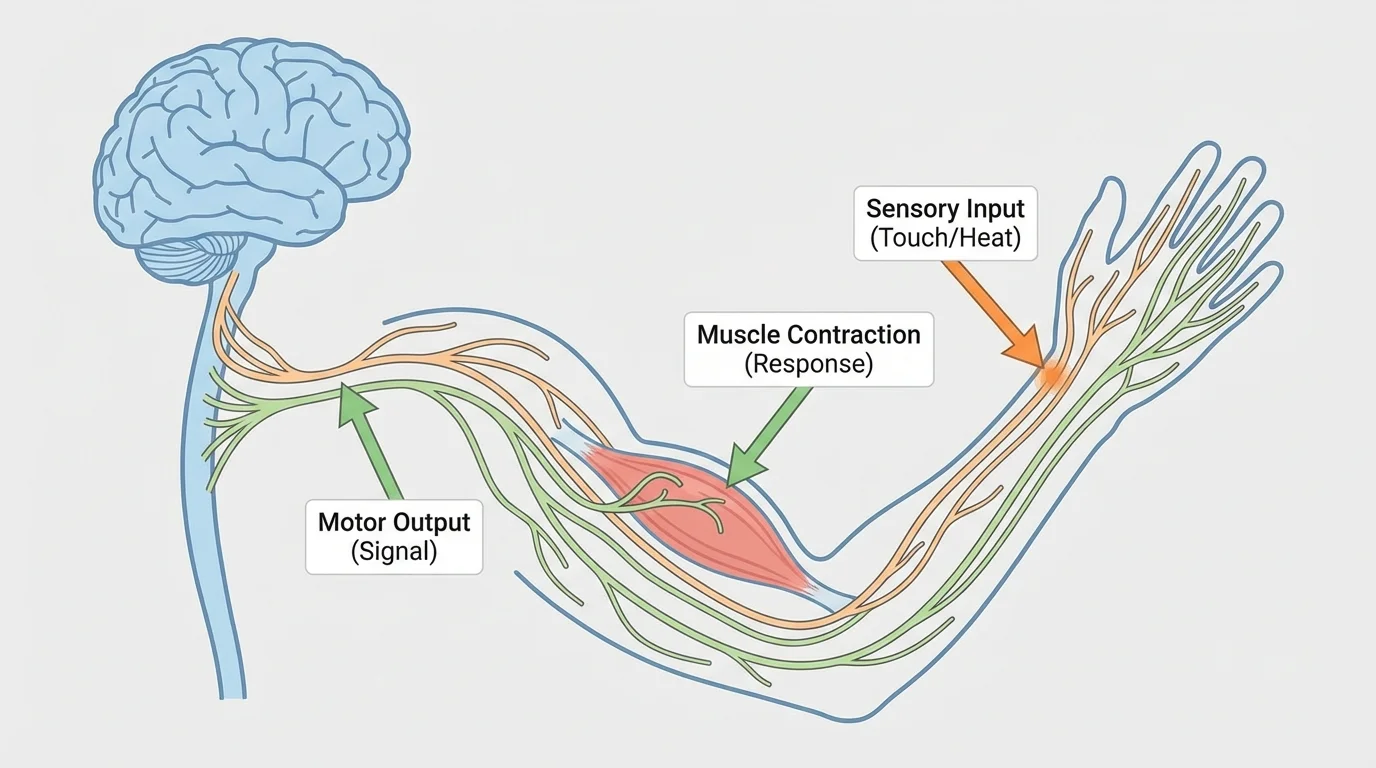
Now notice how many systems are involved in one simple action like climbing stairs. The nervous system sends signals, the muscles contract, the respiratory system brings in more oxygen, the circulatory system delivers that oxygen and nutrients, and the urinary system helps remove wastes produced by active cells. One action can require several interacting subsystems at once.
Case study: catching a falling phone
Step 1: Sensory detection
Your eyes detect the phone falling and send information through the nervous system.
Step 2: Signal processing
The brain and spinal cord process the information and send motor signals.
Step 3: Response
Arm and hand muscles contract quickly to reach for the phone.
Step 4: Support from other systems
The circulatory and respiratory systems keep those nerve and muscle cells supplied with oxygen and nutrients.
Later, if the action continues for a long time, such as during sports practice, the pattern becomes even clearer. The fast signaling shown in [Figure 4] still controls movement, but longer activity also increases demands on breathing, circulation, and waste removal.
Science is not just about naming parts. It is about making explanations that are supported by evidence. To argue that the body is a system of interacting subsystems composed of groups of cells, you can combine several observations.
First, body structures are organized in levels: cells form tissues, tissues form organs, and organs form systems. We saw this organization earlier in [Figure 1]. Second, systems exchange materials and information. Nutrients move from the digestive system into blood. Oxygen moves from the respiratory system into blood. Wastes move from cells into blood and then to organs that remove them. Signals move through nerves to muscles. Third, changes in one system often cause changes in another, especially during exercise, illness, or dehydration.
A model scientific argument
Claim: The body is a system made of interacting subsystems.
Evidence: The digestive system supplies nutrients to blood, the respiratory system supplies oxygen to blood, the circulatory system delivers both to cells, the urinary system removes certain wastes from blood, and the nervous system controls muscles.
Reasoning: Because each system depends on materials or signals from other systems, the systems must interact to keep cells alive.
A good argument also points out what would happen if the systems did not interact. If the circulatory system stopped transporting materials, oxygen from the lungs and nutrients from the intestines would not reach cells. If the nervous system could not signal muscles, coordinated movement would fail. If the kidneys did not filter blood, wastes would accumulate. These cause-and-effect relationships strengthen the argument.
Athletes offer a clear real-world example. During a sprint, muscles need quick energy and more oxygen. The respiratory system increases breathing rate. The circulatory system increases heart rate and blood flow. The nervous system coordinates movement. The urinary system and sweat-related water loss affect fluid balance. Because many systems change together, coaches and doctors often monitor breathing, pulse, hydration, and recovery rather than looking at only one body part.
Doctors also use evidence from interacting systems when diagnosing health problems. Shortness of breath may involve the respiratory system, but it can also connect to circulation because blood must carry oxygen. Swelling can relate to fluid balance and waste removal. Muscle weakness can involve nerves, circulation, or nutrition. Looking at interactions gives a fuller picture of what is happening in the body.
| System | Main job | How it interacts with other systems |
|---|---|---|
| Digestive | Breaks down food and absorbs nutrients | Transfers nutrients into blood for delivery to cells |
| Circulatory | Transports materials in blood | Connects all listed systems by moving oxygen, nutrients, wastes, and some signals |
| Respiratory | Brings in oxygen and removes carbon dioxide | Exchanges gases with blood in the lungs |
| Urinary | Removes certain wastes and balances water | Filters wastes from blood and helps maintain stable conditions for cells |
| Nervous | Receives information, processes it, and sends signals | Controls muscles and helps coordinate responses across the body |
| Muscular | Produces movement | Responds to nerve signals and depends on blood for oxygen and nutrients |
Even something as ordinary as drinking water with lunch shows body systems working together. The digestive system takes in water, the circulatory system moves it, the kidneys regulate how much leaves the body, and the nervous system helps control thirst. Everyday life is full of evidence that your body works as one connected system.
