You are walking barefoot in your house when your foot suddenly meets a tiny Lego brick. Before you even have time to think, you yank your foot up and maybe shout something not very polite. A few days later, just seeing a Lego on the floor makes you step carefully. What happened inside your body during those moments?
That unpleasant Lego story shows two important things your nervous system does all the time: it uses special cells to detect what is happening around you and inside you, and it sends that information to your brain, which can cause an immediate action or be saved as a memory for later.
Consider these quick situations:
In every case, your body uses specialized structures called receptors to detect a stimulus (something that causes a response), sends information along nerve cells to your brain, and then your brain either triggers a rapid behavior or stores that experience as a memory—or both.
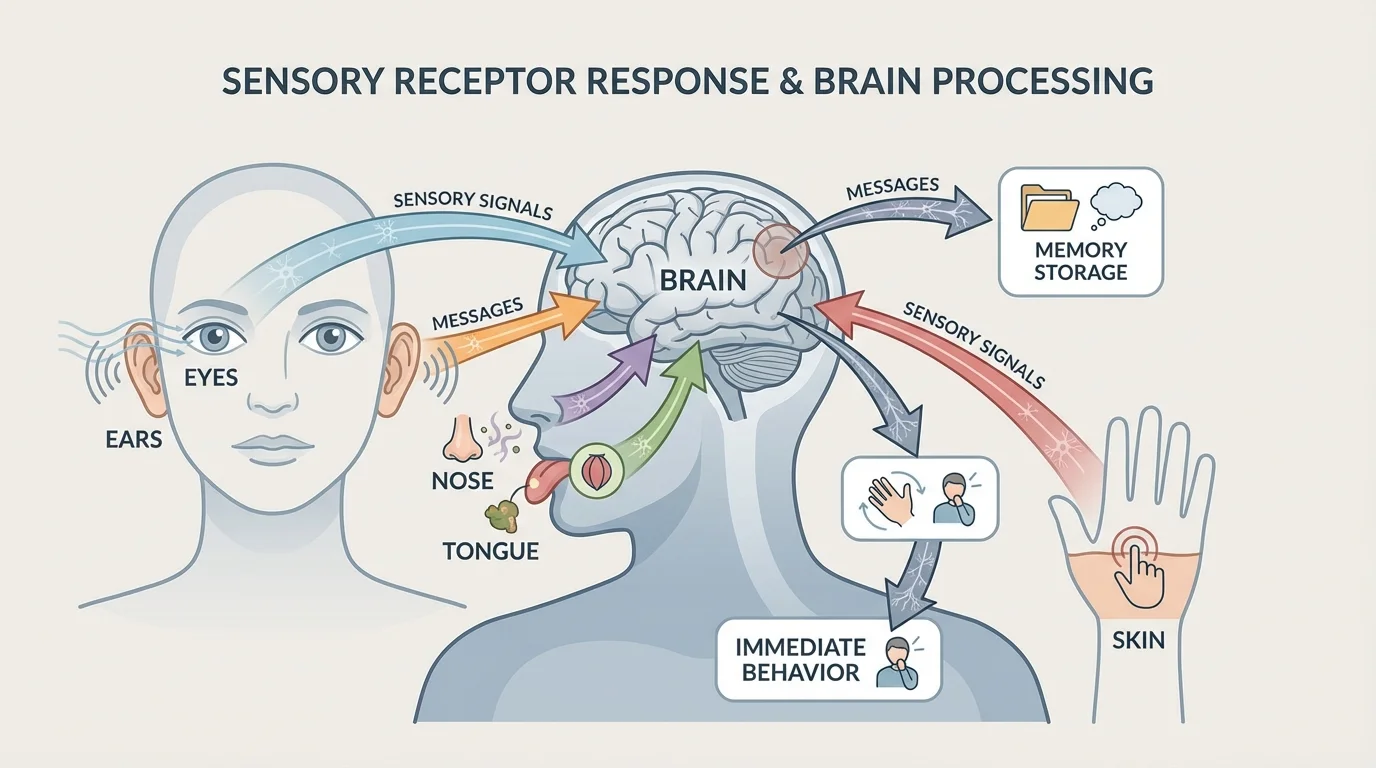
All of these stories depend on sensory receptors. As shown in [Figure 1], these receptors are found in many parts of your body, but they all connect conceptually to your brain, which interprets their signals.
Stimulus is any change inside or outside the body that can be detected and causes a response.
Sensory receptor is a special structure (often part of a nerve cell) that detects a particular kind of stimulus, such as light, sound, pressure, temperature, or chemicals.
Nerve cell (or neuron) is a cell that carries information as signals to and from the brain and spinal cord.
Sensory receptors are like tiny reporters spread throughout your body. They constantly "ask": Is it bright or dark? Hot or cold? Is something touching the skin? Is there a certain chemical in the air or on the tongue?
Some important locations of receptors include:
When a receptor is stimulated, it changes that information into a signal that travels along nerve cells toward the brain, which then decides what to do with that information.
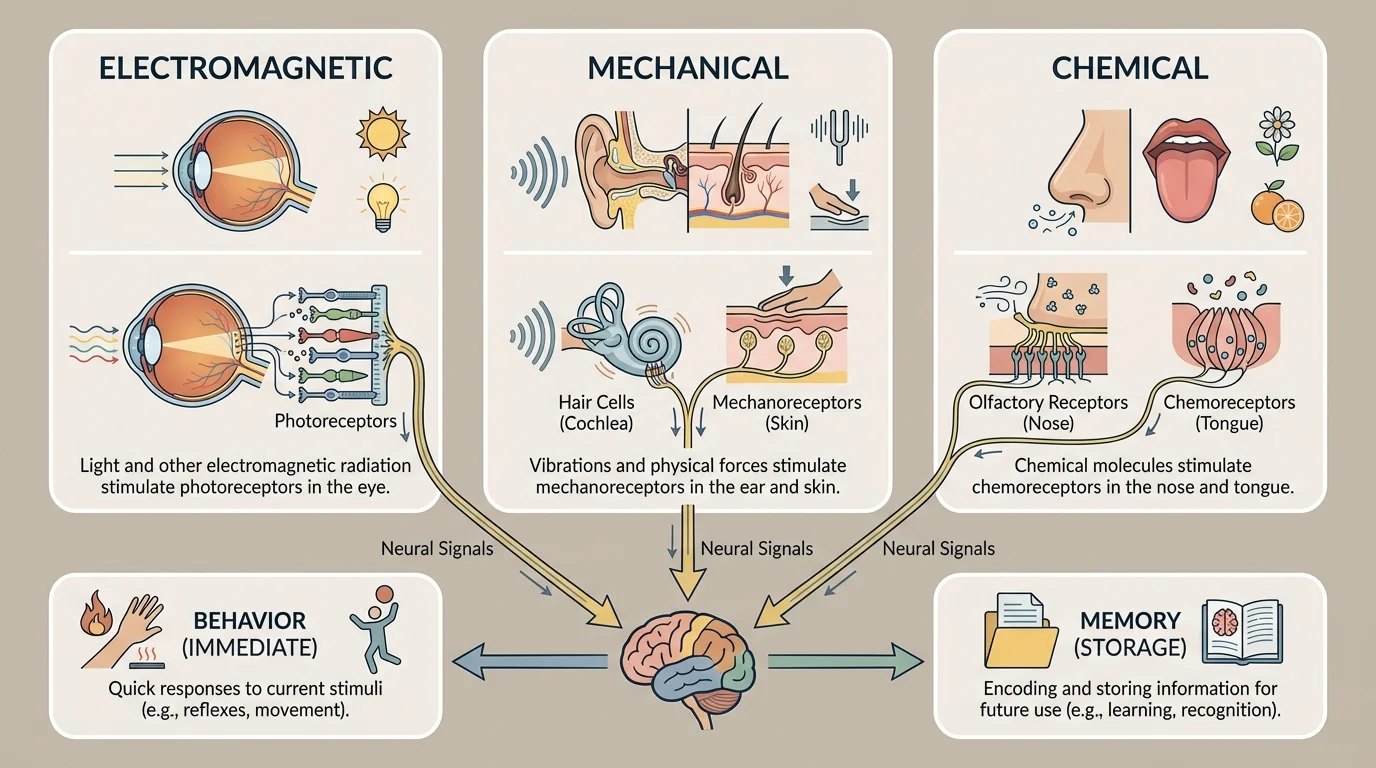
Even though you have many senses, scientists often group the kinds of input they detect into three main types: electromagnetic input, mechanical input, and chemical input. These categories, which are compared in [Figure 2], help us see that different receptors are "tuned" to different kinds of signals.
| Type of input | What it means | Main sense organs | Examples of stimuli |
|---|---|---|---|
| Electromagnetic | Energy such as visible light. | Eyes | Sunlight, light from a screen, colored objects. |
| Mechanical | Physical movement or pressure of matter. | Ears, skin, some internal body receptors | Sound waves, touch, stretch, vibration. |
| Chemical | Presence of specific molecules. | Nose, tongue, some internal body receptors | Food flavors, odors, levels of gases in blood. |
Electromagnetic input is most obvious in your sense of sight. Light bouncing off objects enters your eye and reaches receptors that respond to different wavelengths (colors) and brightness. Those receptors send signals that your brain uses to build the images you see on your "mind's screen".
Mechanical input involves movement and pressure. In your ears, sound waves from a speaker or a friend's voice cause tiny parts of your ear to move. Receptors there detect these movements. In your skin, different receptors respond to light touch, deep pressure, vibration, or stretching. That is why you can tell the difference between a gentle tap and a painful pinch.
Chemical input is key for taste and smell. When you eat something sweet, sugar molecules interact with taste receptors on your tongue. When you walk into a kitchen and notice the smell of garlic or cookies, chemical molecules in the air stimulate receptors high in your nose. The pattern of signals tells your brain what you are tasting or smelling.
Even inside your body, chemical and mechanical receptors monitor things like blood pressure or levels of certain molecules, helping your brain keep the body in balance without you even noticing.
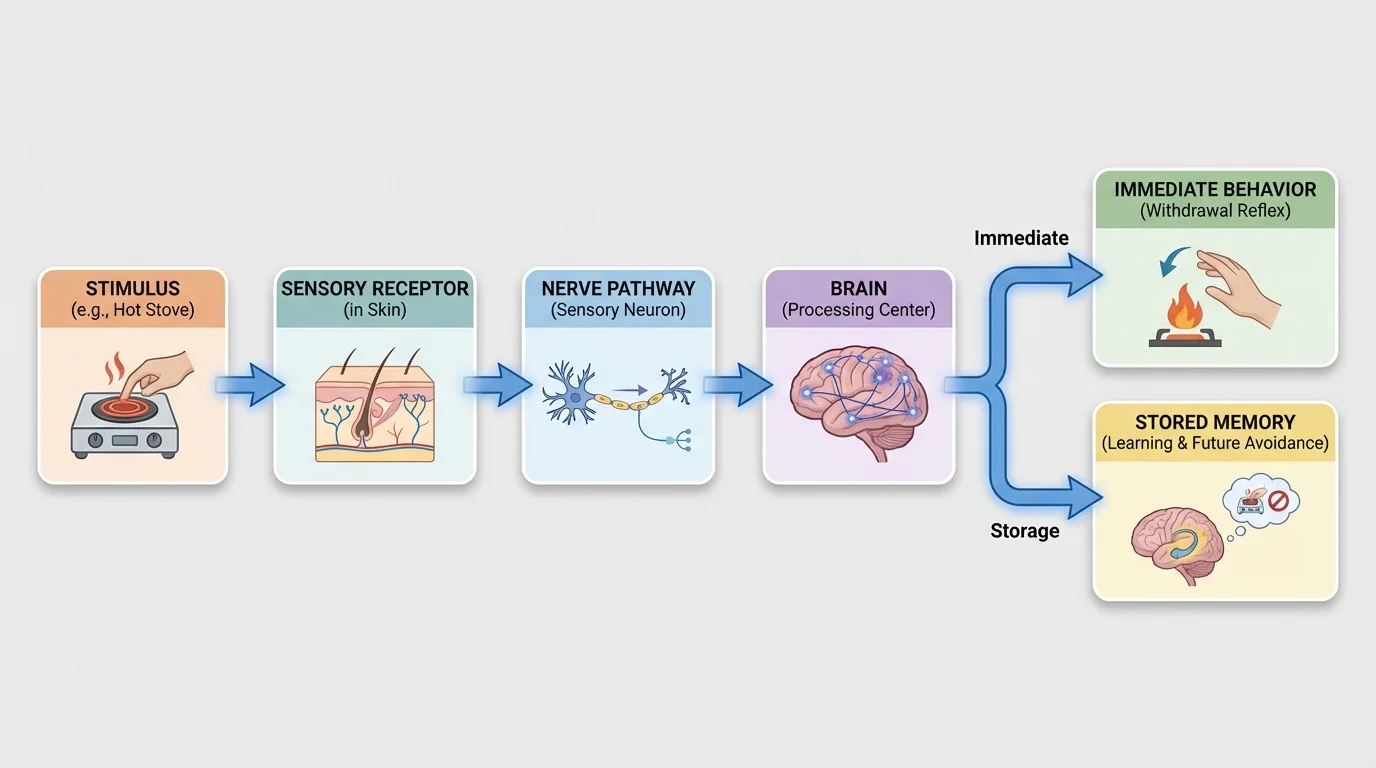
Whenever you react to a hot stove or remember the taste of your favorite snack, the information has followed the same general path: stimulus → receptor → nerve signal → brain → behavior and/or memory. This sequence is summarized in [Figure 3].
Here is the basic idea, staying at a big-picture level:
"The brain is wider than the sky."
— Emily Dickinson (reminding us how powerful the brain's processing can be)
It is important to notice that the same basic path—stimulus to brain—can lead either to quick action, lasting memory, or a combination. When you touch something dangerously hot, your brain (and spinal cord) help you pull back very quickly. But your brain might also "remember" that red-hot stove so you are more careful next time.
Some sensory information leads to very fast behaviors that help keep you safe. This is especially true for painful or threatening stimuli.
Consider again stepping on that Lego. Pain receptors in your skin are mechanical receptors that detect intense pressure and tissue damage. They send strong signals along nerve cells to your spinal cord and brain. Your nervous system uses this information to trigger an immediate behavior: lifting your foot and shifting your weight.
Other quick behaviors include:
These behaviors feel almost automatic. You do not sit there and solve an equation like \(2 + 2 = 4\) before moving your hand; your brain is already set up to respond rapidly to certain patterns of signals from receptors.
Not all immediate behaviors are about danger, though. You also:
In sports and dance, athletes and performers train their brains to use sensory signals quickly and accurately. A tennis player sees the ball (electromagnetic input), feels the racket in their hand (mechanical input), and hears the crowd (mechanical input again, as sound waves). Their brain combines all this information to guide muscles for just the right swing, almost without conscious thought.
Not all sensory information creates sudden movements. Some of it is used to build and update your memories. A memory is information your brain stores so that it can use it in the future.
Think about your first day at a new school. You might remember:
All of these details started as sensory information—light, sound, chemical, and mechanical inputs detected by receptors. Your brain decided that some of this information was important and stored it.
There are different levels of memory, such as:
When you study for a test, you read words (visual input), maybe say them out loud (hearing your own voice), and write them down (mechanical and visual input). These repeated patterns of sensory input help your brain strengthen the memory so that you can recall it later.
Some memories are emotional as well. The smell of a certain food might bring back a strong memory of a holiday or a person you care about. That is because your brain connects the chemical input from smell receptors with stored information about past experiences.
In real life, your senses almost never work alone. As you cross a busy street, your brain uses:
Your brain combines all this information in a process called sensory integration. The signals from different receptors arrive nearly at the same time, and the brain uses them to decide: Is it safe to cross now? Should I wait?
Something similar happens when you watch a movie. Your eyes and ears work together so well that you feel like the characters are real, even though you are just watching patterns of light and hearing patterns of sound. The fact that your brain can blend these inputs shows how powerful its information-processing is.
Sometimes, the brain even has to ignore some sensory information. In a loud room, you might concentrate on your friend's face and voice, letting your brain pay less attention to other sights and sounds. This ability to focus attention is another way your brain controls how it responds to sensory signals.
Remember the human-outline diagram in [Figure 1]? It shows that receptors are everywhere, but it is the brain that acts as the control center, choosing which signals matter most at each moment.
Understanding that receptors respond to specific stimuli and send information to the brain has many practical uses in the modern world.
Example: Eye exams and hearing tests
Doctors often test how well your receptors and brain are working together.
Step 1: In an eye exam, letters on a chart provide electromagnetic input (light at specific shapes and sizes). Your eye receptors detect this light and send information to your brain.
Step 2: If you cannot see certain lines clearly, it suggests your receptors or the path to the brain is not working perfectly, and you might need glasses to help focus the light.
Step 3: In a hearing test, sounds at different volumes and pitches provide mechanical input. If you do not hear certain sounds, it may mean some sound receptors or related structures are damaged or less sensitive.
In both cases, the tests rely on your receptors detecting specific inputs and your brain reporting whether you experienced them.
Technology also often copies or supports human receptors:
In sports training, coaches sometimes measure how quickly athletes respond to visual or sound signals. While we are not calculating exact reaction times with formulas like \(t = \dfrac{d}{v}\) here, the idea is that faster and more accurate communication from receptors to the brain can lead to better performance.
Your own experiences can also act like simple investigations. For example, you might notice that:
A person's brain receives far more sensory information than it can fully notice at once, so a lot of signals from receptors never reach conscious awareness but still help keep the body stable and safe.
Scientists and engineers continue to study how receptors and the brain work so they can design better medical treatments, safer environments, and more realistic technologies that interact smoothly with our senses.
