Why do wolves change rivers, coral reefs depend on tiny algae, and a dry summer can shrink a whole pond food web? These are not random events. Across very different places on Earth, scientists find repeating patterns in how living things affect one another. If you can spot those patterns, you can begin to predict what may happen in an ecosystem before it happens.
An ecosystem is more than a collection of plants and animals. It is a network of interactions. To explain patterns across ecosystems, we look for causes: who eats whom, who competes for resources, which organisms benefit one another, and how nonliving conditions such as temperature, sunlight, water, and soil shape every interaction.
Every ecosystem contains biotic factors, which are living parts such as plants, fungi, animals, and bacteria, and abiotic factors, which are nonliving parts such as water, air, rocks, temperature, and sunlight. Interactions depend on both kinds of factors, as [Figure 1] shows in a single ecosystem scene. A rabbit does not just interact with grass and foxes; it also depends on water, shelter, and weather.
Organisms live in a habitat, the place where they live, but they also have a niche, their role in the ecosystem. A hawk's niche includes hunting small animals during the day. An earthworm's niche includes breaking down dead material in soil. Two organisms can share a habitat but have different niches.
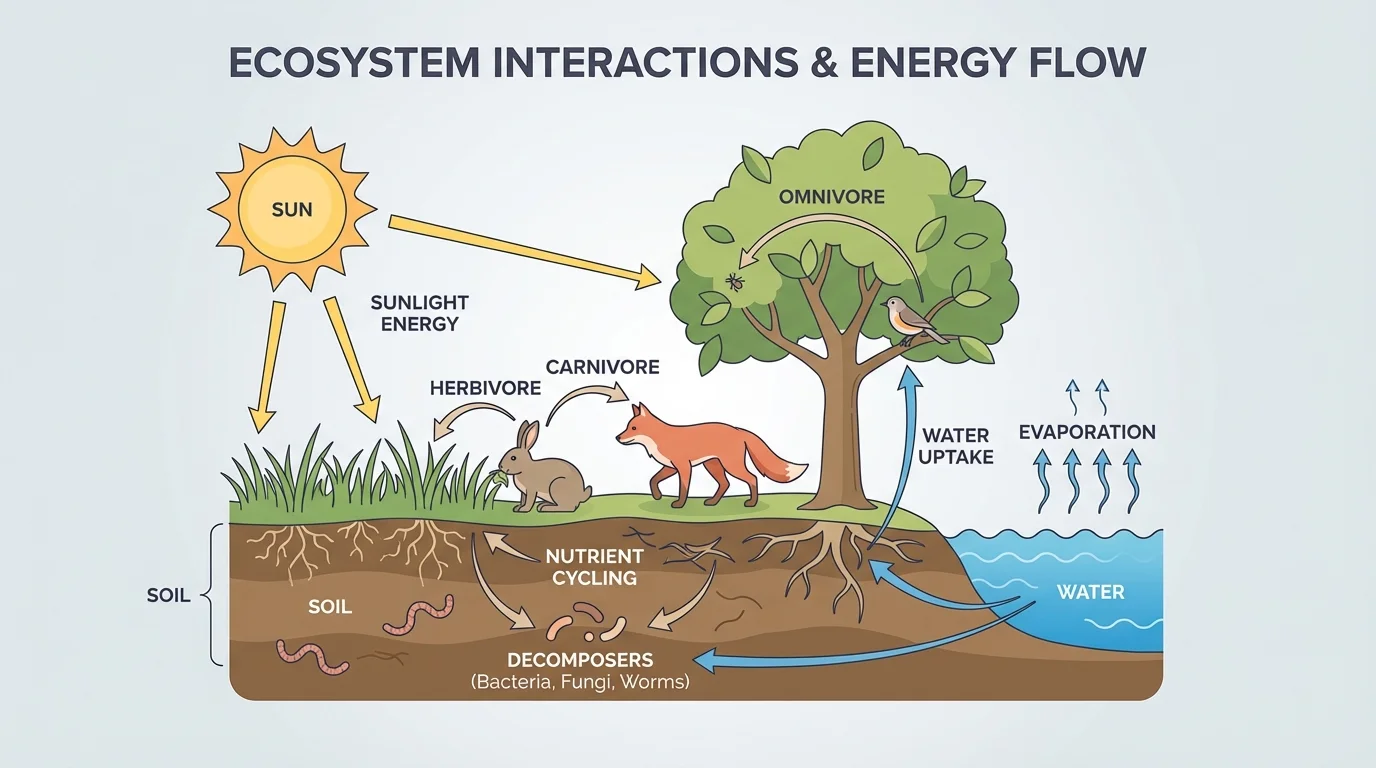
Habitat is the place where an organism lives.
Niche is the organism's role in its ecosystem, including how it gets food, where it lives, and how it interacts with other organisms and the environment.
Because ecosystems differ in abiotic conditions, they do not support the same kinds or numbers of organisms. A desert has little water, so water-saving plants and animals are common. A pond has standing water, so organisms there may depend on dissolved oxygen, mud, and seasonal temperature changes. These differences help explain why interaction patterns repeat in some ecosystems but not others.
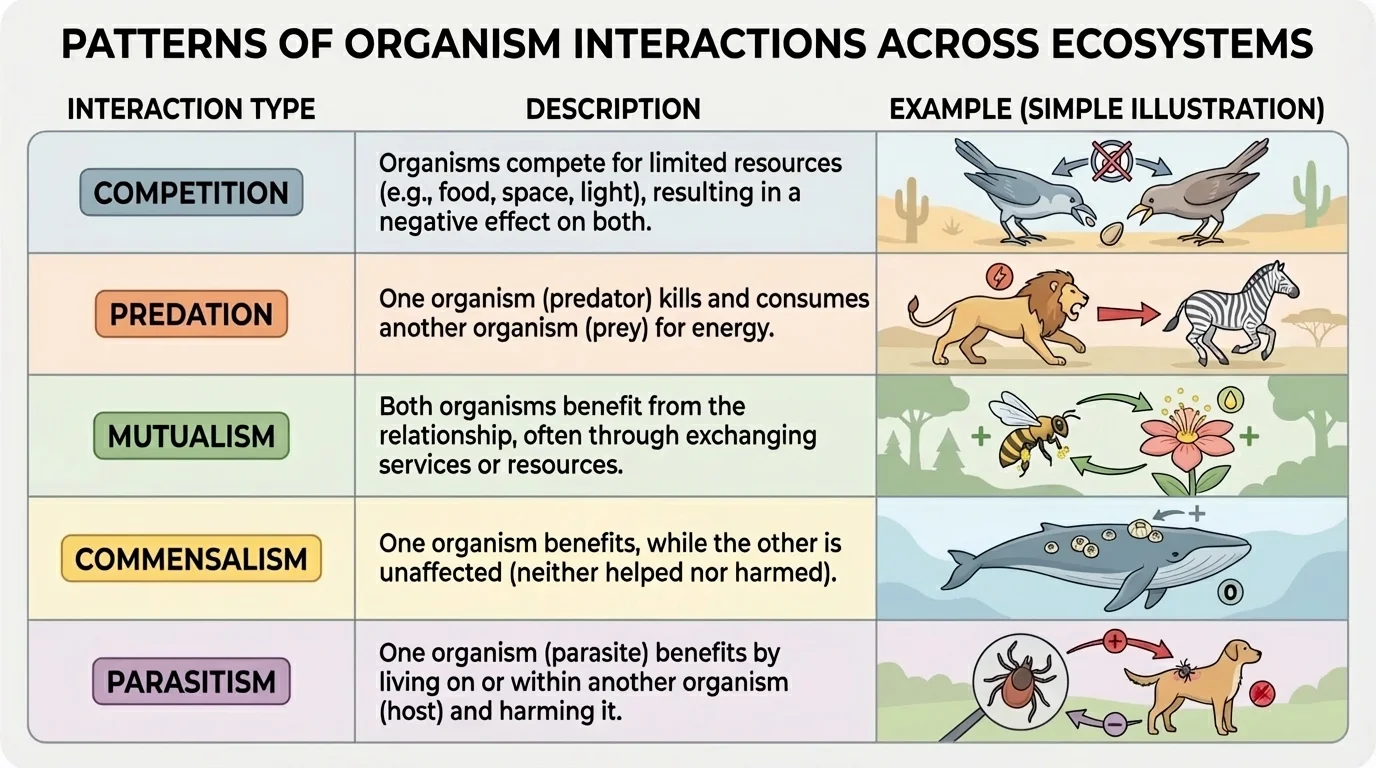
Scientists often group organism relationships into a few major categories. These patterns appear again and again in forests, oceans, grasslands, and even city parks, as [Figure 2] illustrates. Learning these categories helps you predict what kind of relationship is likely when organisms share the same space and resources.
Competition happens when organisms try to use the same limited resource, such as food, water, sunlight, or space. Two plants growing close together may compete for sunlight. Lions and hyenas may compete for prey. Competition may happen within the same species or between different species.
Predation happens when one organism kills and eats another. Owls catching mice, sharks eating fish, and spiders trapping insects are all examples. A closely related interaction is herbivory, when an animal eats plants or algae. Deer eating leaves and sea urchins scraping algae from rocks are examples.
Mutualism is a relationship in which both organisms benefit. Bees get nectar from flowers, and flowers get pollinated. In coral reefs, coral animals live with algae that make food by photosynthesis. The coral gains food, and the algae gain shelter and access to sunlight.
Commensalism is a relationship in which one organism benefits while the other is not clearly helped or harmed. Barnacles attached to a whale gain transportation to food-rich waters, while the whale is usually little affected.
Parasitism is a relationship in which one organism benefits and the other is harmed. Ticks feeding on deer, tapeworms living inside mammals, and fungi infecting crops are examples. Parasites usually do not kill their hosts right away because they depend on them.
Cleaner fish on coral reefs remove parasites from larger fish. The cleaner fish get food, and the larger fish become healthier. This is one of the clearest real-world examples of mutualism.
These interaction types are useful because they let us make predictions. If a drought reduces plant growth, herbivores may compete more strongly for food. If a new parasite enters a population with no resistance, illness may spread quickly. If pollinators decline, flowering plants may produce fewer seeds.
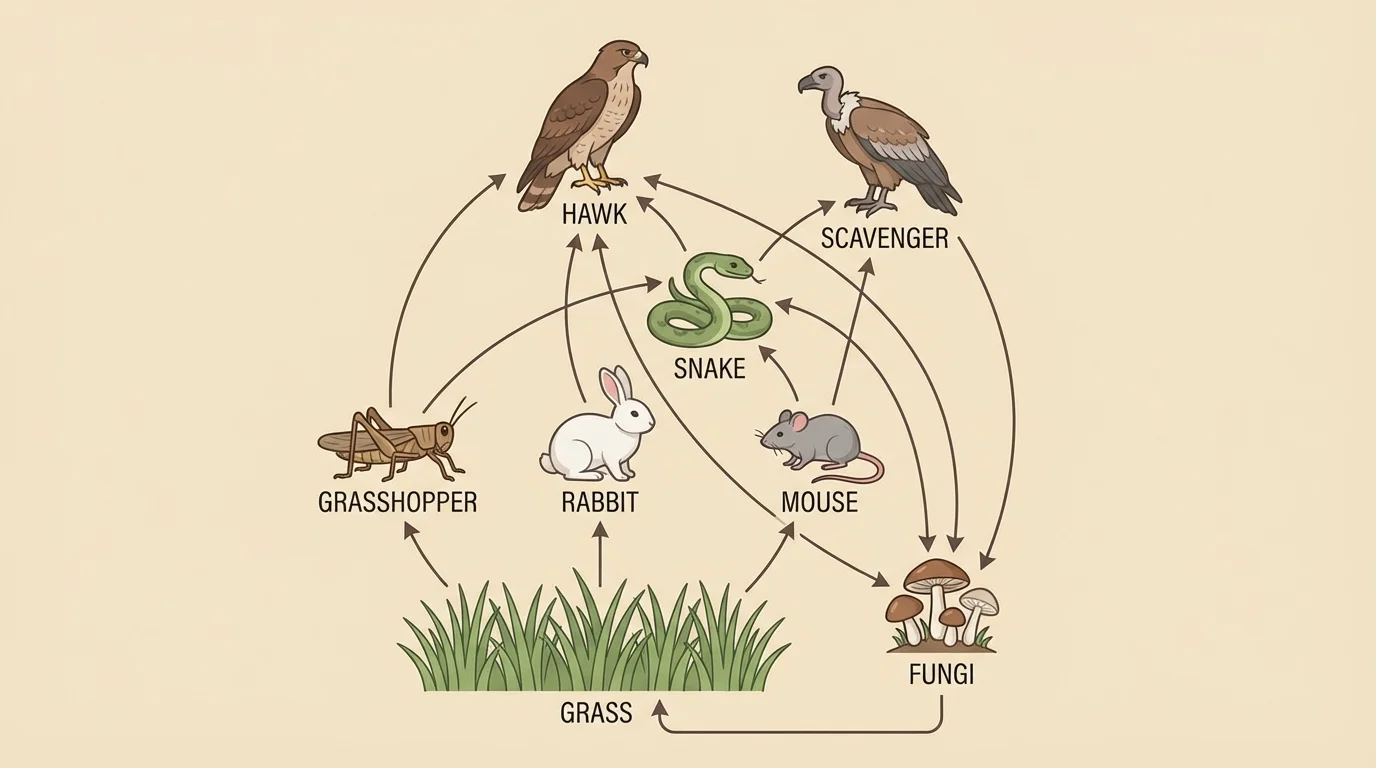
No organism can live without energy. Energy enters most ecosystems from sunlight and moves through organisms, as [Figure 3] shows in a food web. Plants, algae, and some bacteria capture sunlight and make food. These organisms are called producers.
Animals that eat producers or other animals are consumers. Organisms such as fungi and many bacteria are decomposers; they break down dead organisms and wastes, returning matter to the environment. Matter cycles, but energy does not cycle in the same way. Much of it is released as heat at each step, so less energy is available at higher feeding levels.
A food web is a model showing who eats whom in an ecosystem. Food webs are more realistic than simple food chains because most organisms eat more than one kind of food. In a grassland, grass may feed grasshoppers, rabbits, and mice. Snakes may eat mice, and hawks may eat snakes and rabbits.
A useful model for estimating energy transfer is the "10% rule." This is a rough estimate, not an exact law, but it helps explain why there are usually fewer top predators than producers. If grass stores about 10,000 units of energy, herbivores may store about 1,000 units, and carnivores may store about 100 units. In science class, we can describe this as each level receiving about \(10\%\) of the energy from the level below.
Because less energy is available at each higher level, ecosystems usually have many producers, fewer herbivores, and even fewer predators. This helps explain a common pattern across ecosystems: top predators are often rare, need large territories, and are strongly affected when food webs are disturbed.
Cross-ecosystem energy example
Suppose a marsh has producers with about 5,000 energy units available to the next level.
Step 1: Estimate the herbivore level.
About \(10\%\) of 5,000 is \(0.10 \times 5{,}000 = 500\).
Step 2: Estimate the small predator level.
About \(10\%\) of 500 is \(0.10 \times 500 = 50\).
Step 3: Predict the pattern.
There can usually be many more plants than herbivores, and more herbivores than predators, because the available energy decreases sharply at each level.
This helps explain why hawks, wolves, sharks, and other top predators are less numerous than the organisms below them.
The same idea works in oceans, forests, lakes, and deserts. Different organisms may fill the roles, but ecosystems still need producers, consumers, and decomposers.
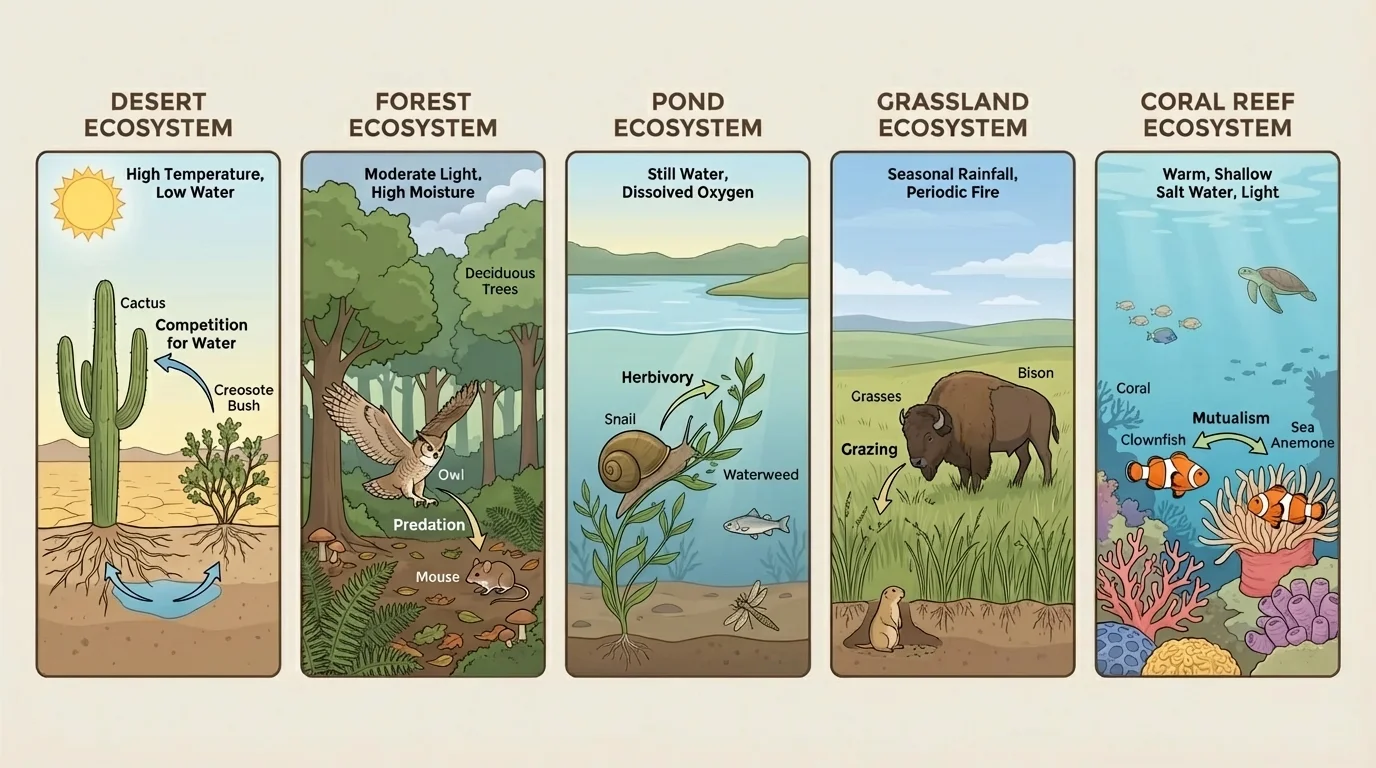
When scientists compare different places, they look for repeated cause-and-effect patterns. Similar abiotic conditions often lead to similar interaction patterns, as [Figure 4] shows by comparing several ecosystems. This does not mean every ecosystem is identical. It means the same scientific ideas can help explain them.
In deserts, water is usually the strongest limiting factor. Plants often grow slowly and store water. Herbivores may be active at night to avoid heat. Competition for water and shelter can be intense. Predators may range over large areas because prey is spread out.
In forests, sunlight may be a key limiting factor on the ground because tree canopies block light. Plants compete upward for sunlight, while decomposers in leaf litter play a major role in recycling nutrients. Mutualisms between fungi and tree roots are common because they help plants absorb water and minerals.
In freshwater ecosystems such as ponds and streams, dissolved oxygen, temperature, and water flow can shape interactions. In a pond with low oxygen, some fish may die or leave, reducing food for predators. Algae growth can increase if extra nutrients enter the water, changing the entire food web.
In grasslands, fires and grazing often shape the ecosystem. Many grasses regrow quickly after being eaten. Large herbivores may dominate energy transfer, and predators may track herds across wide open spaces.
In coral reefs, sunlight, warm water, and clear shallow seas support producers such as algae. Competition for space is intense because many organisms attach to hard surfaces. Mutualism is especially important, including the relationship between coral and algae.
| Ecosystem | Important Abiotic Factor | Likely Strong Interaction Pattern | Example |
|---|---|---|---|
| Desert | Low water | Competition | Plants competing for moisture |
| Forest | Light on forest floor | Competition and mutualism | Trees competing for light; fungi helping roots |
| Pond | Oxygen and nutrient levels | Predation and population shifts | Fish decline affecting herons |
| Grassland | Seasonal rain and fire | Herbivory | Bison feeding on grasses |
| Coral reef | Warm clear water | Mutualism and competition for space | Coral and algae; reef organisms crowding surfaces |
Table 1. Comparison of major interaction patterns across several ecosystems.
Pattern prediction across ecosystems means using what is known about resources, climate, and organism roles to explain what interactions are likely. If resources are scarce, competition often increases. If producers increase, herbivores may increase later. If a keystone predator disappears, populations below it may change dramatically.
This is why a scientific explanation is not guessing. It uses known relationships to predict likely outcomes.
A population is all the members of one species living in the same area. Population size can change because of food supply, water, shelter, disease, predators, weather, and human activity. These are called limiting factors because they limit how large a population can become.
Every ecosystem also has a carrying capacity, which is the largest population size the environment can support over time. If a deer population rises above carrying capacity, food may run short, leading to starvation, disease, or lower birth rates.
Sometimes a change at one level of a food web causes a chain reaction called a trophic cascade. In some places where wolves returned after being absent, elk spent less time overgrazing riverbank plants. As plants recovered, habitats improved for birds and beavers. One predator affected many parts of the ecosystem.
[Figure 5] This pattern is powerful because it helps us predict outcomes in other ecosystems too. If a top predator is removed from a kelp forest, herbivores such as sea urchins may increase and overeat kelp. If kelp declines, many fish and invertebrates lose habitat and food.
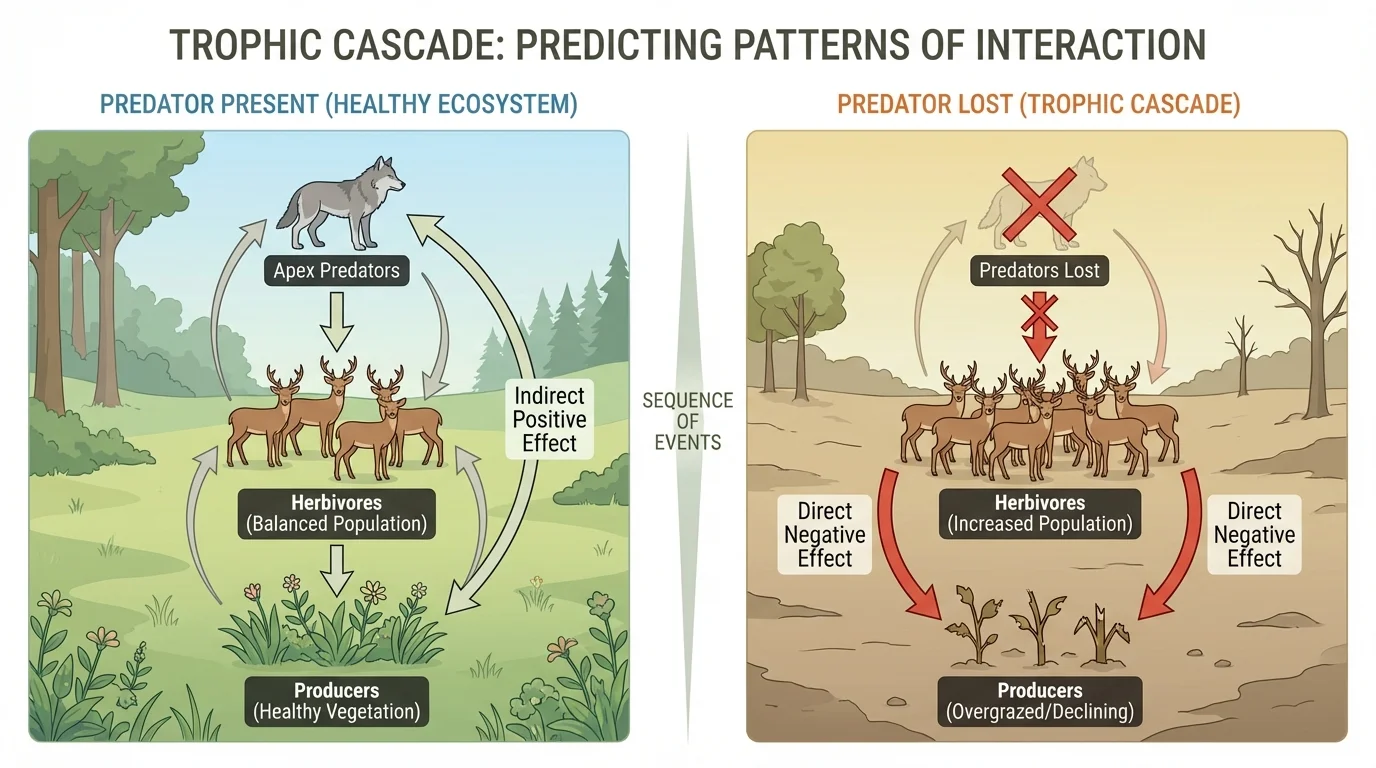
Earlier science learning about matter cycling and energy flow is important here: matter is reused in ecosystems, but energy decreases as it moves from one feeding level to the next. That is why population changes at one level can affect all the others.
Another major pattern involves invasive species, organisms introduced to a new ecosystem where they spread quickly. They may have few predators and can outcompete native species. Zebra mussels in freshwater systems and cane toads in Australia are examples of invasive species causing major interaction changes.
Seasonal change also matters. In temperate forests, food webs in winter differ from summer food webs. In wetlands, migration changes predator-prey patterns. In deserts, a short rainy period can briefly increase plant growth, insects, and bird activity. These are not random changes; they follow environmental patterns.
To construct a strong explanation, scientists often organize their thinking into claim, evidence, and reasoning. A claim is the answer to a question. Evidence is the data or observations that support the claim. Reasoning explains why the evidence supports the claim using scientific ideas.
For example, suppose the question is: Why are top predators less common than producers in many ecosystems? A good claim is that less energy is available at each higher feeding level. Evidence could include food web data from a forest, lake, and grassland showing many producers but fewer top predators. The reasoning connects that evidence to energy transfer: because only about \(10\%\) of energy moves to the next level, predator populations must usually be smaller.
Constructed explanation example
Question: Why might competition increase in a drought across both a grassland and a pond ecosystem?
Step 1: Make a claim.
Competition increases because water becomes a more limited resource.
Step 2: Add evidence.
In grasslands, plants may wilt and produce less biomass. In ponds, water levels drop and organisms are crowded into a smaller space.
Step 3: Explain the reasoning.
When the same resource becomes scarcer, more organisms depend on less of it. That leads to stronger competition, even though the ecosystems are different.
This explanation predicts the same kind of pattern in two ecosystems because both are affected by reduced water availability.
Notice that the explanation does not just describe what happens. It explains why it happens using a scientific principle. That is what makes it predictive.
People change ecosystems in ways that alter organism interactions. Fertilizer runoff can add nutrients to lakes and ponds, causing algal blooms. If algae die and decomposers use large amounts of oxygen while breaking them down, fish may suffocate. This links human land use to changes in freshwater food webs.
Overfishing can remove key predators or consumers from ocean ecosystems. If too many large fish are removed, smaller fish or prey species may increase, changing the whole balance of the system. Conservation scientists use food web knowledge like we saw earlier in [Figure 3] to decide how much harvesting an ecosystem can handle.
Farmers also use ecosystem interaction knowledge. They may encourage pollinators, protect soil decomposers, and use biological pest control. For example, releasing ladybugs in a greenhouse can reduce aphid populations through predation instead of relying only on chemicals.
Climate change is affecting ecosystems by changing temperature, rainfall, seasons, and ocean chemistry. Coral bleaching happens when heat stress disrupts the mutualism between coral and algae. As seen earlier in [Figure 4], when abiotic conditions shift, interaction patterns can shift too. Species may migrate, compete in new ways, or lose important partners.
Scientists, park managers, and communities use these ideas to restore habitats, protect endangered species, and manage natural resources. The better we understand interaction patterns, the better we can predict and respond to environmental change.
"Everything is connected to everything else."
— A core idea of ecology
That idea is not just a slogan. It is a testable scientific idea. If one part of a system changes, we can look for the pattern of effects spreading through the network of interactions, just as we saw with trophic cascades and with energy flow in food webs.
