A forest can be cut down in a few weeks, but the web of life inside it may have taken hundreds of years to form. That contrast helps explain one of the biggest science ideas of our time: humans can change Earth's environments very quickly, and those changes can reshape life across the planet. Some species disappear when their habitats are altered. Others spread into new spaces and multiply. Understanding why that happens begins with the biosphere itself.
The biosphere includes all parts of Earth where life exists: land, water, and the lower atmosphere. It is not just a list of places. It is a giant system in which living things interact with air, water, soil, sunlight, and one another. A habitat is the natural home of an organism, and it includes both living and nonliving parts, as shown in [Figure 1]. A pond habitat, for example, includes water, mud, plants, fish, insects, and tiny organisms too small to see without a microscope.
Every species depends on certain conditions. A cactus survives in dry places because it stores water. A trout needs cool, oxygen-rich water. A frog may need a wet pond for eggs, plants for shelter, and insects for food. If one important part of the habitat changes, the organism may struggle to survive, reproduce, or find food.
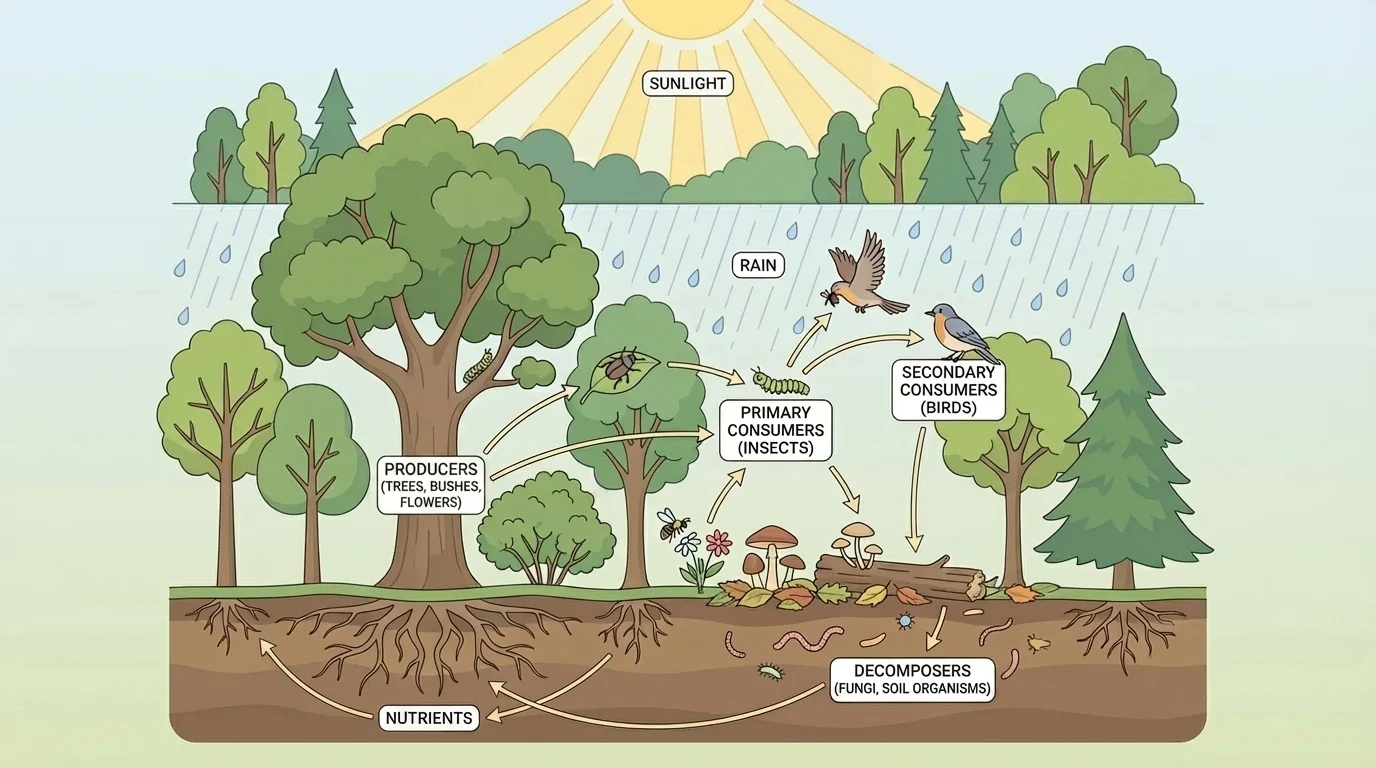
Biodiversity is the variety of living things in an area, including different species, their genes, and the ecosystems they form. Extinction happens when a species no longer exists anywhere on Earth. Ecosystem means a community of organisms interacting with one another and with their physical environment.
Habitats are part of ecosystems, and ecosystems are connected through cycles of matter and flows of energy. Plants capture energy from sunlight. Animals eat plants or other animals. Decomposers break down dead material and return nutrients to the soil. If pollution poisons the water, if a road cuts through migration paths, or if a wetland is drained, those connections can weaken or break.
Because of these connections, changing one part of Earth's system can affect many living things at once. That is why scientists pay close attention not just to single animals or plants, but to whole habitats and the relationships inside them.
Humans alter environments in many ways, and these drivers of environmental change often work together, as [Figure 2] illustrates. We cut forests for farms, roads, and cities. We dam rivers for water and electricity. We mine rocks and metals. We also burn fuels such as coal, oil, and natural gas, which release greenhouse gases into the atmosphere.
When people burn fossil fuels, they release greenhouse gases such as \(\textrm{CO}_2\). These gases trap heat in the atmosphere and contribute to climate change. Warmer temperatures can melt ice, raise sea levels, shift rainfall patterns, and increase the frequency of heat waves in some places. Even small average temperature changes can matter because many organisms are adapted to a narrow range of conditions.
People also change land directly. A shopping center may replace a field. A housing development may replace woodland. Intensive farming can remove native plants and reduce shelter for wild animals. Wetlands are sometimes drained even though they help filter water, store floodwater, and provide homes for birds, fish, and amphibians.
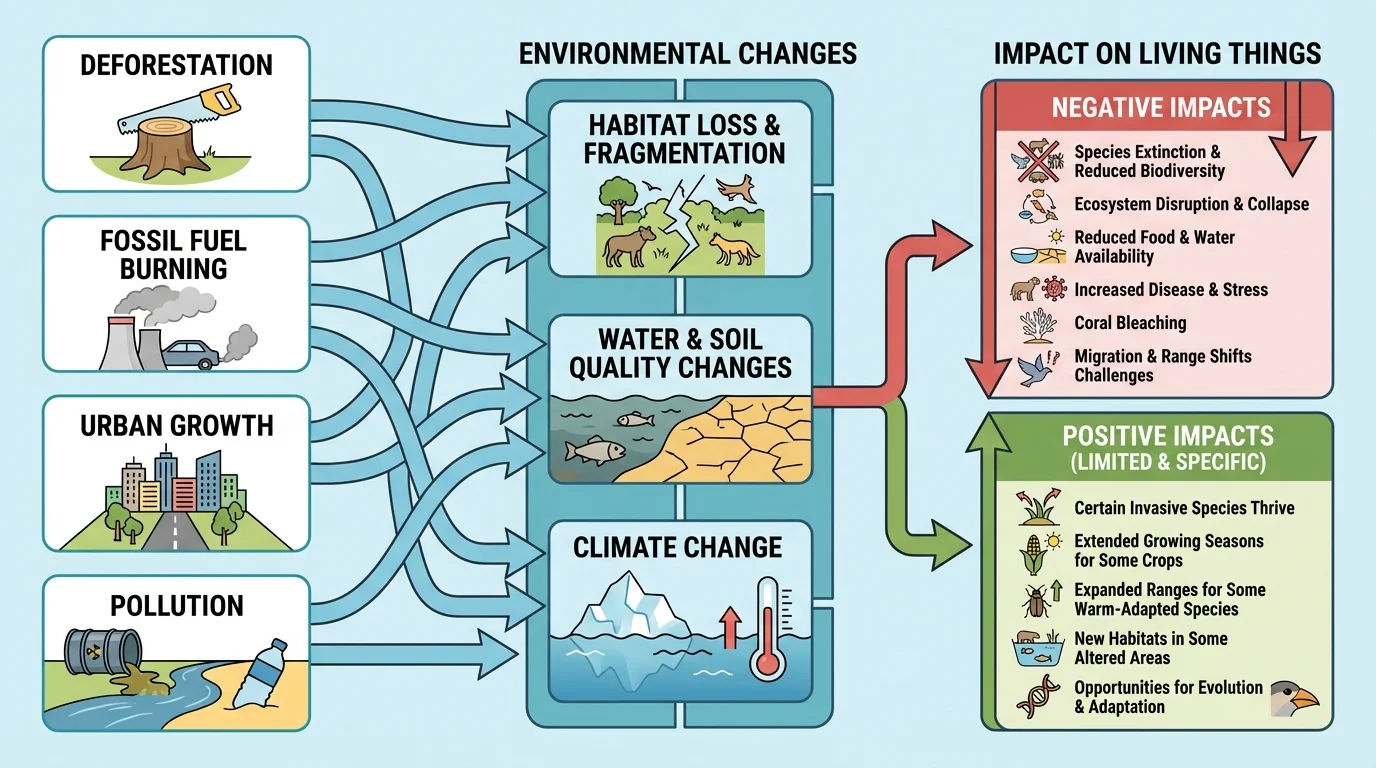
Water systems are often affected too. Fertilizers from farms can wash into rivers and lakes. These nutrients can cause algal blooms. When algae die and decompose, oxygen levels in the water may fall, making it hard for fish and other aquatic organisms to survive. Industrial waste, oil spills, and plastic pollution can also harm organisms directly or damage food chains.
Earth systems are connected. Changes in the atmosphere, hydrosphere, geosphere, and biosphere often influence one another. For example, cutting down trees changes the land surface, reduces habitat, affects how water moves through soil, and can change the amount of \(\textrm{CO}_2\) removed from the air through photosynthesis.
Not all human changes are accidental. Some are planned for useful reasons: growing food, building homes, making transportation easier, or producing energy. But helpful changes for people can still create environmental trade-offs. A dam may provide electricity and reduce some flooding, yet also block fish migration and change river habitats downstream.
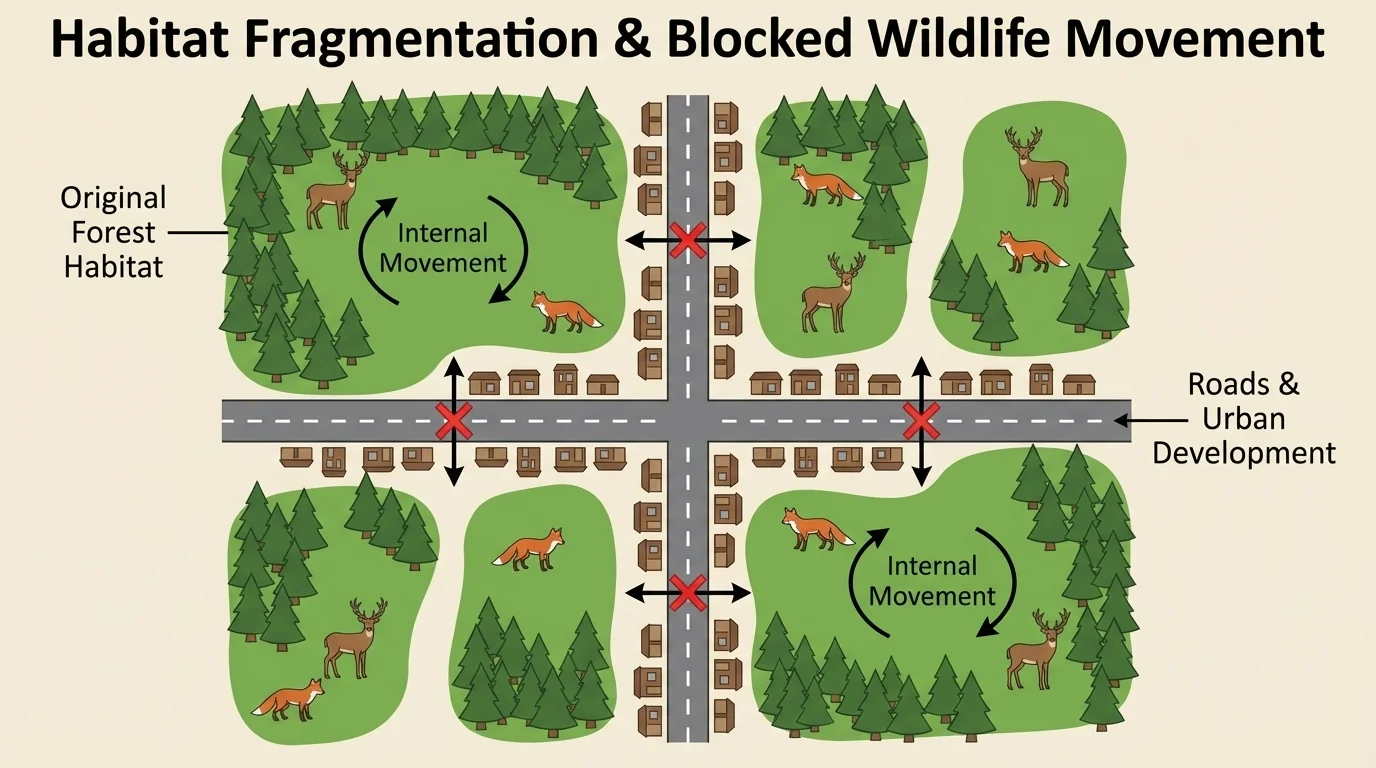
One of the most serious impacts on the biosphere is habitat fragmentation, when a large habitat is broken into smaller pieces. As [Figure 3] shows, roads, neighborhoods, and cleared land can split one continuous forest into isolated patches. Animals that once moved freely to find food, mates, or shelter may no longer be able to cross safely.
Smaller habitat patches often support fewer individuals. If a population becomes very small, it may be more vulnerable to disease, storms, lack of food, or low genetic diversity. A species with few surviving members may have trouble reproducing successfully, and over time it can disappear from that area.
Extinction can happen for many reasons: loss of habitat, overhunting, pollution, invasive species, disease, or rapid climate change. Often several causes act together. For example, if a wetland bird loses nesting areas, faces pollution in the water, and must compete with an introduced predator, its chance of survival drops sharply.
Species do not exist alone. In a food web, each species is connected to others through feeding relationships. If one species disappears, others may be affected. If insects decline, birds that eat them may decline too. If a top predator disappears, prey populations may grow too much and overuse plants or smaller animals. The result can be an ecosystem that is less stable than before.
Some species go extinct before scientists even finish studying them. This is especially likely in habitats with many unique species, such as tropical rainforests and coral reefs.
Habitat destruction does not always mean total removal. Sometimes a habitat still exists, but it becomes too noisy, too polluted, too warm, or too dry for the organisms that once lived there. In that case, the habitat may look present to us but function badly for the species that depend on it.
Environmental change does not affect every organism in the same way. One change can create both winners and losers, as [Figure 4] illustrates. A new city park may provide trees and nesting sites for some birds, yet remove the original meadow habitat needed by certain insects and ground-nesting species. A warmer climate may allow some insects to spread into new regions while making conditions worse for animals adapted to cold environments.
This is an important idea: a change is not simply "good" or "bad" for nature in one single way. It depends on which species you are looking at, how fast the change happens, and whether organisms can adapt or move. Fast-growing species with broad diets often do well in disturbed places. Species with very specific needs often struggle.
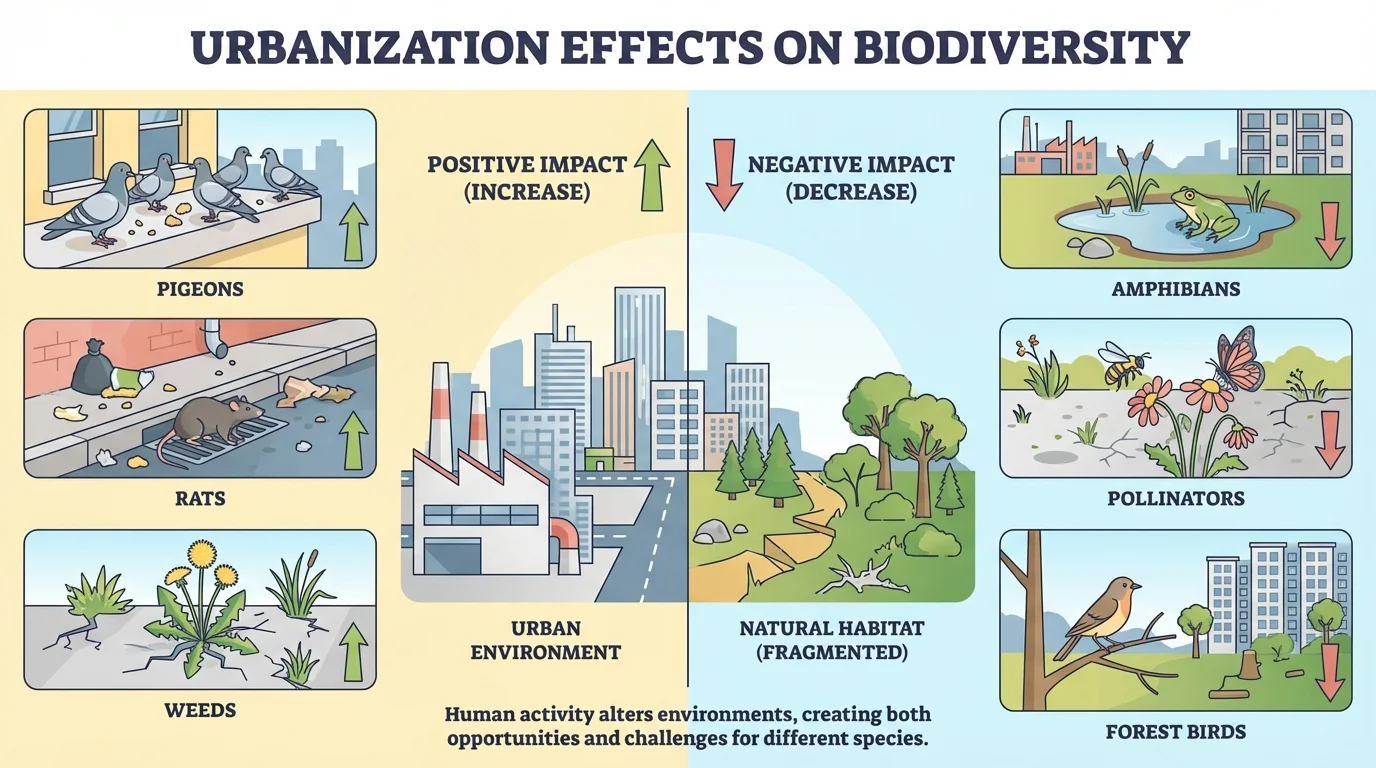
Urban environments are a clear example. Pigeons, rats, raccoons, and some insects can thrive near humans because they find food scraps, shelter, and fewer predators. At the same time, many amphibians suffer because roads, pollution, and loss of wetlands make breeding difficult. Some plants grow well in sidewalk cracks, while others vanish when soil conditions change.
Agriculture also produces mixed effects. Farmland can support species that like open fields, such as some grasses and birds. However, if the land is managed with heavy pesticide use or if a large area contains only one crop, many other species may decline. Monocultures, or large areas of one crop, usually support less biodiversity than habitats with many plant types.
| Human change | Species that may benefit | Species that may be harmed |
|---|---|---|
| Urban growth | Pigeons, rats, some weeds | Amphibians, forest birds, many native plants |
| Dams on rivers | Some reservoir fish, humans needing electricity | Migrating fish such as salmon, downstream river species |
| Warmer temperatures | Some insects moving northward, some crop pests | Polar species, coral reefs, cold-water fish |
| Tree planting in cities | Shade-tolerant birds, pollinators, people | Species needing open grassland if that habitat is replaced |
Table 1. Examples of how the same human-caused environmental change can benefit some organisms while harming others.
Even restoration projects can have mixed effects if they are not planned carefully. Planting trees is often beneficial, but planting nonnative trees in the wrong place can reduce native biodiversity. That is why scientists study local ecosystems before making changes.
Rainforests offer a powerful example. When forests are cleared for cattle ranching, logging, or farming, many species lose homes at once. Tropical forests contain huge amounts of biodiversity, so clearing them can lead to major losses. The removal of trees also affects soil, water cycles, and the amount of \(\textrm{CO}_2\) taken in by plants.
Case study: Coral reefs under stress
Coral reefs are built by tiny animals that live in warm, shallow ocean water. They support many fish and other organisms.
Step 1: Water temperatures rise.
When oceans become too warm, corals become stressed and may lose the tiny algae that help feed them.
Step 2: Coral bleaching occurs.
The corals turn pale and may die if stressful conditions continue.
Step 3: Reef habitats shrink.
Fish and invertebrates that depend on reefs lose shelter and feeding areas.
This shows how climate change in the ocean can affect an entire ecosystem, not just one species.
Rivers provide another example. A dam can create a reservoir that stores water and generates electricity. For people, that can be extremely useful. But as we saw earlier with fragmented habitats in [Figure 3], barriers can interrupt movement. In rivers, fish such as salmon may be unable to reach spawning grounds upstream, and sediment that normally moves downstream may get trapped behind the dam.
Cities are not only places of damage. They can also become places of recovery. Green roofs, rain gardens, protected wetlands, and native plant areas can support pollinators and birds. Cleaner transportation and stronger pollution controls can improve air quality for both people and wildlife. This is one reason the "winners and losers" idea from [Figure 4] matters: choices in design affect which species can live there.
"We do not inherit the Earth from our ancestors; we borrow it from our children."
— Common environmental saying
Some human impacts are surprisingly positive. When overhunting stops, animal populations may recover. When a polluted river is cleaned, fish and birds may return. Protected areas can allow forests to regrow and restore habitat for endangered species. Positive outcomes usually happen when people understand ecosystem connections and make long-term plans.
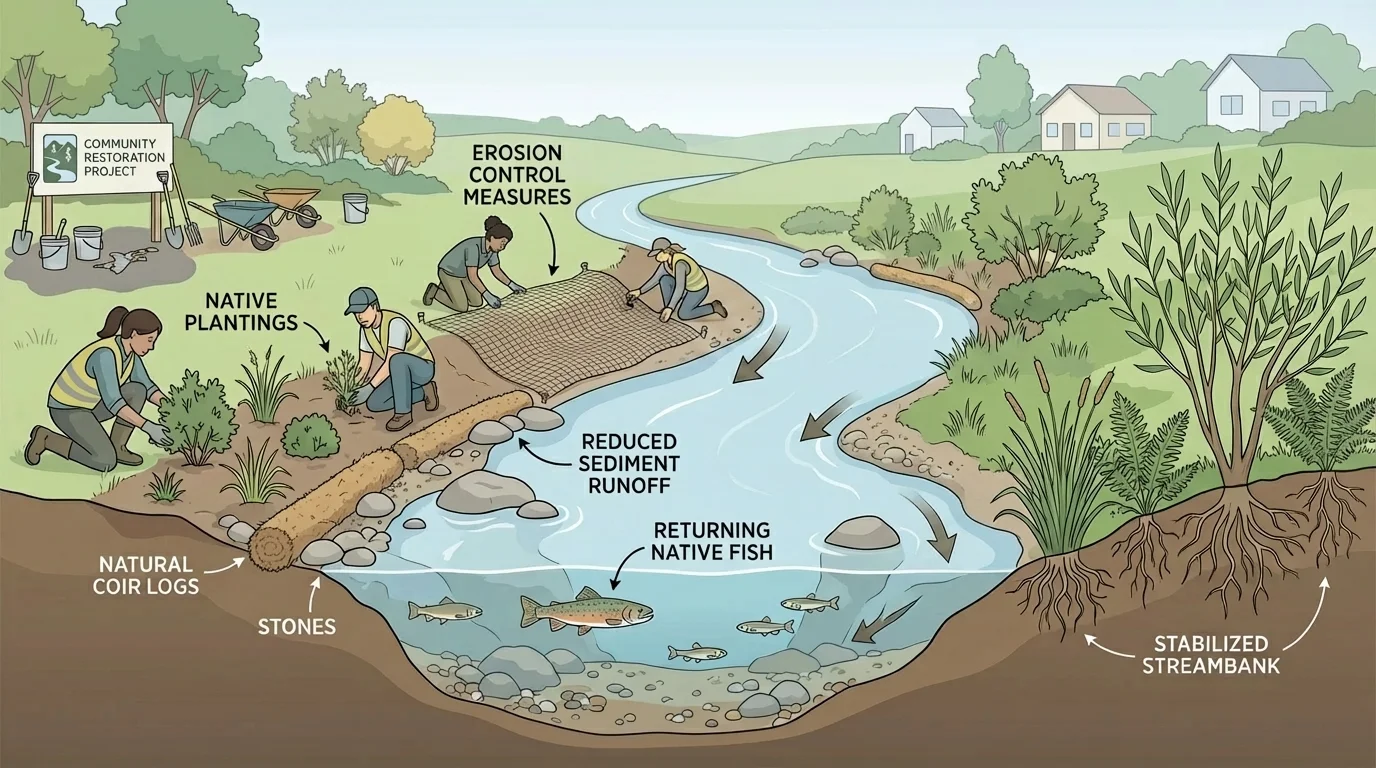
People can damage ecosystems, but people can also repair them. [Figure 5] shows one example: habitat restoration, in which damaged environments are improved so native species can return. This might involve planting native vegetation, removing invasive species, restoring stream banks, rebuilding wetlands, or limiting pollution at its source.
Restoration works best when it matches the local environment. Native plants are especially important because local insects, birds, and other animals often depend on them. A restored stream with cleaner water and better plant cover can reduce erosion, provide shade, and support fish and amphibians.
Conservation also includes protecting habitats before they are badly damaged. National parks, marine protected areas, wildlife corridors, fishing rules, and pollution limits can help keep ecosystems functioning. A wildlife corridor is land that connects habitat patches so animals can move more safely between them. This directly addresses the kind of isolation shown earlier in [Figure 3].
Earth's systems do not operate separately. Water, air, land, and living things constantly interact. A decision about land use can affect runoff, soil, climate, and biodiversity at the same time.
Sustainable practices try to meet human needs without causing long-term environmental damage. Examples include farming methods that reduce soil erosion, fishing limits that prevent overharvesting, and energy choices that reduce greenhouse gas emissions. Replacing some fossil fuel use with wind or solar power can lower emissions of \(\textrm{CO}_2\), although these technologies also need careful planning so they do not create new habitat problems in sensitive areas.
Students are part of this story too. Communities can plant native gardens, reduce plastic waste, protect local streams, and support parks and green spaces. Small actions do not solve every global problem, but they can improve local habitats and build habits of stewardship.
The biosphere is changing because humans are powerful agents of environmental change. We move water, cut forests, build cities, burn fuels, transport species, and reshape land on a large scale. These actions can reduce biodiversity, damage habitats, and push species toward extinction. But they can also create opportunities for restoration and recovery when guided by scientific understanding.
The most important lesson is that environmental change has uneven effects. Some organisms adapt, move, or even benefit. Others decline because the conditions they need disappear. To make wise decisions, scientists and communities must ask not only, "How does this help people?" but also, "Which species and ecosystems are affected, and in what ways?"
When we understand the connections among habitats, species, and Earth systems, we are better prepared to protect the living world that supports us all.
