A century ago, people could not easily estimate the planet's average temperature. Today, scientists use thermometers, weather stations, satellites, ocean instruments, and ice records to track Earth in remarkable detail. Those measurements tell a clear story: Earth is warming, and human actions are a major reason why. This matters not only for polar bears or distant places, but also for farms, cities, water supplies, coastlines, forests, and even how safely people can live during heat waves and storms.
When scientists talk about Earth's mean surface temperature, they mean the average temperature of Earth's surface over land and ocean. This average naturally changes over long periods because Earth's systems are always interacting. Volcanoes erupt, ocean currents shift, and the amount of sunlight reaching Earth can vary slightly. But the rapid warming seen in recent times is too large and too fast to be explained by those natural causes alone.
The current warming trend is often called global warming. That term refers specifically to the rise in Earth's average surface temperature. A related term, climate change, includes global warming plus other long-term changes such as shifting rainfall patterns, stronger heat waves, melting ice, and rising sea level. In other words, global warming is one major part of climate change.
Global warming is the long-term rise in Earth's average surface temperature.
Climate change includes global warming and other long-term changes in weather patterns, oceans, ice, and ecosystems.
Scientists compare temperatures over many years because weather and climate are not the same thing. Weather is what happens in the atmosphere over a short time, such as today's rainstorm or tomorrow's temperature. Climate is the pattern of weather over much longer times, often decades. A cold day in winter does not disprove global warming, just as one hot day does not confirm it. Scientists look for long-term patterns in huge amounts of data.
[Figure 1] helps show why Earth is warm enough for liquid water because of the greenhouse effect. Energy from the Sun reaches Earth mostly as visible light. Earth's surface absorbs some of that energy and warms up. The warm surface then gives off energy in the form of infrared radiation, which is a kind of heat energy. Certain gases in the atmosphere absorb and re-emit some of this heat, slowing the loss of energy to space.
This natural greenhouse effect is essential for life. Without it, Earth would be much colder. The problem is not that the greenhouse effect exists; the problem is that humans are strengthening it by adding extra greenhouse gases to the atmosphere. More of these gases means more heat is trapped.
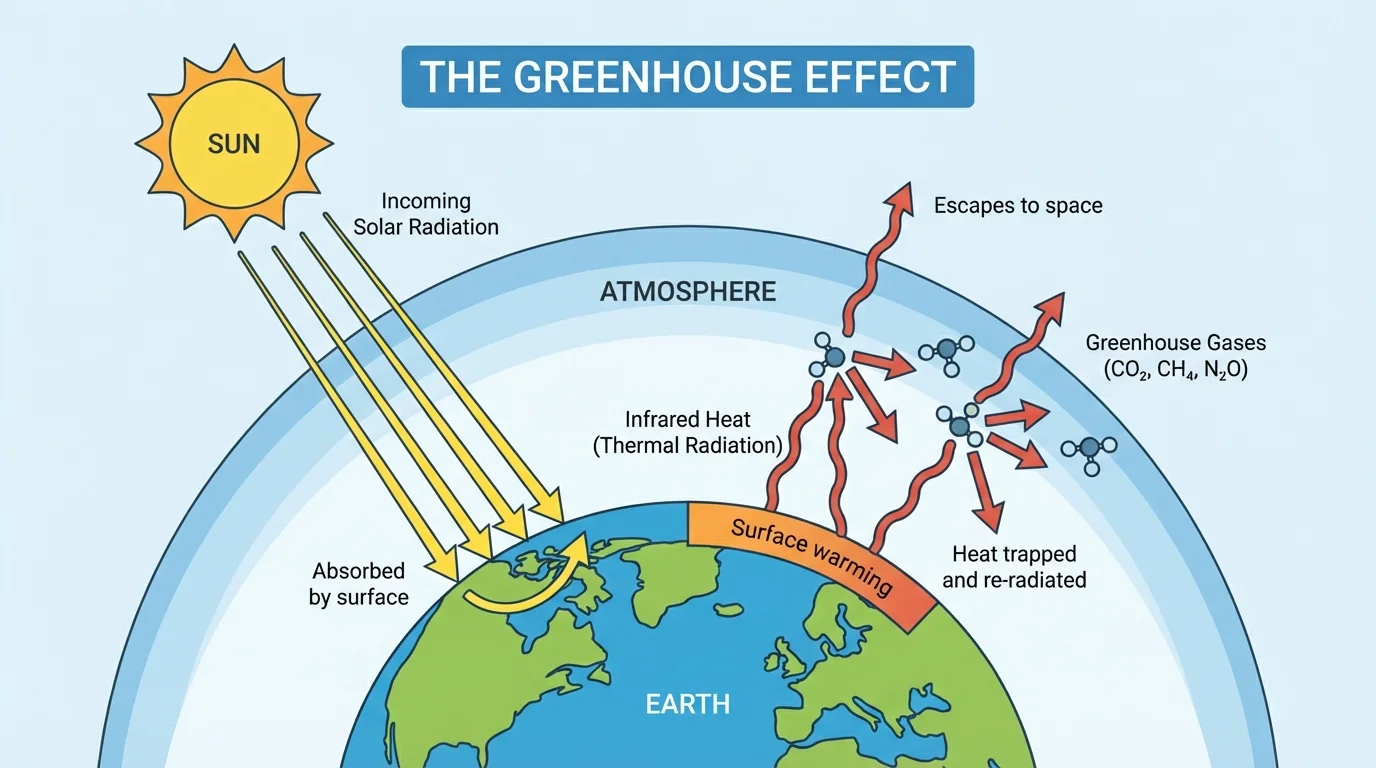
The main greenhouse gases involved in current climate change are carbon dioxide, written as \(\textrm{CO}_2\), methane, written as \(\textrm{CH}_4\), nitrous oxide, written as \(\textrm{N}_2\textrm{O}\), and water vapor. Water vapor is a very important greenhouse gas naturally, but human activities most strongly affect climate by increasing \(\textrm{CO}_2\), \(\textrm{CH}_4\), and \(\textrm{N}_2\textrm{O}\). These gases differ in how much heat they trap and how long they stay in the atmosphere.
A useful way to think about this is Earth's energy balance. Earth receives energy from the Sun and sends energy back to space. When incoming and outgoing energy are balanced, average temperature stays more stable. If extra greenhouse gases reduce how much heat escapes, the balance changes. Earth then warms until outgoing energy increases enough to match incoming energy again.
Why extra greenhouse gases matter
Adding greenhouse gases is a bit like adding another blanket to a bed. The blanket does not create heat by itself, but it slows how quickly heat escapes. In the same way, greenhouse gases do not produce the Sun's energy. They change how quickly Earth loses heat to space.
The idea of a greenhouse effect is based on physics. Sunlight and heat energy interact differently with the atmosphere. As we saw earlier in [Figure 1], sunlight can pass through the atmosphere more easily than infrared heat escaping from Earth's surface. That difference is why extra greenhouse gases can warm the planet.
[Figure 2] illustrates several major ways human activities increase greenhouse gases. The largest factor is the burning of fossil fuels such as coal, oil, and natural gas. These fuels formed from ancient living matter over millions of years. When people burn them in power plants, cars, trucks, ships, airplanes, factories, and home heating systems, carbon that was stored underground is released into the air as \(\textrm{CO}_2\).
For example, when a hydrocarbon fuel burns, carbon atoms combine with oxygen. A simple model is: \[\textrm{C} + \textrm{O}_2 \rightarrow \textrm{CO}_2\] In real fuels the chemistry is more complex, but the key idea is the same: burning carbon-rich fuels produces carbon dioxide.
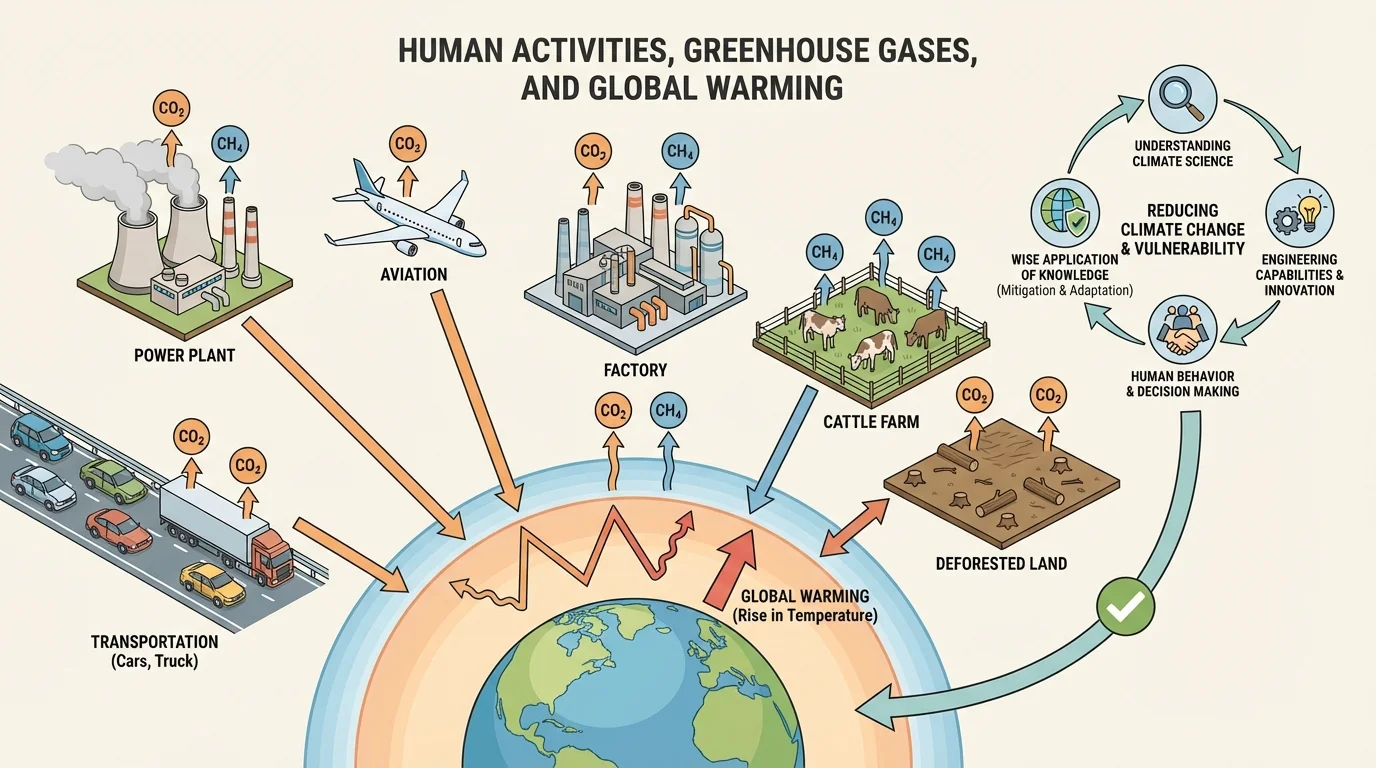
Deforestation is another major cause. Trees and other plants remove \(\textrm{CO}_2\) from the air during photosynthesis and store carbon in wood, roots, and soil. When forests are cut down or burned, two things happen: fewer trees remain to absorb carbon dioxide, and stored carbon is released back into the atmosphere.
Agriculture also contributes. Cows and other ruminant animals release methane during digestion. Rice farming can produce methane in waterlogged fields. Fertilizers used on crops can lead to emissions of nitrous oxide. Landfills produce methane as organic waste breaks down.
Industry matters too. Making cement releases \(\textrm{CO}_2\), and some industrial chemicals are powerful greenhouse gases. Refrigeration and air-conditioning systems can leak gases that trap heat very effectively even in small amounts.
Transportation is often easiest for students to notice in daily life. School buses, family cars, delivery trucks, and airplanes usually run on fossil fuels. One trip may seem small, but billions of trips add up. That is why changing transportation systems can make a big difference.
Carbon dioxide can stay in the climate system for a very long time. That means warming caused by emissions today can still affect future generations.
The different sources shown in [Figure 2] remind us that climate change is not caused by one machine or one country alone. It comes from many connected activities in energy, transportation, food production, manufacturing, and land use.
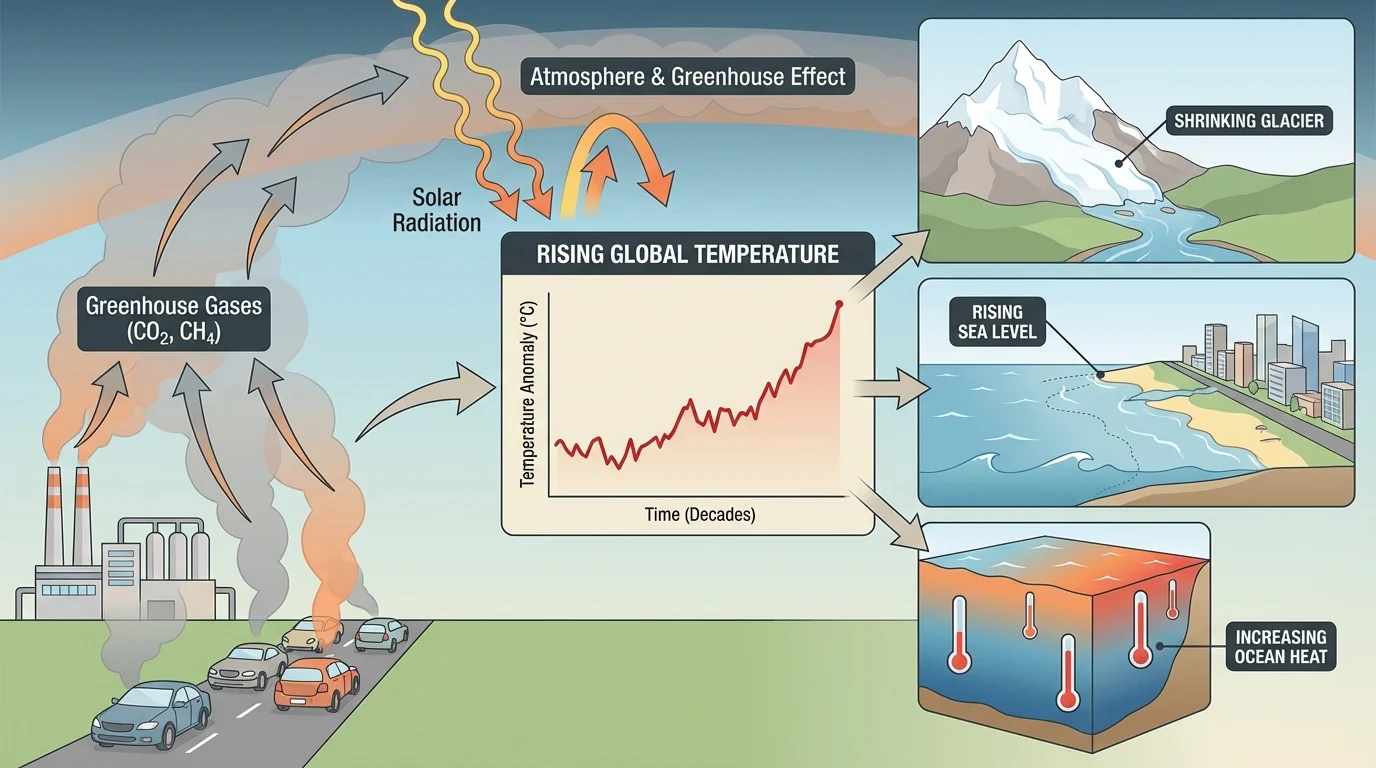
[Figure 3] brings together several independent kinds of evidence used in climate science. Scientists measure air temperatures over land, sea-surface temperatures over oceans, and temperatures within the oceans. They also study glaciers, ice sheets, sea ice, tree rings, corals, sediments, and tiny bubbles of ancient air trapped in ice cores.
These different records support the same conclusion: Earth has warmed significantly in recent decades. Oceans have absorbed much of the extra heat. Glaciers and ice sheets are shrinking in many places. Sea level is rising because warmer water expands and because melting land ice adds more water to the ocean.
Scientists also look at the causes of warming. They compare observed climate patterns with computer models that include different factors. When models include only natural causes such as volcanic eruptions and changes in the Sun's energy, they cannot fully explain the current warming trend. When human greenhouse gas emissions are included, the models match observations much better.
Another clue comes from the atmosphere itself. Carbon in fossil fuels has a particular chemical signature. Measurements show that rising atmospheric \(\textrm{CO}_2\) is strongly linked to the burning of fossil fuels. Scientists also observe that the lower atmosphere is warming while the upper atmosphere cools, which is a pattern expected when greenhouse gases increase.
Energy balance example
Suppose Earth receives an average of \(100\) units of energy from the Sun and sends \(100\) units back to space. The system is balanced. If extra greenhouse gases reduce outgoing energy to \(98\) units while incoming energy stays at \(100\), Earth gains \(2\) units of energy.
Step 1: Compare incoming and outgoing energy.
Incoming energy is \(100\) units and outgoing energy is \(98\) units.
Step 2: Find the imbalance.
\(100 - 98 = 2\), so Earth gains \(2\) units of energy.
Step 3: Interpret the result.
If this imbalance continues over time, Earth warms until outgoing energy rises enough to match incoming energy again.
This simple example is not a full climate model, but it shows why even a small imbalance can matter when it affects the entire planet.
The combined evidence shown in [Figure 3] is one reason climate science is so strong. It does not depend on one thermometer, one glacier, or one year. It comes from many measurements that tell a consistent story.
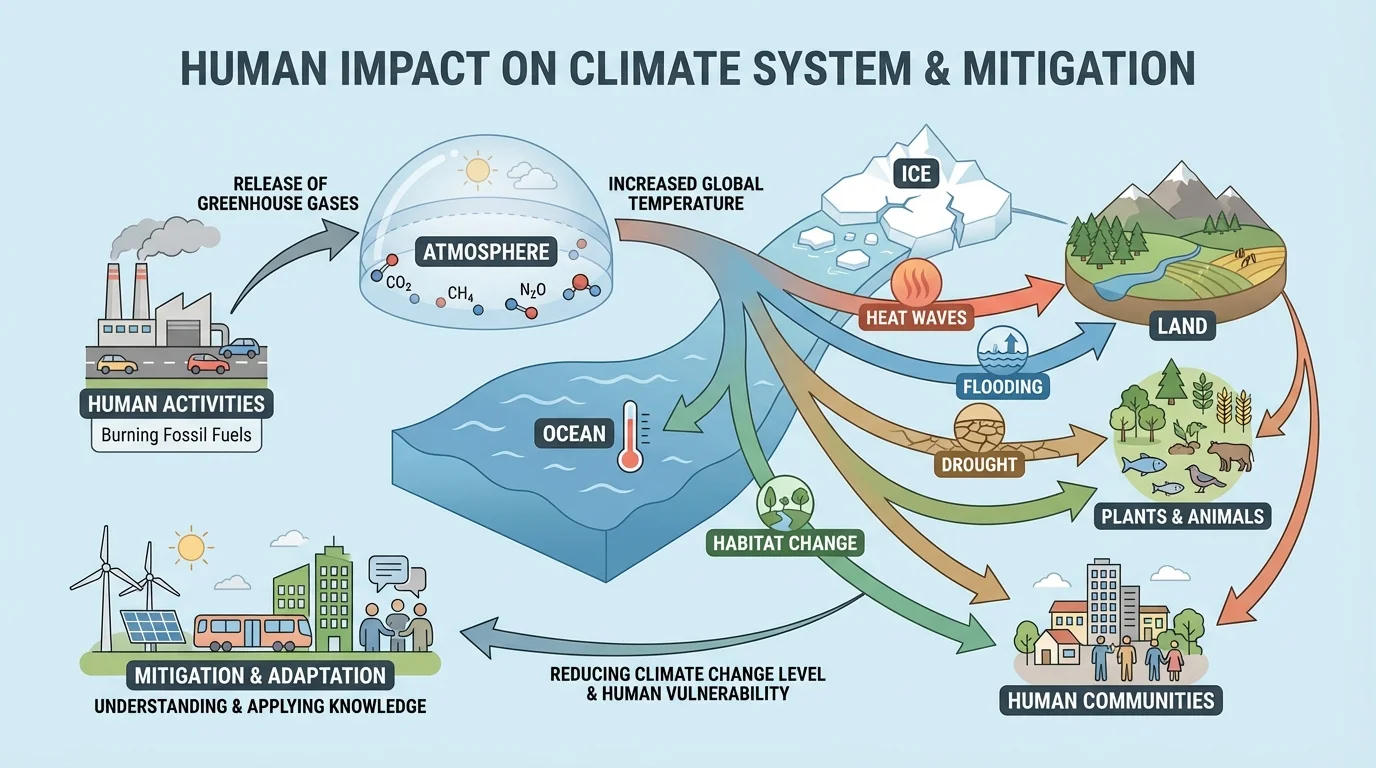
[Figure 4] shows how strongly Earth's major systems are connected as climate change affects them. The atmosphere changes as temperatures rise and weather patterns shift. The hydrosphere, which includes oceans, rivers, lakes, groundwater, and ice, changes as oceans warm, ice melts, and rainfall patterns move. The biosphere, the living world, changes as habitats shift and species face new stresses. The geosphere, Earth's land and rocks, can be affected through drought, erosion, wildfire damage, and thawing permafrost.
Because these systems interact, one change can trigger others. Warmer oceans can increase the energy available to some storms. Reduced snowpack can affect river flow in dry seasons. Drought can weaken forests, making them more vulnerable to fire and pests. Coastal flooding can damage roads, homes, wetlands, and freshwater supplies.
People do not all face the same risks. Vulnerability means how likely a person or community is to be harmed by a hazard. A community with strong buildings, reliable warning systems, clean water, and access to health care is usually less vulnerable than a community without those supports. Age, income, location, and resources all affect vulnerability.
Heat waves are a clear example. Higher average temperatures make very hot days more likely in many places. Heat can be especially dangerous in cities where pavement and buildings absorb and release heat, creating urban heat islands. Elderly people, very young children, outdoor workers, and people without air conditioning may face greater risk.
Food and water systems can also be affected. Some crops may grow better in some places for a time, but many regions face more drought, intense rainfall, heat stress, or shifting growing seasons. Fisheries can change as ocean temperatures and acidity change. Water supplies can become less reliable where snow and ice normally store water for warmer months.
| Earth system or human area | Possible climate-related change | Example |
|---|---|---|
| Atmosphere | More frequent heat waves | Higher risk of heat illness |
| Oceans | Warming and expansion | Sea level rise |
| Ice | Melting glaciers and ice sheets | Less stored freshwater in some regions |
| Ecosystems | Habitat shifts | Species move toward cooler areas |
| Human communities | Flooding, drought, fire risk | Damage to homes, crops, and roads |
Table 1. Examples of how climate change can affect Earth's systems and human society.
The linked changes in [Figure 4] help explain why climate change is more than just "warmer weather." It affects water, food, ecosystems, health, transportation, and where people can safely live.
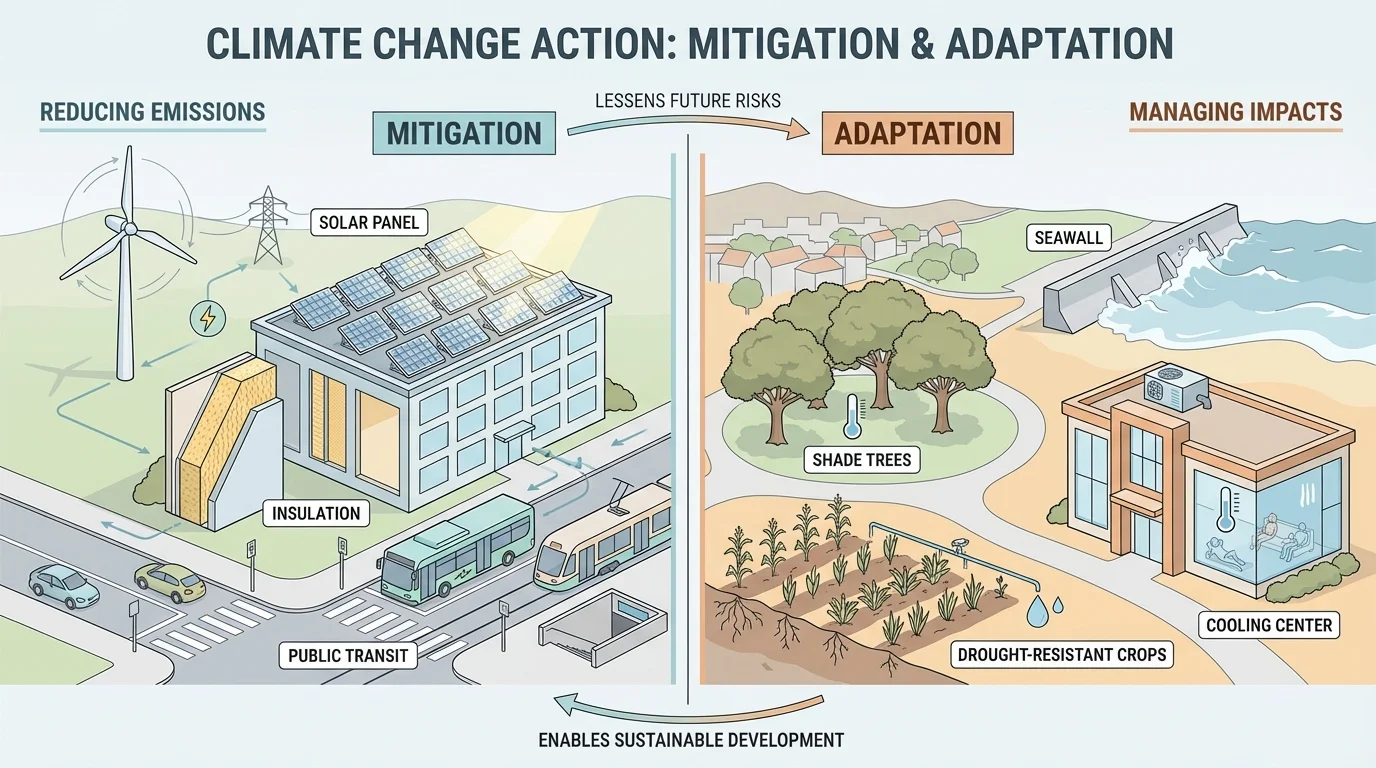
[Figure 5] shows that to reduce the level of climate change, societies focus on mitigation, which means limiting the causes of warming. This includes using energy sources that release little or no greenhouse gases, such as solar, wind, hydropower, and nuclear power. It also includes improving energy efficiency so that homes, schools, factories, and vehicles use less energy to do the same jobs.
Engineering plays a major role here. Engineers design better batteries, electric buses, insulated buildings, smart power grids, more efficient appliances, and machines that use less fuel. Scientists study which technologies work best, while engineers turn ideas into practical systems people can actually use.
Forests, wetlands, and healthy soils also matter because they can store carbon. Protecting ecosystems and restoring damaged ones can help remove some \(\textrm{CO}_2\) from the atmosphere. Scientists are also studying carbon capture technologies that try to trap \(\textrm{CO}_2\) from factories or directly from the air and store it underground.
Small changes can add up when millions of people take part. Saving electricity, wasting less food, using public transit, biking, walking, and choosing efficient products can reduce emissions. Still, large-scale solutions are essential too, because energy systems, transportation networks, and industry operate on a massive scale.
Simple emissions comparison
Suppose a school replaces \(10\) old light fixtures that each use \(100\) watts with new fixtures that each use \(20\) watts less.
Step 1: Find the energy reduction for one fixture.
Each fixture saves \(20\) watts.
Step 2: Multiply by the number of fixtures.
\(10 \times 20 = 200\), so the school reduces power use by \(200\) watts when all \(10\) lights are on.
Step 3: Connect the result to climate change.
If the electricity had come from burning fossil fuels, using less power would mean less fuel burned and less \(\textrm{CO}_2\) released.
Efficiency does not solve climate change by itself, but it is an important part of reducing emissions.
The technology shown in [Figure 5] demonstrates that reducing climate change is not just about sacrifice. It is also about redesigning systems to be cleaner, safer, and more efficient.
Some climate change is already happening, so societies also need adaptation. Adaptation means adjusting to actual or expected climate effects in ways that reduce harm. A coastal city might build seawalls, restore marshes, or raise important roads. A school district might install better cooling systems and change schedules during dangerous heat. Farmers might use drought-resistant crops or improved irrigation.
Adaptation is not admitting defeat. It is a practical response to real risks. If a community knows flooding is becoming more likely, planning ahead can save lives and money. Better forecasting, emergency alerts, stronger buildings, shaded public spaces, and reliable water systems all reduce vulnerability.
Earth's systems are connected. A change in one system, such as ocean warming, can affect weather, ecosystems, and human communities. That is why adaptation often requires looking at the whole system, not just one part.
Not every adaptation works equally well everywhere. Planting trees can cool cities, but the species chosen must fit the local climate. Building a seawall may protect one area but alter water flow somewhere else. Good adaptation uses science, local knowledge, and careful planning.
Reducing climate change and reducing human vulnerability both depend on knowledge. Climate science helps people understand what is happening and why. Engineering provides tools and designs that can reduce emissions and increase safety. Geography helps identify which places are most exposed. Economics helps compare costs and benefits. Public health helps protect people during heat waves, smoke events, or disease changes.
Understanding human behavior is also important. People do not make choices based only on facts. Habits, traditions, convenience, cost, trust, and access all matter. For example, a city can build bike lanes, but people are more likely to use them if they feel safe and if routes connect homes, schools, and jobs. A more efficient appliance helps only if families can afford it. A warning system saves more lives if people trust it and know how to respond.
This is why wise decision-making matters. Scientific knowledge can identify a problem, but solutions succeed only when people apply knowledge thoughtfully. Communities need accurate information, fair planning, and cooperation. Leaders, engineers, scientists, families, and students all have roles to play.
"The climate system does not care what people believe about it. It responds to energy, matter, and physical laws."
One important lesson from climate change is that human actions can influence Earth on a global scale. That may sound alarming, but it also means human choices can improve the future. The same creativity that built modern energy and transportation systems can be used to build cleaner and more resilient ones.
