Your body contains trillions of tiny living units, and every tree, mushroom, goldfish, and bacterium is built from the same basic idea: the cell. That is surprising because a whale and a microscopic bacterium seem to have almost nothing in common. Yet both are alive because they are made of cells, and cells are the smallest structures that can carry out all the activities needed for life.
Scientists learned this only after microscopes improved enough to reveal a hidden world. Once people could actually see cells, biology changed forever. Instead of thinking of living things as solid, unbroken material, scientists realized that life is organized into tiny compartments that take in materials, use energy, respond to surroundings, and reproduce.
Understanding cells helps explain how a scraped knee heals, why antibiotics can fight some infections, how plants make food from sunlight, and why growth happens from the inside out. Cells are not just small parts of an organism. They are the working units that make life possible.
Living things share certain characteristics. They use energy, grow, respond to the environment, maintain internal balance, get rid of wastes, and reproduce. A rock can grow larger if mud sticks to it, but it does not use energy or respond as a living system. A cell, however, can do all of those life functions in some form.
This is why biologists say a cell is the smallest unit of life. Molecules such as water, proteins, fats, and DNA are important parts of living things, but by themselves they are not alive. Even a large molecule like DNA cannot gather food, remove waste, or reproduce on its own outside a cell. Life begins at the level of the cell.
Cell means the smallest unit that can be said to be alive. A cell can take in materials, use energy, respond to its surroundings, and produce new cells.
Organism means any living thing. An organism may be made of one cell or many cells.
Some organisms are made of only one cell, but that single cell still performs every job needed for survival. Other organisms are made of many cells that divide the work among them. In both cases, the basic rule stays the same: if it is alive, it is made of cells.
Over time, observations from many scientists led to a powerful explanation called the cell theory. This theory is one of the most important ideas in biology because it unites all living things under one pattern.
The cell theory has three main ideas. First, all living things are made of one or more cells. Second, the cell is the basic unit of structure and function in living things. Third, all cells come from preexisting cells. In other words, new cells do not suddenly appear from nonliving material. They come from cells that already exist.
This matters because it explains both continuity and change in life. When you grow taller, your body is not making brand-new life from nowhere. Existing cells divide, producing new cells. When a cut heals, cells near the injury divide and replace damaged cells. When bacteria multiply, one bacterial cell divides into two.
Some cells in the human body live only a short time, while others can last for years. Skin cells are replaced often, but many nerve cells can survive for a very long time.
The cell theory also helps scientists study diseases. If all cells come from other cells, then problems in cell division, cell communication, or cell damage can help explain illnesses such as cancer, infections, and inherited disorders.
[Figure 1] Although cells come in many shapes and sizes, most share some basic features. A cell membrane forms the boundary around the cell and helps control what enters and leaves. Inside is the cytoplasm, a jelly-like material where many activities happen. Cells also contain genetic material, the instructions that guide cell activities and reproduction.
You can think of a cell as a tiny, active factory. Materials come in, useful products are made, waste is removed, and instructions are followed. But unlike a factory, a cell can also grow, respond, and create new cells.
The membrane is especially important because cells must stay separate from the outside environment while still exchanging materials with it. Water, oxygen, food molecules, and wastes move in and out in controlled ways. If the membrane failed, the cell could no longer maintain the conditions needed for life.
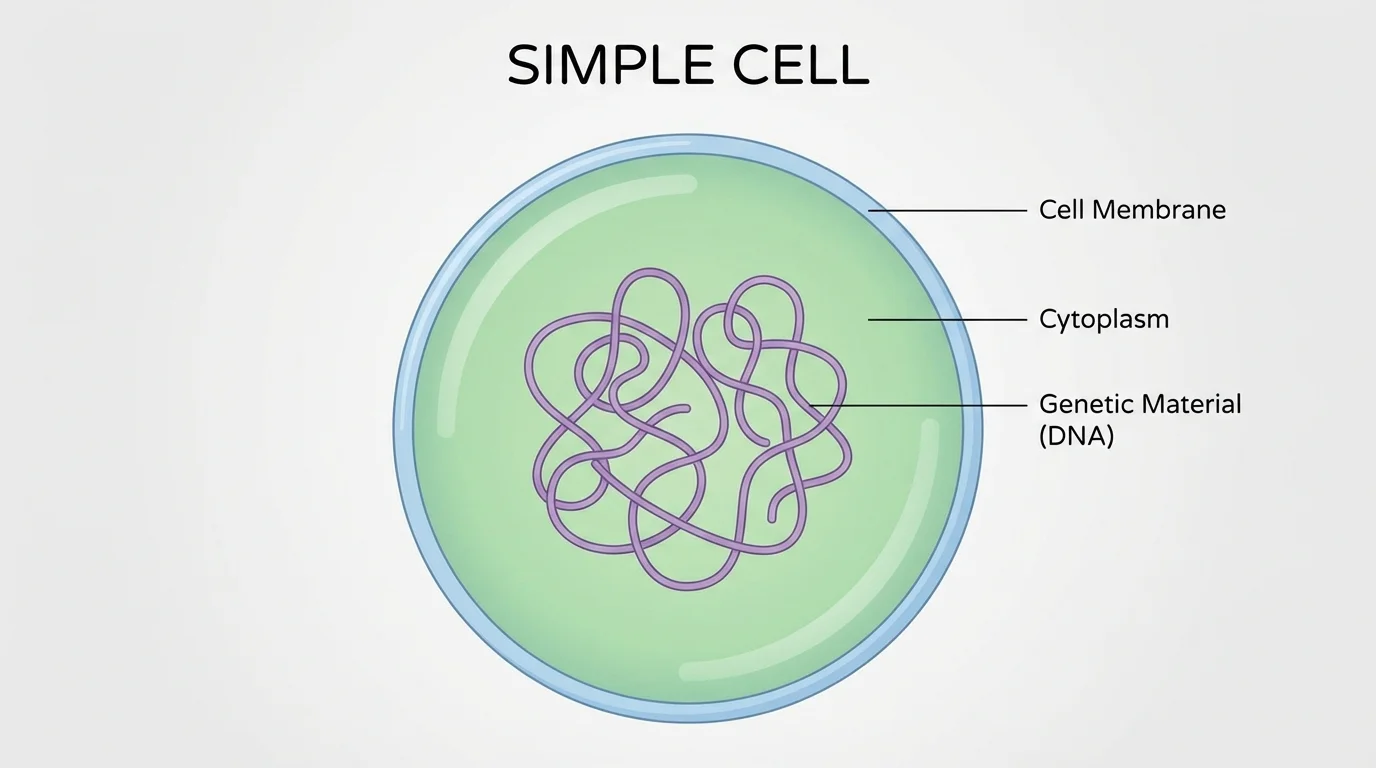
Cells are usually very small. Most are too small to see without a microscope. Their small size is actually helpful because it allows materials to move into and out of the cell more efficiently. If a cell becomes too large, it becomes harder for all parts of the cell to get what they need quickly enough.
Even though cells are tiny, they are highly organized. They are not empty bubbles. They contain structures that carry out specific tasks, and those tasks allow the entire organism to survive.
Life exists in two major organizational patterns: unicellular organisms are made of one cell, and multicellular organisms are made of many cells. This difference affects how organisms live, grow, and interact with their environments.
[Figure 2] A unicellular organism must do everything within a single cell. It must obtain food, use energy, respond to danger, remove waste, and reproduce. Bacteria, many protists, and some yeasts are examples. One cell may be tiny, but it can still constitute a complete organism.
Multicellular organisms, such as humans, dogs, oak trees, and mushrooms, are made of many cells. In these organisms, cells often specialize. Instead of every cell doing every job, different cells take on different roles. Some cells move the body, some carry oxygen, some absorb water, and some protect against disease.
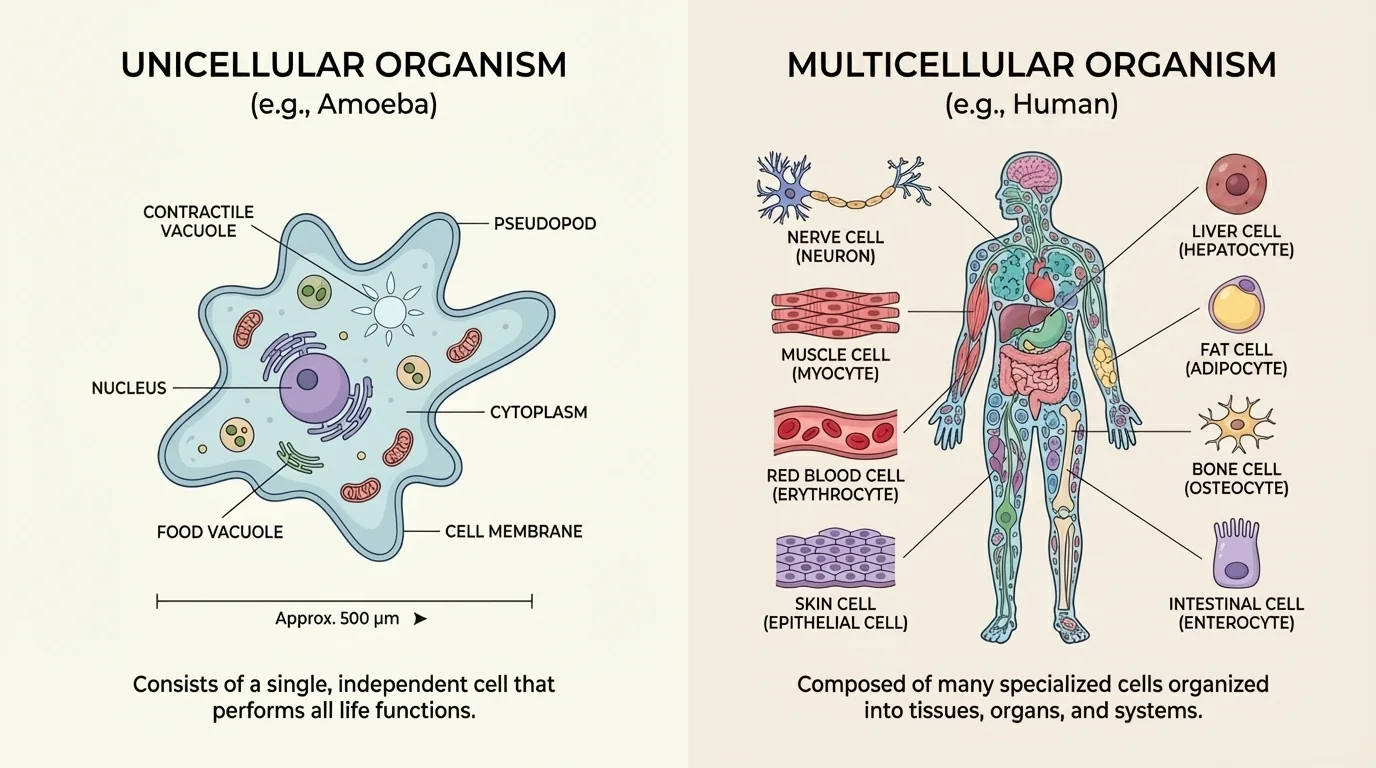
There are advantages to being multicellular. Larger body size can help an organism avoid predators or reach more resources. Specialization also makes life more efficient because cells can become very good at one job. But multicellular life requires coordination. Cells must communicate and work together.
Being unicellular also has advantages. Single-celled organisms can reproduce quickly, often adapt fast to changing conditions, and need fewer resources than large organisms. This is one reason bacteria can live in so many environments, from soil to deep ocean vents to your own digestive system.
Why specialization matters
In a multicellular organism, no single cell usually carries out every task for the whole organism. Instead, groups of specialized cells cooperate. This division of labor makes complex bodies possible, but it also means cells depend on one another.
The contrast between one-celled and many-celled life also helps explain why the same basic unit can support so much diversity. The single cell of a bacterium and the trillions of cells in a human body follow the same basic principle of life, even though their complexity is very different.
In multicellular organisms, cells become specialized to carry out particular functions. A muscle cell can shorten to produce movement. A nerve cell can send signals over long distances. A red blood cell carries oxygen. In plants, root hair cells absorb water and minerals, while leaf cells capture light for photosynthesis.
Specialized cells have shapes and structures that match their jobs. A nerve cell is long and branched, helping it connect with many other cells. A red blood cell has a shape that helps it travel through blood vessels and carry gases. This connection between structure and function is a major theme in biology.
Specialization does not mean the cells are unrelated. Nearly all of the cells in your body contain the same DNA, but different genes are active in different cell types. That is why one cell becomes part of your skin while another becomes part of your heart.
Real-world example: Healing a cut
A small cut in the skin shows how specialized cells work together.
Step 1: Blood cells help stop bleeding by forming a clot.
Step 2: Immune cells move in to fight germs that could cause infection.
Step 3: Skin cells divide to replace damaged tissue.
Step 4: The wound closes as tissue is repaired.
No single cell type can do all of this alone. Healing depends on cooperation among many specialized cells.
This cooperation is one reason injuries and diseases can affect the whole body. If certain cells fail to do their jobs properly, tissues and organs may stop working as they should.
Not all cells are built in exactly the same way. Scientists often divide them into two broad groups: prokaryotic cells and eukaryotic cells.
Prokaryotic cells are simpler and usually smaller. Bacteria are prokaryotic. Their genetic material is not enclosed in a nucleus. Even so, they are fully alive and can carry out all the basic functions of life.
Eukaryotic cells are more complex. Plants, animals, fungi, and protists have eukaryotic cells. Their genetic material is enclosed in a nucleus, and they contain other internal structures that help with different jobs.
| Feature | Prokaryotic Cells | Eukaryotic Cells |
|---|---|---|
| Typical size | Usually smaller | Usually larger |
| Nucleus | No nucleus | Has nucleus |
| Examples | Bacteria | Plants, animals, fungi, protists |
| Complexity | Simpler internal structure | More complex internal structure |
Table 1. Comparison of the two major kinds of cells.
Simple does not mean unimportant. Bacteria play huge roles in ecosystems, in decomposition, in the nitrogen cycle, in food production, and in human health. Your body contains large populations of helpful bacteria, especially in your digestive system.
Plant and animal cells are both eukaryotic cells, but they are not identical.
Their similarities and differences, shown clearly in [Figure 3], connect directly to what plants and animals need to do in everyday life.
Both plant and animal cells have a nucleus, a cell membrane, cytoplasm, and other internal structures. These shared parts support the basic processes of life. Both must obtain energy, grow, respond, and reproduce.
Plant cells also have a cell wall, which provides extra support outside the membrane. Many plant cells have chloroplasts, the structures that carry out photosynthesis. They often contain one large vacuole, which stores water and helps keep the cell firm.
Animal cells do not have cell walls or chloroplasts. Their shapes are often more flexible. Because animals get food by eating rather than making it from sunlight, they do not need chloroplasts.
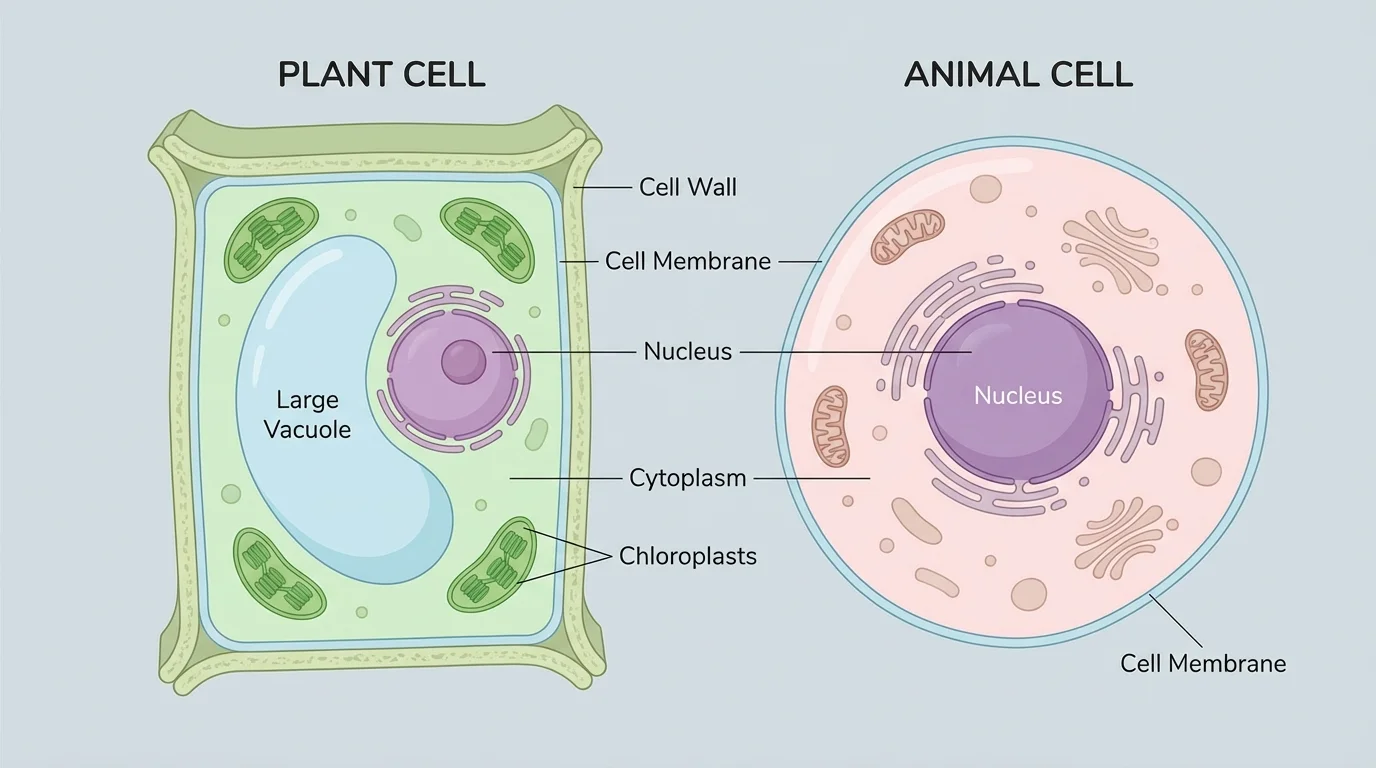
These differences match the needs of the whole organism. Many plants must maintain an upright structure and make food from light, so rigid cell walls and chloroplasts are useful. Animals move around and obtain food from other organisms, so flexible cells fit their way of life better.
Photosynthesis uses light energy to help make sugar in plant cells. Chloroplasts are the structures where this process happens, and the process uses substances such as \(CO_2\) and \(H_2O\) to help produce \(C_6H_{12}O_6\) and \(O_2\).
When you compare plant and animal cells again later, the pattern remains useful: shared structures show what all eukaryotic cells need, while differences show how form matches function.
In multicellular organisms, organization builds upward from cells. Similar cells working together form a tissue. Different tissues combine to form an organ. Organs work together in organ systems, and all the systems together make the organism.
[Figure 4] For example, muscle cells form muscle tissue. Muscle tissue is part of the heart, which is an organ. The heart works with blood vessels and blood in the circulatory system. That system is part of the entire human body.
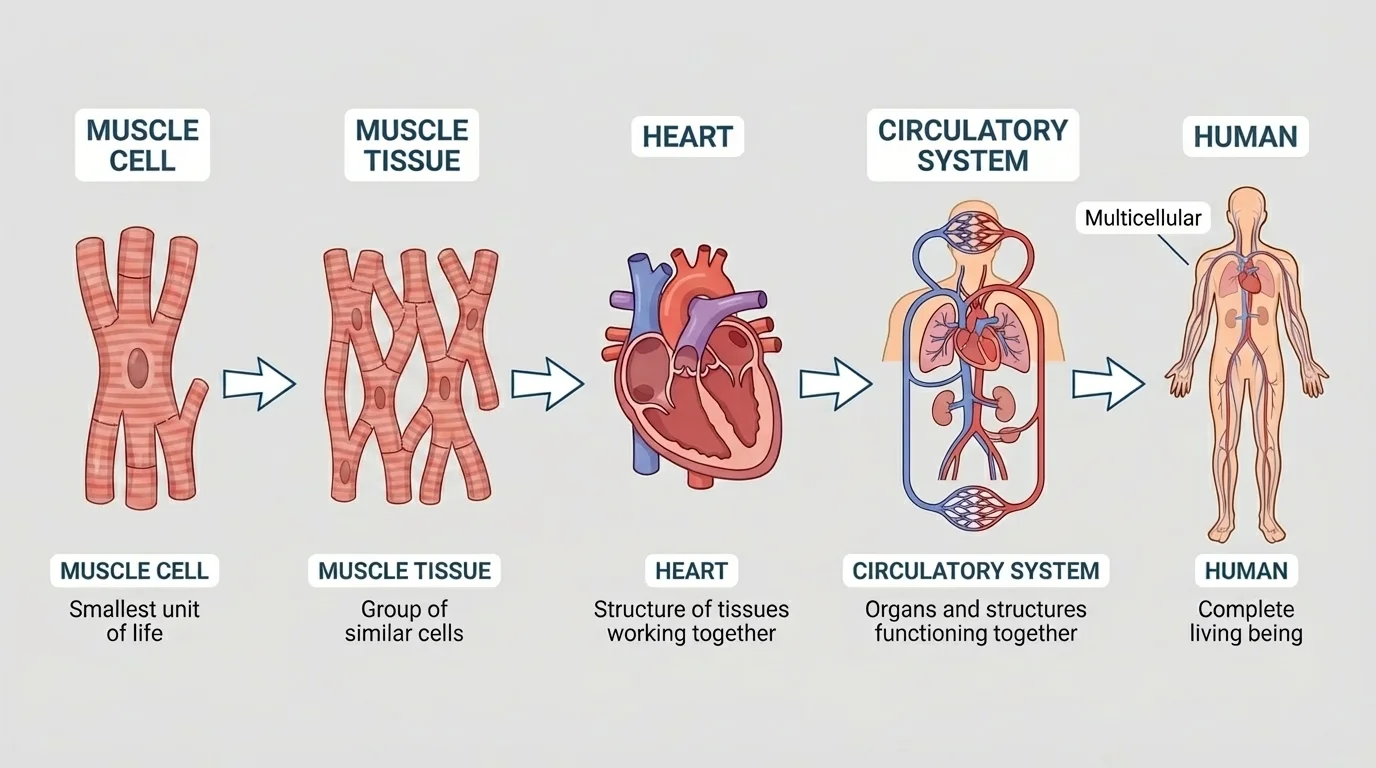
Plants also show levels of organization. Cells form tissues such as xylem and phloem. These tissues help make organs such as roots, stems, and leaves. Together these structures allow the whole plant to survive, transport materials, and grow.
This layered organization allows large organisms to function efficiently. Instead of every cell acting alone, cells are arranged into systems that handle transport, support, protection, movement, and many other jobs.
Cells are always active. They take in materials, transform energy, build molecules, and remove wastes. In animals, cells use oxygen and food molecules to release energy. In plants, many cells use chloroplasts to capture light energy and store it in sugars.
Cells also communicate. A body cell must know when to divide, when to stop dividing, and how to respond to signals from nearby cells. This communication helps tissues stay organized. When communication breaks down, serious problems can result.
One important process is cell division, in which one cell produces new cells. Cell division allows growth, repair, and reproduction. A growing child becomes taller because many cells divide. A broken bone heals because cells divide and rebuild tissue. A single-celled organism reproduces when its cell divides.
Why cells stay small
A smaller cell has a higher surface-area-to-volume ratio than a larger one. That means materials can move into and out of the cell more effectively. Instead of growing endlessly larger, cells usually divide when they reach a certain size.
This is another reason the cell is the fundamental unit of life. Life depends on constant exchange with the environment, and cells are shaped and sized in ways that make that exchange possible.
Cell biology is not just a topic for textbooks. Doctors examine blood cells to look for disease. Farmers study plant cells to improve crops. Microbiologists identify bacteria in food and water. Researchers test medicines by observing how they affect cells.
If you look at a thin onion skin or the inside of your cheek under a microscope, you can observe real cells. Onion cells often appear like tiny boxes because of their cell walls. Cheek cells usually look more rounded because they do not have cell walls. Observing these cells makes the idea of living structure much more concrete.
Simple observation example
A microscope slide of onion tissue helps reveal that plants are made of many cells.
Step 1: A very thin layer of onion skin is placed on a slide.
Step 2: A drop of stain may be added to make structures easier to see.
Step 3: Under the microscope, many boxlike cells become visible.
Step 4: The repeated pattern shows that the tissue is made of individual cells, not one solid sheet.
This observation supports the idea that all living things are made of cells.
Modern medicine also depends on understanding cells. Vaccines prepare immune cells to respond to pathogens. Cancer treatments often target cells that divide uncontrollably. Tissue engineering aims to grow replacement tissues from living cells.
Scientists can grow some cells outside the body in special dishes. This allows them to study diseases, test medicines, and learn how cells behave under different conditions.
The more scientists understand cells, the better they can explain health, disease, growth, inheritance, and the relationships among living things.
One common misunderstanding is that bigger organisms have bigger cells. Usually, larger organisms have more cells, not much larger ones. The cells in an elephant are not enormously bigger than the cells in a cat.
Another misunderstanding is that all cells look alike. In reality, cells vary widely in shape, size, and function. A bacterial cell, a leaf cell, and a nerve cell may look very different, but all are still cells because they carry out life processes.
Some people also think a single-celled organism is simple in every way. But many unicellular organisms can sense light, move toward food, avoid danger, and reproduce rapidly. A single cell can be remarkably capable.
Finally, it is incorrect to say that nonliving things are made of cells. Wood in a living tree contains cells because it comes from a living organism. But a plastic bottle or a rock is not cellular and was never alive.
"All living things are made of cells, and cells come from cells."
— A core principle of modern biology
Once you understand this principle, many other parts of biology begin to make sense. Growth, healing, reproduction, inheritance, and specialization all depend on what cells are and what cells do.
