Your brain is sealed inside a dark, silent skull, yet it can tell whether a basketball is flying toward you, whether soup is too hot, and whether something smells burnt. That is only possible because your body is packed with tiny detectors called receptors. These specialized cells or nerve endings gather information from the outside world and from inside your body, then send messages to the brain at amazing speed.
Everything you see, hear, taste, smell, or feel begins when a receptor picks up a certain kind of input. Some receptors detect light. Others detect pressure, motion, or vibration. Others detect chemicals in the air or in food. The brain does not receive light beams or smells directly. Instead, it receives electrical signals carried by nerve cells and interprets them.
A stimulus is any change in the environment that can be detected by a receptor. A flash of lightning, pressure from a shoe on your foot, the smell of popcorn, or the sting of cold air on your face are all stimuli.
Sense receptor means a specialized cell or nerve ending that responds to a certain kind of stimulus. Sensory input is the information gathered by receptors. Signal means the electrical message that travels through nerve cells to the brain or spinal cord.
Scientists often group important sensory inputs into three broad categories. Electromagnetic inputs include light, which your eyes detect. Mechanical inputs include pressure, touch, stretching, vibration, and sound waves. Chemical inputs include molecules from food or air that activate taste and smell receptors.
These categories help explain why your senses are not all built the same way. The eye must capture light energy. The ear must detect vibrations. The nose and tongue must interact with specific chemicals. A single receptor cannot do all of these jobs well, so living things have many specialized receptors.
Different organs contain different receptor cells. This is why your eye can detect color but your skin cannot, and why your nose can detect the scent of smoke but your ear cannot. The body uses specialization so that each receptor type is best suited for one kind of input.
The main receptor groups include photoreceptors for light, mechanoreceptors for pressure and movement, and chemoreceptors for chemicals. There are also receptors for temperature and pain. Together, these systems help the body survive by noticing useful and dangerous changes quickly.
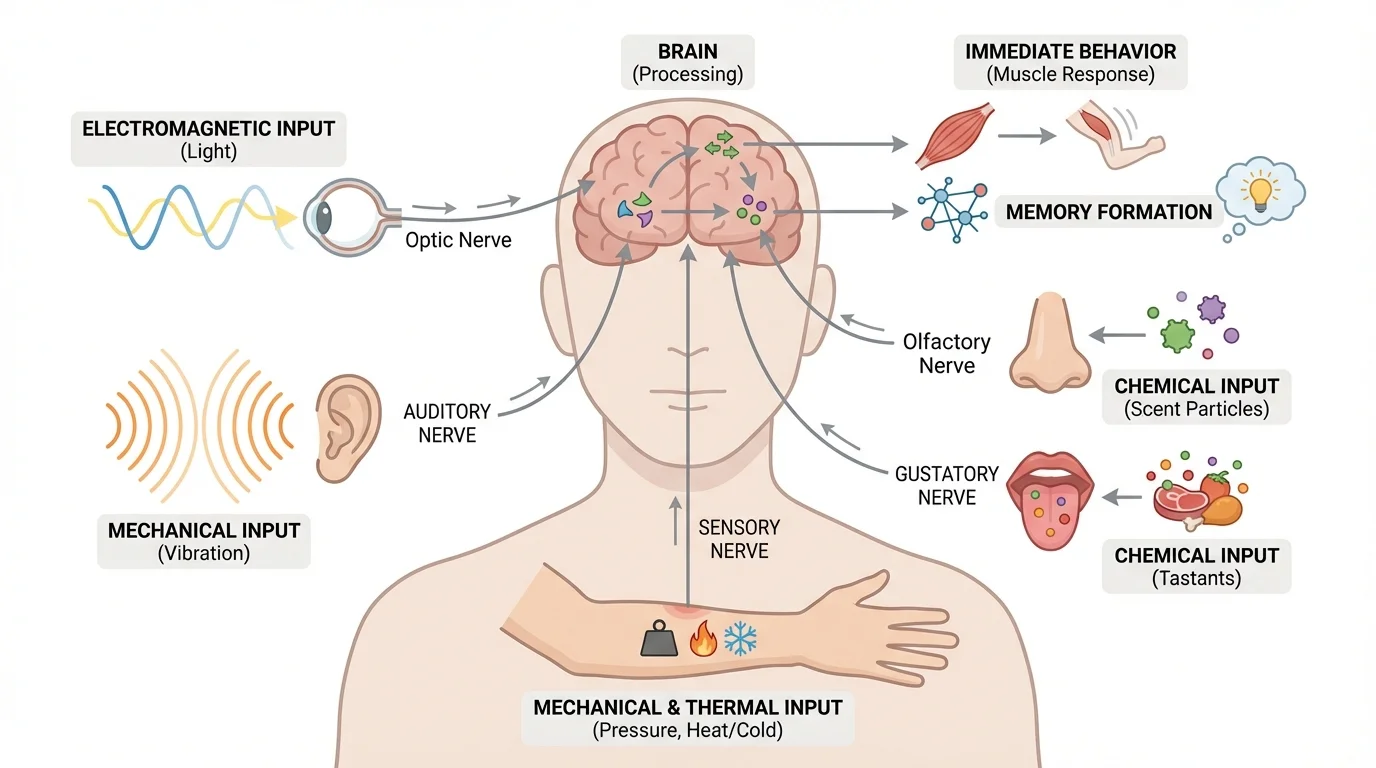
Think about catching a ball. Your eyes detect its movement, your ears may hear teammates calling, your skin senses the grip of the ball, and receptors in your muscles and joints detect body position. Many receptors work together, but each starts with its own special kind of input.
Receptor specialization also helps organisms interact with their environments. A nocturnal animal may have eyes that are especially sensitive to low light. A shark has receptors that can detect tiny movements in water. Humans have especially developed vision, touch sensitivity in the fingertips, and a strong ability to combine information from several senses at once.
Some snakes can detect infrared radiation from warm prey, giving them a kind of heat-sensing ability. This shows that living things can evolve receptor systems that fit their environments very closely.
The same idea applies to people: receptors are tools that match the job. As shown earlier in [Figure 1], the body is not using one general-purpose detector. It is using a network of organs and cells, each tuned to a particular kind of information.
The path from a stimulus to a response follows a clear pattern. First, a receptor detects a stimulus. Next, the receptor converts that stimulus into an electrical message. Then that message travels along a nerve cell to the spinal cord and brain. Finally, the brain processes the information and may trigger a behavior.
This conversion step is called transduction. In transduction, a receptor changes one form of energy or chemical interaction into an electrical signal that neurons can carry. For example, light hitting the retina becomes a nerve signal, and pressure on the skin becomes a nerve signal. Different stimuli begin differently, but they all end up in a form the nervous system can use.
Neurons are nerve cells specialized to send signals. They communicate using tiny electrical changes across their membranes and chemical signals at connections called synapses. The brain does not "see light" directly or "hear sound" directly. It interprets patterns of incoming nerve signals.
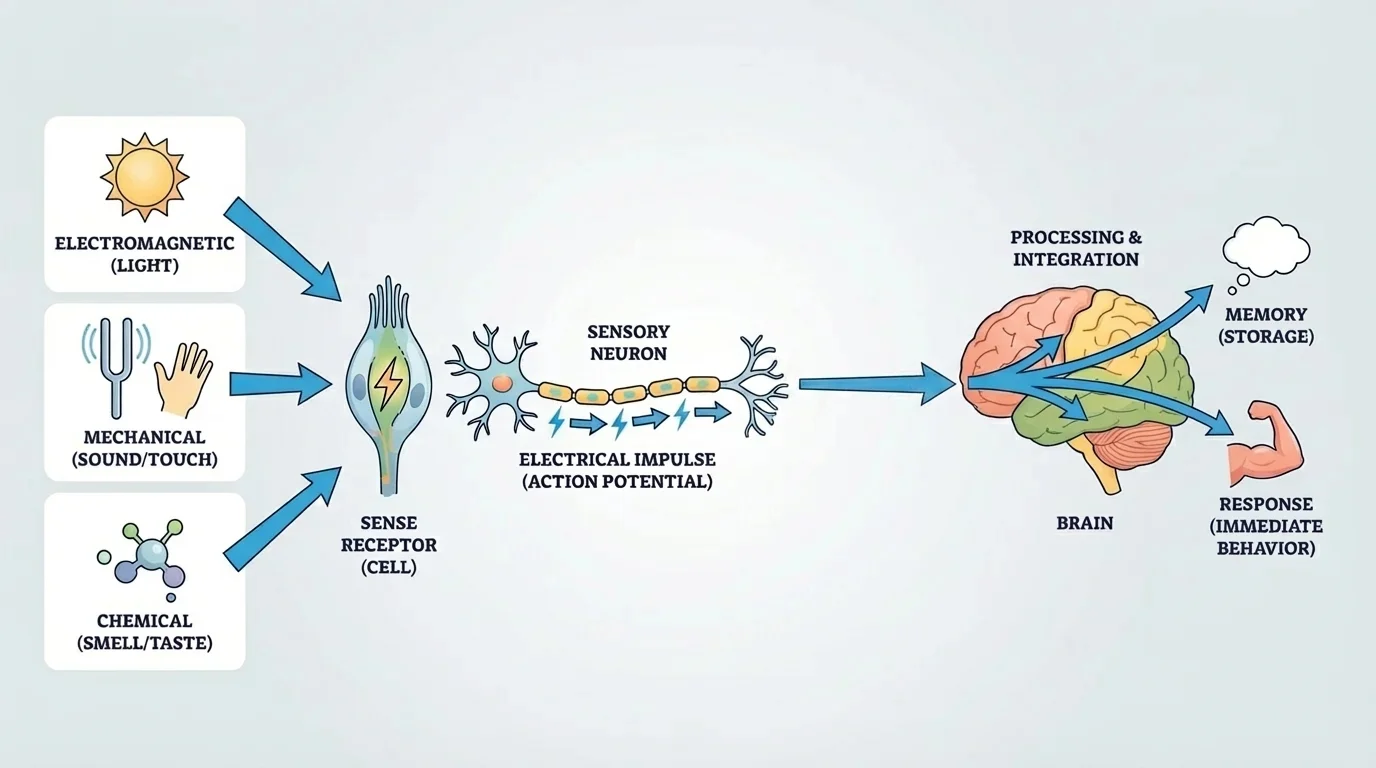
You can compare this to a phone camera. The camera sensor detects light, changes it into electronic data, and software turns that data into an image on the screen. Your sensory system also detects raw input and converts it into signals. The brain then makes sense of those signals.
Why all sensory messages become electrical
The body needs one common "language" for communication. Light, vibration, and chemicals are very different in the outside world, but the nervous system can process them efficiently once receptors convert them into electrical patterns. What differs is which receptor fired, how strongly it fired, and where the signal traveled in the brain.
This is why a signal from the eye feels like vision while a signal from the ear feels like sound. The type of experience depends not only on the signal itself but also on the receptor that started it and the brain area that receives it. Later, when we discuss brain processing, [Figure 2] remains useful because it connects every sense to the same general pathway.
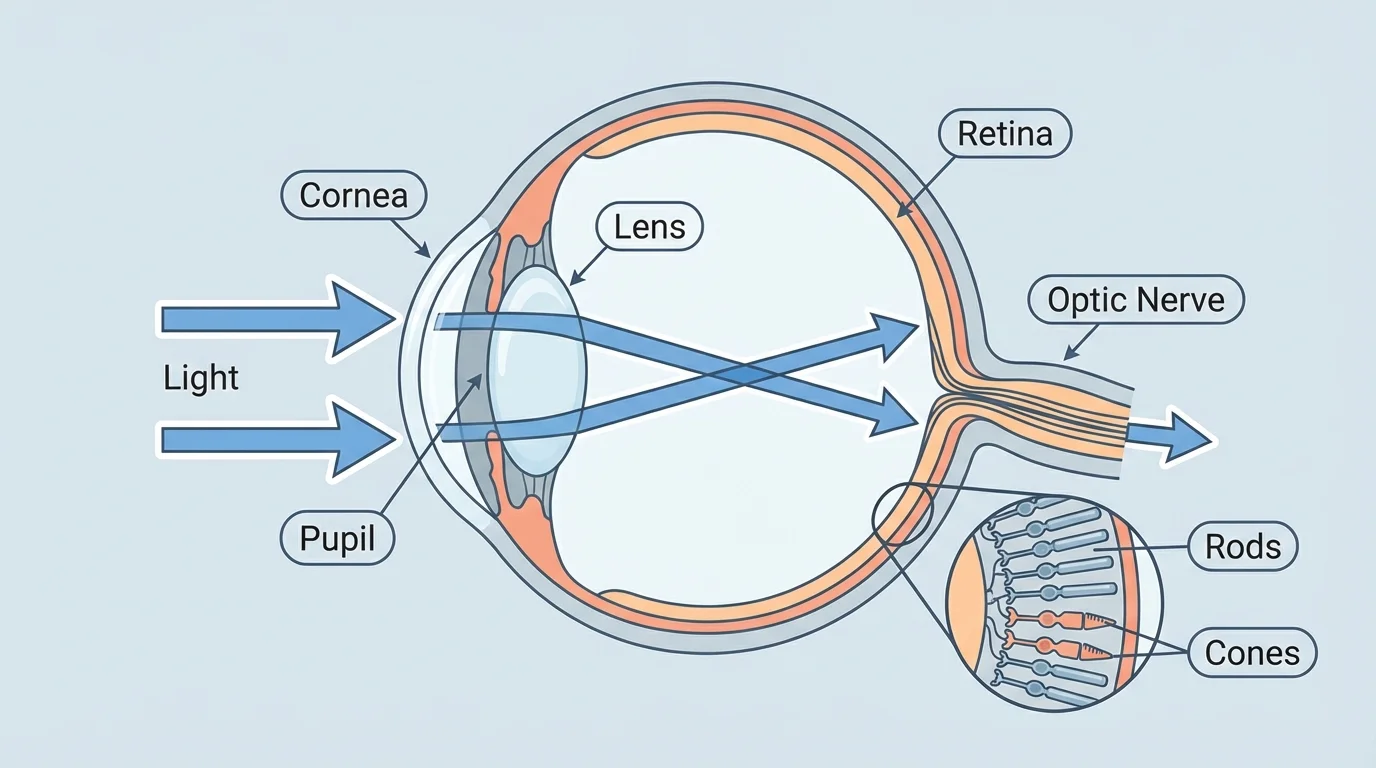
Your eyes detect a tiny part of the electromagnetic spectrum called visible light. The basic parts of the eye and the path of light help explain how vision begins. Light enters through the cornea, passes through the pupil, is focused by the lens, and reaches the retina at the back of the eye.
The retina contains photoreceptors. Two major kinds are rods and cones. Rods are very sensitive to dim light and help you see in low-light conditions, but they do not detect color well. Cones work best in brighter light and allow color vision and sharp detail.
When light hits these receptors, transduction occurs. The photoreceptors change the light input into electrical signals. Those signals travel along the optic nerve to the brain, where they are processed into shapes, colors, movement, and depth.
This process explains why bright sunlight can feel overwhelming after being in a dark room. Your receptors and brain have adjusted to dim conditions, so sudden strong light causes a rapid change in signaling. After a short time, the system adapts again.
Vision also shows that the brain is an active interpreter. Your eyes may detect lines, brightness, and color, but the brain puts them together into meaningful objects. When you recognize a friend across a field, that is not the eye acting alone. It is the brain organizing and identifying the signal pattern.
Real-world example: reacting to a flying ball
Step 1: Light reflected from the ball enters the eyes and reaches the retina.
Step 2: Photoreceptors convert the light into electrical signals.
Step 3: Signals travel through neurons to the brain, which judges speed and direction.
Step 4: The brain sends commands to muscles so the hands move into position.
A fast catch depends on sensing, signal transmission, brain processing, and motor response working together.
The eye structure in [Figure 3] also helps explain nearsightedness and farsightedness. In those conditions, light is not focused properly on the retina, so the signal sent to the brain is less clear. Glasses or contact lenses help focus the light correctly before it reaches the photoreceptors.
Mechanical stimuli include pressure, stretch, vibration, and movement. The ear is a powerful example of how sound vibrations move through the ear to receptor cells. Sound waves enter the outer ear, vibrate the eardrum, and make tiny bones in the middle ear move. Those vibrations reach the cochlea in the inner ear.
Inside the cochlea are special hair cells, which are mechanoreceptors. Movement of fluid and tiny structures bends these cells. That bending starts electrical signals that travel to the brain, which interprets them as sound. Different vibration patterns become different pitches and volumes.
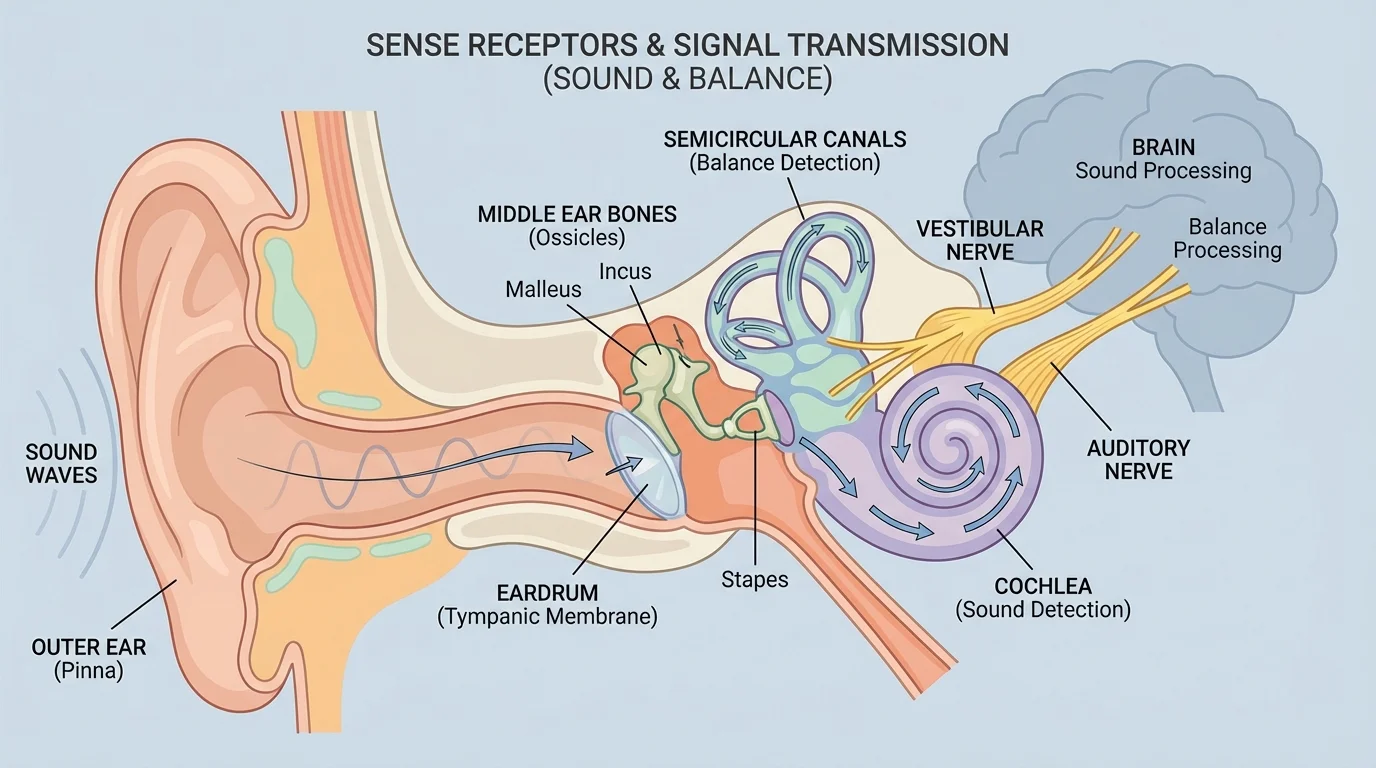
The inner ear also helps with balance. Semicircular canals detect head movement. If you spin around quickly and stop, the fluid in these canals keeps moving briefly, which can confuse the brain and make you feel dizzy.
Your skin also contains mechanoreceptors. Some respond to light touch, some to strong pressure, and some to vibration. This is why tapping your shoulder, hugging a friend, and feeling a buzzing phone all produce different sensations even though they all involve mechanical input.
Other receptors in the skin detect temperature and pain. Pain receptors help protect the body by signaling possible damage. Pulling your hand away from a hot pan often happens very fast because the nervous system can trigger a response before you even become fully aware of the sensation.
Your body has both the central nervous system, made of the brain and spinal cord, and the peripheral nervous system, made of nerves that carry messages to and from the rest of the body. Sensory signals travel inward, and motor commands travel outward.
This quick protective action is called a reflex. A reflex is an automatic response that happens rapidly, often through the spinal cord, before the brain fully processes the event. Later, the brain catches up, and you become conscious of what happened. The mechanical and pain pathways connected in [Figure 4] help explain why speed matters for survival.
Smell and taste begin when chemicals interact with receptors. In the nose, odor molecules enter with the air and bind to receptors high in the nasal cavity. In the mouth, chemicals from food dissolve in saliva and interact with taste receptors on the tongue.
These receptor cells are chemoreceptors because they respond to specific molecules. A receptor does not respond equally to every chemical. Its shape and molecular properties make it more likely to interact with certain substances. That selective matching is one reason why different foods and smells produce different patterns of signaling.
Taste is often described using a few major categories such as sweet, sour, salty, bitter, and savory, also called umami. But what people call "flavor" is usually a combination of taste and smell. If your nose is stuffed during a cold, food may seem bland because much of the chemical information from smell is missing.
Real-world example: why flavor changes during a cold
Step 1: Taste receptors on the tongue still detect chemicals from food.
Step 2: Fewer odor molecules reach receptors in the nose because mucus blocks airflow.
Step 3: The brain receives less chemical information overall.
Step 4: Flavor feels weaker, even if the food itself has not changed.
This shows that the brain combines signals from more than one sensory system.
Chemical sensing is important far beyond enjoying meals. Smell can warn you about smoke, spoiled food, or a gas leak. Taste can help animals avoid harmful substances; for example, many poisonous substances taste bitter. Receptors are part of survival, not just comfort.
The brain does far more than receive messages. It sorts, compares, and interprets them through pathways from different sense organs to different processing areas. Signals from different receptors travel to brain regions specialized for vision, hearing, touch, smell, and taste. The meaning of a signal depends on where it comes from, where it goes, and how the brain combines it with other information.
This processing can lead to immediate behavior. If you hear a sudden crash behind you, you may turn your head at once. If you feel a mosquito on your arm, you may swat it. If you smell smoke, you may stop what you are doing and look for danger. Fast responses help organisms stay safe.
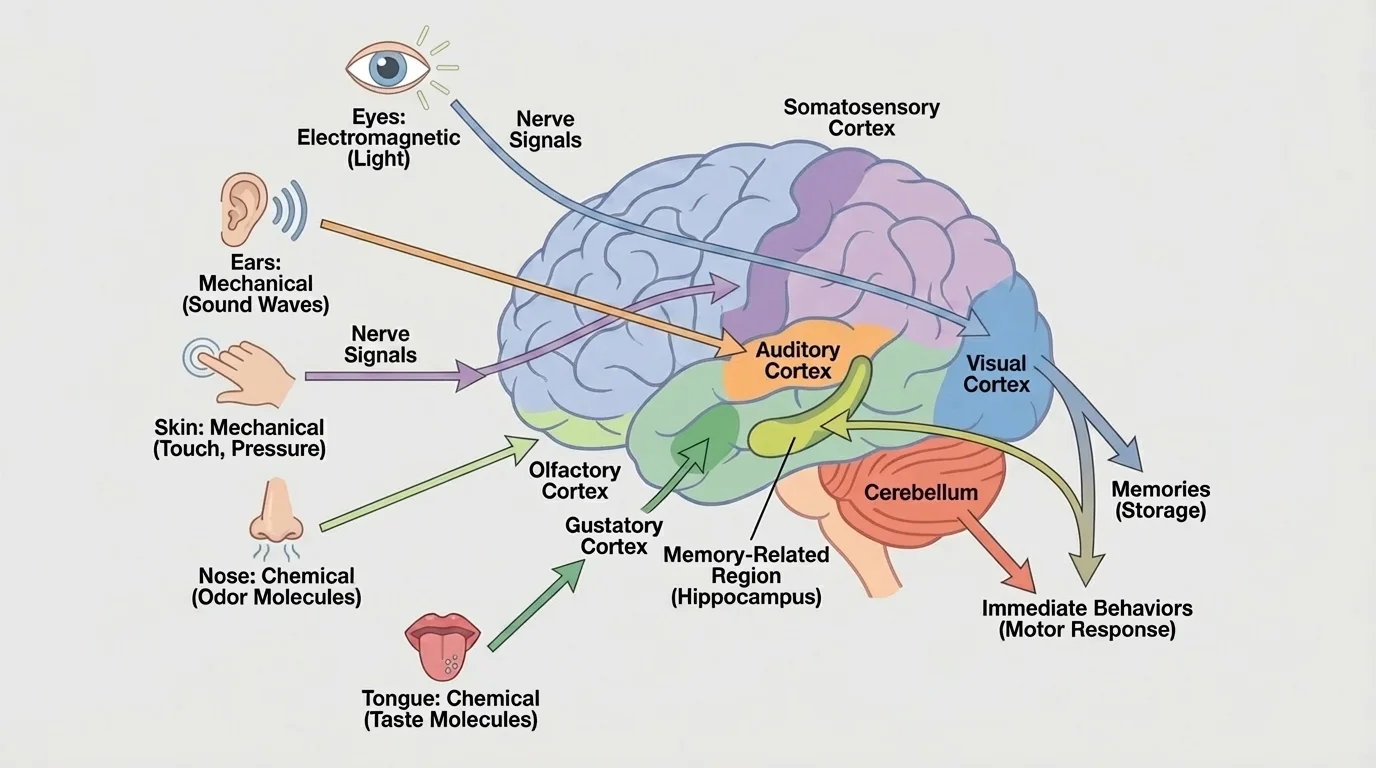
The brain also combines senses. Watching a drummer in a band, you expect the stick strike and the sound to match. In sports, athletes constantly combine visual information, balance signals, touch, and body-position signals. Smooth movement depends on this integration.
Sometimes the brain fills in missing information. Optical illusions work because the brain is making its best guess based on signal patterns. This does not mean the senses are useless. It means perception is an active process, not a simple recording.
Perception is constructed by the brain
Receptors detect pieces of information, but the brain organizes those pieces into a meaningful experience. What you consciously notice depends on attention, past experience, and how different sensory pathways interact. Two people can receive similar signals but pay attention to different details.
The processing map in [Figure 5] helps explain why damage to one brain area may affect a specific sense more than others. For example, injury to visual processing areas can interfere with seeing, even if the eyes themselves still detect light.
Not every sensory signal becomes a lasting memory. Your brain is receiving enormous amounts of information all day, so it must decide what matters. Signals that are repeated, unusual, emotional, or important for survival are more likely to be stored.
If you touch a hot stove once, the pain signal and the rapid response may become a strong memory. The next time you reach toward a hot surface, your behavior changes because the brain has connected sensation with experience. In this way, sensory systems help build learning.
Memory also improves recognition. The first time you hear a new song, it may seem unfamiliar. After repeated hearing, the brain stores the pattern, and you can identify it quickly. The same happens with faces, voices, smells, and places.
A smell can trigger memory very strongly because smell pathways connect closely with brain systems involved in emotion and memory. That is why a certain perfume, food, or campfire scent can suddenly bring back vivid experiences.
Immediate behaviors and memories are linked. The brain uses present sensory signals and past experience together. A soccer goalie reacting to a penalty kick is not relying only on what the eyes detect in that instant. Practice has built memories of movement patterns, speed, and timing that improve the response.
Sensory science matters in medicine, engineering, and everyday life. Doctors test reflexes to check nervous system health. Hearing tests examine how well mechanoreceptors and auditory pathways are working. Eye exams check whether light is being focused properly and whether the retina is healthy.
Technology is also inspired by sensory systems. Cameras model some features of vision, microphones model sound detection, and chemical sensors can detect dangerous gases. Scientists studying receptors can design better prosthetic devices, safer alarms, and improved treatments for sensory disorders.
You can observe sensory processing in simple ways. Close one eye and notice how judging distance changes. Rub your hands together and then touch a cool desk to compare temperature sensation. Hold your nose while tasting a food, then release it and notice how flavor changes. These observations remind us that sensation depends on receptor type, signal transmission, and brain interpretation.
Case study: touching a hot mug
Step 1: Heat and pressure receptors in the skin are activated when the hand touches the mug.
Step 2: Receptors convert the stimulus into electrical nerve signals.
Step 3: Signals travel through sensory neurons to the spinal cord and brain.
Step 4: A fast protective response may loosen the grip, while the brain identifies the mug as hot.
Step 5: The experience may be remembered, changing how the person handles hot drinks later.
This single event includes detection, transduction, signaling, processing, immediate behavior, and memory.
All of these examples point to one powerful idea: receptors do not simply collect information. They begin a chain of events that allows living things to respond, survive, learn, and interact with the environment in meaningful ways.
