Why does an empty shopping cart speed up so easily, while a full one seems stubborn? The answer connects to one of the most important ideas in physical science: the way an object's motion changes depends on both the forces acting on it and the object's mass. Scientists do not just memorize this idea. They test it with evidence. That means planning careful investigations where the motion happens in a straight line, measurements are clear, and only one thing changes at a time.
When scientists study motion, they need a shared way to describe what is happening. If one person says a cart moved "forward," everyone must agree on what "forward" means. That shared point of view is called a reference frame. In middle school investigations, this is usually simple: a straight track, a meterstick, and a chosen positive direction such as "to the right."
Motion is all around you. A soccer ball rolls faster after a stronger kick. A skateboard slows down because of friction. A heavy wagon takes more effort to get moving than a light one. These are not separate facts. They all connect to the same rule: if the total force on an object changes, the object's motion changes. If the mass changes, the amount of motion change also changes.
Learning to plan an investigation about this idea is powerful because science depends on evidence, not guesses. A good investigation helps you answer questions such as: What happens if the force increases but the mass stays the same? What happens if the mass increases but the force stays the same?
Force is a push or a pull. Motion can be described by speed and direction. If either speed or direction changes, the motion changes. In this topic, the motion stays in one dimension, which means along a single straight line such as left-right or forward-backward.
Because the investigation stays in one dimension, you do not need trigonometry or angled forces. That keeps the focus on the main relationship: stronger total force causes a bigger change in motion, and greater mass resists that change more.
When more than one force acts on an object, scientists look at the net force, which is the sum of all the forces with direction included. In a straight-line situation, forces in opposite directions can cancel. If the net force is zero, the object's motion does not change. If the net force is not zero, the object's motion changes.
[Figure 1] A force can make an object start moving, stop moving, speed up, slow down, or change direction. In this lesson, direction changes happen only along the same straight line. For example, a cart moving right might slow down if the net force points left, or speed up if the net force points right.
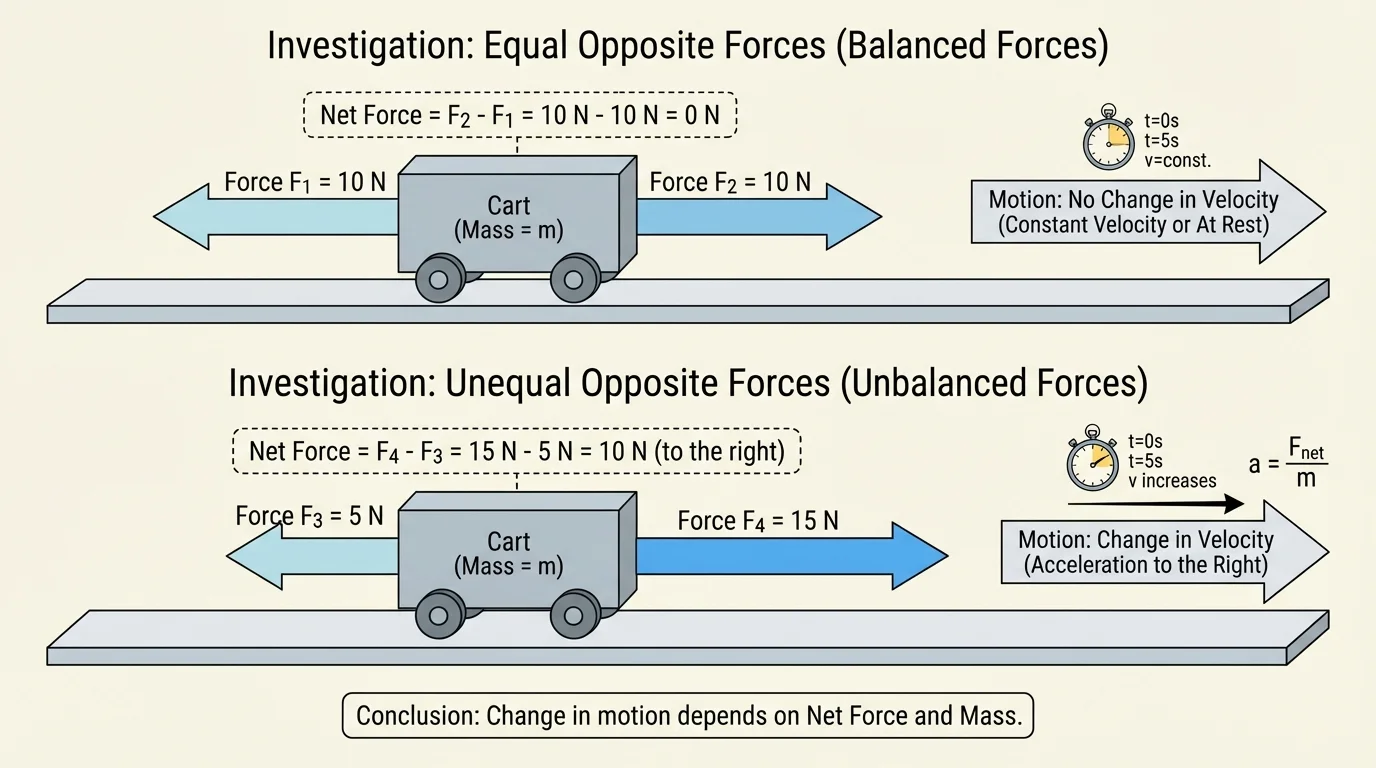
This idea can be described with a simple relationship:
\[a = \frac{F_{\textrm{net}}}{m}\]
Here, \(a\) is acceleration, which means the rate of change of velocity, \(F_{\textrm{net}}\) is net force, and \(m\) is mass. You do not need difficult algebra to understand the meaning. If \(m\) stays the same and \(F_{\textrm{net}}\) gets bigger, \(a\) gets bigger. If \(F_{\textrm{net}}\) stays the same and \(m\) gets bigger, \(a\) gets smaller.
Net force is the total force acting on an object after combining all forces in the same line of motion.
Mass is the amount of matter in an object and also a measure of how hard it is to change the object's motion.
Acceleration is how quickly velocity changes. In one-dimensional middle school investigations, this usually appears as speeding up, slowing down, or changing direction along a straight line.
Suppose a cart has a net force of \(4 \textrm{ N}\) and a mass of \(2 \textrm{ kg}\). Then its acceleration is \(a = \dfrac{4}{2} = 2 \textrm{ m/s}^2\). If the same cart has a net force of \(8 \textrm{ N}\), then \(a = \dfrac{8}{2} = 4 \textrm{ m/s}^2\). Doubling the force doubles the acceleration when mass stays the same.
Now keep the force at \(4 \textrm{ N}\), but change the mass to \(4 \textrm{ kg}\). Then \(a = \dfrac{4}{4} = 1 \textrm{ m/s}^2\). The bigger mass has a smaller change in motion. This matches what you feel when pushing something heavy.
The word inertia helps explain why mass matters. Objects with more mass have more inertia, which means they resist changes in motion more strongly. A small toy car is easy to speed up with a gentle push. A loaded cart needs a stronger push to get the same effect.
This does not mean heavy objects cannot move quickly. It means that, for the same force, the heavier object changes motion less. If you want a heavier object to have the same acceleration as a lighter one, you need a greater net force.
Seat belts are designed using this same idea. When a car stops suddenly, your body tends to keep moving because of inertia. The seat belt provides the force needed to change your motion safely.
The connection between force and mass becomes clear when you compare pairs of objects. If one cart has mass \(1 \textrm{ kg}\) and another has mass \(2 \textrm{ kg}\), and each one experiences the same net force of \(3 \textrm{ N}\), their accelerations are different. The first has \(a = \dfrac{3}{1} = 3 \textrm{ m/s}^2\). The second has \(a = \dfrac{3}{2} = 1.5 \textrm{ m/s}^2\). The smaller mass changes motion more.
A scientific investigation must be planned carefully. A good plan changes one variable at a time. If you change both force and mass at once, you cannot tell which one caused the change in motion.
[Figure 2] Every investigation should have a clear question. For this topic, two strong questions are: "How does changing net force affect the motion of an object if mass stays constant?" and "How does changing mass affect the motion of an object if net force stays constant?" Each question needs its own plan.
Scientists also identify variables. The independent variable is the factor you choose to change. The dependent variable is what you measure. Controlled variables are the things you keep the same so the test is fair.
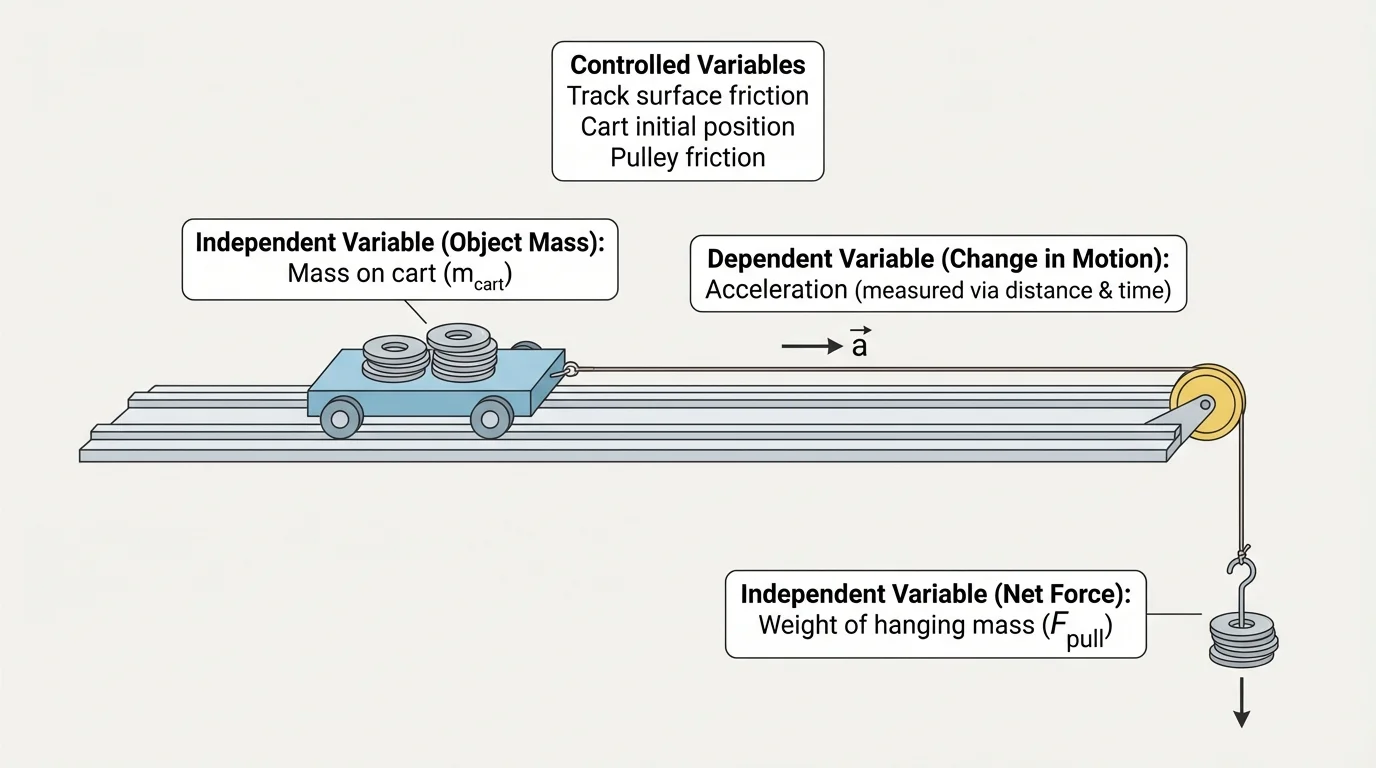
For example, if you are testing how force affects motion, the independent variable is force. The dependent variable might be acceleration, or it could be a simpler measurement connected to motion change, such as how much the speed changes in a fixed time. Controlled variables could include the same cart, same track, same starting point, and same method of measuring time and distance.
Evidence is strongest when measurements are repeated. One trial may have timing mistakes or a slightly uneven push. Three or more trials for each condition help you see the true pattern. Then you can calculate an average. For example, if three measured accelerations are \(0.8\), \(0.9\), and \(1.0 \textrm{ m/s}^2\), the average is \(\dfrac{0.8 + 0.9 + 1.0}{3} = 0.9 \textrm{ m/s}^2\).
What counts as evidence? In science, evidence is not just one observation. It is a pattern in measurements. If larger forces consistently lead to greater acceleration while mass stays the same, that pattern supports the claim that change in motion depends on net force. If larger masses consistently lead to smaller acceleration while force stays the same, that pattern supports the claim that mass matters too.
To make sure everyone describes motion the same way, choose a shared reference frame before starting. For instance, mark the track so that motion to the right is positive. Measure distance from the same zero point each time. This avoids confusion when comparing trials.
A middle school investigation often uses a cart on a straight track, a spring scale or rubber band pull, masses such as washers, a stopwatch, and a meterstick. If available, motion sensors or a phone video can give more precise data, but simple tools can still provide useful evidence.
You need a consistent way to apply force. One method is to use a hanging mass over a pulley, so the pulling force stays more constant. Another method is to use stretched rubber bands at marked lengths. If the stretch amount is always the same, the pull is more consistent than pushing by hand.
The track should be as level and smooth as possible. Friction is difficult to remove completely, but you can reduce it. That matters because friction adds another force, which changes the net force. The idea from [Figure 1] still applies: the motion depends on the total of all the forces, not just the one you notice first.
| Part of investigation | If testing force | If testing mass |
|---|---|---|
| Independent variable | Net force | Mass |
| Dependent variable | Acceleration or change in speed | Acceleration or change in speed |
| Keep constant | Mass, track, start point, timing method | Force, track, start point, timing method |
| Direction of motion | Same straight line | Same straight line |
Table 1. Comparison of variables for two different investigation designs.
Notice that both investigations focus on one-dimensional motion. The cart moves only along the track. This respects the limits of the topic and keeps the science question clear.
Suppose you want evidence that more net force causes a greater change in motion when mass stays constant. You can plan the investigation so only force changes.
Investigation plan: changing force
Step 1: Ask the question
How does increasing net force affect a cart's acceleration when the mass stays the same?
Step 2: Choose the variables
Independent variable: force. Dependent variable: acceleration. Controlled variables: same cart, same total mass, same track, same starting point, same timing method.
Step 3: Set up the test
Use one cart with a total mass of \(1.0 \textrm{ kg}\). Pull it along the same straight track using three different forces, such as \(1 \textrm{ N}\), \(2 \textrm{ N}\), and \(3 \textrm{ N}\).
Step 4: Repeat trials
Run at least three trials for each force level and record the acceleration each time.
Step 5: Look for a pattern
If the average acceleration increases as force increases, the evidence supports the claim.
Here is a possible set of average results for a \(1.0 \textrm{ kg}\) cart: with \(1 \textrm{ N}\), acceleration is \(1 \textrm{ m/s}^2\); with \(2 \textrm{ N}\), acceleration is \(2 \textrm{ m/s}^2\); with \(3 \textrm{ N}\), acceleration is \(3 \textrm{ m/s}^2\). The pattern matches the equation \(a = \dfrac{F_{\textrm{net}}}{m}\).
Even if your numbers are not perfect because of friction or timing errors, you should still see the overall trend: larger force leads to larger acceleration when mass is kept the same.
Now ask the second question: what happens if mass changes while net force stays constant? This is a different investigation because you must keep force fixed.
Investigation plan: changing mass
Step 1: Ask the question
How does increasing mass affect a cart's acceleration when the net force stays the same?
Step 2: Choose the variables
Independent variable: mass. Dependent variable: acceleration. Controlled variables: same pulling force, same track, same starting point, same timing method.
Step 3: Set up the test
Use the same pulling force, such as \(2 \textrm{ N}\), for carts with masses of \(1 \textrm{ kg}\), \(2 \textrm{ kg}\), and \(4 \textrm{ kg}\).
Step 4: Repeat trials
Collect several trials for each mass and calculate the average acceleration.
Step 5: Interpret the evidence
If the average acceleration gets smaller as mass gets larger, the evidence supports the claim.
A possible data pattern is: \(2 \textrm{ N}\) applied to \(1 \textrm{ kg}\) gives \(2 \textrm{ m/s}^2\); the same \(2 \textrm{ N}\) applied to \(2 \textrm{ kg}\) gives \(1 \textrm{ m/s}^2\); the same \(2 \textrm{ N}\) applied to \(4 \textrm{ kg}\) gives \(0.5 \textrm{ m/s}^2\).
This is why adding heavy books to a rolling cart makes it harder to speed up. The same pull causes less change in motion because the cart's mass is greater.
Data become easier to understand when organized in a table or graph. Graphs make patterns especially easy to see. In a force investigation, the graph should show acceleration increasing as force increases if mass is constant. In a mass investigation, the graph should show acceleration decreasing as mass increases if force is constant.
When you analyze results, make a claim and support it with evidence. A claim might be: "For a constant mass, increasing net force increases acceleration." The evidence would be the measured data from your trials. Then add reasoning: according to the relationship \(a = \dfrac{F_{\textrm{net}}}{m}\), a larger net force with the same mass should produce greater acceleration.
[Figure 3] You can also compare ratios in simple cases. If the force doubles from \(1 \textrm{ N}\) to \(2 \textrm{ N}\) while mass stays at \(1 \textrm{ kg}\), the expected acceleration doubles from \(1 \textrm{ m/s}^2\) to \(2 \textrm{ m/s}^2\). If mass doubles from \(1 \textrm{ kg}\) to \(2 \textrm{ kg}\) while force stays at \(2 \textrm{ N}\), the expected acceleration is cut in half from \(2 \textrm{ m/s}^2\) to \(1 \textrm{ m/s}^2\).
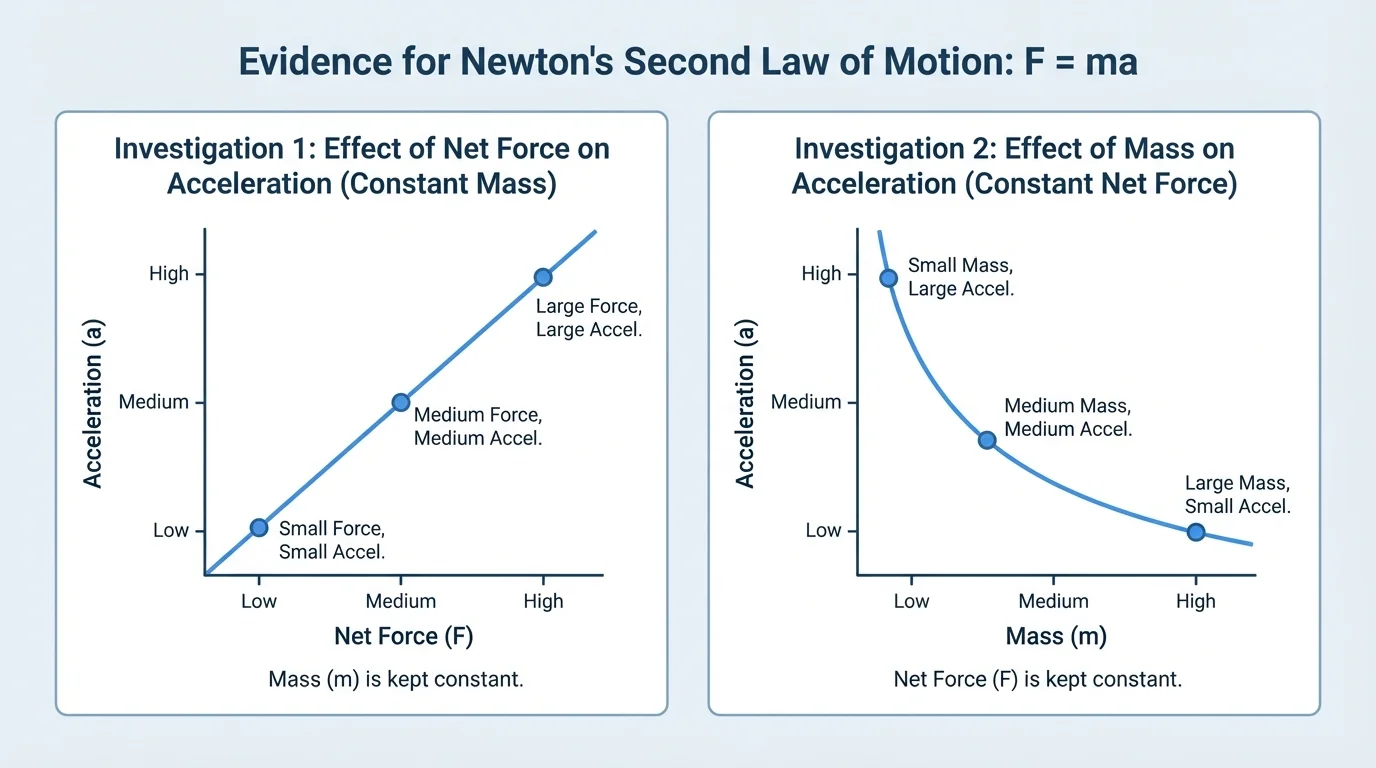
Sometimes data are messy. One trial may not fit the pattern perfectly. That does not automatically mean the idea is wrong. It may mean there was experimental error. Scientists look for the overall trend across repeated measurements. Later, when you compare results again, the graph helps you see whether the evidence still supports the claim.
"Science is a way of thinking much more than it is a body of knowledge."
— Carl Sagan
That idea matters here because planning the investigation carefully is just as important as knowing the equation. A poor test can hide the true relationship between force, mass, and motion.
Engineers use these ideas when designing cars, elevators, bicycles, and amusement park rides. A more massive vehicle needs more force from its engine to speed up at the same rate as a lighter one. Brakes must also provide enough force to change motion safely.
In sports, athletes use the same physics. A harder kick gives a soccer ball a greater change in motion. A bowling ball and a tennis ball react differently to the same push because their masses are so different. Coaches may not always say "net force" aloud, but the idea is there in every movement.
Rocket launches are dramatic examples too. As fuel burns, the rocket's mass decreases. With powerful forces from the engines, the changing mass affects the rocket's acceleration over time. Even though real rocket motion is more complicated than a middle school straight-track experiment, the core idea is the same.
No investigation is perfect. Friction may differ slightly from trial to trial. A hand push may not be identical each time. Timing with a stopwatch can introduce human reaction error. The track may not be perfectly level.
To improve reliability, use the same release method every time, measure carefully, and run multiple trials. If possible, use a motion sensor or video analysis. Keep the direction and starting point the same. Check that any added masses are attached securely so the system stays consistent.
It also helps to test a wider range of values. For example, instead of only two force levels, try three or four. More data points make patterns clearer. A fair test, careful measurements, and repeated trials turn an activity into real scientific evidence.
