A magnet can pull a paper clip across a small gap, and a charged balloon can tug on tiny pieces of paper without touching them first. That seems almost like a trick, but it is actually evidence of something real in nature: forces can act through space. Scientists explain this using fields, which are invisible regions around objects where other objects can experience a force.
When two objects push or pull each other by direct contact, the interaction is easy to see. A hand pushes a door. A foot kicks a ball. But some forces happen even when there is empty space between the objects. In this lesson, the focus is only on magnetic and electric interactions. These are called non-contact forces because the objects do not need to touch.
A field is a region in space where an object can exert a force on another object. You cannot see a field directly with your eyes. Instead, you detect it by what it does. If a magnet causes a compass needle to turn, or a charged object causes bits of paper to move, that motion is evidence that a field is present.
Non-contact force means a push or pull between objects that are not touching. A test object is a small object used to detect the effect of a field, such as a compass near a magnet or paper bits near a charged balloon.
This idea is important in science because evidence often comes from effects we can observe, even when the cause itself is invisible. You do not see the field itself; you see the results of the field acting on a test object.
A magnetic field surrounds a magnet, and its presence becomes visible through its effects, as [Figure 1] illustrates. If you place a paper clip near a magnet, the clip may slide or jump toward it even though there is a gap between them. If you bring two magnets near each other, they may attract or repel depending on which poles face each other. Attraction and repulsion without contact are strong qualitative clues that a field exists.
Another powerful piece of evidence comes from using test objects that respond in a clear pattern. Iron filings sprinkled around a bar magnet line up in curved paths. Small compasses placed around the magnet point in different directions depending on their location. These patterns are not random. They show that the magnetic effect extends through the space around the magnet.
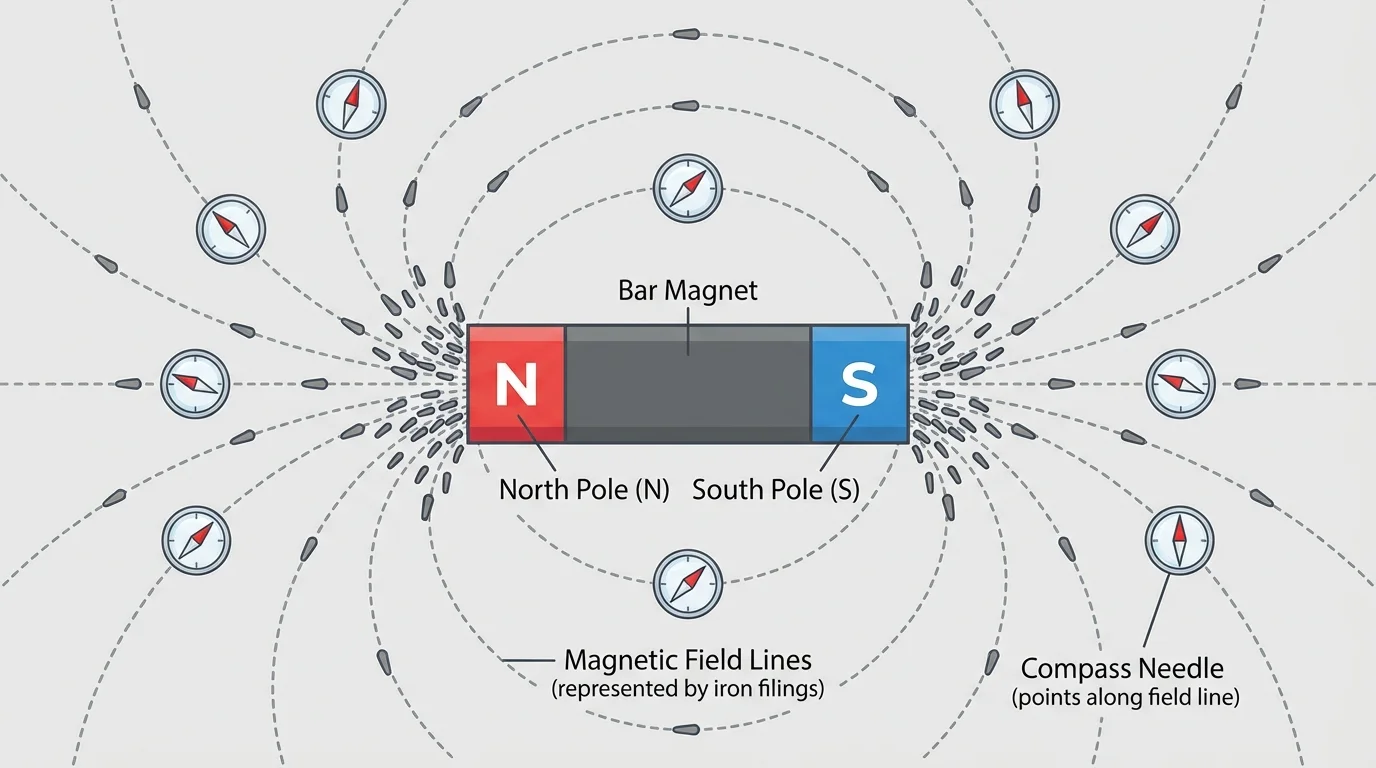
If the magnet is removed, the filings no longer form that pattern and the compasses return to responding only to other nearby magnetic influences, such as Earth's magnetic field. This comparison matters because it helps connect the observed pattern to the magnet itself.
Scientists often use the idea of field lines to describe this pattern. Field lines are not physical strings in space. They are a model that helps show the direction and shape of the magnetic field. A place where the effect on a test object is clear is part of the field.
Earth itself has a magnetic field. A compass works because its tiny magnet lines up with Earth's magnetic field, which is why compasses can help people find direction.
The pattern in [Figure 1] also helps explain why a compass needle turns instead of simply moving straight toward the magnet. The field has direction at each location, so a test object responds differently depending on where it is placed.
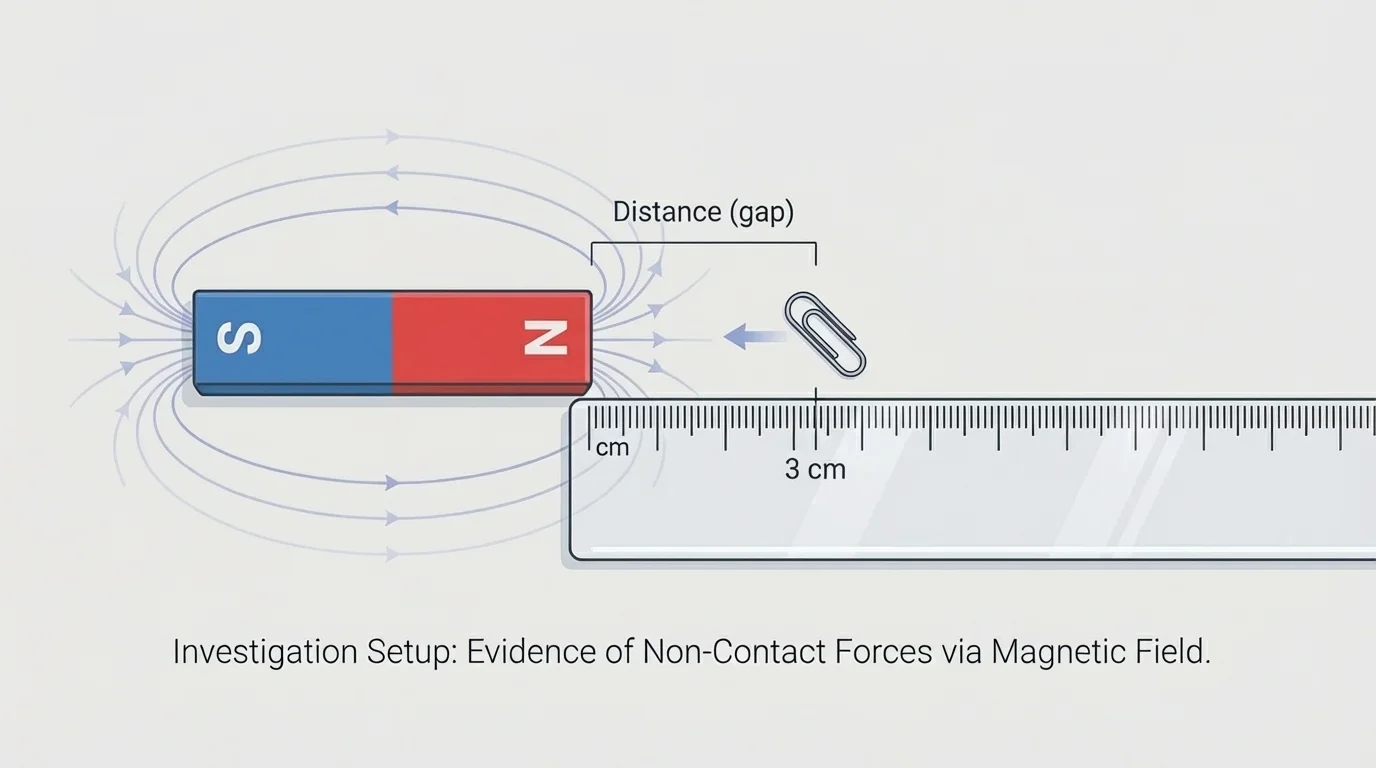
Suppose you want to investigate whether a magnet exerts a force through space. A good investigation begins with a clear question, such as: "How does the distance from a magnet affect whether a paper clip moves?" [Figure 2] shows a setup that focuses attention on one important variable: distance.
In a fair test, you change only one variable at a time. For this investigation, the independent variable could be the distance between the magnet and the paper clip. The dependent variable could be whether the paper clip moves, how quickly it moves, or the greatest distance at which motion still occurs. Important controlled variables include using the same magnet, the same size paper clip, the same surface, and the same starting position each time.
A ruler can help you place the magnet at distances such as 1 cm, 2 cm, 3 cm, and 4 cm from the paper clip. The exact numbers are less important than the pattern of observations. If the clip moves at shorter distances but not at larger ones, that is qualitative evidence that the magnetic field reaches through space and changes with distance.
Example: evaluating a simple magnetic investigation
A student places a bar magnet near a paper clip and says, "This proves the magnet has a field." Is that enough evidence?
Step 1: Identify the observation
The paper clip moves toward the magnet without being touched.
Step 2: Decide what makes the evidence stronger
The student should repeat the test, measure several distances, and compare with a trial where the magnet is removed.
Step 3: Evaluate the claim
One observation suggests a field, but repeated observations with controls provide stronger evidence.
The best conclusion is that the motion is evidence of a magnetic field, especially when the investigation includes repeated trials and controls.
Repeating trials is important because a single result might be affected by a bump in the table, a hidden piece of metal nearby, or a paper clip that was already slightly moving. When several trials show the same pattern, confidence in the conclusion increases.
A strong experimental design also uses a comparison. For example, if the paper clip stays still when the magnet is far away or absent, but moves when the magnet is nearby, the difference supports the claim that the magnetic field is causing the motion. The investigation makes this comparison easier because distance is measured in a consistent way.
Magnetic fields are not the only fields that can be detected through their effects. An electric field exists around charged objects, and its presence can also be inferred from motion, as [Figure 3] shows. A classic example is a balloon rubbed on hair or clothing. After rubbing, the balloon can attract small pieces of paper without touching them at first.
This happens because rubbing can give the balloon an electric charge. The charged balloon then affects nearby objects through space. The paper bits may jump upward, and a thin stream of water from a faucet may bend toward the balloon. These effects are evidence that the balloon is producing an electric field in the surrounding space.
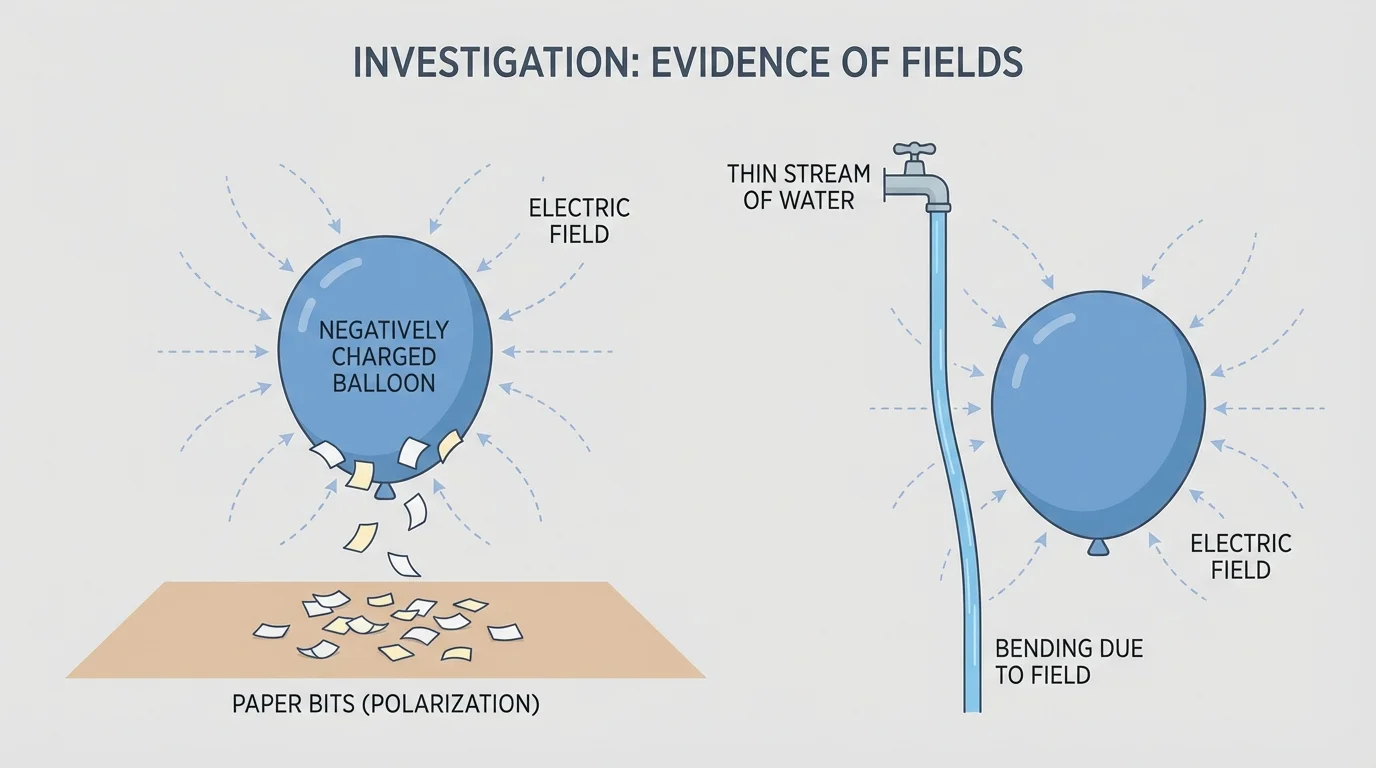
Just as with magnetism, the field itself is invisible. What we observe is the behavior of a test object. In an electric investigation, a test object might be tiny paper pieces, lightweight foil, or even a thin stream of water, which changes direction when the electric field acts on charges within the water.
Electric interactions can be especially convincing because they often happen suddenly. A paper bit may remain still and then leap toward the balloon when it is close enough. That change in motion shows that something in the space between the objects is affecting the test object.
Earlier studies of force showed that a force can change an object's motion. If a paper bit starts moving toward a balloon or a compass needle turns near a magnet, that change in motion is evidence that a force is acting.
The electric example in [Figure 3] is useful because it reduces the chance that students think all non-contact forces work the same way. Magnets act on magnetic materials and other magnets, while charged objects affect other charges and can also influence neutral objects in ways that produce motion.
A careful electric field investigation might ask: "How does the distance from a charged balloon affect the motion of paper bits?" Again, the goal is to gather evidence from an observable effect on a test object.
Experimental design matters a lot in electric investigations because static charge can change quickly. The amount of charge on a balloon may decrease over time. Humid air can also reduce the effect because moisture helps charge leak away. That means the student should rub the balloon the same way before each trial, use the same materials, and complete trials in a similar amount of time.
Possible controlled variables include the size and mass of the paper bits, the type of surface they rest on, the kind of cloth used for rubbing, and the room conditions. If one trial uses tissue paper and another uses heavier cardboard pieces, the comparison is less fair because the test objects do not respond equally easily.
Repeated trials are especially helpful here. If paper bits move toward the charged balloon in several trials but do not move when the balloon is uncharged, the evidence becomes stronger. A good design includes both a charged condition and a comparison condition.
Why test objects matter
Fields are often detected by using objects that respond clearly and predictably. A compass is a good test object for a magnetic field because it turns to line up with the field. Tiny paper bits are useful for an electric field because their small mass makes motion easy to notice. Choosing a sensitive test object can make the evidence much clearer.
One weakness in an electric investigation is that students may accidentally touch the balloon to the paper, which mixes contact and non-contact effects. Another weakness is failing to control how strongly the balloon is charged. These flaws do not make the idea wrong, but they reduce how convincing the evidence is.
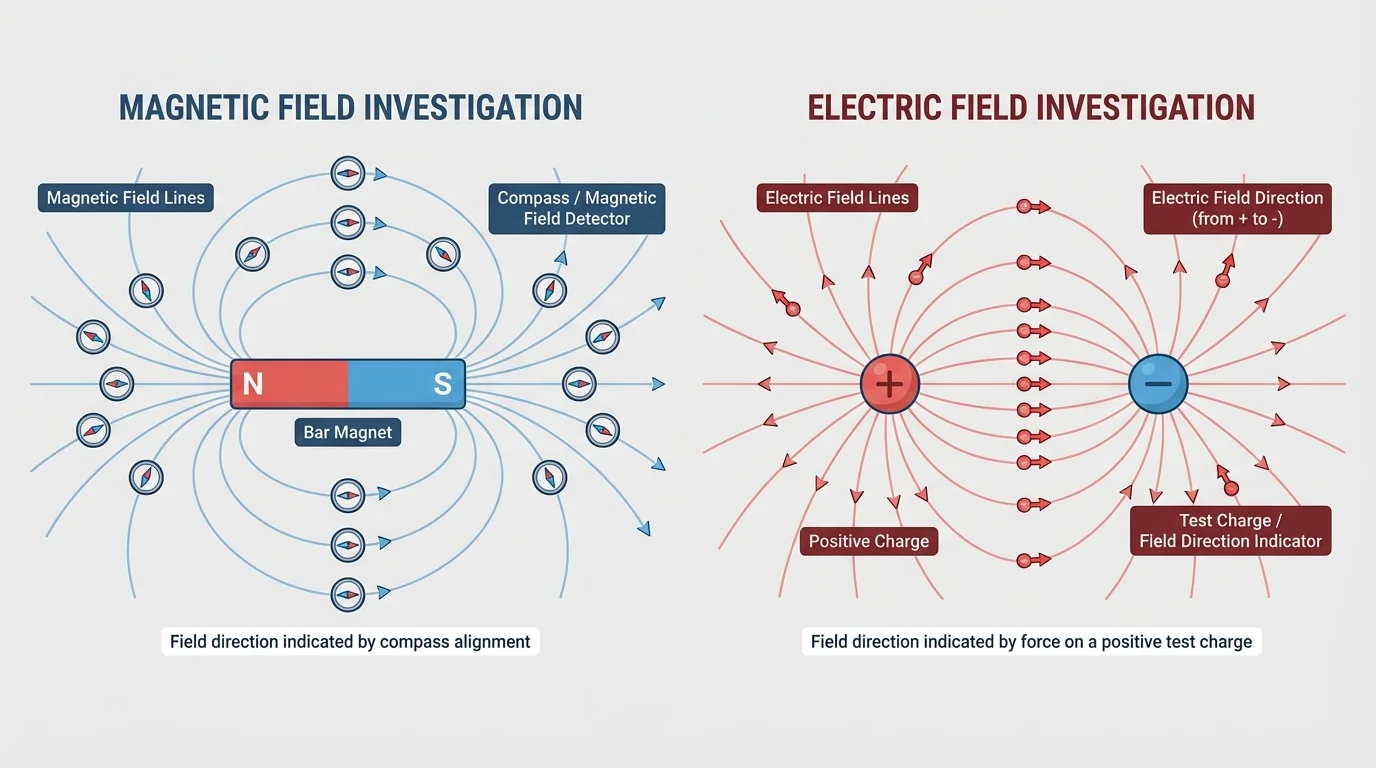
Scientists often want more than a single yes-or-no result. They also want to know how a field is arranged in space. Field mapping uses many observations from many positions, as [Figure 4] illustrates, to build a picture of where the force acts and in what direction.
For a magnet, you can place compasses around it and note the direction each needle points. You can also use iron filings to reveal a pattern over a larger area. For electric interactions, very light test objects or indicators can reveal the direction of the effect at different locations around a charged object. Each observation is local, meaning it describes what happens at one spot, but together the observations form a map.
This is one of the strongest ideas in modern science: invisible things can still be studied when they cause regular, measurable effects. The map is not a photograph of the field itself. It is a model based on evidence.
Notice that the pattern depends on position. Near a magnet, the direction of a compass changes from place to place. Near a charged object, the direction a test object tends to move also depends on location. That position-dependent behavior is exactly what you would expect if a field fills the surrounding space.
The comparison in [Figure 4] also shows that fields are not just "blobs" around objects. They have structure. The structure can be mapped because test objects respond differently in different places.
Good science is not just about getting a result. It is also about asking whether the investigation was designed well enough to support the conclusion. If a student claims, "Fields exist because my paper clip moved once," the claim may be headed in the right direction, but the evidence is limited.
To evaluate an investigation, ask several questions. Was there a clear independent variable? Was the dependent variable observable? Were important variables controlled? Were there repeated trials? Was there a comparison or control condition? Did the test object respond in a way that directly matched the claim?
A strong design for magnetic evidence includes measured distances, the same test object each time, and multiple trials. A strong design for electric evidence includes a consistent charging method, similar environmental conditions, and a comparison between charged and uncharged cases.
| Feature of design | Why it matters | Example |
|---|---|---|
| Single variable changed | Makes cause and effect easier to identify | Only distance changes |
| Controlled variables | Keeps the test fair | Same paper clip, same magnet, same surface |
| Repeated trials | Checks whether results are consistent | Test at each distance three times |
| Comparison condition | Shows what happens without the cause | Use an uncharged balloon as a control |
| Clear observations | Provides direct evidence | Compass turns, paper bits move |
Table 1. Features that make an investigation of electric or magnetic fields more reliable.
Weak designs often have hidden problems. A magnet investigation may be affected by nearby metal objects. An electric investigation may be affected by humidity or by students changing how hard they rub the balloon. If these factors are ignored, the evidence may seem confusing or inconsistent.
Example: comparing two designs
Design A places a magnet near a paper clip once and observes motion. Design B tests four distances, repeats each trial three times, and includes a trial with no magnet.
Step 1: Compare the amount of evidence
Design A gives one observation. Design B gives many observations.
Step 2: Compare control of variables
Design B is more controlled because it changes distance systematically and includes a comparison condition.
Step 3: Judge the better design
Design B provides stronger evidence for the existence of a field because the pattern is clearer and easier to trust.
The better experimental design is not just the one that "works." It is the one that gives the most convincing evidence.
When scientists evaluate evidence, they also look for patterns across different test objects. If compasses turn in organized ways around a magnet, as seen earlier in [Figure 1], and paper clips also move toward it, the claim about a magnetic field becomes more convincing because more than one kind of evidence supports it.
Fields are not just classroom ideas. Magnetic fields are used in speakers, headphones, and electric motors. In a speaker, electric current and magnetic fields work together to move parts of the speaker and create sound. Compasses rely on Earth's magnetic field to show direction.
Electric fields appear in everyday experiences too. Static cling in clothing, a small shock after walking on carpet, and the attraction of dust to screens all involve electric charge and electric fields. Some printers and copiers use electric charges to attract toner to specific areas.
Understanding fields helps explain why these devices work even when the important action is not direct contact. The lesson from investigations such as those connected to [Figure 3] and [Figure 4] is that science can study invisible causes by tracing their visible effects.
"Science often reveals the unseen by carefully studying what can be seen."
That is why experimental design matters so much. If the design is careful, the evidence can show that empty space between objects is not really "nothing" in terms of force interactions. It can contain a field that allows one object to exert a force on another without direct contact.
