A shark tooth can outlast the animal it belonged to by millions of years. A footprint pressed into wet mud can become stone. A leaf can leave behind a thin carbon film. Fossils are not just old objects in museums—they are evidence. They let scientists ask big questions: What kinds of organisms lived long ago? When did certain forms of life become more common? When did some disappear? And how do we know that life on Earth has changed over time?
To answer those questions, scientists do more than collect fossils. They analyze data: where fossils are found, what rock layer they are in, how many different kinds appear together, and how their structures compare. From these patterns, scientists build a picture of the history of life on Earth.
A fossil record is the collection of all fossil evidence and its position in rock layers. It does not act like a complete photo album with every page preserved. Instead, it is more like a puzzle with many missing pieces. Even so, the pieces we do have reveal major patterns.
When scientists look across many rock layers, they find evidence that life has existed for a very long time, that living things have shown great diversity, that many groups have gone extinct, and that forms of life have changed over long periods. These are the key patterns students should be able to interpret from fossil data.
A fossil is preserved remains, traces, or other evidence of an organism from the past. Extinction is when a kind of organism no longer exists. Diversity means the variety of life forms in a place or time. Natural laws are the consistent rules of nature, such as gravity, erosion, and how sediments are deposited.
One important idea behind fossil science is that natural laws operating now also operated in the past. Water still flows downhill. Sediment still settles in layers. Hard parts like shells and bones are still more likely to last than soft tissues. By observing these processes today, scientists can make careful interpretations about what happened long ago. The main types of fossils include preserved body parts, mineral-replaced remains, and traces of activity, as [Figure 1] shows.
Not all fossils are the same. The main types include preserved body parts, mineral-replaced remains, and traces of activity. A bone may be buried and later filled or replaced by minerals. A shell may leave an impression in mud. A footprint, burrow, or trail can also become fossilized.
A trace fossil records what an organism did rather than preserving the organism's body. Footprints can suggest how an animal moved. Burrows can show that an organism dug into sediment. Even droppings can become fossils and provide clues about diet.
Many fossils form when an organism is buried quickly by sediment such as mud, sand, or volcanic ash. Over time, more layers build up. Pressure increases, water carrying dissolved minerals moves through the material, and the sediment hardens into rock. Minerals may replace original tissues particle by particle. In some cases, original material remains; in others, only a mold, cast, or trace is left behind.
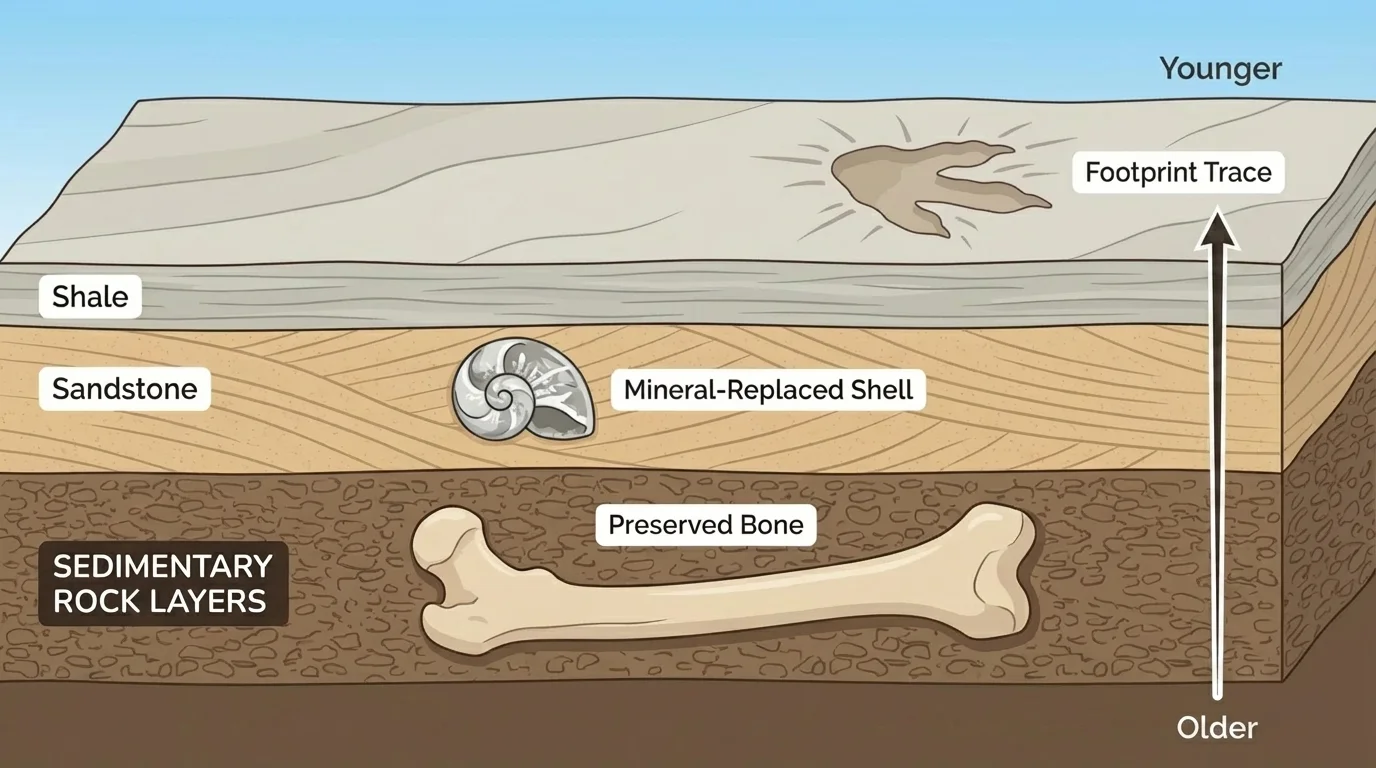
Fossil formation is rare. Most organisms are eaten, broken apart, or decay before burial. This is why the fossil record is incomplete. Still, even a partial record can reveal strong patterns when many fossil sites are compared.
Some fossils preserve tiny details such as leaf veins, skin impressions, or ripple marks in ancient mud. Small details can help scientists reconstruct environments, not just the organisms themselves.
The same preservation processes happening today help scientists interpret the past. For example, if a river today sorts sediment by water speed, then similar patterns in ancient sedimentary rock suggest moving water in the past too. This use of present-day processes to understand ancient evidence is a key scientific idea.
One major clue comes from a rock layer, also called a stratum. In an undisturbed sequence, lower layers are generally older than layers above them. This lets scientists place fossils in a relative order from older to younger.
Scientists then compare which fossils appear in which layers. If one fossil type is found only in deeper layers and another appears higher up, that pattern suggests a change through time. As [Figure 2] illustrates, if several layers contain many different fossil forms, that suggests greater diversity during that interval. If a fossil type appears in layer after layer and then no longer appears above a certain level, that may indicate extinction.
Scientists also analyze fossil shapes and structures. For instance, a sequence of related fossils may show a gradual change in the form of teeth, limbs, or shells. These changes are evidence that populations changed over long stretches of time. Scientists do not assume this from a single fossil; they look for repeated patterns across many specimens and many places.
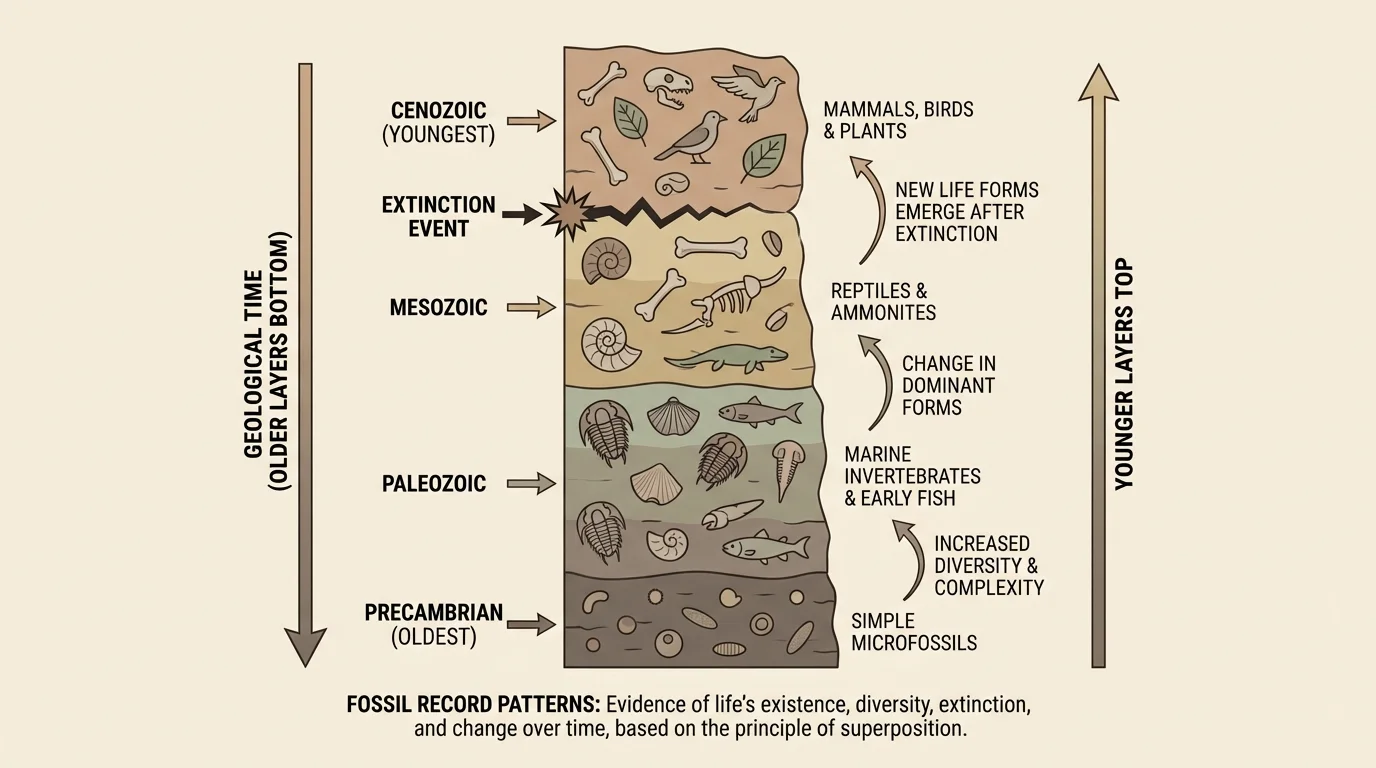
Data analysis often involves counting and comparing. A scientist might record the number of fossil types in each layer. Suppose one layer has only a few fossil forms, another has many more, and a higher layer has fewer again. That rise and fall is a pattern. Students do not need to memorize names of species to interpret the data. They only need to identify what the pattern means.
For example, if layer A contains 3 fossil types, layer B contains 8, and layer C contains 2, the pattern shows diversity increased from A to B and then decreased from B to C. Written mathematically, the change from A to B is \(8 - 3 = 5\), and the change from B to C is \(2 - 8 = -6\). The numbers matter because they help support a conclusion instead of relying on guesswork.
Interpreting a simple fossil data set
A set of rock layers contains these numbers of fossil types: lower layer \(= 4\), middle layer \(= 9\), upper layer \(= 1\).
Step 1: Compare lower to middle.
Diversity increases because \(9 > 4\).
Step 2: Compare middle to upper.
Diversity decreases because \(1 < 9\).
Step 3: Interpret the pattern.
The environment or living community likely changed over time. The sharp drop in the upper layer may suggest extinction of several kinds of organisms or a major change in conditions.
This kind of interpretation uses evidence from patterns, not from memorizing names.
Scientists also compare fossil data from different locations. If the same fossil pattern appears in separate rock layers far apart, confidence in the interpretation grows. A single site can mislead, but repeated evidence from many sites is much stronger.
The fossil record reveals several large-scale patterns. One is existence: fossils show that life lived in the past. Another is diversity: different rock layers contain different ranges of organisms, and some intervals show many more kinds than others. A third is extinction: some fossil forms disappear from later layers. A fourth is change: features of organisms can shift over long periods, showing that populations did not stay exactly the same. As [Figure 3] shows, these patterns can be displayed clearly in charts and graphs.
These patterns can be displayed in charts and graphs. A graph of fossil types across time intervals may rise when diversity increases and fall when many forms disappear. A sudden drop may suggest a major environmental disruption. A slower trend may suggest gradual change.
Change in the fossil record does not mean every organism changed at the same speed or in the same way. Some groups remain fairly stable for long periods. Others show more noticeable shifts. The fossil record therefore reveals both continuity and change.
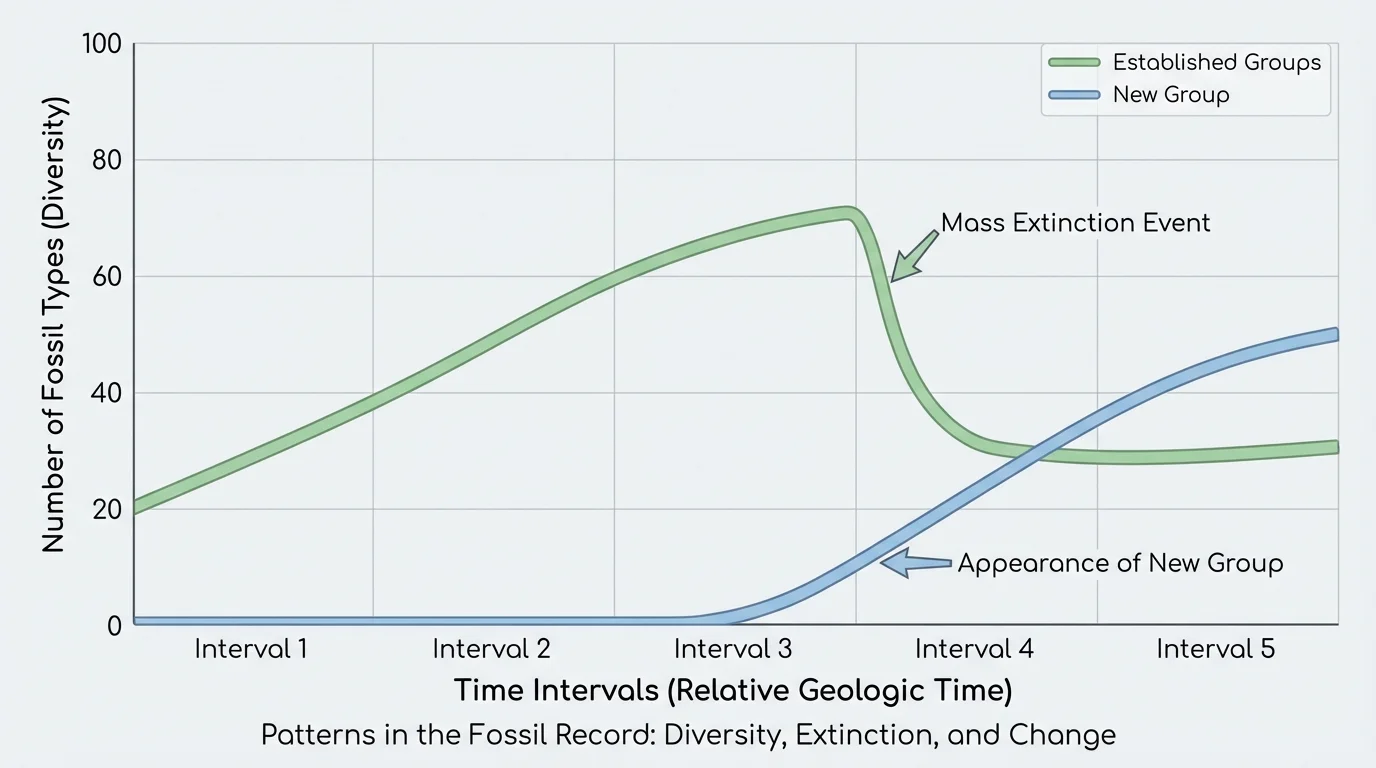
Another important pattern is replacement. In some sequences, one set of fossil forms becomes less common while a different set becomes more common higher in the rock column. This suggests that environments changed or that different groups became better suited to the new conditions.
The same graph pattern can have more than one possible explanation, so scientists look for additional evidence. For example, fossils found with ripple marks, mud cracks, or layers of volcanic ash can provide environmental clues. If a habitat dried out, cooled, warmed, flooded, or changed chemically, the kinds of organisms living there might also change.
How natural selection connects to fossil patterns
Fossils do not show natural selection directly in action the way a video would, but they preserve the long-term results. If certain traits helped organisms survive and reproduce in changing environments, those traits could become more common over many generations. Over a long enough time, the fossil record may preserve evidence of those shifts in body structures.
This is why fossils are part of the evidence for biological evolution. They show that Earth has not always had the same life forms in the same proportions. As [Figure 4] helps illustrate, preservation is uneven, so scientists must interpret this record carefully. Instead, the record documents appearance, spread, change, and disappearance.
The fossil record is powerful evidence, but it is not complete. Preservation favors some organisms and environments more than others. Hard parts such as shells, teeth, and bones are more likely to fossilize than soft tissues like skin or muscle. Organisms buried quickly in calm sediment are more likely to be preserved than organisms in places where remains are scattered or decay quickly.
This means missing fossils do not prove an organism never existed. Sometimes the remains were never preserved. Sometimes the rocks containing them were eroded away. Sometimes they have not yet been discovered. Scientists must therefore be careful: no single gap in the record overturns all the patterns found in many other places.
There is also a difference between relative age and exact age. In middle school, the key idea is that lower undisturbed layers are older than upper layers. That ordering helps scientists see sequences of change without needing to learn complicated dating methods.
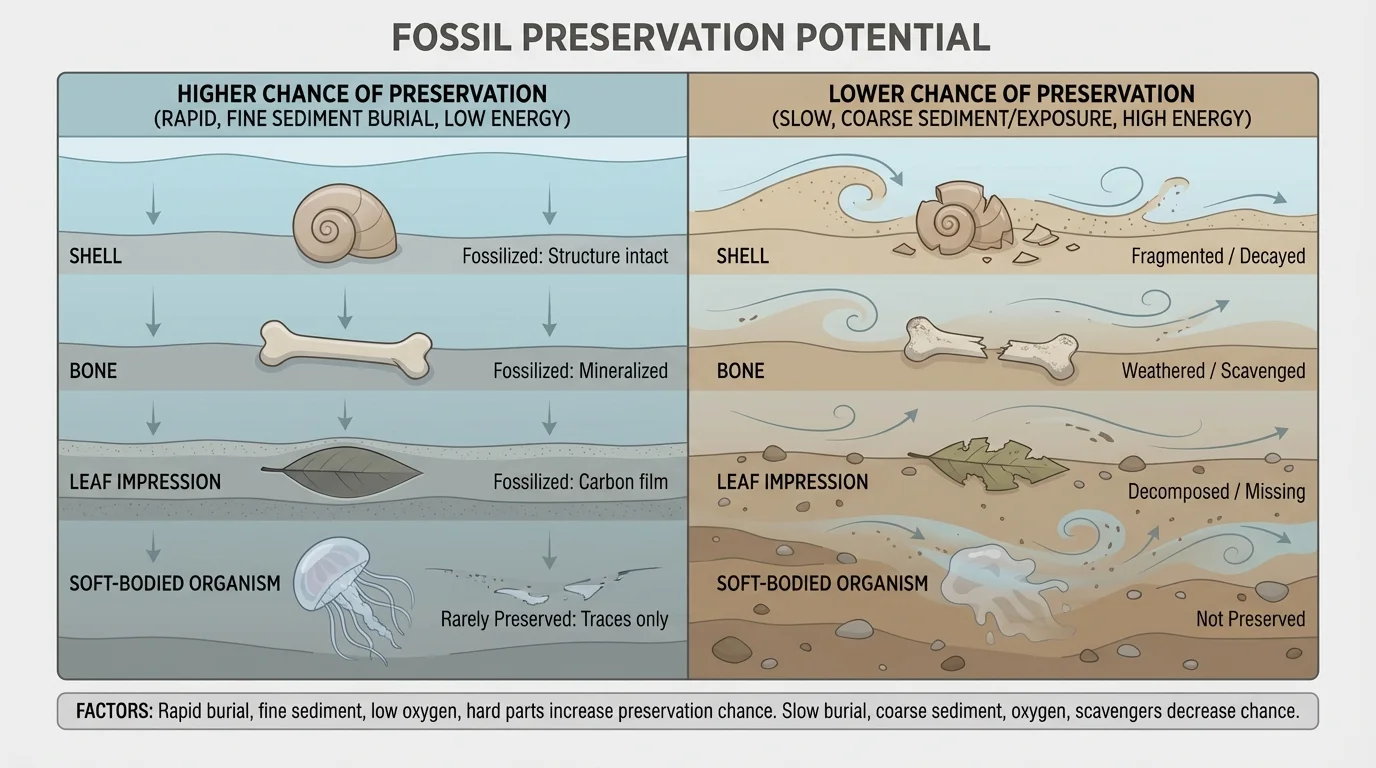
Because the fossil record is incomplete, scientists combine fossil data with information from modern biology, sedimentary rocks, and Earth processes. The idea that natural laws operate today as in the past helps make these comparisons reliable. Water, pressure, burial, decay, and mineral deposition did not suddenly follow different rules long ago.
We can return to [Figure 1] here: trace fossils such as footprints may be preserved even when the organism's body is not. That reminder is important because evidence of life can survive in more than one form. Similarly, [Figure 2] remains useful when judging whether a disappearance in upper layers may represent extinction or simply a missing piece of rock.
Fossil analysis is not only about ancient life. It also helps scientists understand ancient climates, changing coastlines, and past ecosystems. If marine fossils are found in rock now located far inland, scientists infer that the area was once covered by water. If plant fossils are found in layers that also contain signs of drying, scientists can reconstruct environmental shifts.
Drill cores taken from the ground or ocean floor are another source of fossil data. These long cylinders of layered material act like vertical records of the past. Scientists compare the fossils in deeper and shallower parts of a core to identify changes in life and environment over time.
Using fossil evidence in a real investigation
Suppose scientists examine a sediment core from the seafloor.
Step 1: They record fossil types in each layer.
Lower layers contain many shell fossils. Higher layers contain fewer shell fossils and more plant fragments.
Step 2: They compare the pattern with modern environments.
Today, shells are common in shallow or open water, while plant fragments are more common closer to land.
Step 3: They infer environmental change.
The area may have shifted from more open water to a setting closer to shore, or sediments from land may have increased.
This shows how fossil evidence helps reconstruct Earth's past environments.
Museums, parks, and universities also use fossil data to build timelines of local environments. Engineers and geologists can use layered rock information when studying groundwater, natural resources, and land history. Fossils are one part of a much larger system of evidence about Earth.
Good scientific interpretation depends on matching claims to evidence. If a student sees that one fossil type appears in several lower layers and then disappears, the best statement is not "we know exactly why it vanished." The best statement is that the data support the conclusion that the organism no longer appears after that point in the record, which may indicate extinction or a major change in conditions.
Likewise, if a layer contains many fossil forms, we can infer greater diversity for that layer than for a layer with fewer fossil forms. If structures change across a sequence, we can infer change over time. These are evidence-based interpretations.
As seen earlier in [Figure 3], graphs help make those trends easier to spot. A rise, plateau, or sudden drop becomes visible. In the same way, [Figure 4] reminds us that preservation bias can affect what data are available, so scientists must always consider what may be missing.
| Observed fossil pattern | Possible interpretation |
|---|---|
| A fossil form appears in lower layers only | It existed earlier and did not continue into younger layers at that location |
| Many different fossil forms appear together | The layer records relatively high diversity |
| A fossil form disappears above a certain layer | Possible extinction or environmental shift |
| Structures gradually differ across layers | Life forms changed over time |
| Mostly hard parts are preserved | The record is incomplete and biased toward easier preservation |
Table 1. Common fossil patterns and the scientific interpretations they can support.
When scientists interpret the fossil record, they are not guessing wildly. They use observations, comparisons, repeated patterns, and the assumption that natural processes work consistently through time. That combination makes fossils one of the strongest lines of evidence for the long history and changing diversity of life on Earth.
