A colony of bacteria can become resistant to antibiotics. A moth can go from easy to spot to nearly invisible when the background color of trees changes. A mouse with dark fur may be safer on black lava rock, while a light-colored mouse may survive better on pale sand. These are not random stories. They all point to one big idea in life science: differences among individuals can change who survives long enough to have offspring.
In nature, organisms face challenges every day. They need food, water, space, shelter, and protection from predators, disease, heat, cold, and other pressures. Not every individual in a group has exactly the same characteristics. Some are faster. Some are better camouflaged. Some can handle disease better. Some can survive drought more easily.
A group of the same kind of organism living in the same area is called a population. Within a population, individuals can differ in a trait, which is a characteristic such as fur color, beak shape, resistance to disease, or height. These differences are called genetic variation when they are connected to different versions of genes.
Population means a group of organisms of the same species living in the same place at the same time.
Trait means an observable characteristic of an organism.
Natural selection is the process in which individuals with traits that help them survive and reproduce in a particular environment tend to leave more offspring.
Not all trait differences matter in the same way. A trait is only considered an advantage if it increases an individual's chance of surviving and reproducing in a specific environment. A white coat helps an animal in snow, but it may be a disadvantage in a dark forest. That is why scientists always ask, "Advantageous where?"
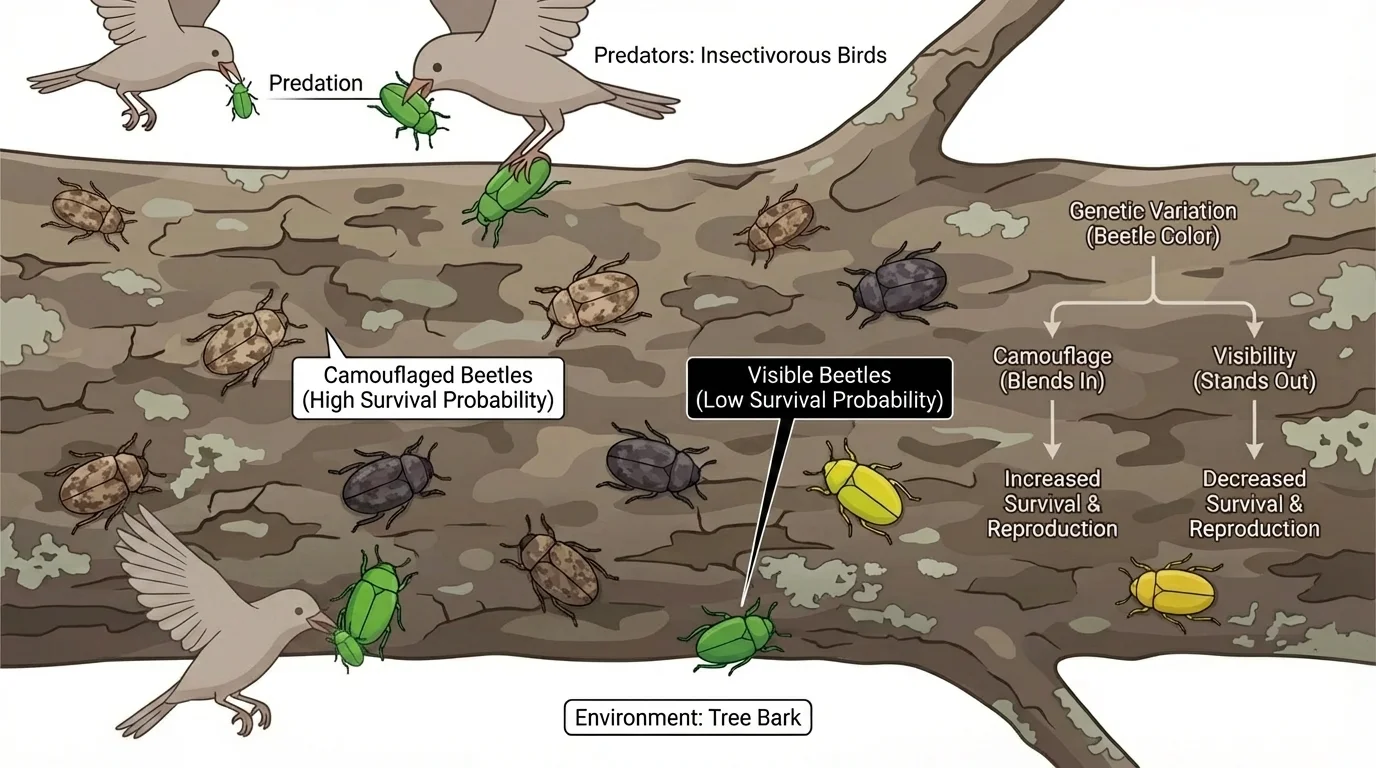
Variation among individuals is the starting point for natural selection, as [Figure 1] illustrates with beetles that differ in color. If birds hunt by sight, beetles that blend into tree bark are harder to spot, while beetles that stand out are eaten more often. The population includes both types, but the environment affects which type is more likely to survive.
Some traits are inherited, meaning they are passed from parents to offspring through genes. Other differences can come from the environment, such as nutrition or injury. For natural selection to affect a population over generations, the helpful trait must be one that can be inherited.
Think about a class relay race. If everyone runs at exactly the same speed, no one has an advantage. But if some runners are faster, they are more likely to be picked for the team. In populations, individuals are not choosing roles the way humans do, but the idea of different performance matters. Small differences can lead to different outcomes.
Scientists study variation by observing populations, measuring traits, and looking for patterns. If a certain trait appears more often in the survivors than in those that do not survive, that can be evidence that the trait provides an advantage in that environment.
Some populations contain enormous amounts of variation that we cannot see just by looking. Two animals may appear similar on the outside but carry different gene versions that affect disease resistance, metabolism, or tolerance to heat.
The beetle example remains useful later because the same pattern appears in many species. As in [Figure 1], the environment does not "choose" with a plan. It simply creates conditions in which some traits work better than others.
Traits are often influenced by genes, segments of DNA that carry instructions for building and running an organism. Offspring receive genes from their parents, but they do not receive an identical mixture every time. That helps create differences among brothers, sisters, and other members of a population.
One source of variation is a mutation, which is a change in DNA. Most mutations have little effect or may even be harmful, but some can create a trait that becomes useful in a certain environment. A mutation might affect color, body shape, behavior, or how well an organism handles disease.
[Figure 2] Another source of variation is sexual reproduction. Offspring inherit a mix of genes from two parents. Because each parent passes on different gene combinations, offspring are genetically unique. This mixing is often called recombination, and it increases the variety of traits in a population.
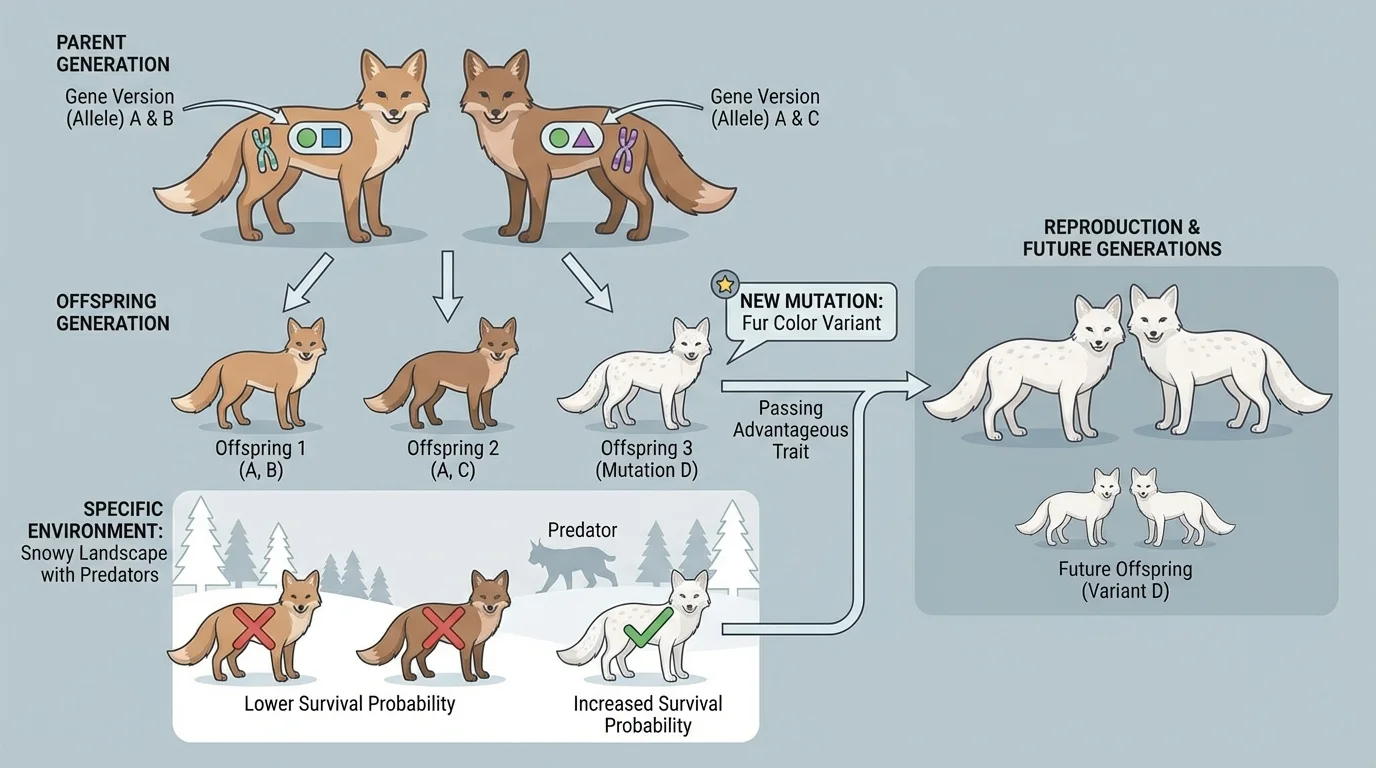
Genetic variation does not appear because organisms "need" it. A population does not produce exactly the trait it wants on purpose. Instead, variation already exists or appears through mutation, and then the environment affects which variations become more common over time.
Traits can be influenced by both genes and the environment. However, only inherited genetic differences can be passed to future generations and contribute directly to natural selection.
This is why a bodybuilder's stronger muscles are not passed to children as an inherited trait, but a gene variation related to muscle type could be. Natural selection acts on inherited traits, not on changes an individual gets during life from practice, injury, or experience.
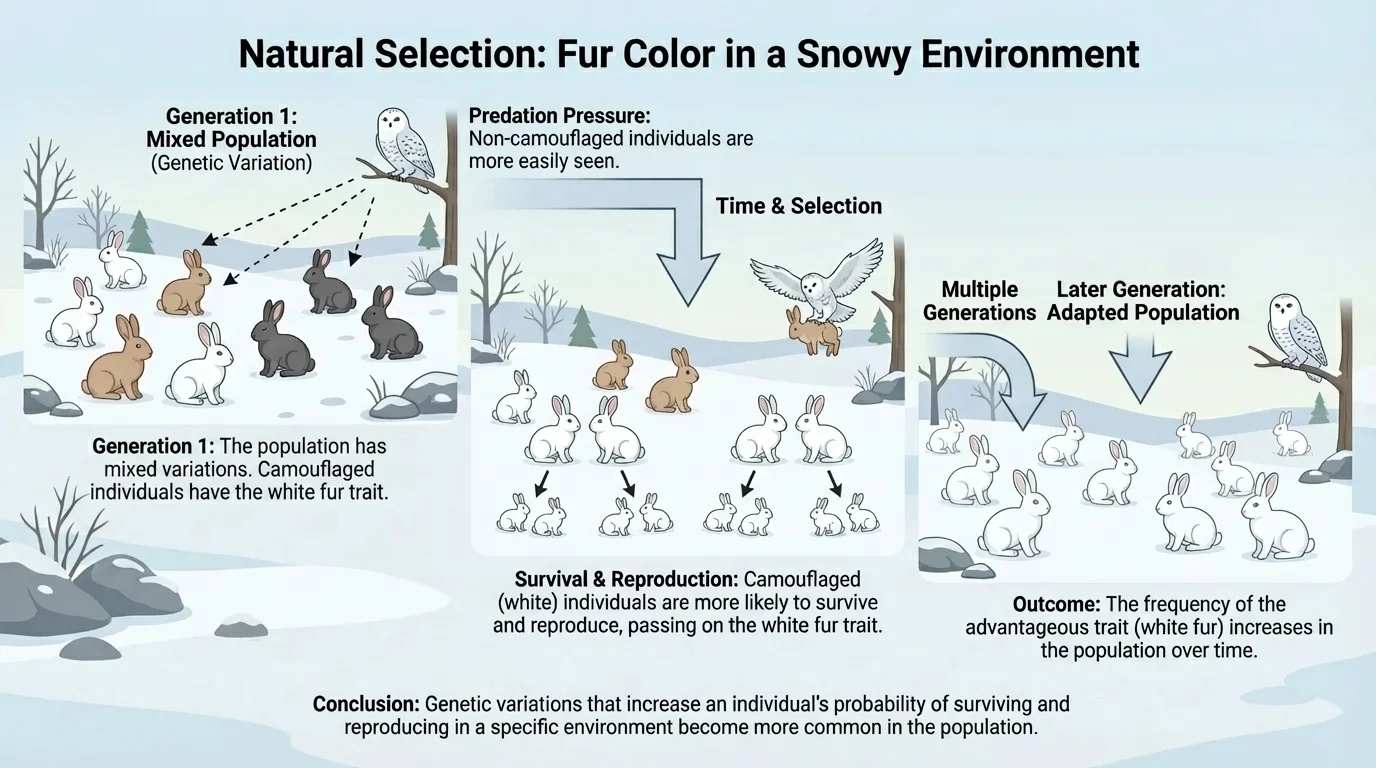
[Figure 3] Natural selection is a process with repeated steps. First, individuals in a population vary. Second, more offspring are usually produced than can survive. Third, because resources are limited and dangers exist, some individuals survive and reproduce more than others. Fourth, if the traits that helped them are inherited, those traits can become more common in future generations.
Notice something important: individuals do not evolve during their own lifetime. A single rabbit does not become white because winter snow arrives. Instead, if some rabbits are already lighter in color and that color helps them avoid predators in snowy conditions, those rabbits may leave more offspring. Over many generations, the population may become lighter overall.
Survival alone is not enough. The full idea is surviving and reproducing. An organism may live a long time, but if it does not have offspring, its genetic traits are less likely to spread through the population. Reproduction is the part that changes the population over generations.
Biologists often use the word adaptation to describe an inherited trait that improves survival and reproduction in a particular environment. Adaptations are not perfect and they are not good in every setting. They are simply traits that increase the chance of success under certain conditions.
For example, suppose a population of rabbits includes both white-furred and brown-furred individuals. In a snowy habitat, predators may spot brown rabbits more easily. If white rabbits survive at a higher rate and have more offspring, the white-fur trait may become more common. The steps in [Figure 3] match this pattern: variation, environmental pressure, different survival, and inheritance across generations.
Why "probability" matters
Natural selection does not guarantee that every individual with a helpful trait will survive. A well-camouflaged mouse can still be caught, and a less-camouflaged mouse can still escape. The key idea is that a helpful trait increases the probability of surviving and reproducing. Over many individuals and many generations, that probability difference can change the population.
This idea of probability is very important in science. Scientists do not usually say, "This trait always causes survival." They say, "This trait makes survival and reproduction more likely in this environment."
Science is not just about memorizing examples. It is about constructing explanations based on evidence. That means making a claim, supporting it with observations or data, and connecting the evidence to the scientific idea.
A strong explanation often has three parts. First is the claim: a statement such as "dark fur increased some mice's probability of survival on lava rock." Second is the evidence: observations that more dark mice survived or were more common in that habitat. Third is the reasoning: the connection that dark fur provided camouflage, reducing the chance of being eaten by predators.
Case study: explaining a population change
Scientists observe a mouse population living in two nearby habitats: black lava rock and light-colored sand.
Step 1: State the claim
Dark fur increases the probability of survival in the lava-rock habitat.
Step 2: Add evidence
More dark mice are found on lava rock, while more light mice are found on sand. Predators more easily spot mice that contrast with the ground.
Step 3: Explain the reasoning
Camouflage lowers the chance of predation. Mice that survive longer are more likely to reproduce and pass on fur-color genes. Over generations, the matching fur color becomes more common in each habitat.
Evidence can come from field observations, experiments, fossils, DNA comparisons, and long-term data. The best explanations use evidence that directly matches the trait and the environment being studied.
Scientists also compare different possible explanations. Maybe a trait is common not because it helps survival, but because of chance or because organisms moved into the area from somewhere else. Good scientific explanations consider these possibilities and test them against the evidence.
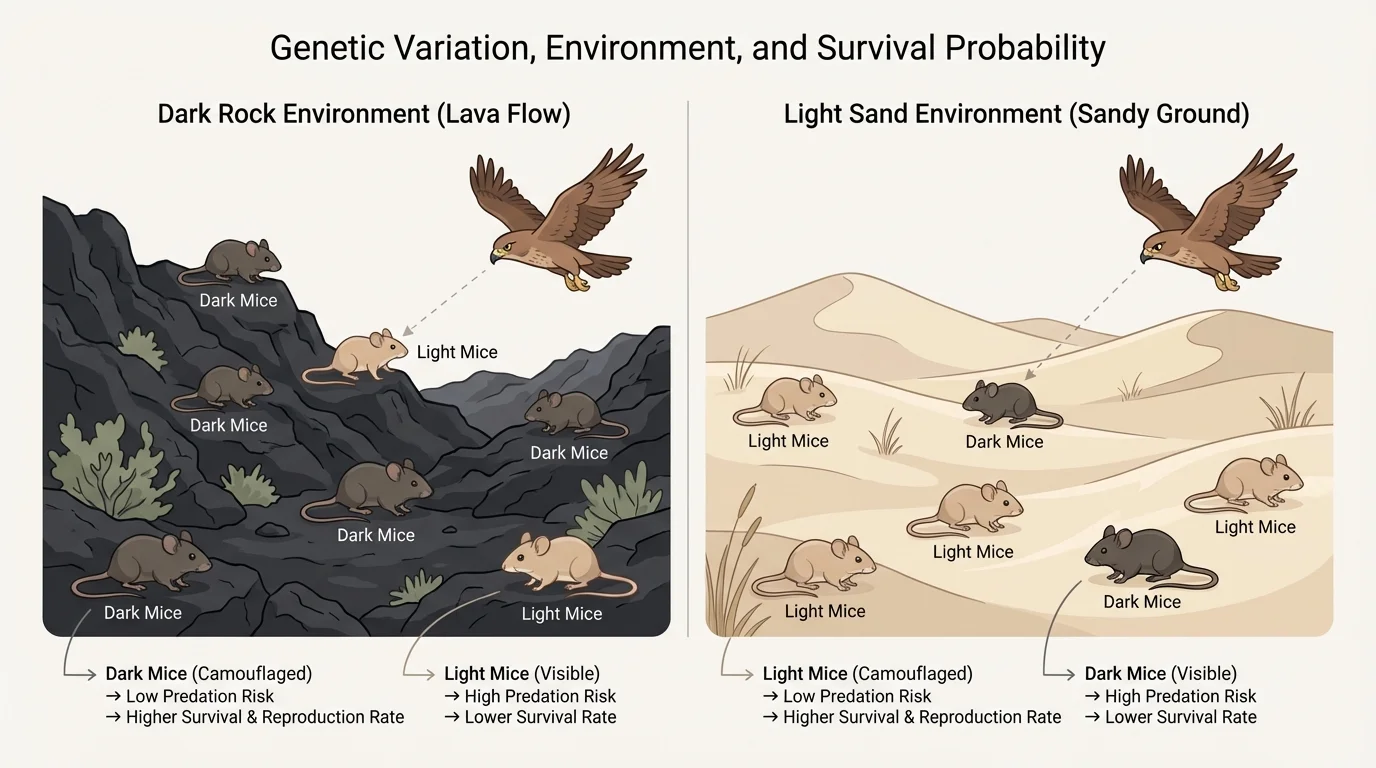
The same trait can help in one habitat and not in another, as [Figure 4] shows with mice living on dark and light ground. This is why natural selection must always be described in relation to a specific environment.
Peppered moths are a classic example. In parts of England during the Industrial Revolution, soot darkened many tree trunks. Dark moths became harder for birds to see on dark bark, while light moths became easier to spot. Later, when pollution decreased and trees became lighter again, the advantage shifted back. The environment changed, so the favored trait changed too.
Rock pocket mice provide another strong example. In areas with black volcanic rock, dark mice blend in better. In nearby sandy areas, light mice blend in better. Predators such as owls and hawks can spot the mice that contrast with the background more easily. Over time, camouflage affects which fur-color genes become more common.
Antibiotic resistance in bacteria is one of the most important modern examples. A bacterial population may contain a few individuals with gene variations that help them survive an antibiotic. When the medicine is used, many bacteria die, but resistant ones survive. These survivors reproduce quickly, so the population becomes more resistant. This is one reason doctors try to use antibiotics carefully.
Plants in dry environments also show natural selection. If a population of plants has variation in root depth, leaf size, or water storage, the plants with traits that help conserve water may survive drought better and produce more seeds. In a wetter environment, the same traits may not give the same advantage.
Bacteria can evolve noticeably fast because they reproduce so quickly. In a short time, scientists can observe population changes that would take much longer in many animals and plants.
The mouse example in [Figure 4] and the beetle pattern in [Figure 1] follow the same core idea: when predators hunt by sight, camouflage can strongly affect survival. But camouflage is only one kind of adaptation. Other adaptations involve temperature tolerance, digestion, disease resistance, or behavior.
It is easy to misunderstand natural selection if the examples are simplified too much. One common mistake is thinking organisms change because they try hard. A giraffe does not grow a longer neck by stretching. Instead, if neck length varies and longer necks help some giraffes get food and reproduce more in that environment, then longer necks may become more common over generations.
Another mistake is thinking evolution always leads to "better" organisms in a general sense. Natural selection does not aim for perfection. It leads to traits that work well enough in current conditions. If conditions change, a once-helpful trait may become less useful.
A third mistake is assuming every trait is an adaptation. Some traits may have no major effect on survival, and some population changes can happen partly by chance. Natural selection is powerful, but scientists still need evidence before deciding that a trait became common because it was advantageous.
"Fittest" in evolution does not mean strongest. It means best suited to a particular environment.
This is why the phrase "survival of the fittest" can be misleading if people think only of strength. In many cases, being smaller, quieter, better hidden, or more disease-resistant matters more than being strongest.
Understanding genetic variation and natural selection helps people make decisions in medicine, farming, and conservation. In medicine, scientists track how bacteria and viruses change so treatments can stay effective. In agriculture, plant breeders and farmers look for inherited traits that help crops survive drought, resist pests, or tolerate heat.
Conservation scientists study variation because populations with more genetic diversity are often better able to handle environmental change. If all individuals are too genetically similar, a disease or climate shift may affect nearly all of them in the same harmful way. More variation can increase the chance that some individuals will survive and reproduce.
Humans are also part of the story. Our species has genetic variation too. Different populations have inherited traits that reflect long histories in different environments. Scientists study these patterns carefully, using evidence and avoiding oversimplified conclusions.
Real-world application: protecting endangered species
Suppose a small endangered population has very little genetic variation.
Step 1: Identify the risk
If a new disease appears, many individuals may be vulnerable in the same way.
Step 2: Connect to variation
With greater genetic variation, some individuals may carry traits that improve survival.
Step 3: Apply the idea
Conservation programs may protect habitats, connect separated populations, or carefully manage breeding so variation is not lost.
These applications matter because natural selection is not just a chapter in a textbook. It helps explain antibiotic resistance in hospitals, crop success during drought, and how species may respond to climate change.
When you construct an explanation, be precise. Name the population. Name the trait. Name the environment. Then explain how that trait changes the probability of surviving and reproducing. A complete explanation sounds like this: "In this population, inherited variation in this trait caused some individuals to survive and reproduce more often in this environment, so the trait became more common over generations."
That wording matters because natural selection is about populations, not single individuals, and about inherited differences, not temporary changes. It is also about probabilities, not guarantees.
Scientists may collect data over many generations to support an explanation. For example, if the percentage of dark mice increases on lava rock while predator observations show that light mice are caught more often, that combination of evidence strongly supports natural selection.
| Trait variation | Specific environment | Why it may help | Likely result over generations |
|---|---|---|---|
| Dark fur in mice | Black lava rock | Better camouflage from predators | Dark-fur genes become more common |
| Light fur in mice | Pale sand | Better camouflage from predators | Light-fur genes become more common |
| Antibiotic resistance in bacteria | Presence of antibiotic | Survival during treatment | Resistant bacteria become more common |
| Deep roots in plants | Dry habitat | Better access to water | Deep-root traits become more common |
Table 1. Examples of trait variation, environmental conditions, and likely population changes due to natural selection.
Once you understand this pattern, many examples across biology begin to connect. The details differ, but the core explanation stays the same: inherited genetic variation gives some individuals an advantage in a certain environment, and those individuals are more likely to survive and reproduce.
