If you compare a tiny wild grass from long ago with modern corn from a farm today, the difference is huge. Corn did not just "appear" as a better crop. Over many generations, humans kept choosing plants with traits they wanted, such as bigger kernels and easier harvesting. Today, people can still do that, but they can also use laboratories, DNA tools, and gene editing to influence traits much more directly.
Living things have traits, such as fur color, fruit size, disease resistance, or speed of growth. Many traits are inherited, which means they are passed from parents to offspring. In nature, some inherited differences help organisms survive and reproduce better in a certain environment. Humans have learned to take advantage of those differences. Over time, technology has changed how quickly, how accurately, and how powerfully people can influence inheritance.
Organisms in a population are not all exactly alike. These differences are called genetic variation. Some variation comes from differences in genes, which are parts of DNA that help determine inherited traits. For example, one plant may naturally produce sweeter fruit, while another may survive drought better. These differences matter because they affect which individuals do well in a certain environment.
In the wild, this connects to natural selection. If a trait helps an organism survive and reproduce, that trait may become more common over generations. Humans can influence this process by deciding which organisms get to reproduce. Instead of letting the environment do all the "choosing," people can choose for a purpose, such as growing more food, producing more milk, or creating flowers of a certain color.
Inherited trait is a characteristic passed from parent to offspring through genes.
Population is a group of organisms of the same species living in the same area.
Artificial selection is human-controlled breeding to increase desired traits.
It is important to notice that humans do not create every trait from nothing. Useful traits often begin as natural variations already present in a population. Technology changes how people find those traits, select them, combine them, or alter them.
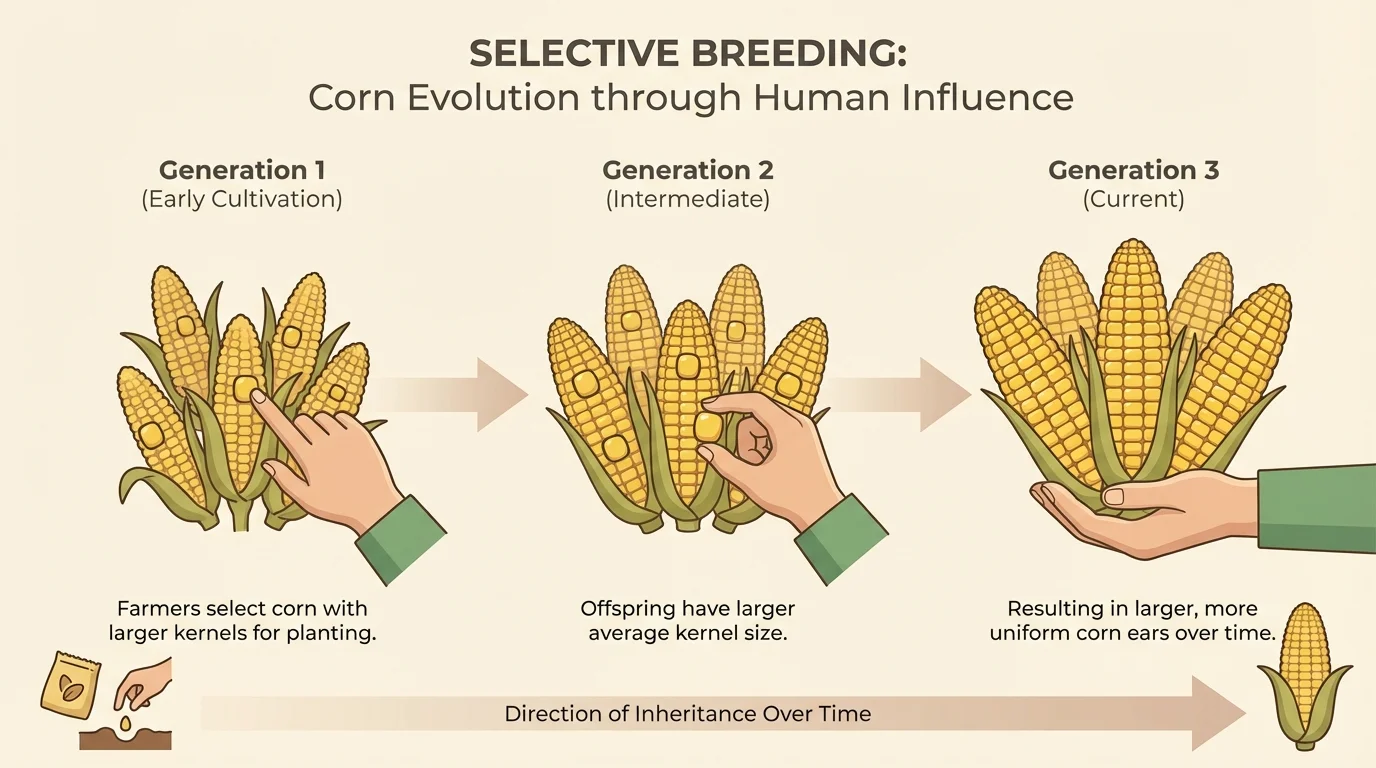
The earliest major technology for influencing inheritance was selective breeding, also called artificial selection. As [Figure 1] illustrates, people noticed that some plants and animals had useful traits and bred those individuals on purpose. Over many generations, human choices can shift which traits become common in a population.
For example, farmers saved seeds from plants with the largest fruits, strongest stems, or best taste. Herders bred animals that were calmer, stronger, or produced more wool or milk. This method takes time because inheritance happens generation by generation, but it has changed life on Earth in major ways.
Dogs are a striking example. All dog breeds belong to the same species, but humans selected different traits over many generations. Some breeds were developed for herding, some for hunting, some for guarding, and some mainly for appearance. Size, fur length, ear shape, and behavior can all be influenced by selective breeding.
Plants show this even more dramatically. Wild ancestors of crops often had smaller edible parts, tougher coverings, or lower yields. Through repeated selection, humans developed modern varieties of corn, wheat, bananas, broccoli, and many other crops. Broccoli, cauliflower, kale, cabbage, and Brussels sprouts all came from the same wild plant species. People selected different traits, and the result was several vegetables that look very different.
Case study: breeding dairy cattle
Step 1: Farmers observe variation.
Some cows naturally produce more milk than others.
Step 2: Farmers choose parents carefully.
Cows and bulls with a history of high milk production are more likely to be used for breeding.
Step 3: The process repeats over many generations.
Offspring with the desired trait are selected again.
Over time, the average milk production of the herd increases. This is powerful, but it can also reduce genetic diversity if only a narrow set of animals is repeatedly chosen.
Selective breeding has benefits, but it also has limits. It can only work with traits that already exist in the population or closely related populations. It can also accidentally increase unwanted traits. For instance, breeding dogs for a certain face shape can sometimes lead to breathing problems. This shows that when humans influence inheritance, there can be effects on the health of individuals as well as on society's ideas about what traits are "desirable."
That concern about trade-offs is one reason scientists and breeders now pay more attention to evidence, data, and long-term effects. The same pattern seen in crop selection, shown earlier in [Figure 1], applies to animals too: repeated choices can reshape a population, but not always without cost.
For most of history, people used selective breeding without understanding exactly how inheritance worked. They could see results, but they did not know about DNA, chromosomes, or genes. Science and technology changed that. Better microscopes helped scientists study cells. Experiments in heredity helped explain how traits are passed on. Later, DNA analysis allowed people to examine inherited information more directly.
DNA is the molecule that carries genetic instructions in living things. Once scientists learned more about DNA, breeders no longer had to rely only on visible traits. They could also use tests to identify organisms carrying useful genes, even if the trait was not obvious yet. This made breeding more efficient.
From visible traits to hidden information
Early breeders mainly selected organisms based on what they could see: size, color, taste, or behavior. Modern genetic tools let people look for inherited information that may not be visible, such as resistance to a disease or a tendency to tolerate drought. This does not replace observation, but it adds a deeper layer of evidence.
One example is plant breeding for disease resistance. A young plant might look healthy whether it has the resistance gene or not. But a DNA test can help identify which seedlings are most likely to survive a certain disease. That saves time and resources, especially when growing large numbers of plants.
These advances did not erase selective breeding. Instead, they improved it. Farmers, scientists, and breeders could combine old methods with new information. In many cases, modern technology means making better choices earlier and more accurately.
[Figure 2] Newer technologies influence inheritance more directly than selective breeding. Instead of only choosing which parents reproduce, scientists can sometimes change genetic information itself or move genes in more targeted ways. This broad area is often called biotechnology.
One important method is genetic engineering. In genetic engineering, scientists alter an organism's DNA to give it a new trait. For example, some crop plants have been engineered to resist certain insect pests. This can reduce crop damage and may lower the need for some insect sprays.
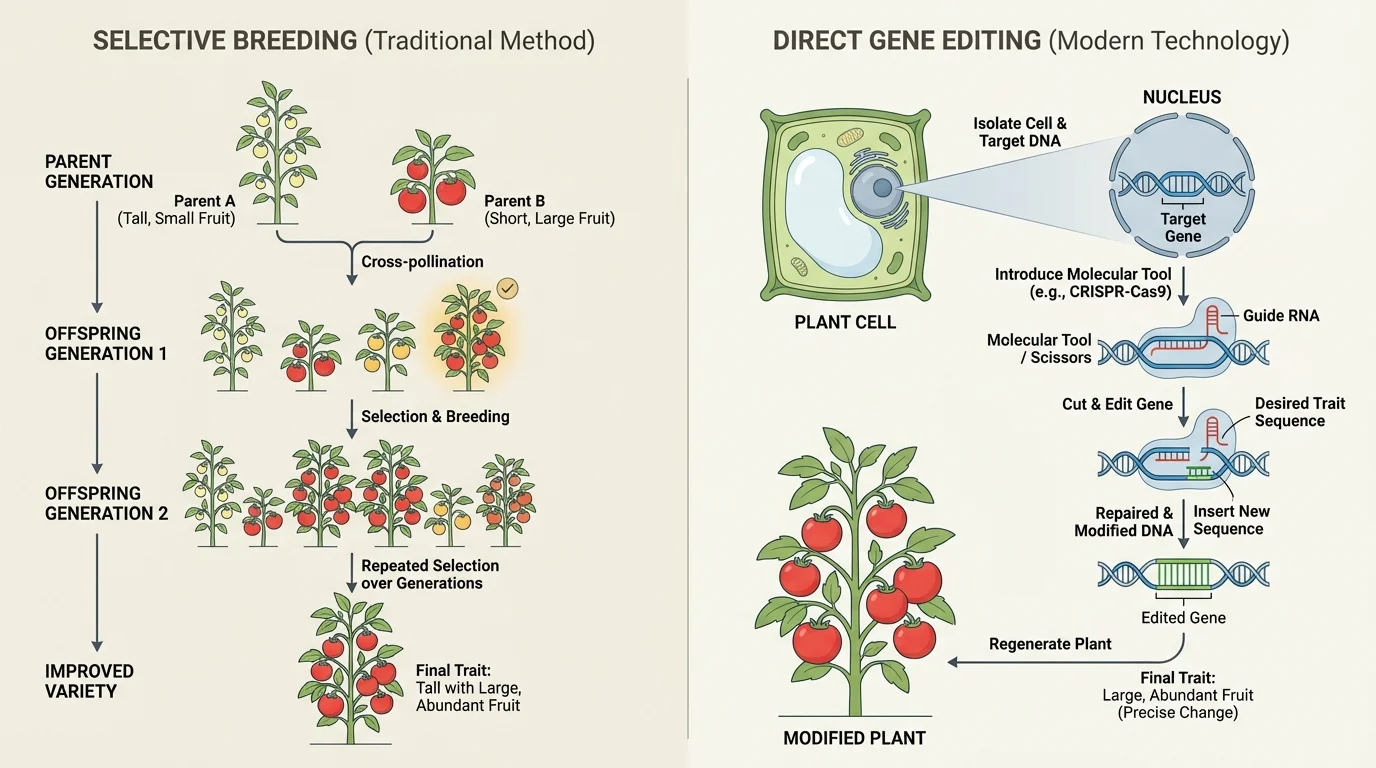
Another newer method is gene editing. A well-known tool is CRISPR. Gene editing works more like revising a sentence than mixing two whole books together. Instead of combining many traits at once through breeding, scientists can target a specific part of DNA. That can make gene editing faster and more precise than older methods in some situations.
Cloning is another technology related to inheritance. A clone is a genetically identical or nearly identical copy of an organism. In plants, cloning is common and often simple. Gardeners can grow new plants from cuttings, and scientists can use tissue culture to produce many plants with the same desirable traits. In animals, cloning is more difficult and raises additional ethical concerns.
Biotechnology is also used in medicine. Some bacteria are genetically modified to produce useful human medicines, such as insulin. In that case, technology influences inheritance in microorganisms so they can make a product that helps people. This is a powerful example of how a change in an organism's genetic instructions can affect human health.
Seedless fruits such as some watermelons and bananas are linked to human control over reproduction and inheritance. People often prefer them because they are easier to eat, but producing them usually requires special breeding methods and careful farming practices.
[Figure 3] Even with these powerful tools, traits are often complex. A single trait may involve many genes and also be affected by the environment. For example, plant height may depend on genes, water, soil nutrients, sunlight, and temperature. So technology can guide inheritance, but it does not control every outcome perfectly.
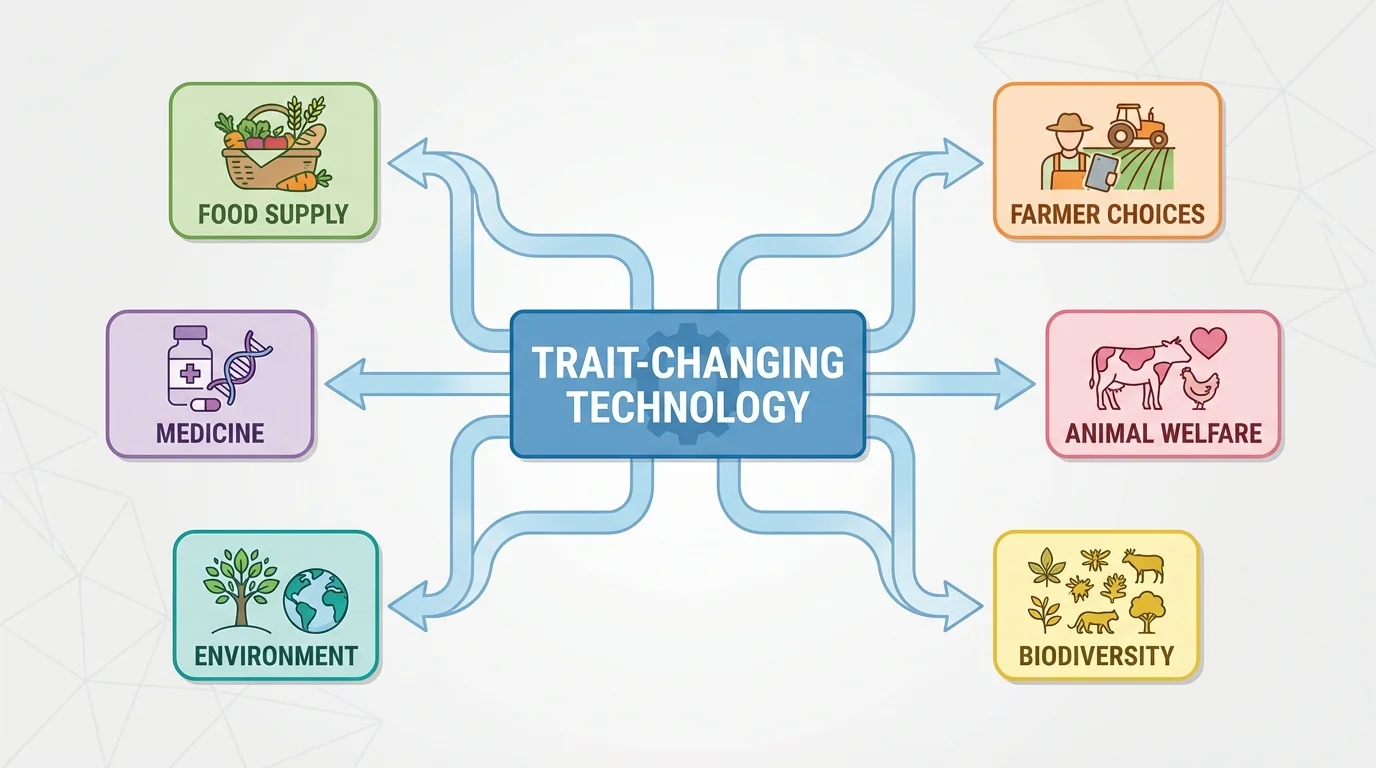
Technologies that influence inheritance affect much more than a single organism. Their effects spread into food systems, medicine, economics, environmental choices, and everyday life through several connected impacts. This is why understanding both science and society is essential.
For individuals, these technologies can bring benefits. A farmer may grow crops that survive disease better. A patient with diabetes may take insulin made by genetically modified microorganisms. Families may buy fruits that stay fresh longer or foods that are easier to grow in dry climates. These changes can improve health, convenience, and food supply.
But there are also concerns. If many farms use only a few genetically similar crop varieties, a disease might spread more easily through those crops. If animals are bred very strongly for one trait, such as rapid growth, there may be health problems. If a company controls patented seeds, farmers may become more dependent on that company. These are not just scientific questions; they are social questions too.
Another issue is biodiversity, the variety of living things. Biodiversity matters because it makes ecosystems more stable and gives populations a wider range of traits. That wider range can be important when environments change. If humans focus only on a few traits, they may reduce variation that could be useful later.
Variation in a population is important in evolution because it provides options. When conditions change, some organisms may already have traits that help them survive. Human technologies can concentrate certain traits quickly, but reducing variation too much can make populations less flexible in the future.
Society also has to think about fairness and ethics. Who decides which traits are desirable? Should every useful technology be used just because it is possible? What counts as helping an organism, and what counts as harming it? For middle school science, the key point is not to solve every ethical debate but to understand that technology choices affect real people, real organisms, and real environments.
These questions become clearer when we look back at the comparison in [Figure 2]. A more direct technology can be faster and more precise, but it may also raise stronger questions about safety, control, and responsibility.
Different technologies influence inheritance in different ways. Some depend on choosing whole organisms to breed. Others work by examining or changing DNA more directly. Comparing them helps show why technology has changed human influence so much.
| Technology | How it works | Speed | Precision | Example |
|---|---|---|---|---|
| Selective breeding | Chooses parents with desired traits | Usually slower | Lower, because many traits may be inherited together | Breeding dogs or dairy cattle |
| DNA-assisted breeding | Uses genetic tests to guide breeding choices | Faster than traditional breeding | More precise selection | Choosing disease-resistant crop seedlings |
| Genetic engineering | Adds or alters genes to create a trait | Can be faster | High for selected targets | Insect-resistant crops |
| Gene editing | Makes targeted changes in DNA | Often fast | Very high for specific edits | Editing a plant gene for disease resistance |
| Cloning | Produces genetically similar copies | Varies | Keeps existing traits rather than creating new combinations | Plant tissue culture |
Table 1. Comparison of major technologies humans use to influence inherited traits.
Notice that "better" depends on the goal. If a breeder wants to combine many existing traits over time, selective breeding may work well. If scientists want to target one specific gene, gene editing may be more effective. Every method has strengths and limits.
One real-world example is modern corn. Long ago, people selected seeds from plants that had useful traits. Over many generations, this produced a crop with bigger ears and better yield. Today, crop scientists may also use DNA tests and other technologies to develop corn varieties suited for dry climates or resistance to disease. This means the history of one crop includes both ancient and modern technologies.
Another example is medicine made with modified microorganisms. Bacteria reproduce quickly and can pass on genetic instructions. Scientists can alter bacterial DNA so the bacteria produce useful substances. That change in inheritance has direct effects on individuals who need those medicines and broader effects on society because it changes how medicines can be produced on a large scale.
Case study: balancing benefits and risks in crop technology
Step 1: Identify the goal.
A farming region wants crops that suffer less damage from insects.
Step 2: Consider the benefit.
Less insect damage can mean more food and less crop loss.
Step 3: Consider the wider impact.
Communities must ask how the technology affects the environment, seed access, and long-term biodiversity.
A good scientific discussion includes both biological evidence and social consequences.
Dog breeding gives another case study. Humans have created breeds with very different looks and behaviors. Some of those traits are useful, but some can lead to health problems. This reminds us that influencing inheritance is not only about whether humans can create a trait. It is also about whether doing so supports the well-being of organisms.
When society makes decisions about these technologies, people need evidence from science and careful thinking about consequences. The network of effects shown earlier in [Figure 3] is a good reminder that one change in inheritance can ripple outward into many parts of human life.
"With great power comes great responsibility."
— A principle that fits modern biotechnology
Technology has changed human influence over inheritance from slow observation-based selection to fast and sometimes direct genetic change. That shift is one of the most important developments in life science because it affects food, medicine, ecosystems, and the choices societies make about the future.
