A forest after a fire, a pond after a heavy storm, or a reef during a heat wave may look completely different from what it looked like before. That is because ecosystems are not fixed machines. They are living systems made of organisms, water, air, soil, light, and temperature, all affecting one another every day. Even small changes can ripple outward and reshape the whole system.
An ecosystem is all the living things and nonliving things in one area, interacting as a system. In a pond, for example, fish, frogs, insects, algae, plants, and bacteria live together with water, sunlight, mud, rocks, and dissolved gases. An ecosystem includes both the organisms and the physical conditions around them.
The living parts of an ecosystem are called biotic factors. These include plants, animals, fungi, and microorganisms. The nonliving parts are called abiotic factors. These include temperature, water, sunlight, soil, air, and minerals. An ecosystem works because these parts are connected. Plants need sunlight and water. Animals need food and shelter. Decomposers break down dead matter and return nutrients to the soil or water.
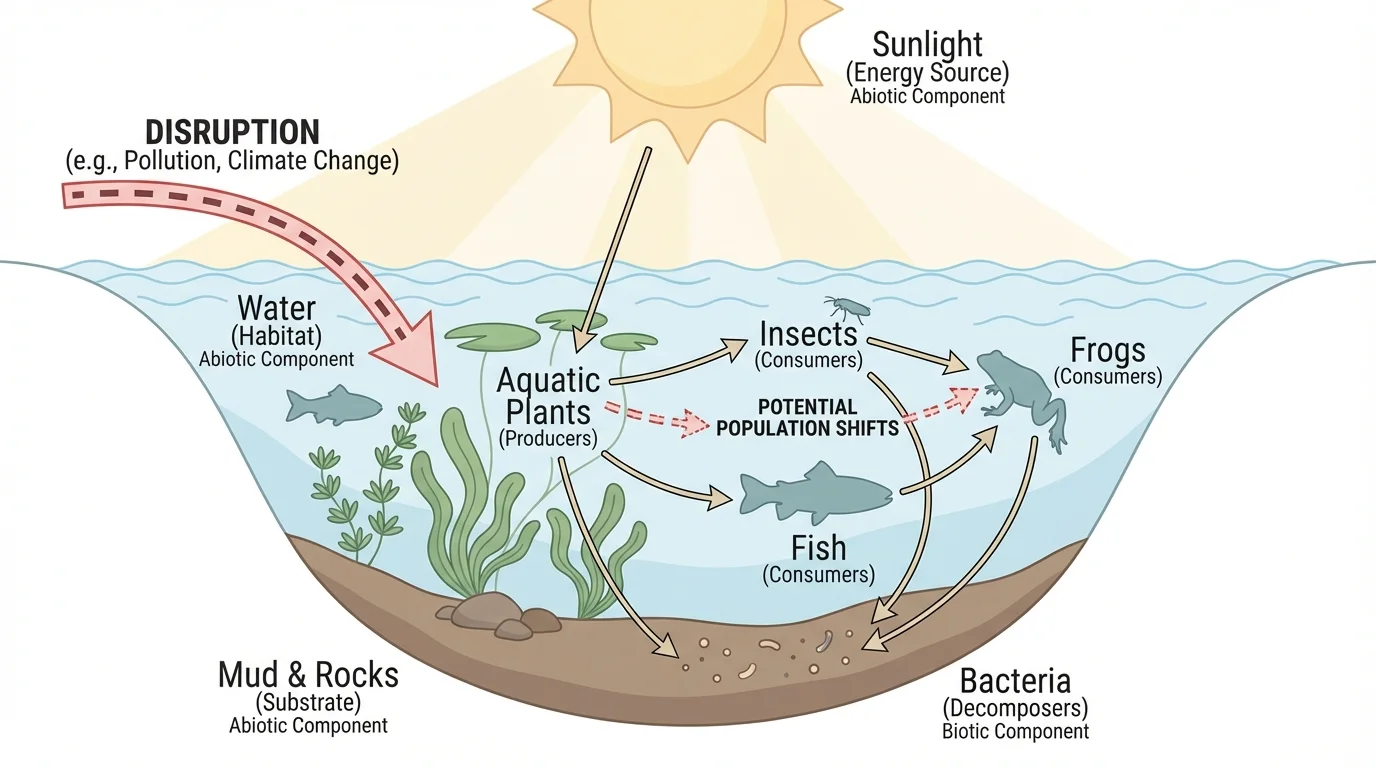
If one part changes, other parts often change too. If a pond loses water during a drought, fish may have less space and less oxygen. If fewer fish survive, animals that eat fish may also decline. This is why scientists study ecosystems as networks of interactions rather than as collections of isolated parts.
Ecosystem means the community of organisms in an area together with the nonliving environment they interact with.
Biotic factors are the living parts of an ecosystem.
Abiotic factors are the nonliving parts of an ecosystem.
Different ecosystems have different structures. A desert has little water and extreme temperatures, so organisms there are adapted to conserve water. A rainforest has abundant rainfall, dense plant growth, and high biodiversity. A grassland has seasonal rain, frequent grazing, and open space. The same big idea applies everywhere: the environment influences which organisms can live there, and organisms also change their environment.
An ecosystem is dynamic, which means it changes over time. Some changes happen every day. Light levels shift from morning to night. Temperatures rise and fall. Some animals hunt at night while others feed during the day. Other changes happen across seasons. In winter, some trees lose leaves, some birds migrate, and some mammals hibernate. In spring, plant growth often increases, creating more food for herbivores.
Population sizes also change naturally. Organisms are born, grow, reproduce, move, and die. A rabbit population may increase in a year with plentiful rain and grass. The same population may shrink in a dry year. These changes do not mean the ecosystem is failing. They are part of how natural systems work.
Weather events can create short-term changes, while climate patterns can create longer-term ones. A week of heavy rain may flood a stream. Several years of reduced rainfall may turn parts of a wetland into drier habitat. Because ecosystems respond to both short-term and long-term conditions, they are always adjusting.
Some lakes change so much with the seasons that the amount of oxygen in deeper water can drop sharply in summer or winter, making it hard for certain fish to survive in those layers.
These changes can be hard to notice if they happen slowly. A hillside may seem stable from year to year, but over decades the kinds of plants growing there can shift as temperatures, rainfall, and soil conditions change. Ecosystems are not frozen snapshots; they are ongoing stories.
One reason a change can spread through an ecosystem is that organisms depend on one another for energy. A producer, usually a plant or algae, makes food using sunlight. A consumer gets energy by eating other organisms. A decomposer breaks down dead organisms and wastes. As [Figure 2] illustrates, energy moves through many connected feeding relationships, not just one straight line.
A simple food chain might go from grass to rabbit to fox. But real ecosystems are more complex, so scientists often use a food web. In a forest, a hawk may eat mice, snakes, or rabbits. A fox may eat rabbits and insects. Many animals rely on the same plant species for food or shelter. That means one change can affect many paths in the web.
When plants grow, they capture energy from sunlight and use materials such as water and carbon dioxide, written as \(\textrm{CO}_2\), to make sugars. Animals then use that stored energy by eating plants or other animals. Decomposers return nutrients to the environment, where producers can use them again. Matter cycles, but energy flows through the system and is gradually lost as heat at each step.
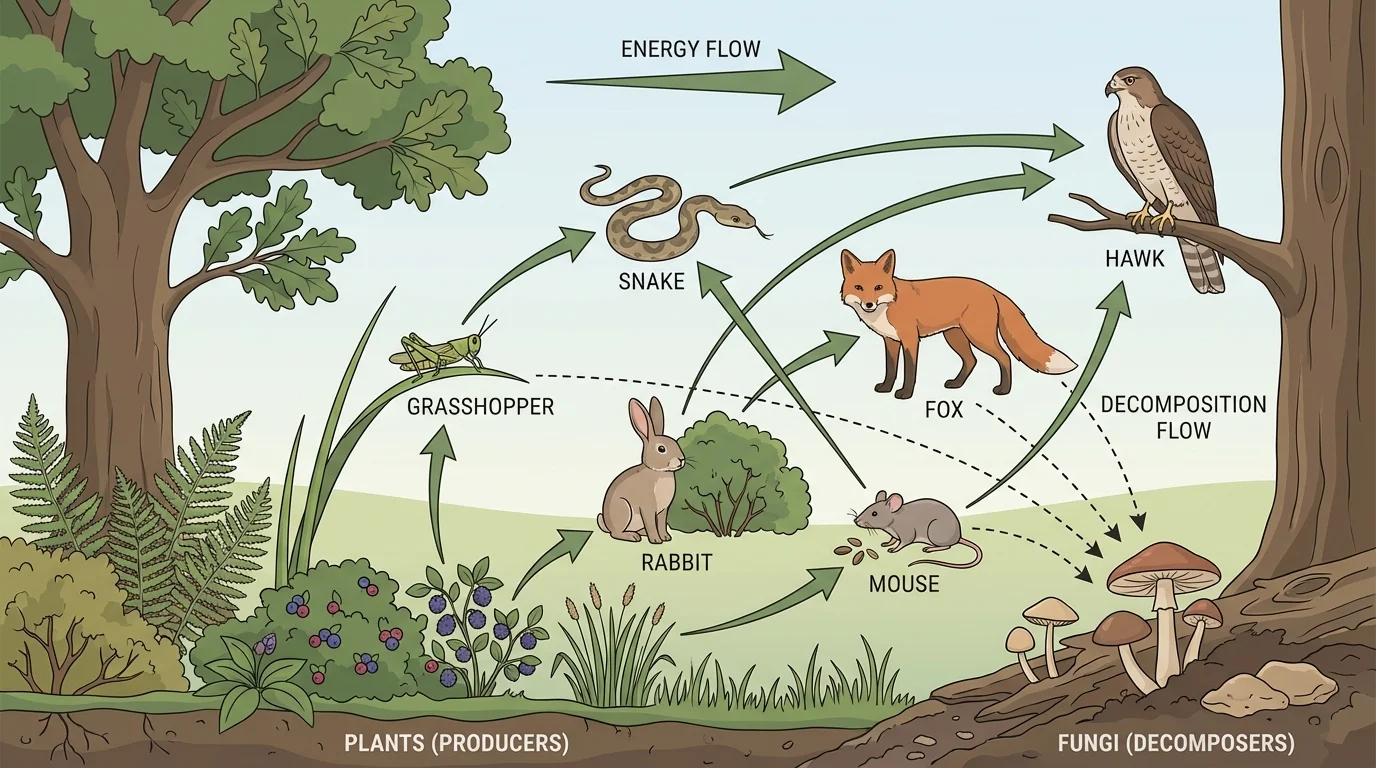
This is why a drop in producer populations can have such wide effects. If algae in a pond decrease sharply because of low light, fewer tiny animals can feed on them. Then fish that eat those animals may decrease, and birds that eat the fish may also be affected. The connected arrows in [Figure 2] help explain why ecosystem responses are often chain reactions.
Why one change spreads
Each population depends on access to energy, nutrients, habitat, and other organisms. Because these needs overlap, a change in one species or one physical condition can alter competition, food supply, and survival for many other species at the same time.
Even decomposers are essential. Without fungi and bacteria breaking down dead material, nutrients would stay locked in remains and wastes. Soil fertility would drop, plant growth would slow, and the whole system would be affected.
A population is a group of the same species living in the same area. A forest does not have one giant "animal population." It has deer populations, squirrel populations, owl populations, insect populations, and many more. Each one can rise or fall depending on resources and conditions.
Population growth is limited by factors such as food, water, space, predators, disease, and weather. These are called limiting factors because they limit how large a population can become. If there is not enough food, more organisms will struggle to survive. If there are too many predators, prey populations may decrease. If disease spreads quickly, population size can drop in a short time.
Scientists sometimes describe the largest population an environment can support over time as its carrying capacity. This is not a fixed number forever. It can change if rainfall changes, if habitat is lost, or if a new species enters the system. For example, a grassland may support fewer grazing animals during a drought because plants grow less.
Predator-prey relationships are a good example of changing balance. If rabbit numbers rise, foxes may have more food and their population may increase later. As more foxes hunt rabbits, rabbit numbers may fall. Then fox numbers may also drop because food becomes scarcer. These cycles are not perfectly regular, but they show how connected populations influence one another.
Case study: A pond in late summer
A small pond receives less rainfall than usual for several weeks.
Step 1: Water levels drop.
There is less space for fish, amphibians, and aquatic insects.
Step 2: Oxygen levels can decrease in warmer, shallower water.
Some fish become stressed or die.
Step 3: Predators and scavengers respond.
Birds may gather to feed on weakened fish, while decomposers increase as they break down dead material.
Step 4: The whole population pattern changes.
Fish numbers drop, food sources shift, and species better adapted to low water may become more common.
This example shows how a physical change can lead to biological changes across many populations.
"Balance" in an ecosystem does not mean every population stays at exactly the same number. It means the system continues functioning even while populations fluctuate. Healthy ecosystems often change continuously, but they still maintain enough interactions to support life.
A disruption is an event or change that strongly affects an ecosystem. A disruption can start with one physical or biological change and then spread through the ecosystem. Disruptions can be natural, human-caused, or a mix of both.
Physical disruptions affect nonliving conditions. These include drought, floods, storms, wildfire, volcanic eruptions, pollution, and sudden temperature changes. A wildfire can remove trees, change soil conditions, increase sunlight on the ground, and expose animals to predators. A flood can wash away soil, eggs, nests, and small organisms while also carrying nutrients to new places.
Biological disruptions affect living components. These include disease outbreaks, overpopulation of one species, loss of a key predator, or the arrival of an invasive species. An invasive species is an organism that enters a new area and spreads, often harming native species by competing for food, preying on them, or changing habitat conditions.
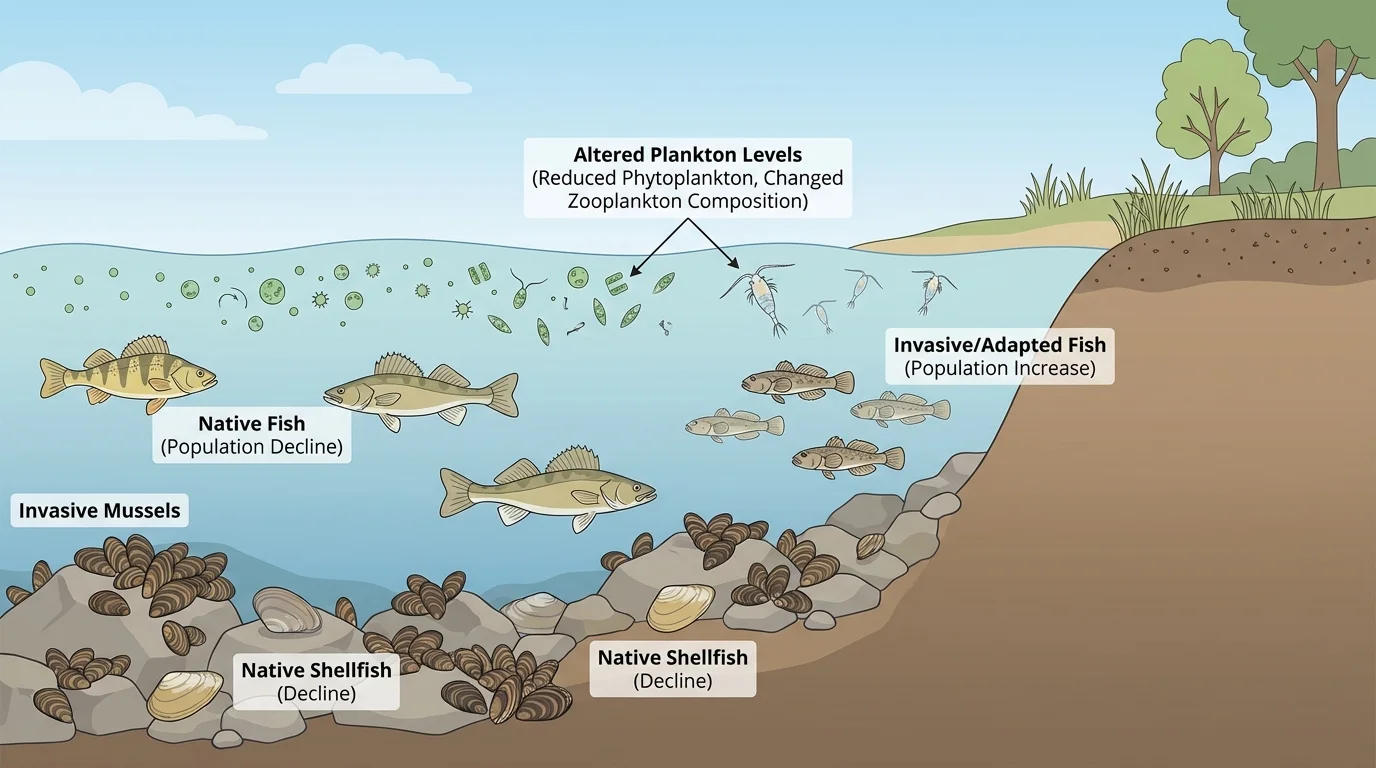
For example, invasive zebra mussels in North American lakes filter huge amounts of tiny food particles from the water. That may leave less food for native organisms. Water may become clearer, which changes plant growth near shore. Fish populations can shift because the food web changes. One new species can reshape the entire ecosystem.
Pollution is another powerful disruption. Extra fertilizer from farms can wash into ponds and lakes. This can cause an algal bloom, where algae grow very quickly. At first this may seem like more food in the system, but when the algae die, decomposers use oxygen while breaking them down. Oxygen levels can become so low that fish and other organisms die.
Habitat destruction also changes populations. Cutting down forests, draining wetlands, or building roads can split habitats into smaller pieces. Animals may lose nesting sites, feeding areas, or migration routes. Smaller habitats often support fewer individuals and make it harder for populations to recover after disturbances.
Living things depend on both resources and conditions. Resources include food, water, and space. Conditions include temperature, light, and soil or water quality. A disruption can change either one.
Sometimes a disruption affects one species especially strongly, and that species has a major role in the ecosystem. If that species declines, many other populations may also change. This kind of effect is easier to understand when we examine real examples.
Not every disruption destroys an ecosystem forever. Many ecosystems have some level of resilience, which means they can resist change or recover after disturbance. Recovery depends on how severe the disruption was, how often it happens, and which organisms remain. Recovery after a fire often happens in stages rather than all at once.
One important recovery process is succession. After a major disturbance such as fire, flood, or volcanic activity, the species in an area may change in a sequence over time. Small plants such as grasses may appear first. Shrubs may follow. Later, young trees may grow, and eventually a mature forest may return if conditions allow.
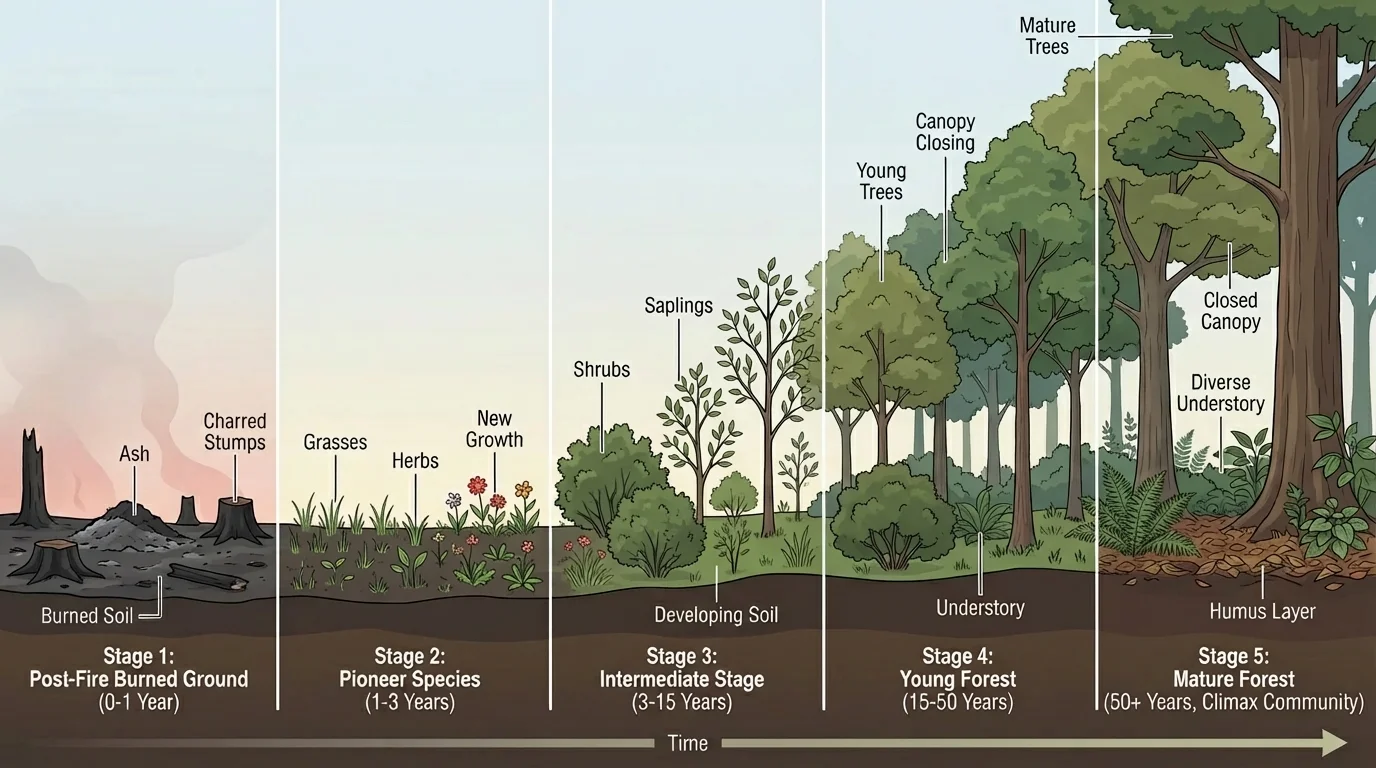
Recovery does not always mean returning to exactly the previous state. If climate conditions have changed, if soil has been lost, or if invasive species have become established, the new ecosystem may be different. A grassland after drought may recover with different plant species than before. A coral reef after repeated heat stress may lose many corals and become dominated by algae.
Sometimes ecosystems are pushed past a limit where recovery becomes difficult. If wetlands are drained and paved over, they cannot easily return on their own. If too many top predators are removed, herbivore populations may grow too large and overuse vegetation. The step-by-step change in [Figure 4] helps show that rebuilding an ecosystem usually takes time.
Resilience is not the same as no change
An ecosystem can be resilient even if populations rise and fall. Resilience means the system can still function, cycle nutrients, support organisms, and recover important interactions after disturbance.
Humans sometimes help recovery by replanting native species, removing invasive species, protecting habitats, or reducing pollution. Restoration works best when it supports natural relationships instead of focusing on just one species alone.
In Yellowstone National Park, wolves were removed for many years and later reintroduced. Without wolves, elk populations grew and fed heavily on young trees and shrubs in some areas. When wolves returned, elk behavior and numbers changed. In some places, plants such as willow and aspen recovered, and this affected beavers, birds, and stream habitats. This example shows how changing one predator population can influence many other populations.
Coral reefs offer another example. Corals live best within a narrow temperature range. When ocean water becomes too warm, corals can lose the helpful algae living in their tissues, a process called bleaching. If stressful conditions continue, many corals die. Fish that depend on coral reefs for shelter and feeding then lose habitat. A physical change in water temperature leads to biological changes across the ecosystem.
A pond with fertilizer runoff can also shift quickly. As discussed earlier, algal blooms can reduce oxygen after decomposition increases. Fish kills may follow, and scavengers and decomposers may temporarily increase. The same food-web logic shown in [Figure 2] helps explain why this happens: when one part of the web changes sharply, many linked populations are affected.
Case study: Forest fire and regrowth
Not all fires have the same effects. Some are severe, but some are part of normal ecosystem cycles.
Step 1: Fire removes some plants and leaf litter.
Animals that depend on dense ground cover may decline right away.
Step 2: Ash adds minerals to the soil.
Fast-growing plants may sprout quickly when sunlight reaches the ground.
Step 3: Herbivores respond to new plant growth.
Insects and grazing animals may increase in newly open areas.
Step 4: Predators and nesting species shift over time.
As shrubs and trees return, the animal community changes again.
This shows that disruptions can cause losses at first but may also create new opportunities for some species during recovery.
Even city ecosystems change. A vacant lot, a roadside ditch, or an urban stream can support insects, birds, plants, fungi, and small mammals. But paving, mowing, litter, heat, and pollution can alter which species survive there. Ecosystem dynamics are not only something that happens in remote wilderness.
People depend on ecosystems for food, clean water, oxygen, soil fertility, and climate regulation. Farmers depend on pollinators, healthy soil, and predictable rainfall. Fisheries depend on stable breeding grounds and balanced food webs. Forests help store carbon, reduce erosion, and support biodiversity. When ecosystems shift, human communities often feel the effects too.
Understanding dynamic ecosystems helps scientists and communities make better decisions. If overfishing removes too many predators, fish populations may become unstable. If wetlands are protected, they can reduce flooding and provide habitat. If pollution is reduced, oxygen levels in rivers may improve and aquatic populations may recover.
It also reminds us to be careful with simple answers. Removing one species, introducing another, or changing one physical condition can produce unexpected results. Because ecosystems are connected, solving environmental problems usually means looking at the whole system, not just one part.
"Everything is connected to everything else."
— A core idea of ecology
When scientists monitor ecosystems, they often track population sizes, water quality, temperature, soil conditions, and species diversity over time. These measurements help reveal patterns that may not be obvious in a single visit. A stream may look healthy on one day, but months of data can show warming water, declining insect populations, or increasing pollution.
The big idea is clear: ecosystems are always changing, and disruptions to physical or biological parts of those systems can lead to shifts in all their populations. Understanding those connections helps us explain the natural world and protect it more wisely.
