A single disappearing species can affect something as ordinary as the fruit in a lunchbox or the clean water coming from a faucet. That may sound surprising, but biodiversity is not just about rare animals in faraway places. It is about the living systems that support human life every day. When biodiversity changes, people can gain or lose important resources, including food, energy sources, medicines, and the natural processes that keep ecosystems working.
Biodiversity is the variety of life on Earth. It includes the many kinds of organisms, the differences within each kind, and the different places where living things survive. Humans are part of this living world, not separate from it. We depend on plants, animals, fungi, and microorganisms for survival, even when we do not notice it directly.
Think about breakfast. Bread or cereal may come from grains such as wheat, corn, or rice. Fruit may depend on pollinators. Milk, eggs, or yogurt come from animals that depend on healthy habitats, clean water, and food plants. Even the oxygen people breathe is linked to photosynthetic organisms such as plants and algae. Biodiversity supports these systems by keeping ecosystems productive and balanced.
Biodiversity means the variety of life in an area or on Earth as a whole. It includes diversity within species, between species, and among ecosystems.
Ecosystem services are the benefits people receive from nature, such as clean water, pollination, fertile soil, and the breakdown of waste.
When biodiversity is healthy, ecosystems are often more stable. If one species declines, another may sometimes help fill part of its role. But when biodiversity drops too much, ecosystems can become less resilient, meaning they have a harder time recovering from fires, droughts, storms, pollution, or disease.
Biodiversity includes several levels, as [Figure 1] shows: differences within a species, differences among species, and differences among ecosystems. These levels matter because each one helps living systems survive change.
Genetic diversity is the variety of traits within a species. For example, some plants of the same species may tolerate drought better than others. If weather becomes hotter and drier, the plants with drought-tolerant traits may survive and reproduce. This can help the species continue.
Species diversity is the variety of species in an area. A forest with many kinds of birds, insects, trees, fungi, and mammals has higher species diversity than a field with only a few kinds of organisms.
Ecosystem diversity refers to the variety of ecosystems, such as wetlands, deserts, grasslands, coral reefs, and forests. Different ecosystems provide different habitats and services. A region with forests, streams, and wetlands can support more types of life than a region with only one habitat type.
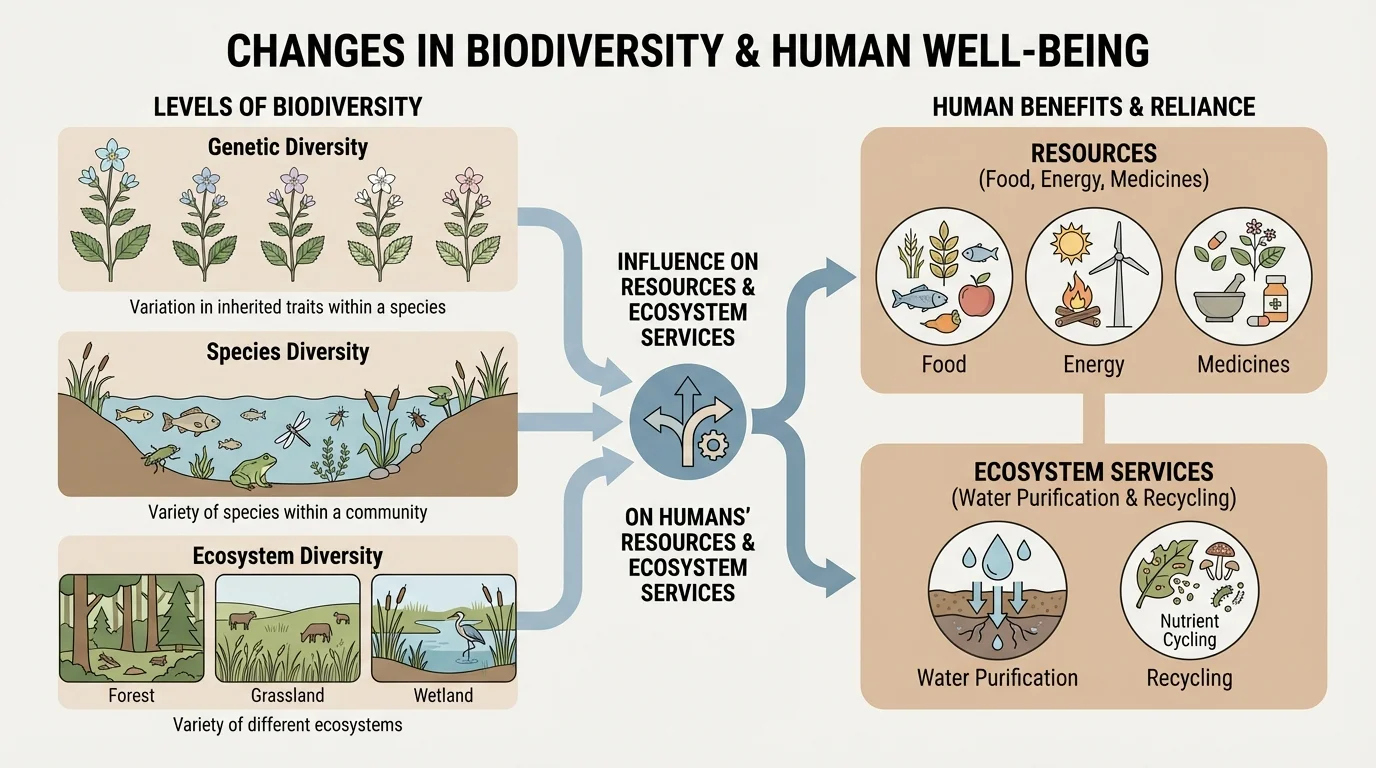
These levels are connected. If genetic diversity within a crop species becomes too low, disease may spread more easily. If species diversity decreases, food webs can weaken. If ecosystem diversity declines because wetlands are drained or forests are cut down, many organisms lose their homes at the same time.
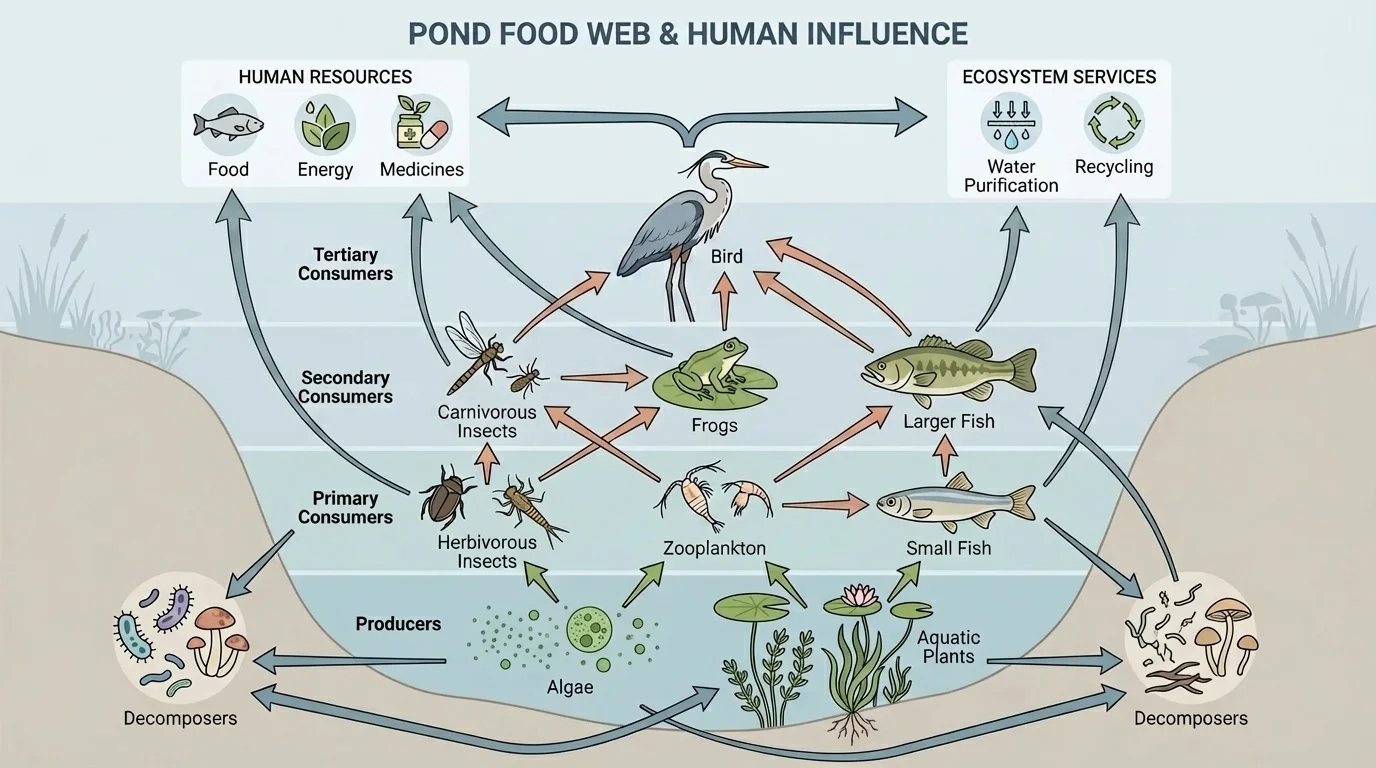
Living things interact in complex systems. A food web, shown in [Figure 2], connects many feeding relationships in an ecosystem. Plants and algae capture energy from sunlight. Herbivores eat plants. Carnivores eat other animals. Decomposers break down dead matter and return nutrients to the environment.
No species lives completely alone. Bees depend on flowers for nectar and pollen, while many flowering plants depend on bees for pollination. Fungi help plants absorb water and minerals from soil. Predators can keep prey populations from growing too large. Even tiny bacteria in soil and water help recycle matter that other organisms need.
Because of this interdependence, removing one species can affect many others. If insect populations drop sharply, birds, frogs, and fish that eat insects may also decline. If top predators disappear, prey populations may grow too quickly and damage vegetation. This is why changes in biodiversity can spread through an ecosystem like a chain reaction.
Later, when scientists study damaged ecosystems, they often find that the problem is not just the loss of one organism. The bigger issue is the loss of many relationships. Species are linked through feeding, shelter, pollination, and recycling of matter.
Why diversity can make ecosystems stronger
If several species perform similar jobs in an ecosystem, the system may keep working even when one species declines. For example, if one pollinator becomes rare, another pollinator species may still help flowering plants reproduce. Greater biodiversity can act like a safety net.
This does not mean ecosystems are unbreakable. Some species have especially important roles. A major loss can still cause serious change, especially if the ecosystem is already stressed by drought, pollution, or habitat destruction.
Humans use biodiversity for many resources. One major category is natural resources, materials or living things from nature that people use. Biodiversity affects how available, reliable, and sustainable these resources are.
Food is one of the clearest examples. People eat many species of plants, animals, and fungi. Biodiversity supports farming in several ways. Wild relatives of crop plants may carry genes for disease resistance, heat tolerance, or salt tolerance. Farmers and scientists can use these traits to improve crops. A greater variety of crops can also reduce the risk of total failure. If a disease harms one crop, others may still survive.
Seafood is another example. Healthy oceans, rivers, and lakes with many species are more likely to support long-term fishing. If people catch too many fish from one species, that species may collapse, affecting food supplies and local economies. A more diverse aquatic ecosystem often has a better chance of staying productive over time.
Energy resources can also be linked to biodiversity. Wood from forests is a source of fuel in many places. Biofuels can be made from plants such as corn, sugarcane, or algae. But if energy production destroys habitats or replaces diverse ecosystems with a single crop over huge areas, biodiversity may decrease. This can lead to soil damage, water problems, and the loss of species that once helped keep the ecosystem balanced.
Medicines are strongly connected to biodiversity. Many medicines were discovered in living things. For example, compounds from plants have been used to treat pain, infections, and heart problems. Organisms in rainforests, oceans, and even soil may contain chemicals that scientists can develop into new drugs. If a species goes extinct before it is studied, a possible medicine may be lost forever.
Real-world example: biodiversity and medicine discovery
Step 1: Scientists study organisms that make unusual chemicals for defense or survival.
Step 2: They test whether those chemicals affect bacteria, viruses, cancer cells, or pain signals.
Step 3: If a useful compound is found, researchers investigate whether it can become a safe medicine.
This is one reason protecting forests, coral reefs, and other habitats matters to human health as well as to wildlife.
Different groups of people may depend on biodiversity in different ways. A city may rely heavily on clean drinking water from forested watersheds. A fishing village may depend on coral reefs or estuaries. A farming region may depend on pollinators, healthy soils, and diverse crop genetics.
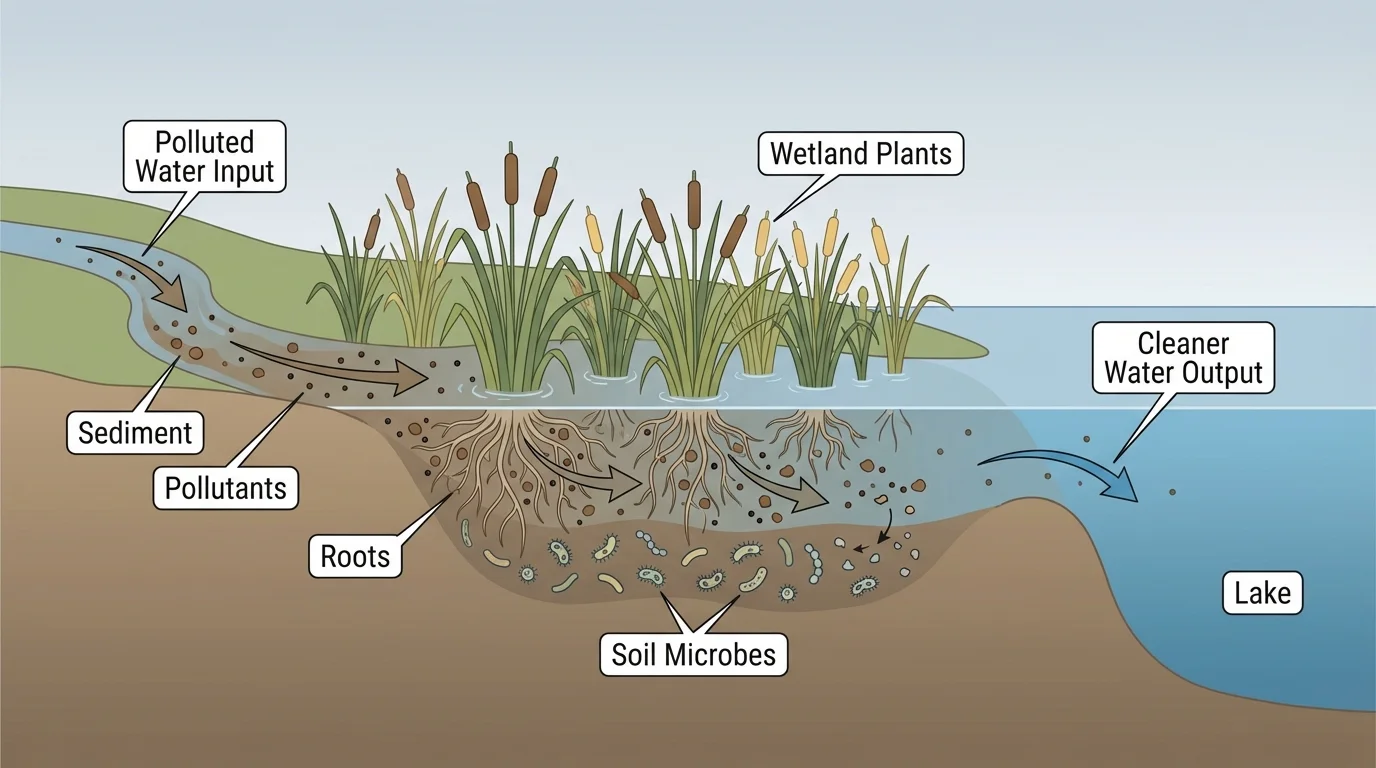
Some of nature's most important benefits are not products people harvest directly. They are processes that ecosystems perform. These are called ecosystem services. Wetlands are a strong example, and [Figure 3] illustrates how water can be cleaned as it moves through plants, soil, and microorganisms.
Water purification happens when ecosystems filter water naturally. In wetlands, water slows down. Dirt settles. Plant roots and microbes can remove or break down some pollutants. This helps improve water quality before the water reaches rivers, lakes, or groundwater supplies.
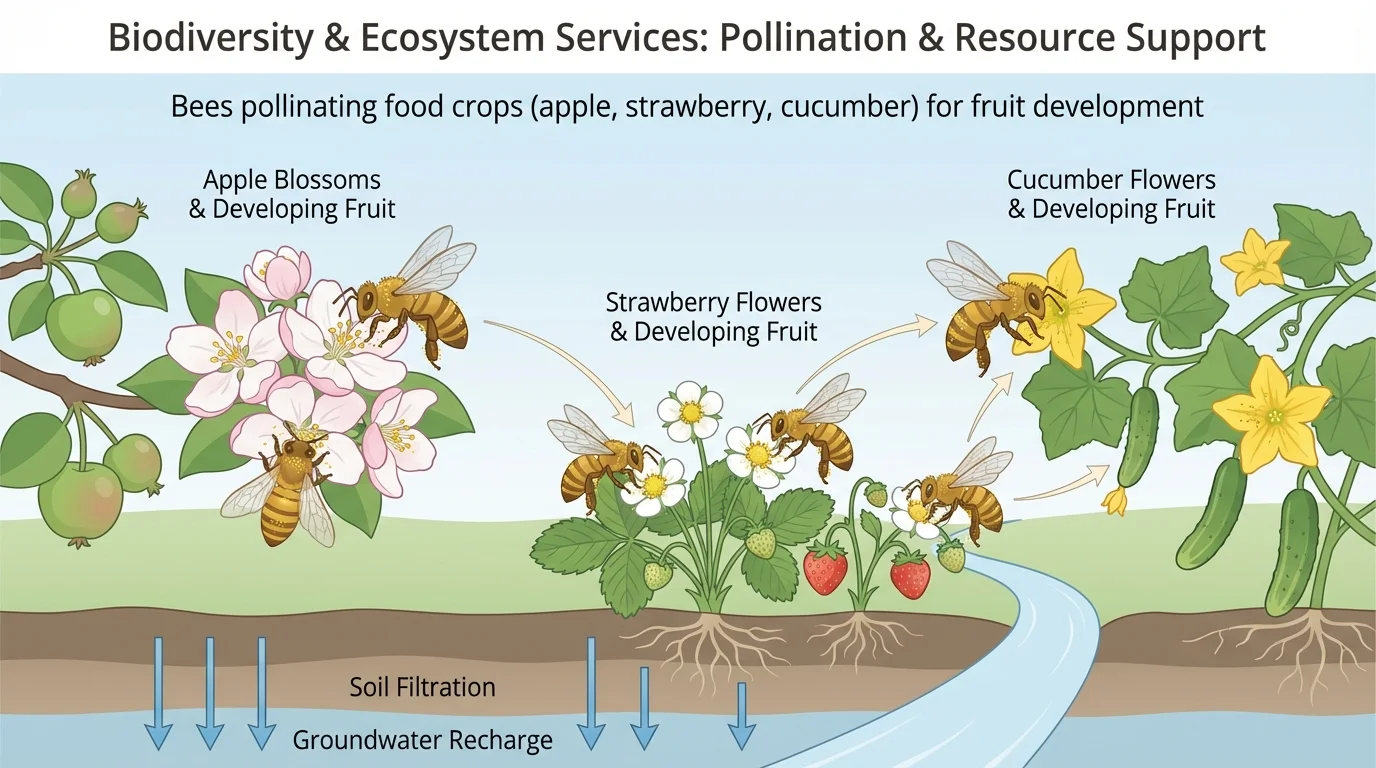
Pollination is another major ecosystem service. Bees, butterflies, moths, bats, birds, and other animals move pollen from one flower to another, helping plants reproduce. Many fruits, nuts, and vegetables depend on this process. Without pollinators, crop yields can decrease.
Recycling of matter is essential for life. Decomposers such as fungi and bacteria break down dead organisms and wastes. This returns nutrients to the soil and water, where producers can use them again. Without decomposition, dead matter would pile up and nutrients would not cycle efficiently.
Soil formation and soil health also depend on biodiversity. Earthworms, insects, microbes, and plant roots help create and maintain soil structure. Healthy soil stores water better, supports crops, and reduces erosion.
Climate regulation is supported by ecosystems such as forests, oceans, and grasslands. Plants help regulate the carbon cycle by removing carbon dioxide from the air during photosynthesis, using \(CO_2\) and water to help make sugars such as \(C_6H_{12}O_6\). When forests are cut down, this balance changes and more carbon may remain in the atmosphere.
Plants, algae, and some bacteria are producers. They capture energy and build food molecules that support the rest of the food web. Decomposers return matter to the environment, which lets ecosystems keep recycling important materials.
Scientists sometimes describe these natural processes as "life-support systems" for humans. This is not an exaggeration. Clean water, fertile soil, breathable air, and productive farms all depend on the work of living organisms and the ecosystems they form.
Biodiversity is not fixed. It changes over time because environments change, species evolve, and populations move. Some changes happen naturally, but today many major changes are caused or accelerated by humans.
Habitat loss is one of the biggest causes. When forests are cleared, wetlands drained, or grasslands paved over, organisms lose food, shelter, and breeding places. Even if some habitat remains, it may become broken into small pieces. This fragmentation can make survival harder.
Pollution can poison organisms or disrupt ecosystem processes. Chemicals entering water may harm fish and amphibians. Plastic waste can injure animals. Air pollution can damage plants and soil.
Invasive species are species introduced to a place where they are not native and spread quickly. They may outcompete native species for food or space, or bring new diseases. Native species may not have defenses against them.
Climate change affects temperature, rainfall, storms, and ocean conditions. Some species can adapt or move, but others cannot. A species living in a mountain habitat or a coral reef may have nowhere suitable to go if conditions shift too far.
Overuse also reduces biodiversity. Overfishing, overhunting, and overharvesting plants can make populations too small to recover. Disease can spread more easily in stressed ecosystems as well.
Some medicines used today came from chemicals first found in wild organisms, and scientists continue to study rainforest plants, ocean organisms, and soil microbes for new drug discoveries.
These causes often work together. For example, a polluted river may already stress fish populations, and then warmer water from climate change can make survival even harder.
When biodiversity decreases, human life can become less secure in ways that are sometimes obvious and sometimes hidden. Food systems may become more fragile. A farm that depends on a single crop variety may be hit hard by one disease. A fishery may collapse if breeding populations become too low.
Water quality can also suffer. If wetlands are destroyed, there may be less natural filtering of water. Communities may need more expensive technology to clean water, and some places may still struggle with pollution problems.
Reduced biodiversity can make ecosystems less able to recover after disturbances. If drought, fire, or storms strike, ecosystems with fewer species and weaker food webs may take longer to recover or may shift into a very different state.
Human health can be affected too. Fewer wild species may mean fewer chances to discover new medicines. Changes in ecosystems can also alter how diseases spread. For example, if predator populations fall, certain animals that carry disease may become more common.
The idea of resilience is important here. Resilience is the ability of an ecosystem to resist damage or recover after change. Earlier, [Figure 1] showed that biodiversity exists at several levels, and each level can contribute to resilience by providing options for survival and recovery.
| Change in biodiversity | Possible effect on ecosystems | Possible effect on humans |
|---|---|---|
| Loss of pollinators | Less plant reproduction | Lower yields of some fruits, nuts, and vegetables |
| Wetland destruction | Reduced water filtering and habitat loss | Dirtier water and increased flooding risk |
| Overfishing | Disrupted aquatic food webs | Less seafood and economic losses |
| Forest loss | Less habitat and weaker carbon storage | Reduced biodiversity, climate effects, and soil erosion |
| Loss of decomposers | Slower nutrient cycling | Poorer soil health and reduced plant growth |
Table 1. Examples of how biodiversity changes can affect ecosystems and human life.
Protecting biodiversity does not mean locking nature away from all human use. It means using ecosystems in ways that allow living systems to continue functioning. Conservation can include protected areas, sustainable fishing, careful forestry, restoring wetlands, planting native species, reducing pollution, and limiting invasive species.
Scientists monitor biodiversity by counting species, studying population sizes, tracking migration, testing water quality, and even examining genetic differences. This helps communities make better decisions. If a pollinator population begins to decline, action can be taken before crop production is heavily affected.
People can help at many scales. Governments can create laws and protected areas. Farmers can use methods that protect soil and pollinators. Cities can preserve green spaces and watersheds. Individuals can reduce waste, avoid releasing invasive species, and support practices that protect habitats.
Conservation and sustainable use
Conservation means protecting living things and their habitats. Sustainable use means using natural resources in ways that do not use them up faster than they can recover. Both are important because humans need resources from nature, but those resources depend on healthy ecosystems.
Protecting one species can sometimes help many others. For example, preserving a wetland helps fish, birds, amphibians, insects, and plants while also supporting flood control and water purification. The same ecosystem can provide several benefits at once.
Pollinators provide a clear case of biodiversity supporting food systems. Bees and other pollinators help many crop plants produce fruits and seeds. If pollinator populations decline because of habitat loss, pesticide exposure, or disease, farmers may harvest less food.
Wetlands provide another case. A wetland may look like a simple marsh, but it can slow floodwater, trap sediment, support fish nurseries, and filter water. Removing that wetland may increase flooding and lower water quality for nearby communities.
Rainforests are important not only because they contain many species, but also because those species may produce chemicals useful in medicine. A plant, fungus, or microorganism that seems unimportant at first could one day help scientists treat disease.
Fisheries show the need for balance. If fish are harvested faster than they can reproduce, populations shrink. But when habitats are protected and catches are managed carefully, fish populations can recover. This protects both biodiversity and people's livelihoods.
These examples all point to the same idea: biodiversity is not an extra feature of nature. It is part of the system that supplies resources and keeps ecosystems functioning. Looking back at [Figure 4], it becomes clear that a small animal such as a bee can have a huge effect on food production.
"When we save the variety of life, we also protect the systems that support our own lives."
Understanding biodiversity helps explain why protecting habitats, species, and ecological relationships matters. Human societies depend on the living world for materials, energy, health, and environmental stability. Changes in biodiversity can therefore shape the future of food supplies, medicine, water quality, and many other parts of daily life.
